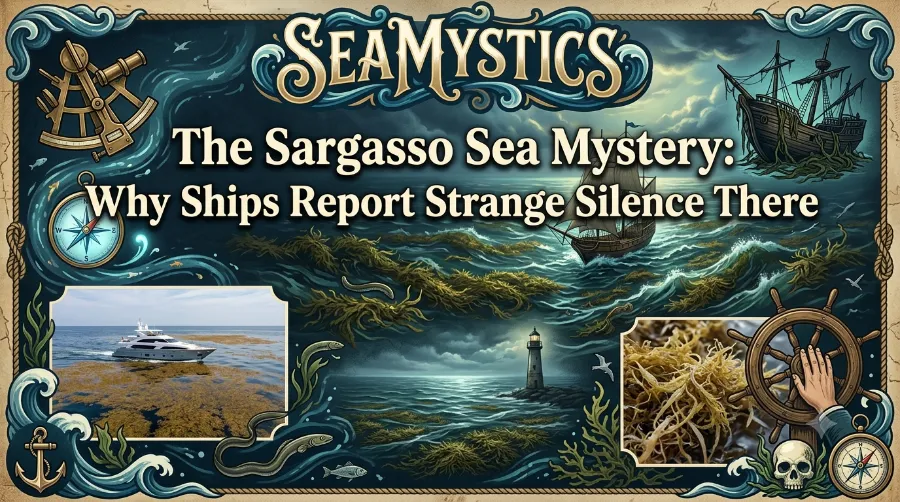

Sailors have a saying about one stretch of the Atlantic. They say the wind simply stops. Not slows down. Stops. Old logs from the Age of Sail describe ships sitting dead still for days. Sails hung like wet laundry. Crews stared at a horizon that never changed. This is the heart of the Sargasso Sea mystery. It is one of the strangest stories the ocean has to tell.
Brinicle Ice Finger of Death The Antarctic Phenomenon Filmed for the First Time
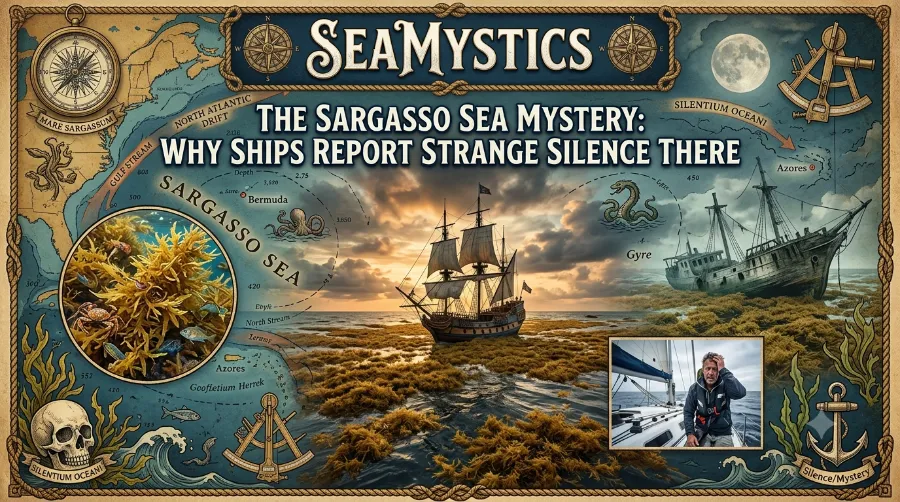
The Sargasso Sea sits in the North Atlantic, but it has no coastline at all. Four ocean currents circle around it like a wall of moving water, closing it in completely. That single fact explains a lot of what follows. It explains why the water goes so quiet. It explains why sailors have feared it for centuries.
Cold Seeps The Deep Sea Ecosystems That Run on Gas Not Sunlight
Key Takeaways
| Fact | Detail |
|---|---|
| Location | North Atlantic, roughly 20°N to 35°N, 40°W to 70°W |
| Size | About 1,100 km wide and 3,200 km long |
| Boundaries | Gulf Stream, North Atlantic Current, Canary Current, North Atlantic Equatorial Current |
| Unique trait | Only sea on Earth with no land border |
| Named for | Sargassum, a free floating brown seaweed |
| Known for | Calm winds, still water, historic becalmed ships |
| Famous residents | American and European eels, migrating here to spawn |
| Water clarity | Visibility up to 60 meters in places |
TL;DR: The Sargasso Sea is the only sea in the world with no coastline. Four rotating ocean currents hold it in place and trap warm, calm air and water in the middle. That calm is exactly why old sailing ships got stuck there for days with no wind. It’s why the sea earned a reputation for eerie silence that still shows up in sailor stories today.
What Makes The Sargasso Sea Different From Every Other Sea
Every other sea on the map touches land somewhere. The Sargasso Sea breaks that rule completely. Four currents bound it and form an ocean gyre. It stands alone as the only named sea without land boundaries at all. The Gulf Stream closes it off on the west. The North Atlantic Current closes it off on the north. The Canary Current takes the east, and the North Atlantic Equatorial Current takes the south. Together they spin in a slow clockwise loop known as the North Atlantic Gyre.
The Bermuda Triangle What Ocean Science Actually Says
Picture a whirlpool the size of a continent, except the water barely seems to move on the surface. That is the paradox at the center of the Sargasso Sea’s geography. The currents around the edge move fast. The water trapped inside barely moves at all.
The sea stretches roughly between 20 and 35 degrees north and 40 to 70 degrees west. It measures about 1,100 kilometers wide by 3,200 kilometers long. Bermuda sits near its western edge. That’s one reason the island has become a base for so much Sargasso Sea research over the past century. You can explore more of Bermuda’s connection to ocean mysteries on The Bermudian.
A Sea Without Shores: Geography Built By Currents, Not Coastlines
Calling it a sea without shores isn’t just a poetic nickname. Four ocean currents define the Sargasso Sea entirely, acting like a coastline made of moving water instead of land. Sailors crossing into it don’t pass a headland or a reef. They simply notice the water changing color and the wind changing mood.
This matters for the strange silence story. A sea closed off by slow moving air masses behaves very differently from open ocean. Wind systems around the world usually keep moving. Here, warm high pressure air tends to settle and stay. That’s the direct cause of the calm that unsettled generations of sailors. Our pillar guide on unidentified submerged objects looks at several other patches of ocean where geography alone explains most of the mystery.
Why Ships Report Strange Silence In The Sargasso Sea
Christopher Columbus wrote about this in his own logs during his first Atlantic crossing in 1492. His crew grew anxious after days of dead calm and thick floating seaweed. They believed they had reached the edge of the world. That single voyage planted the first seeds of the Sargasso Sea’s reputation, one that sailors kept repeating for the next four centuries.
The reason is straightforward once you understand the geography. The Sargasso Sea sits inside a subtropical high pressure zone, similar to the belts sailors called the doldrums further south. Air sinks instead of rising, and that kills the wind sailing ships depended on. A ship trapped in that dead zone could sit for a week or more without moving an inch.
What Happens When A Ship Drifts In
Here is what usually happens when a sailing vessel enters this calm:
- Wind drops sharply within a day or two of entering the sea’s outer edge.
- Surface currents slow down compared to the fast moving gyre around the perimeter.
- Mats of sargassum seaweed thicken around the hull, adding to the eerie stillness.
- Sound seems to travel differently across flat, glassy water. Sailors often describe it as an unnatural quiet.
- A ship without an engine can sit for days with no measurable progress.
Modern engine powered ships don’t get physically trapped the way old sailing ships did. But many sailors and yacht crews crossing the region still report an unusual hush. They describe flat water with almost no swell, and a strange absence of the background noise you’d expect at sea. That lived experience is exactly why the Sargasso Sea mystery has survived into the era of GPS and diesel engines.
You can read more firsthand sailing accounts of this calm in Sail Magazine’s feature on crossing the Sargasso Sea, which describes the sensation from a modern cruising sailor’s point of view.
Sargasso Sea Facts That Explain The Golden Seaweed
The sea takes its name from sargassum, and understanding this plant explains a lot of what sailors were reacting to. The sea is named for the floating sargassum that covers its surface. This macroalgae is built for a fully open ocean life and never attaches to the seafloor. Sylvia Earle, former Chief Scientist of NOAA, once called it a golden floating rainforest, because it forms the base of a rich, biodiverse habitat in open water.
That seaweed does two things to a passing ship. It slows the vessel physically, since thick mats can catch on a hull or rudder. And it feeds the psychological unease, since sailors moving through miles of golden weed on dead calm water reported a landscape that looked nothing like normal ocean.
Sargassum acts as a nursery for many economically important juvenile fish, including dolphinfish, jacks, mackerel, wahoo, tuna, and billfish. Several endangered sea turtle species also develop within it. Far from being an empty dead zone, the sea is one of the most productive nurseries in the entire Atlantic.
Water Clarity And Color
Currents constantly deposit marine plants and debris into the Sargasso Sea, yet it’s known for its deep blue color and unusually clear water. Visibility reaches up to 60 meters in places. That clarity is part of why the calm feels so eerie to sailors. On a still day, you can look straight down and see nothing but blue for tens of meters, with no waves to break the view.
The Eel Mystery Hiding Beneath The Calm Water
The strangest part of the Sargasso Sea story might not be the wind at all. It’s what happens beneath the surface. Every adult American and European eel gathers in the Sargasso Sea to spawn. That migration likely spans decades of a single eel’s life before it dies there.
Danish biologist Ernst Johannes Schmidt spent years trawling the ocean for smaller and smaller eel larvae. In 1921, he discovered that European eels travel across the Atlantic to spawn in the Sargasso Sea. That discovery solved one riddle and opened another: no scientist has ever actually witnessed an eel spawning there. Researchers have still never observed the mating itself, even though finding adult eels reaching the Sargasso Sea was a major milestone in marine biology.
Recent tagging studies have added detail without closing the case. The European eel now carries a critically endangered status after a 95 percent drop in its numbers since the 1980s. As an adult, it undertakes the longest migration of any eel species, crossing 5,000 to 10,000 kilometers of ocean to reach the Sargasso. A 2020 study even proposed a new theory: the real spawning zone might sit near the Mid-Atlantic Ridge rather than deep inside the Sargasso Sea itself. That debate traces back to a puzzle that first appeared in written record roughly 2,400 years ago.
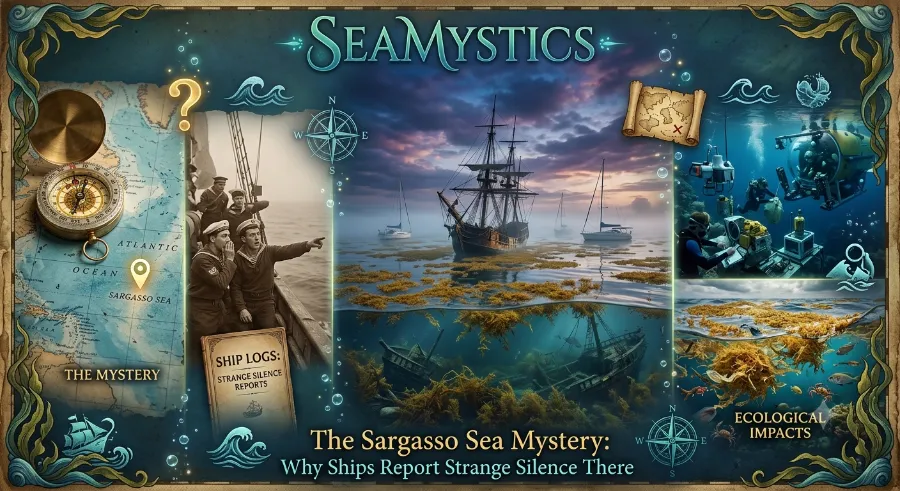
This eel mystery matters for the wider Sargasso Sea story because it proves the calm water isn’t empty water. Beneath the flat, silent surface that unnerved sailors for centuries, one of the ocean’s longest and least understood migrations has been happening the entire time. For a related deep sea puzzle involving currents rather than migration, see our feature on the underwater river mystery.
Historic Encounters With The Sargasso Sea
Real accounts from across five centuries show a consistent pattern of unease.
In 1492, Columbus’s crew grew fearful after several days of calm winds and thick seaweed mats. They believed land was near, or that the voyage was cursed. Through the 1700s and 1800s, sailing ship logs regularly noted the sea as a place to avoid, since a becalmed vessel with limited food and water could face real danger. William Beebe’s bathysphere dives near Bermuda from 1930 to 1934 gave scientists their first direct look at deep sea life in this region, using a steel sphere lowered on a cable into waters connected to the Sargasso Sea. In the twentieth century, the Sargasso Sea’s western edge became linked in popular imagination to the nearby Bermuda Triangle. That link fed decades of speculation about missing ships and aircraft.
If unexplained ocean anomalies interest you, our deep dive into the Baltic Sea Anomaly covers a very different kind of underwater mystery, this time involving a seafloor formation rather than a calm water zone.
Why The Silence Still Gets Reported Today
Modern ships have engines, radar, and satellite weather. So why do sailors still talk about strange silence in the Sargasso Sea? Part of the answer is meteorological. Part of it is psychological.
The high pressure system over the region hasn’t gone anywhere. Diesel engines solve the practical problem of being stuck, but they don’t change the fact that wind speeds here regularly drop lower than almost anywhere else in the North Atlantic. Add unusually flat water and thick patches of sargassum, and a modern sailor gets the same sensory experience that unsettled crews five hundred years ago, just without the risk of starving.
There’s also a documented feedback loop with popular culture. The Sargasso Sea sits close to the region popularly associated with the Bermuda Triangle, so any strange report from this patch of ocean tends to get amplified and connected to that older legend, even when the explanation is simple oceanography. This is a pattern our related piece on the Puerto Rico Trench explores as well, since that trench sits along the same general stretch of ocean that fuels Bermuda Triangle stories.
For a slower, more literary account of what it actually feels like to sail through this calm, Ocean71’s essay on a sea like none other is worth reading. It captures the sensory side of the experience in a way most scientific sources don’t attempt.
Sargasso Sea Location Facts At A Glance
| Question | Answer |
|---|---|
| Where is the Sargasso Sea? | North Atlantic Ocean, roughly between Bermuda and the Azores |
| Does it have a coastline? | No, it is bounded entirely by ocean currents |
| What currents form its border? | Gulf Stream, North Atlantic Current, Canary Current, North Atlantic Equatorial Current |
| How was it named? | After sargassum seaweed found floating on its surface |
| Is it dangerous to ships today? | Not physically, though calm conditions and heavy weed can still slow small vessels |
| What lives there? | Sargassum ecosystem, juvenile game fish, sea turtles, and spawning eels |
Readers curious about other patches of ocean with strange reputations may also want to look at our guide on the vanishing island mystery and our feature on the Yonaguni Monument mystery.
Conservation Pressures Facing The Sargasso Sea
The calm that made this sea famous hasn’t protected it from modern threats. Pollution from ships and land reaches the Sargasso Sea, and harvesting of sargassum for fertilizer and biofuel adds more pressure. Climate change and ocean acidification may threaten it too. The open ocean ecosystem generally falls outside any single country’s jurisdiction, so protecting it requires international cooperation. The Sargasso Sea Alliance has worked toward that goal alongside Bermuda’s government.
This matters for the eel story too. A sea under environmental pressure is a harder place for an already endangered species to complete a multi thousand kilometer migration. The quiet water sailors feared for so long is now, in a very real sense, an ecosystem that needs active protection rather than avoidance.
Frequently Asked Questions
Is the Sargasso Sea part of the Bermuda Triangle? The western edge of the Sargasso Sea overlaps with the region popularly called the Bermuda Triangle, but the two aren’t the same thing. The Sargasso Sea is a defined oceanographic feature. The Bermuda Triangle is a loosely drawn area tied to specific missing ship and aircraft stories.
Why do ships get stuck in the Sargasso Sea? Older sailing ships lost wind because the sea sits under a stable high pressure system that produces long stretches of calm air. Modern engine powered ships aren’t physically stuck, but they can experience unusually flat, quiet conditions and thick patches of floating sargassum weed.
What lives in the Sargasso Sea? The sea hosts a floating sargassum ecosystem that shelters juvenile dolphinfish, jacks, mackerel, tuna, and several sea turtle species. It’s also the confirmed spawning ground for both American and European eels.
Has anyone ever seen eels spawning in the Sargasso Sea? No. Despite a century of research since Johannes Schmidt’s 1921 discovery, no scientist has directly observed eels spawning there. It remains one of the biggest open questions in marine biology.
Is the Sargasso Sea dangerous today? Not in the way old sailors feared. There’s no physical trap and no real risk of a modern vessel being stranded. The main hazards now are environmental, including pollution and heavy weed accumulation, rather than danger to the ship itself.
Conclusion
The Sargasso Sea earns its reputation honestly. It’s the only sea without a coastline, held together by four rushing currents while its own interior sits nearly still. That stillness explains centuries of unsettling sailor stories, from Columbus’s anxious crew in 1492 to modern yacht owners describing an unnatural quiet on flat blue water. Underneath that calm, one of the ocean’s oldest unsolved mysteries continues without interruption, as generations of eels complete a migration that scientists still can’t fully explain. The silence sailors report is real. It’s just not empty.
References
- NOAA Ocean Exploration, “The Importance of Exploring the Sargasso Sea” — https://oceanexplorer.noaa.gov/expedition-feature/okeanos-ex2104-features-sargasso-sea/
- NOAA, “Marine Protected Areas (MPAs): Sargasso Sea” — https://www.noaa.gov/gc-international-section/marine-protected-areas-mpas-sargasso-sea
- Wikipedia, “Sargasso Sea” — https://en.wikipedia.org/wiki/Sargasso_Sea
- Alliance for the Chesapeake Bay, “The American Eel: International Fish of Mystery” — https://www.allianceforthebay.org/2021/01/the-american-eel-international-fish-of-mystery/
- Nature Scientific Reports, “First direct evidence of adult European eels migrating to their breeding place in the Sargasso Sea” — https://www.ncbi.nlm.nih.gov/pmc/articles/PMC9562336/
- Nature Scientific Reports, “New clues on the Atlantic eels spawning behavior and area” — https://www.nature.com/articles/s41598-020-72916-5
- Smithsonian Ocean, “The Origin of Eels” — https://ocean.si.edu/ocean-life/fish/origin-eels
- Sail Magazine, “The Mysterious Life of the Sargasso Sea” — https://sailmagazine.com/cruising/the-mysterious-life-of-the-sargasso-sea/
- The Bermudian, “Mysteries of the Sargasso Sea” — https://www.thebermudian.com/home-a-garden/nature/mysteries-of-the-sargasso-sea/
- Ocean71 Magazine, “Sea Like None Other” — http://ocean71.com/chapters/sea-like-none-other/