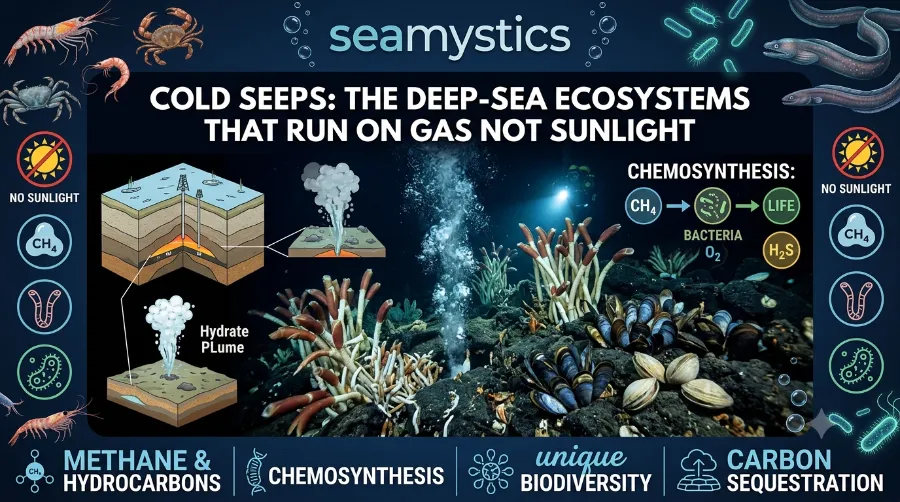

Picture a place on Earth where nothing has ever seen the sun. Yet life still grows thick and strange across the seafloor here. This is exactly what happens at cold seep ecosystems, hidden pockets of the deep ocean where methane and other gases leak up from below. These gases quietly become the base of an entire food web. No light reaches these zones, so animals here depend on chemosynthesis instead of photosynthesis. In this process, bacteria turn gas into energy. Because of this simple trick, scientists have found these strange oases along nearly every continental margin on the planet. In fact, researchers keep discovering new ones every year.
The Sargasso Sea Mystery: Why Ships Report Strange Silence There
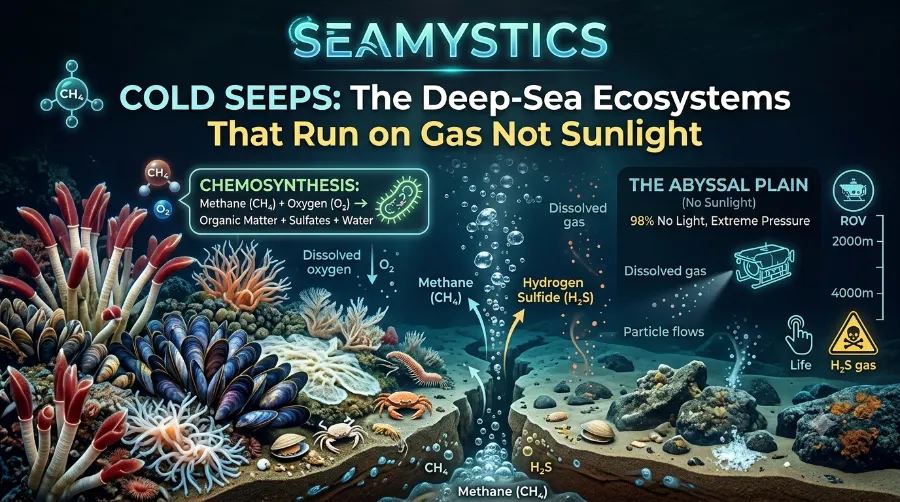
TL;DR: Cold seep ecosystems are deep-sea communities that survive on methane and other gases seeping from the seafloor instead of sunlight. Bacteria convert these gases into usable energy through chemosynthesis, and this energy then feeds tube worms, clams, mussels, and dozens of other species. These habitats also matter for climate science, since they naturally filter out most of the methane before it ever reaches the ocean surface.
Brinicle Ice Finger of Death The Antarctic Phenomenon Filmed for the First Time
| Key Takeaway | What It Means |
|---|---|
| Energy source | Methane and hydrogen sulfide, not sunlight |
| Core process | Chemosynthesis, powered by symbiotic bacteria |
| Depth range | Roughly 200 meters to over 9,600 meters |
| Global spread | Found on continental margins in every ocean basin |
| Notable animals | Tube worms, vesicomyid clams, Bathymodiolus mussels, bacterial mats |
| Longest-lived resident | Escarpia laminata tube worms, some over 300 years old |
| Climate role | Natural methane filter through microbial oxidation |
| Biggest threat | Deep sea mining and oil and gas exploration |
What Are Cold Seep Ecosystems
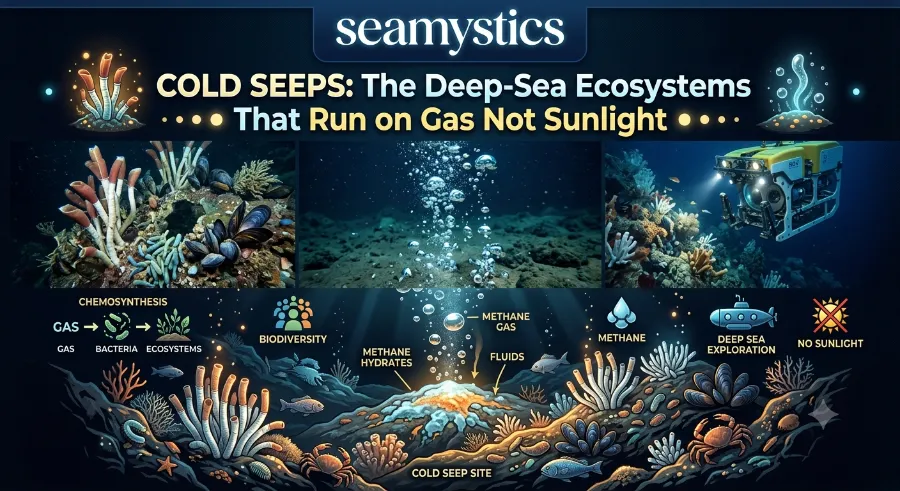
Cold seep ecosystems form wherever methane, hydrogen sulfide, or other hydrocarbons escape from cracks in the ocean floor. Unlike hydrothermal vents, the fluid here stays close to the surrounding seawater temperature. It usually sits between 2 and 4 degrees Celsius. That is exactly why scientists gave these sites the name cold seeps. Even so, the chemical energy pouring out of these cracks supports dense, thriving communities. This happens in a part of the ocean that would otherwise stay almost empty.
The Bermuda Triangle What Ocean Science Actually Says
Experts consider these chemosynthetic cold seep habitats because the entire food chain starts with bacteria rather than plants. As soon as methane or sulfide reaches the sediment surface, specialized microbes get to work breaking it down. This single chemical step supports everything from bacterial mats to giant tube worms. Remarkably, all of this happens without a single ray of sunlight ever touching the seafloor.
How Chemosynthesis Replaces Sunlight
In a sunlit ecosystem, plants absorb light and turn it into sugar. At cold seeps, bacteria absorb methane or hydrogen sulfide instead. Through chemosynthesis, these microbes turn that gas into organic carbon. Interestingly, many larger animals here do not even eat the bacteria directly. Instead, tube worms and clams host these bacteria inside their own bodies. In return, the host provides shelter and raw gas, while the bacteria provide food.
Because of this partnership, deep sea gas vents can support surprisingly large animals. Some tube worms grow this large despite having no mouth or gut at all. They simply absorb nutrients straight from their bacterial partners. As a result, a chemical reaction that seems minor on land becomes the entire economic engine of an ecosystem hundreds or thousands of meters underwater.
Cold Seeps vs Hydrothermal Vents
People often confuse cold seeps with hydrothermal vents, and this makes sense since both rely on chemosynthesis. However, the two habitats differ in several important ways, as the table below shows.
| Feature | Cold Seeps | Hydrothermal Vents |
|---|---|---|
| Fluid temperature | Near ambient, roughly 2 to 4°C | Can exceed 300°C |
| Fluid source | Hydrocarbon reservoirs in sediment | Magma-heated seawater |
| Typical lifespan | Decades to thousands of years | Often just years to decades |
| Common animals | Tube worms, mussels, clams | Giant tube worms, shrimp, crabs |
| Best known locations | Gulf of Mexico, Cascadia margin, Mediterranean | Mid-Atlantic Ridge, East Pacific Rise |
Where Cold Seep Ecosystems Are Found
According to NOAA Ocean Exploration, teams have already mapped thousands of cold seeps off the United States coast alone. Better mapping technology keeps revealing more each year. These sites tend to cluster along tectonically active margins. There, subduction and sediment compression create natural plumbing systems for gas to escape.
The Gulf of Mexico stands out as the most studied region for methane seep life anywhere in the world. Seeps here range from about 500 meters down to over 3,000 meters. They host massive tube worm bushes that have grown for centuries. Meanwhile, off the coast of Vancouver Island, the Cascadia margin holds over 1,000 known seeps. Most cluster around Clayoquot Slope and Barkley Canyon, and trawlers actually confirmed some of these sites by accident back in 1992.
Arctic and Antarctic waters have produced some of the most exciting recent finds. In December 2025, researchers reported a gas hydrate cold seep on the Molloy Ridge in the Greenland Sea at 3,640 meters. This is the deepest one confirmed in the Arctic so far, and it extends the known depth limit for this kind of ecosystem by nearly 1,800 meters. A similar surprise came from the South Sandwich Islands in the Southern Ocean during 2025. There, scientists found a shallow vent field at roughly 700 meters that turned up 30 species new to science, including a carnivorous sponge nicknamed the death ball sponge.
Brine pools add another odd twist to this picture. These dense, super salty patches sit on the seafloor and behave almost like small underwater lakes or rivers. They even show visible shorelines and ripples, despite sitting fully submerged in ocean water. Readers curious about similar underwater flow features may also enjoy our related piece on the underwater river mystery, which explores this phenomenon from a different angle.
Recent Expeditions Worth Knowing
A handful of expeditions over the last two years have reshaped how scientists think about cold seep ecosystems. Here are some of the most significant.
- In July 2025, a team led by geochemist Mengran Du from the Chinese Academy of Sciences published findings in Nature. They described chemosynthetic communities living over 9 kilometers down in the Kuril-Kamchatka Trench, making it the deepest confirmed ecosystem of this kind on record.
- During the Arctic Deep EXTREME24 expedition in the summer of 2024, researchers found the Freya gas hydrate mounds in the Fram Strait. This revealed an unexpected biological link between seeps and vents in Arctic waters.
- Scientists first confirmed a methane driven chemosynthetic system on the Rio Grande Cone in the western South Atlantic back in 2016. Since then, later studies through 2026 have continued mapping its microbial layers down to 18 meters below the seafloor.
- Between October and December 2024, an international team aboard the Research Vessel Falkor mapped methane seep systems along the Chile margin. They focused specifically on sites like the Limarí Seeps.
Cold Seep Animals: Life Without Sunlight
The animals living at these sites have adapted in ways that would look impossible almost anywhere else on the planet. Tube worms stand out as the most famous residents, and for good reason. Species such as Lamellibrachia luymesi can live for up to 250 years. Meanwhile, Escarpia laminata in the Gulf of Mexico has reached beyond 300 years in some individuals, based on growth models built from hundreds of tagged specimens. As a result, these cold seep animals rank among the longest lived creatures known anywhere on Earth.
Beyond tube worms, several other groups dominate these communities.
- Vesicomyid clams, which bury themselves in sediment and rely on sulfide absorbed through their gills
- Bathymodiolus mussels, often found in dense clusters around active seepage points
- White filamentous bacterial mats, usually the first visible sign that a seep site is active
- Sea cucumbers, crabs, and brittle stars, which scavenge around the edges of these communities
- Deep sea octopuses and foraging fish such as sablefish, which visit seeps for food even though they are not chemosynthetic themselves
A Closer Look at Longevity
Marine biologists have spent years trying to understand why these animals live so long. Slower metabolism at depth plays a role, of course. However, tube worms also benefit from an unusually low death rate once they settle at a stable seep. Researchers at Temple University tagged and measured 356 individual tube worms across several Gulf of Mexico sites to build these age models. Based on this data, a worm reaching 50 centimeters in length is likely over 200 years old.
Why Cold Seep Ecosystems Matter for the Climate
Cold seeps are not just a biological curiosity. They also play a real role in the planet’s carbon cycle. Researchers estimate that seafloor cold seeps release roughly 0.02 gigatons of methane into the ocean each year. At the same time, microbes consume a similar amount directly within the sediment before it can escape at all.
Most of this filtering happens through anaerobic oxidation of methane. During this process, microbial communities pair up with sulfate reducing bacteria to break methane down before it drifts upward. Some studies show that this microbial partnership can consume more than 80 percent of the methane rising through seafloor sediments on a global scale. In short, chemosynthetic cold seep communities act like a natural filter. This filter keeps a significant amount of greenhouse gas from ever reaching the atmosphere.
| Process | Approximate Contribution |
|---|---|
| Sulfate driven anaerobic oxidation | Up to 80 percent plus of diffusing methane |
| Metal driven anaerobic oxidation | At least 3 percent of total methane consumption |
| Annual methane consumed in sediment | Roughly 0.02 gigatons globally |
| Annual methane released to ocean | Roughly 0.02 gigatons globally |
Because of this filtering role, cold seeps have become a growing focus for climate researchers. This matters even more as warming oceans and shifting sediment stability raise new questions. Could methane release rates change in the coming decades? Researchers are still working to answer that.
Threats Facing Cold Seep Ecosystems
Despite their resilience, these habitats are far from indestructible. Bottom trawling has already disturbed shallow seep sites by accident. On top of that, deep sea mining proposals now threaten to disturb far larger areas of seafloor that host both seeps and nearby vent communities. Many seep species grow and reproduce so slowly that recovery from physical damage could take decades or even centuries.
Oil and gas exploration adds another layer of pressure. Some seep fields sit directly above the same hydrocarbon reservoirs that energy companies target. Researchers studying the Molloy Ridge site have specifically called for evidence based environmental assessments as interest in Arctic resource extraction grows. Readers who enjoy fragile deep ocean environments and other unexplained seafloor features may also want to read our coverage of the Puerto Rico Trench, one of the deepest points in the Atlantic Ocean.
Cold Seeps Around the World: A Quick Reference
| Region | Depth Range | Notable Feature |
|---|---|---|
| Gulf of Mexico | 500 to over 3,000 meters | Centuries old tube worm bushes |
| Cascadia Margin, Canada | 800 to 1,300 meters | Over 1,000 mapped seeps |
| Greenland Sea, Molloy Ridge | 3,640 meters | Deepest confirmed Arctic seep |
| Kuril-Kamchatka Trench | Over 9,000 meters | Deepest confirmed seep ecosystem globally |
| South Sandwich Islands | Approximately 700 meters | 30 newly identified species |
| Chile Margin | Variable | Active tectonic seep mapping since 2024 |
Frequently Asked Questions
What is a cold seep in simple terms?
A cold seep is a spot on the ocean floor where gases like methane slowly leak out. These gases support life through chemosynthesis instead of sunlight.
How deep are cold seep ecosystems usually found?
Most sit below 200 meters. However, confirmed sites now range from a few hundred meters down to over 9,600 meters in hadal trenches.
Do cold seeps help or hurt climate change?
Cold seeps actually help limit climate impact in most cases. Microbial communities filter out a large share of methane before it can escape into the water column.
What is the difference between a cold seep and a hydrothermal vent?
Cold seeps release fluid close to ambient ocean temperature and rely on hydrocarbon reservoirs. Hydrothermal vents, on the other hand, release fluid that can exceed 300 degrees Celsius due to nearby magma activity.
Are cold seep animals edible or dangerous?
No cold seep species pose a direct danger to humans. Almost none of them get commercially fished either, given their extreme depth and slow growth rates.
Conclusion
Cold seep ecosystems prove that life does not need sunlight to build something rich and lasting. From centuries old tube worms in the Gulf of Mexico to newly confirmed communities thousands of meters down in Arctic and hadal waters, these gas fueled habitats keep reshaping what marine biologists thought was possible. As mapping technology improves and climate research leans more heavily on methane cycles, cold seeps will likely stay at the center of deep sea science for years to come. Anyone fascinated by the ocean’s stranger corners might also enjoy exploring our related coverage of the Baltic Sea anomaly and other unexplained seafloor discoveries on Sea Mystics.
References
- Ocean Exploration Trust, Nautilus Live, Deep-Sea Biology of Cold Seeps and Gas Hydrates, 2024
- NOAA Ocean Exploration, Cold Seeps education theme page
- Frontiers in Marine Science, Cold seeps: climate relevance and anthropogenic impacts, 2026
- Nature, hadal trench chemosynthetic ecosystem findings led by Mengran Du, published July 30, 2025
- Nature Communications, gas hydrate mounds and chemosynthetic fauna at Molloy Ridge, 2025
- Springer, The Science of Nature, extreme longevity in Escarpia laminata tube worms, 2017
- Science in School, introduction to cold seep biology
- Deep Ocean Education Project, cold seep biodiversity resources