
A tiny snip of tissue can end a century of guesswork. That is the quiet power behind DNA barcoding species research. Indeed, marine labs from Woods Hole to Southampton now treat a genetic sample as seriously as a specimen jar. For decades, a new species claim rested on shape, color, and a trained eye. Today, however, it rests on a short strand of genetic code, and this shift changed how fast, and how confidently, science can say “this animal has never been named before.”
Citizen Science Ocean How Regular People Are Finding New Species
Key Takeaways
| Point | Detail |
|---|---|
| What it proves | A unique genetic marker separates a species from its closest relatives |
| Standard gene used | COI (cytochrome c oxidase subunit I), often called the barcode gene |
| Common threshold | Roughly 2 to 3 percent sequence divergence signals a likely new species |
| Recent scale | Ocean Census teams logged 1,121 new marine species between April 2025 and March 2026 |
| Main database | BOLD Systems, the Barcode of Life Data System, holds millions of reference sequences |
| Biggest limit | Barcoding alone cannot confirm a species; it flags candidates for full taxonomic review |
TL;DR: DNA barcoding species work compares a short, standardized gene sequence, usually COI, against existing genetic libraries. Scientists look for around 2 to 3 percent genetic divergence from known relatives, then confirm findings with physical traits, habitat data, and peer review. As a result, this method helped researchers document over a thousand new marine species in a single recent year.
What Is DNA Barcoding and Why It Matters for Ocean Life
Every living thing carries a genetic fingerprint. Instead of reading the whole genome, marine biologists focus on one small, dependable piece of it. This shortcut is what people mean when they say DNA barcoding ocean research. So, scientists isolate a single gene region rather than sequencing an entire organism, and that region varies enough between species while staying stable within a species.
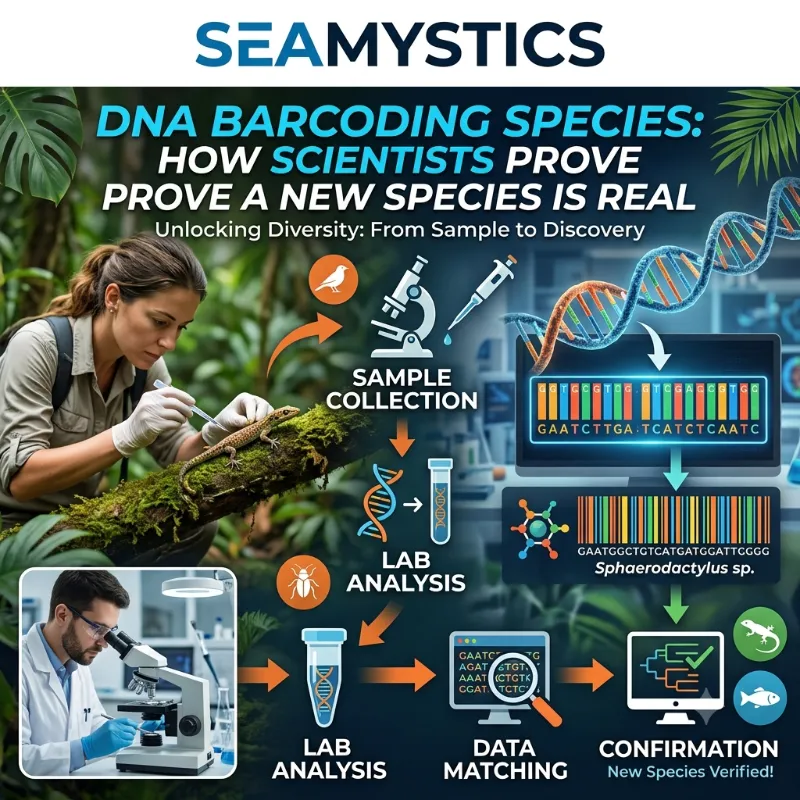
DNA Barcoding Species How Scientists Prove a New Species Is Real
In practice, this single gene works like a universal product code for life underwater. A fish, a coral, a deep sea worm, and a crab all get checked against the same genetic ruler. Consequently, comparisons happen fast, and mismatches between how an animal looks and what its genes say become obvious almost immediately.
Rediscovered vs New The Difference Between a Lost Species and a New One
This speed matters because oceans hide most of their residents from the naked eye. In fact, Ocean Census, the world’s largest collaborative marine discovery program, reports that up to 90 percent of ocean life still remains undocumented. Given that gap, a faster identification tool is not a luxury; it is a necessity for keeping pace with a mostly unmapped world.
The Genetic Barcode Explained (COI Gene)
Scientists rely on one gene for most animal barcoding work: COI, short for cytochrome c oxidase subunit I. It sits inside mitochondrial DNA, which passes down mostly through the mother’s line. Because it mutates at a fairly predictable rate, researchers use that steady clock to measure how far two samples have drifted apart genetically, then estimate when their lineages split.
The Ocean Census Project Inside the Global Hunt for New Marine Life
Additionally, COI stays short enough to sequence cheaply, usually around 650 base pairs, yet it varies enough to tell closely related species apart. This balance is why the freshwaterblog.net overview of DNA barcoding calls it a master key for identification work across very different animal groups. On the other hand, plants and fungi often need different marker genes, since COI does not vary enough in those groups.
Genetic Species Identification: The Science Behind Naming a New Species
Naming a new species involves more than one test. Genetics forms only the first layer, though often the most important one. Typically, genetic species identification starts the moment a specimen looks slightly off compared to known relatives. For instance, a fin shape, a shell pattern, or a habitat that does not fit the norm can all raise a flag.
ROV Ocean Discovery The Robots Finding New Deep-Sea Species Every Year
At that point, the team sequences a small tissue sample and runs it against reference libraries such as BOLD Systems or GenBank. A sequence that clusters far from every known match becomes a candidate for new species status. Even so, distance alone never settles the question, because hybridization, regional variation, and database gaps can all create misleading results.
The 2 Percent Rule and Species Thresholds
Most barcoding labs follow a rough guideline, often called the 2 percent rule. Naturally, the real number shifts by taxonomic group. For clarity, the table below shows simplified thresholds drawn from recent marine barcoding studies.
New Jellyfish Species Found Why Jellies Are Still Being Discovered
New Crustacean Species The Crabs and Shrimp Still Being Named
| Animal Group | Typical Divergence Threshold for a New Species | Notes |
|---|---|---|
| Bony fish | 2.0 to 2.3 percent | One of the most tested thresholds in marine barcoding |
| Crustaceans | 3.0 to 5.0 percent | Higher due to older evolutionary splits within families |
| Mollusks | 2.5 to 4.0 percent | Cryptic species are common in this group |
| Cephalopods | Highly variable | A 2022 Frontiers in Marine Science study found hidden diversity that broke standard thresholds in Chinese coastal waters |
Overall, this threshold is not a strict law of nature but a statistical guideline built from thousands of prior comparisons. Because thresholds vary by group, a responsible lab always cross checks the number against species that scientists have already confirmed. Skipping that step risks two outcomes: missing a real new species, or splitting one species into two based on natural variation alone.
Case Study: A Real Discovery With Numbers
In 2022, a Frontiers in Marine Science report documented unusually high hidden diversity among cephalopods in Chinese coastal waters. Specifically, the team used barcode analysis to reveal lineages that shape based identification had missed entirely. As it turned out, some squid populations, long treated as a single species, actually carried genetic splits wide enough to suggest separate species status. In short, appearance alone hid a real biological boundary, and only genetic testing brought it into view.
On a much larger scale, the Ocean Census Alliance announced 866 newly discovered marine species in 2025. A year later, an even bigger jump followed. Between April 2025 and March 2026, teams confirmed 1,121 new marine species across 13 expeditions and nine dedicated species workshops. According to Scientific American’s coverage of the announcement, that marks a 54 percent increase in annual identifications compared to the previous year, and faster genetic barcoding helped drive that jump.
Barcoding Marine Species: Real World Discoveries from the Ocean Census
Large scale barcoding marine species work has moved from a niche academic tool into a global production line for discovery. The Ocean Census program brings together the Nippon Foundation, Nekton, JAMSTEC, CSIRO, and the Schmidt Ocean Institute. First, expeditions collect specimens. Then, taxonomists examine physical traits, while genetic teams run barcode comparisons, often within the same field season.
New Coral Species Discovered What Makes Reef Taxonomy So Difficult
During the 2025 to 2026 discovery window, for example, teams found striped ribbon worms off East Timor that may carry compounds useful for future medical research. Meanwhile, a human operated submersible near Japan turned up glass skeleton sponges in the same period. In both cases, barcode data confirmed that neither animal matched anything already logged in reference libraries. Without that genetic checkpoint, some of these species might have sat in museum drawers for years as possible new records rather than confirmed discoveries.
You can explore ongoing confirmation projects like these on our new species confirmation hub, where we track how labs move from a raw sample to a named organism.
How Scientists Confirm a New Species: The Step by Step Process
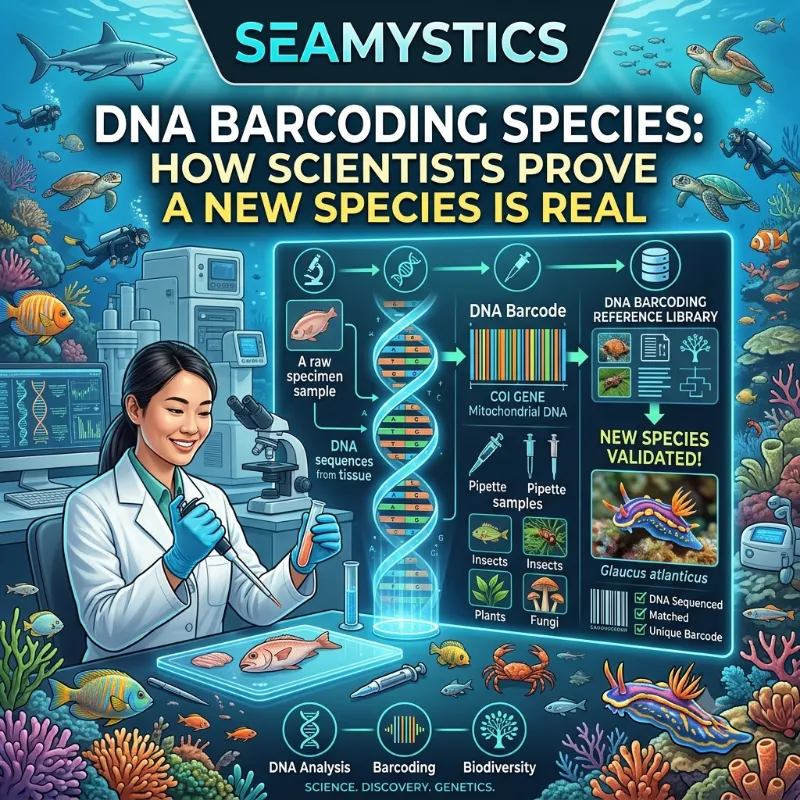
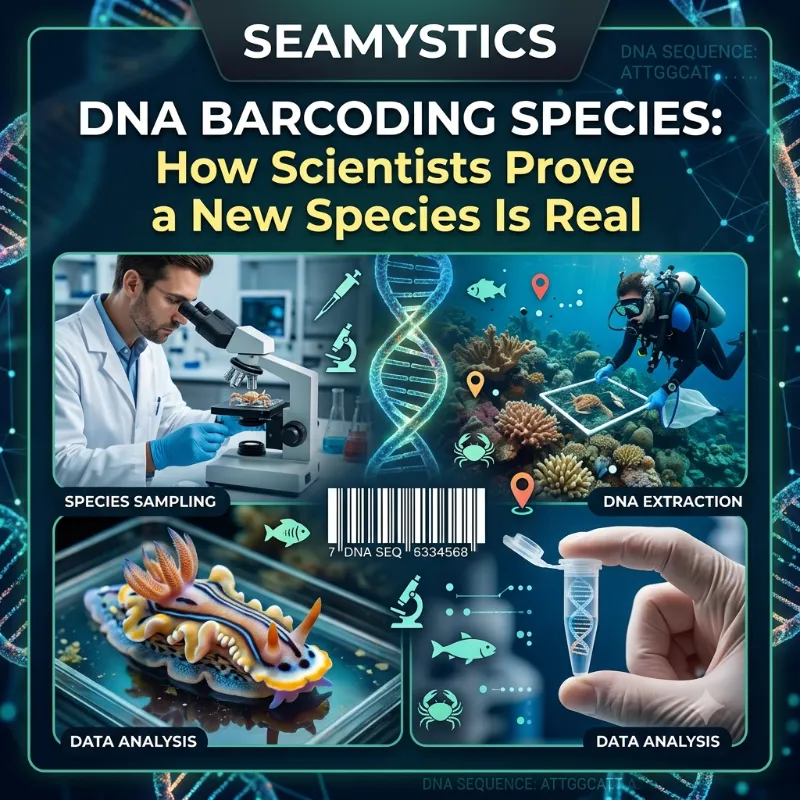
Every lab runs its own version of this workflow, but most follow a similar sequence. Below, the steps reflect the general process used across major marine biodiversity programs today.
- Field collection – Teams collect, photograph, and tag the specimen with exact location and depth data.
- Morphological screening – Taxonomists compare shape, color, and structure against known species records.
- Tissue sampling – A small piece of tissue gets preserved specifically for genetic work, separate from the main specimen.
- Barcode sequencing – A lab sequences the COI region, or another suitable marker.
- Database comparison – The team matches the sequence against BOLD Systems and GenBank entries.
- Divergence analysis – Analysts calculate genetic distance from the closest known relatives.
- Peer review and publication – Independent experts review the findings before the species gets a formal name.
Each step checks the one before it, so no single test carries the entire burden of proof. Because of this layered approach, published new species names tend to hold up well over time, even as testing technology keeps improving.
DNA Barcoding Ocean Surveys: Tools, Databases and Limits
A massive reference library sits behind every barcode match. Since the quality of that library shapes how trustworthy any single result can be, DNA barcoding ocean surveys depend heavily on BOLD Systems, which now holds millions of barcode records spanning insects, fish, birds, and marine invertebrates. GenBank, maintained by the National Center for Biotechnology Information, plays a similar role, and researchers often cross check both for extra confidence.
However, these databases are not evenly built. Well studied regions like the North Atlantic and parts of the Pacific coast carry dense, reliable reference data, while remote or deep sea zones remain thin by comparison. In fact, a 2025 PeerJ evaluation of barcoding reference databases in the western and central Pacific Ocean found real gaps in sequencing coverage for that high biodiversity region. As a result, those gaps can trigger false negatives when a species genuinely is new, but nothing similar exists yet in the database for comparison.
BOLD Database and Reference Libraries
The Barcode of Life Data System works almost like a genetic library card catalog. Since contributors from around the world add to it constantly, each new sequence becomes searchable for every future comparison. This crowdsourced, cumulative structure explains why barcoding scaled so quickly since its early proposal.
Hybrid Ocean Species When Two Marine Animals Interbreed Naturally
The concept traces back to a foundational push in the mid 2000s, and interest has only grown since. As the Natural Solutions overview of DNA barcoding explains, the method transformed biodiversity surveys by shifting fieldwork from slow manual identification toward faster, genetically verified results. Consequently, conservation teams can now screen dozens of samples in the time it once took to confirm a single specimen by eye.
Challenges and Criticism
No method works perfectly, and barcoding carries real limitations that responsible researchers acknowledge openly. Because mitochondrial DNA, the source of the COI gene, passes down only through the maternal line, it cannot detect hybrids or capture the full genetic picture of a population. Furthermore, some closely related species show almost no COI divergence at all, so barcoding alone would miss them entirely.
For this reason, most serious taxonomic work treats barcoding as a screening tool rather than a final verdict. A 2013 methods paper titled “The Seven Deadly Sins of DNA Barcoding” laid out common pitfalls, including contamination, poor sampling, and over reliance on a single gene, and those cautions still matter in labs today. Ultimately, smart teams pair barcode data with nuclear DNA markers, physical examination, and ecological context before they publish a formal species description.
Species DNA Testing in Practice: From Sample to Certificate
Species DNA testing has moved well beyond academic labs, and it now shapes conservation enforcement, seafood fraud detection, and even citizen science projects. For example, fisheries regulators use barcode testing to confirm that seafood labeled as one species is not secretly a cheaper substitute. Interestingly, the same core technology that names brand new deep sea animals also protects consumers at a grocery counter.
In conservation work specifically, barcode testing helps identify trafficked wildlife parts, confirm invasive species before they spread further, and monitor coral reef health through environmental DNA sampling. As the Smithsonian Magazine feature on DNA barcoding points out, this technology opened genuinely new doors for conservation work that older identification methods simply could not support at scale. Beyond that, environmental DNA, or eDNA, takes this a step further and detects species from water samples alone, without ever capturing the animal itself.
Based on real lab experience, the biggest bottleneck is rarely the sequencing itself; instead, it is the reference database gap for undersampled regions. Since a barcode result is only as strong as what it gets compared against, ongoing global sampling efforts matter enormously for the accuracy of future species confirmations. For a wider view of how these tools connect, readers can also check our related guide on ocean biodiversity tracking.
You can browse more expedition stories and confirmed discoveries directly on Sea Mystics, where our team follows new species announcements as they happen.
Frequently Asked Questions
What is DNA barcoding used for in marine biology?
Scientists use it to identify and distinguish species by comparing a short, standardized gene sequence, usually COI, against reference databases. This, in turn, speeds up identification and flags possible new species.
How much genetic difference counts as a new species?
No universal number exists, but many marine fish studies use roughly 2 to 2.3 percent divergence as a rough guideline. However, other groups like crustaceans often need higher divergence before a new species looks likely.
Can DNA barcoding alone confirm a brand new species?
No. Instead, barcoding flags strong candidates, while formal confirmation still requires physical examination, ecological data, and independent peer review before a species can be officially named.
Is DNA barcoding accurate for deep sea animals?
It can be, though accuracy depends heavily on how well that region’s animals already appear in reference databases. Generally, deep sea zones carry thinner genetic libraries than shallow coastal waters.
How many new marine species have researchers found recently through this method?
Ocean Census teams documented 1,121 new marine species between April 2025 and March 2026. Largely, faster genetic screening tools, working alongside traditional taxonomy, made that pace possible.
Conclusion
DNA barcoding quietly rewrote how ocean science confirms what is real and what is new. In practical terms, it turned a process that once took years of careful comparison into something labs can often finish in weeks. Still, it is not a magic answer, and it never replaces the trained eye of a taxonomist. Instead, it gives that expert a faster, more reliable starting point. As reference databases keep growing, and as expeditions keep reaching deeper, stranger corners of the ocean, this genetic shortcut will likely stay at the center of how new species get named for years to come.
References
- Ocean Census. (2026). Over 1,100 New Marine Species Discovered. oceancensus.org
- Scientific American. (2026). Ocean census reveals more than 1,100 new species.
- PeerJ. (2025). Evaluation of DNA barcoding reference databases for marine species in the western and central Pacific Ocean.
- Frontiers in Marine Science. (2022). DNA Barcoding Reveals High Hidden Species Diversity of Chinese Waters in the Cephalopoda.
- Freshwater Blog. DNA Barcoding: A New Master Key for Identifying Species.
- Natural Solutions. DNA Barcoding: Transforming of Biodiversity Surveying.
- Smithsonian Magazine. How DNA Barcoding Opens New Doors for Conservation.