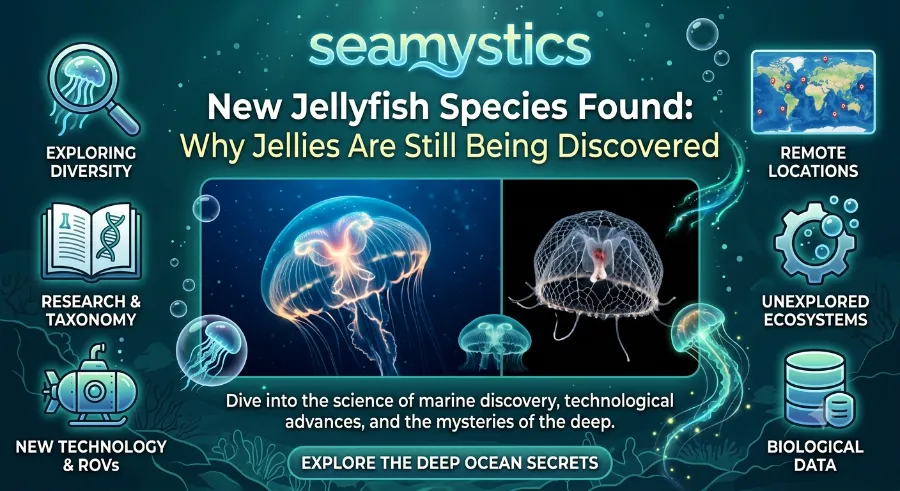

A student in Japan scooped a glowing blue blob into a plastic bag. He drove it home on his scooter. Within months, his name was attached to a brand new animal. That is not a movie plot. It happened in 2025, and it marks just one of several recent cases of a new jellyfish species turning up. From the Gulf of Mexico to the coast of Singapore, researchers keep finding jellies that science has never named before. That pattern says a lot about how little we still know about the ocean.
Hybrid Ocean Species When Two Marine Animals Interbreed Naturally
New Coral Species Discovered What Makes Reef Taxonomy So Difficult
Key Takeaways
| Question | Quick Answer |
|---|---|
| Are new jellyfish species still being found? | Yes, several were confirmed between 2025 and 2026 alone |
| Why do jellyfish go unnoticed for so long? | They look alike, live in remote water, and lack hard body parts to fossilize or easily compare |
| How do scientists confirm a new species? | Through DNA barcoding combined with close study of body shape |
| Where are most new jellies being found? | Deep sea zones, coastal estuaries, and well-studied regions that turn out to hide look-alike species |
| Does a new discovery matter to ocean health? | Yes, it helps track changing ecosystems, climate shifts, and food webs |
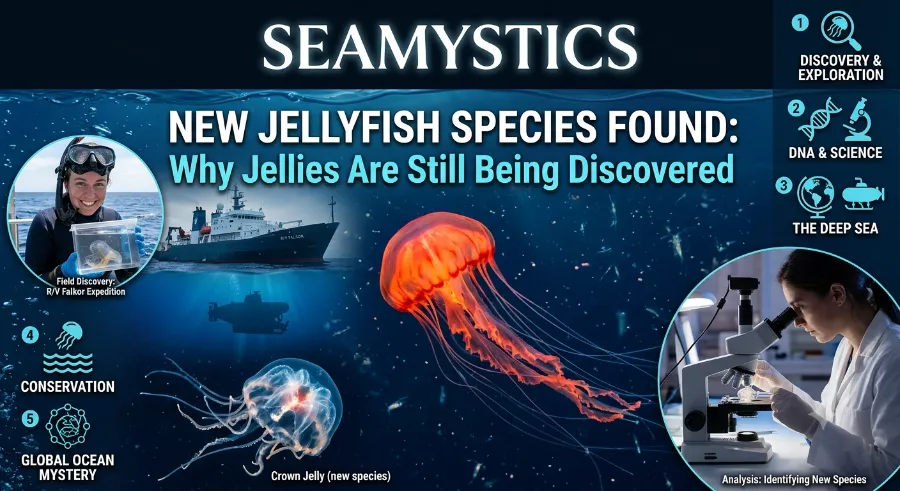
TL;DR: Yes, scientists still find new jellyfish species on a fairly regular basis. Teams confirmed several between 2025 and 2026 across Japan, the Gulf of Mexico, Singapore, and the Philippines. They rely on DNA testing, underwater robots, and citizen science to tell these creatures apart, because jellyfish often look nearly identical even when their genes tell a different story.
The Ocean Census Project Inside the Global Hunt for New Marine Life
Why Jellyfish Are Still Being Discovered in 2026
Many people assume that after centuries of ocean exploration, most large sea creatures already have names. Jellyfish keep proving that assumption wrong. Their bodies are soft and boneless, so they decay fast and rarely leave fossils behind. Scientists cannot lean on a fossil record the way they do with fish or shellfish. As a result, jellyfish taxonomy keeps shifting, and a new jelly species can still show up in places researchers have studied for decades.
Modern tools are speeding up the pace of discovery too. Genetic testing, sharper cameras, and remotely operated vehicles now let scientists reach places that used to be off limits. A new jellyfish species discovery no longer counts as a once-in-a-generation event. Marine biologists now expect one almost every year.
Rediscovered vs New The Difference Between a Lost Species and a New One
What Actually Counts as a New Jellyfish Species?
Not every unusual jellyfish sighting turns into a new species. Before a jelly earns a scientific name, researchers clear a few specific hurdles first.
- Genetic sequencing. Scientists compare a tissue sample against known species through DNA analysis to confirm it matches nothing already on record.
- Physical comparison. They study body structure, tentacle count, bell shape, and stinging cell patterns against close relatives.
- Life cycle documentation. Where possible, they raise the jellyfish from larva to adult in a lab to map its full life stages.
- Peer review and naming. They publish the findings in a scientific journal, where other experts review the evidence before the name becomes official.
Our guide on how new species get confirmed walks through these standards in more detail. Genetic work has become the backbone of the whole process. Our breakdown of DNA barcoding for species identification explains why a single gene sequence can settle debates that used to take years.
Recent New Jellyfish Species: Real Examples From 2025 and 2026
The last two years produced an unusually steady stream of jellyfish discoveries. The table below shows a snapshot of confirmed finds. Published research or direct reporting from the research teams backs each one.
| Species Name | Location | Year Confirmed | Notable Detail |
|---|---|---|---|
| Physalia mikazuki | Sendai Bay, Japan | 2025 | A cobalt blue Portuguese man o’ war relative, only the fifth known Physalia species worldwide |
| Aurelia profunda | Gulf of Mexico | 2025 | A deep-water moon jellyfish, smaller than its relatives, bringing the Gulf total to four known moon jelly species |
| Chironex blakangmati | Waters off Sentosa Island, Singapore | 2026 | A fourth confirmed species in the extremely venomous Chironex box jellyfish group |
| Malagazzia michelin | Nagasaki and Yamaguchi, Japan | 2026 | A nearly transparent jellyfish, only the second species of its genus found in Japanese waters |
| Multiple carybdeid box jellies | Philippine coastal waters | 2025 | First confirmed national records of species including Alatina alata and Morbakka virulenta |
The Samurai Jellyfish From Japan
A Tohoku University student first spotted Physalia mikazuki while working on an unrelated project near Sendai Bay. He noticed it did not match anything he had seen locally, so he brought it back for testing. Its nickname, the crescent helmet man-o-war, honors a local samurai legend. Researchers formally described the species in Frontiers in Marine Science in October 2025. ScienceDaily reported it as the first formal description of a Physalia species from Japan.
A Deep-Water Moon Jellyfish in the Gulf of Mexico
Moon jellyfish rank among the most studied jellies in the world, which is exactly why Aurelia profunda surprised researchers. A graduate student at Texas A&M University-Galveston spotted a single specimen offshore in the Gulf of Mexico. It looked unusually small and out of place for a coastal species. Associate professor Maria Pia Miglietta explained that the animal turned up offshore rather than in the shallow water where moon jellies usually live. It also measured about five centimeters, compared to the roughly fifteen centimeters typical of other Aurelia species.
New Crustacean Species The Crabs and Shrimp Still Being Named
Genetic sequencing confirmed the specimen belonged to a distinct, previously unknown species. The team then raised its larvae in the lab to document the full life cycle before publishing the discovery. You can read the full interview with the research team through the Texas Standard coverage of the discovery. The Houston Chronicle’s report on the new Texas jellyfish species adds further detail on the find.
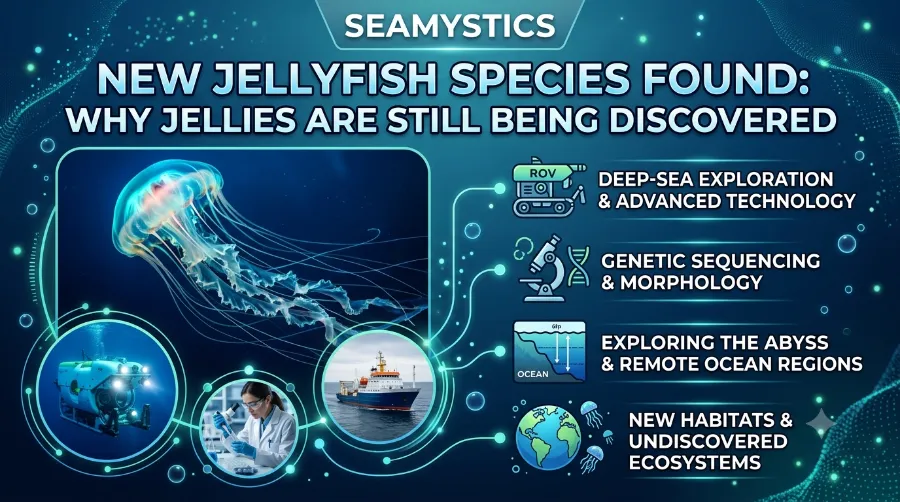
This case shows how a single unusual specimen, brought in by one observant researcher, can change the recognized species count for an entire genus.
A New Box Jellyfish Off Singapore
Box jellyfish already rank among the most dangerous animals in the ocean. The Sentosa Island discovery adds one more name to that watch list. Researchers from Tohoku University and the National University of Singapore found a key anatomical difference that set this specimen apart from its closest relatives. They named it Chironex blakangmati after the island’s historical Malay name. It became the fourth confirmed member of the Chironex genus.
A Nearly Invisible Jelly Hiding in Plain Sight
Malagazzia michelin proves that new species do not always hide in remote deep water. This small, nearly transparent jellyfish went unnoticed for years in the shallow coastal waters of Nagasaki and Yamaguchi prefectures, areas that scientists and the public visit often. Researchers needed close observation and lab-based growth tracking to confirm it was genetically distinct from its only known relative.
How Scientists Actually Find These Species
Jellyfish discovery rarely follows one single formula. A few tools and approaches, though, keep showing up across recent finds.
- DNA barcoding. A short genetic sequence works like a fingerprint. It lets researchers compare a sample against a global reference library within days instead of months.
- Remotely operated vehicles (ROVs). Underwater robots can now reach depths and pressures that are unsafe for human divers. That access opens up entire habitat zones that used to be a blind spot. Our guide to ROV-powered ocean discovery covers how these vehicles are reshaping deep-sea research.
- Citizen science and chance encounters. A surprising number of recent discoveries, including both the Japanese and Texas finds above, started when one person noticed something did not look right. Our piece on citizen science in ocean research explains how amateur observers increasingly earn co-author credit on formal species descriptions.
- Coordinated global survey efforts. Large-scale programs now search under-explored regions systematically instead of waiting for chance finds. The Ocean Census project leads one such effort, aiming to document 100,000 new marine species over the next decade through a global network of research vessels and ROVs.
Why Jellyfish Keep Slipping Past Scientists
Several factors make jellyfish uniquely hard to fully catalog, even in places researchers study often.
Look-Alike Species Hide the Real Numbers
Jellyfish within the same genus can look almost identical to the naked eye while carrying enough genetic difference to count as separate species. This holds especially true for moon jellyfish. Researchers currently recognize 28 genetically distinct moon jellyfish species worldwide, yet they have fully described the life cycle for only 13 of them. That gap between what exists and what scientists have documented explains why new jellyfish discoveries keep happening in groups researchers already thought they understood.
Shifting Ranges Create New Encounters
Range shifts add another layer of complexity. Species once confined to a specific region can turn up somewhere unexpected as ocean temperatures and currents change. Sometimes that means a well-known species is simply expanding its territory rather than evolving into something new. This pattern has shown up outside deep water too, in places people visit every summer. Along the New Jersey coast, researchers have tracked the clinging jellyfish, a species that was not historically common in the region but now appears more often in coastal bays. This closer look at clinging jellyfish in New Jersey’s coastal waters covers the shift in detail. Tracking these changes matters for public safety as much as for taxonomy, since some newly prominent species carry a painful sting.
Deep-Sea Missions Keep Adding New Names
Jellyfish research also connects to broader ocean discovery work happening right now. Ocean Census-linked missions have documented other soft-bodied deep-sea life at extreme depths. One team recorded a rare giant phantom jellyfish at roughly 820 feet using a remotely operated vehicle, an animal about the size of a large Ferris wheel. These discoveries form part of the same wave of exploration turning up new jellies, and they echo patterns seen in other marine groups. Our recent coverage of a newly identified coral species tells a similar story.
What a New Jellyfish Species Discovery Actually Means
A new name in a scientific journal might look like a small detail, but it carries real weight for ocean science.
- It helps researchers track how healthy or disrupted a given ecosystem is, since jellyfish populations often respond quickly to changes in water temperature and oxygen levels.
- It improves public safety, particularly for venomous groups like box jellyfish, where knowing the exact species in a swimming area can change how doctors treat a sting.
- It fills in gaps in the food web, since jellyfish serve as both predators and prey for a wide range of ocean animals, and undercounting species can distort broader ecological models.
- It signals how much of the ocean remains unmapped. Miglietta noted that finding a new species within such a well-studied group shows how little scientists understand about biodiversity in general, and that likely applies to many other animal groups as well.
Frequently Asked Questions
Is it common for new jellyfish species to be discovered? Yes. Researchers formally confirmed multiple new jellyfish species within just the past two years, spanning Japan, the Gulf of Mexico, Singapore, and the Philippines.
How do scientists confirm a jellyfish is a new species and not just an unusual specimen? They combine genetic sequencing with a detailed physical comparison against known relatives. The findings must also pass peer review before a name becomes official.
Are newly discovered jellyfish dangerous? Some are. The recently confirmed Chironex blakangmati belongs to the box jellyfish family, one of the most venomous groups in the ocean. Others, like the deep-water moon jellyfish Aurelia profunda, pose no threat to humans.
Why do so many new jellyfish turn up in already well-studied areas? Jellyfish within the same family frequently look nearly identical, so genetic testing often becomes the only way to tell them apart. That means look-alike species can hide in plain sight for years.
Can regular beachgoers or divers help find new species? Yes, and it has already happened. Several recent discoveries began when a student or researcher simply noticed a jellyfish that did not look right and brought it in for testing.
Conclusion
Jellyfish have drifted through the ocean for more than 500 million years, yet science is still catching up to how many kinds actually exist. The cobalt blue Physalia found near Japan, the deep-water moon jelly pulled from the Gulf of Mexico, and the newly confirmed box jellyfish off Singapore all point to the same conclusion. Jellyfish taxonomy is far from finished. Every new jellyfish species found adds another piece to a much bigger picture of ocean health. It also reminds us that even the most familiar corners of the sea can still hold something science has never named. For more on how researchers map the ocean’s remaining unknowns, explore our full new species confirmation guide.
References
- ScienceDaily, “Japan’s new ‘samurai jellyfish’ is simply stunning,” November 1, 2025
- Houston Public Media, “Galveston researchers discovered a new ‘moon’ jellyfish species in the Gulf,” April 24, 2026
- Texas Standard, “Jellyfish discovery shows how little we know about Gulf ecosystems,” April 28, 2026
- Oceanographic Magazine, “New species of deadly box jellyfish discovered in Singapore waters,” May 15, 2026
- Earth.com, “New ‘Milky Way’ jellyfish species discovered in Japanese waters,” March 4, 2026
- Bow Seat Creative Action for Conservation, “Nature’s Latest Masterpieces: The Unbelievable Life Found This Year,” March 12, 2026
- Houston Chronicle, “New jellyfish species found off the Texas Gulf Coast”
- Barnegat Bay Partnership, “A Closer Look at Clinging Jellyfish in New Jersey’s Coastal Waters”