
Picture a crab the size of a fingernail. Now picture a shrimp living inside a pitch black limestone cave, cut off from sunlight for a million years. Add a “supergiant” sea bug over a foot long, hauled up off the coast of Vietnam. None of these animals had names until very recently. That is the strange truth sitting at the heart of ocean science today. Every year, taxonomists open drawers full of unnamed specimens. Slowly and carefully, they give each new crustacean species its scientific identity, sometimes decades after the animal was first pulled from the water.
Rediscovered vs New The Difference Between a Lost Species and a New One
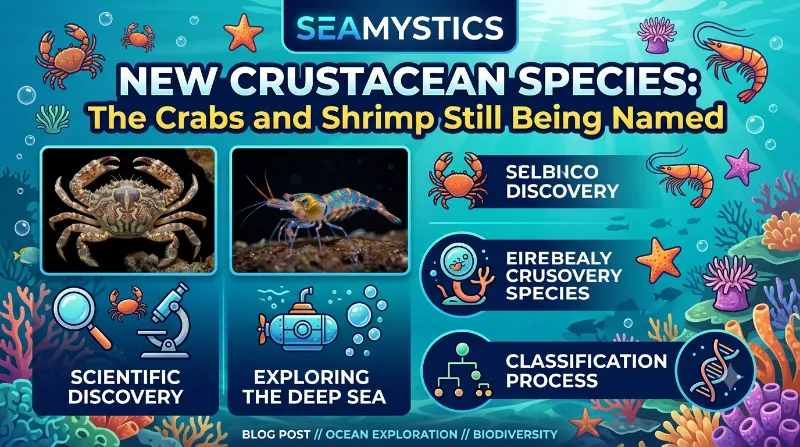
I have spent two decades around tide pools, trawl nets, and museum specimen jars. So one thing still surprises me every time: how much of the crab and shrimp world remains a blank page. This is not just a niche curiosity for scientists. It touches food webs, coastal economies, and even new medicines being developed from ocean chemistry right now.
Hybrid Ocean Species When Two Marine Animals Interbreed Naturally
Key Takeaways
| Topic | Quick Fact |
|---|---|
| New species pace | Ocean Census described 1,121 new marine species between mid-2025 and mid-2026, a 54% jump from the year before |
| Ocean explored | Scientists have directly seen less than 0.001% of the seafloor |
| Time to name a species | Formal identification and registration can take up to 13.5 years from first collection |
| Recent crab example | Researchers described a new freshwater crab genus with three new species from Vietnam in 2023 |
| Recent shrimp or isopod example | A team named a supergiant isopod, a crustacean cousin of shrimp, from Vietnam in January 2025 |
| Main discovery tools | DNA barcoding, ROV deep sea cameras, museum re-examination, and citizen science reports |
TL;DR: Scientists still name new crustacean species every year, including crabs, shrimp, and their relatives, because most of the ocean floor has never been surveyed. Groups like Ocean Census confirmed over 1,100 new marine species in a single recent year. Tools such as DNA barcoding and remotely operated vehicles now speed up how fast a new crab species or new shrimp species earns an official name.
Why So Many Crustaceans Are Still Undescribed
The ocean covers about seventy percent of the planet. Yet most of it remains a mystery to science. Researchers estimate that scientists have catalogued only around ten percent of marine life so far. That gap leaves an enormous number of undescribed crustaceans swimming, burrowing, and scuttling around without a name. This is not because nobody is looking. The ocean is simply too vast, too deep, and too hard to reach for any single team to cover.
Crustaceans make this problem even trickier. Crabs, shrimp, isopods, amphipods, and copepods often look almost identical to their close relatives. A shrimp from Florida might resemble one from the Bahamas at first glance. Yet genetically, the two can turn out to be completely separate species. This is where careful lab work, not just a quick look under a microscope, becomes essential.
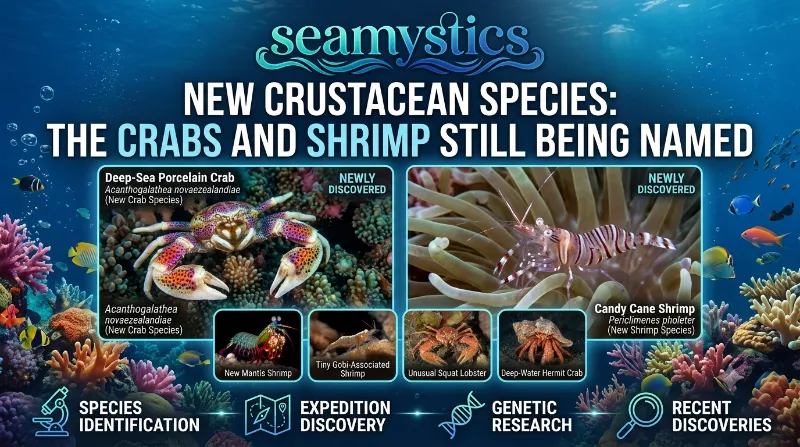
New Crustacean Species The Crabs and Shrimp Still Being Named
A built-in bottleneck also slows things down. Once a strange specimen turns up, researchers usually need to compare it against every known relative. They photograph it, measure it, and often sequence its DNA before anyone can confidently call it new. Consequently, that review process can stretch on for years before it reaches a peer reviewed journal. Our pillar guide on how new species get confirmed walks through the entire pipeline step by step.
The Deep Sea Is the Biggest Blind Spot
Depth explains most of the surprises in crustacean discovery. More than eighty percent of the ocean floor remains unmapped in any real detail. The hadal zone, meaning trenches deeper than 6,000 meters, looks especially promising for new finds. As a result, nearly every dive by a remotely operated vehicle into these zones brings back something nobody has ever catalogued.
Consider the recent haul from the Ocean Census Alliance, a partnership between the Nippon Foundation and Nekton. This effort has become one of the largest coordinated projects in the field. Across thirteen expeditions in a single year, the team confirmed 1,121 new marine species. That figure marked a 54 percent jump in annual identifications compared with the year before. Crabs and isopods made up part of that haul, alongside sea anemones, corals, and a small shark relative barely as long as a ruler.
Caves add a second layer of mystery. Subterranean and anchialine systems, meaning caves connected to the sea, tend to host isolated populations that evolve on their own for long stretches of time. Take Tetragoniceps bermudensis, a newly named copepod, or tiny crustacean, from a single cave on the island of Bermuda. Researchers first collected one egg-bearing female back in 2016. Then they spent years confirming it belonged to a brand new species. According to Nautilus magazine’s coverage of the discovery, it is the first cave-dwelling member of its genus found anywhere on Earth. Because its range is so limited, the cave itself may now need formal protection.
How Scientists Actually Confirm a New Crab or Shrimp Species
Finding a strange looking crab in a trawl net is only the start. Turning that specimen into an officially recognized new crustacean species takes fieldwork, lab science, and plenty of patience. Here is roughly how the process unfolds.
- Field collection. Researchers use traps, trawl nets, cave dives, or ROV dives in poorly studied habitats, often returning to the same site across several expeditions.
- Morphological comparison. Scientists measure the specimen and compare it against known relatives, checking shell shape, claw structure, and other physical traits under a microscope.
- Genetic sequencing. Labs extract DNA and compare it to existing genetic libraries, a method known as DNA barcoding that can catch differences invisible to the naked eye.
- Museum cross-checking. Scientists often dig through old museum collections. Improved genetic techniques regularly reveal that a specimen sitting in a jar for decades is actually a distinct, previously unnamed species.
- Peer review and publication. Researchers write up a formal species description and submit it to a taxonomic journal. Other experts then review the evidence before the name becomes official.
That last step matters more than people realize. A species is not “new” in any scientific sense until it clears peer review and receives a Latin binomial name. This is exactly why the gap between first sighting and formal naming can run so long.
DNA Barcoding Changed the Speed of Discovery
Genetic tools have quietly transformed how fast a new shrimp species or crab species can be confirmed. Before DNA barcoding became routine, taxonomists relied almost entirely on physical traits. Because of this, two crustaceans that looked alike were often assumed to be the same species, even when they were not. Now, a short genetic marker can flag a “cryptic species,” meaning one that looks identical to a known relative but is genetically distinct.
This matters for conservation too. Imagine a fishery managing what it believes is one widespread shrimp species. If genetic testing later reveals two or three separate species with different ranges and reproduction rates, the old management plan can quietly fail. Getting the naming right is not just paperwork. It protects populations that might otherwise face overfishing without anyone noticing.
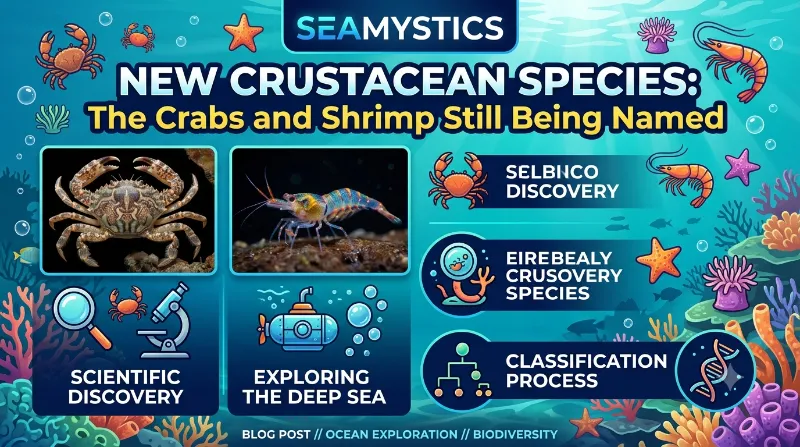
Citizen Science and ROVs Are Filling Old Gaps
Not every discovery comes from a research vessel with a huge budget. Coastal residents, recreational divers, and amateur photographers increasingly submit unusual finds through citizen science ocean programs. Surprisingly, a good number of those tips have led to formal scientific descriptions. Urban shorelines, tide pools near busy ports, and even aquarium supply chains have all produced specimens that turned out to be entirely new to science.
Meanwhile, remotely operated vehicles are opening up the deep sea in ways that were simply impossible a generation ago. These robotic subs can film, collect, and sample at depths no human diver could safely reach. Today, they are a standard tool on nearly every major Ocean Census expedition.
Real Crabs and Shrimp Recently Named
Numbers and process matter, but the actual animals are where this topic gets memorable. Below are a few concrete, dated examples of new crustacean species work from the past few years.
| Species (or group) | Type | Location | Year Confirmed | Notable Detail |
|---|---|---|---|---|
| Bathynomus supergiant isopod | Isopod, crab and shrimp relative | Off Vietnam | January 2025 | Grows over 12 inches long, nicknamed for its resemblance to a Star Wars villain |
| Booralana nickorum | Isopod | Bahamas, over 500 meters deep | 2024 | Second new isopod species found in the same long-term Exuma Sound survey since 2016 |
| Indochinamon signum and two relatives | Freshwater crab | Central and northern Vietnam | 2023 | Part of an entirely new crab genus described in one paper |
| Tetragoniceps bermudensis | Cave copepod | Bermuda’s Roadside Cave | 2025 | First cave-dwelling species ever recorded in its genus |
| Squat lobster, genus Galathea | Squat lobster (crustacean) | Nazca Ridge, near Easter Island | 2025 | First confirmed record of the genus in the southeastern Pacific |
| More than 200 isopod species | Isopods | Described at a workshop in Germany | 2025 to 2026 | Named during a single two-week taxonomy workshop |
Notice how varied the depths and habitats are here. Some of these animals came from a few hundred meters down. Others came from within a single cave chamber, or from seamounts that had barely been surveyed before. That spread gives a good snapshot of where crustacean discovery is currently happening.
Crabs Getting New Names
Crab discoveries have leaned heavily toward freshwater and shallow coastal habitats in recent years, especially across Southeast Asia. In 2023, researchers described Indochinamon signum alongside two sibling species in the Raffles Bulletin of Zoology. This case shows a pattern that keeps repeating: scientists often find not just one new crab, but an entire cluster of closely related species once they take a closer look at a region’s rivers and streams.
Coral reef habitats are producing their own share of surprises too, often alongside newly described coral and sponge species from the same expeditions. If you want to see how coral discovery compares, our guide on new coral species covers a parallel story happening in the same reef systems.
Shrimp and Their Crustacean Cousins
Shrimp discoveries tend to split into two very different worlds: shallow reef and mangrove habitats, and the pitch dark deep sea. During the 2025 to 2026 expeditions, the Ocean Census team turned up new squat lobsters, deep sea shrimp relatives, and dozens of amphipods. This group alone already contains more than 10,000 known species. Some amphipods measure barely a few millimeters long, while the largest recorded species can stretch to the size of a small loaf of bread.
One newly confirmed amphipod, Elimedon breviclunis, made headlines mostly for its unusual name, which references a distinctly short tail section. The Natural History Museum in London now holds its type specimen. There, curators are cataloguing dozens of similar finds pulled from recent deep sea expeditions.
What Undescribed Crustaceans Tell Us About Ocean Health
Every undescribed crustacean sitting in a museum drawer represents a gap in what scientists know about ocean biodiversity. That gap matters for practical reasons, not just academic ones. Fisheries management, pollution monitoring, and climate adaptation planning all depend on knowing what species exist, where they live, and how sensitive they are to change.
Take the Bermuda cave copepod again. Researchers found only a single individual, so they could not confidently estimate the population’s size or range. Still, that same rarity is exactly why officials have flagged the cave habitat for protection. Pollution, sediment disturbance, and unauthorized access could wipe out a species before anyone even finishes studying it. A similar pattern shows up with newly described jellyfish. Our new jellyfish species guide explores how fragile, poorly known habitats keep producing these single-record finds.
A genuine urgency runs underneath all of this. Some taxonomists estimate that formally registering a new species can take up to 13.5 years from first collection to a published name. During that long gap, a species could theoretically go extinct before anyone officially records that it ever existed. That is partly why large scale, coordinated efforts matter so much right now. Our Ocean Census project guide tracks this work in more detail.
Recent Discovery Numbers at a Glance
The pace of ocean species discovery has been climbing steadily, and crustaceans make up a consistent share of that total. The table below reflects publicly reported totals from the Ocean Census Alliance across its recent expedition cycles.
| Reporting Period | New Marine Species Confirmed | Expeditions Involved |
|---|---|---|
| Year 1 (2023 to 2024) | Over 800 | Multiple global sites |
| Year 2 (2024 to 2025) | 866 | Coordinated with regional museums |
| Year 3 (mid-2025 to mid-2026) | 1,121 | 13 expeditions worldwide |
That climb from roughly 800 to over 1,100 species across three annual cycles is not just a coincidence of extra funding. Better genetic tools, wider ROV access to deep water, and a growing citizen science network are all compounding at once. This is exactly why the new crustacean species story keeps producing fresh headlines instead of slowing down.
Frequently Asked Questions
How many new crustacean species are discovered each year? The number varies, but recent Ocean Census reporting confirmed 1,121 new marine species in one twelve month cycle. Crabs, shrimp, isopods, and amphipods made up a meaningful share of that total.
Why does it take so long to officially name a new crab or shrimp species? Formal description requires physical comparison, often DNA sequencing, and peer reviewed publication. Taxonomists say the full process can stretch past a decade from first collection to an accepted scientific name.
Are new crustacean species mostly found in the deep sea? Many recent headline finds come from deep water, since over eighty percent of the seafloor remains unmapped. However, shallow reefs, mangroves, caves, and even freshwater rivers continue to produce new species too.
Can regular divers or beachgoers help discover a new species? Yes. Citizen science reporting has contributed to several confirmed discoveries, especially in coastal areas that professional survey teams rarely visit as often as recreational divers do.
What is the difference between a new species and a cryptic species? A cryptic species looks nearly identical to an already known relative, but it is genetically distinct. DNA barcoding usually reveals the difference that a visual inspection alone would miss.
Conclusion
The ocean keeps handing scientists new crabs, new shrimp, and countless unnamed relatives every year, and that pace shows no sign of slowing down. From a cave in Bermuda to a seamount near Easter Island, each confirmed discovery adds one more piece to a puzzle that is far from finished. What makes this moment genuinely exciting is the combination of tools now available, from DNA barcoding to ROV dives to ordinary people reporting strange finds on a beach walk. Somewhere, the next new crustacean species may already be sitting in a specimen jar, simply waiting for someone to take a closer look.
References
- Oceana, “5 Species From 2025: Meet Some of the Newest Discovered Ocean Creatures,” oceana.org
- Popular Science, “New crustacean named after its unique butt”
- Nautilus, “Meet a Newly Discovered Cave Crustacean”
- Association of American Universities, “New Deep-Sea Crustacean Discovered in Bahamas”
- Ocean Census, Year 3 Impact Report, oceancensus.org
- Scientific American, “Ocean Census Reveals More Than 1,100 New Species”
- Ng, P.K.L. & Tri, N.V. (2023), “A new genus and three new species of freshwater crab,” Raffles Bulletin of Zoology