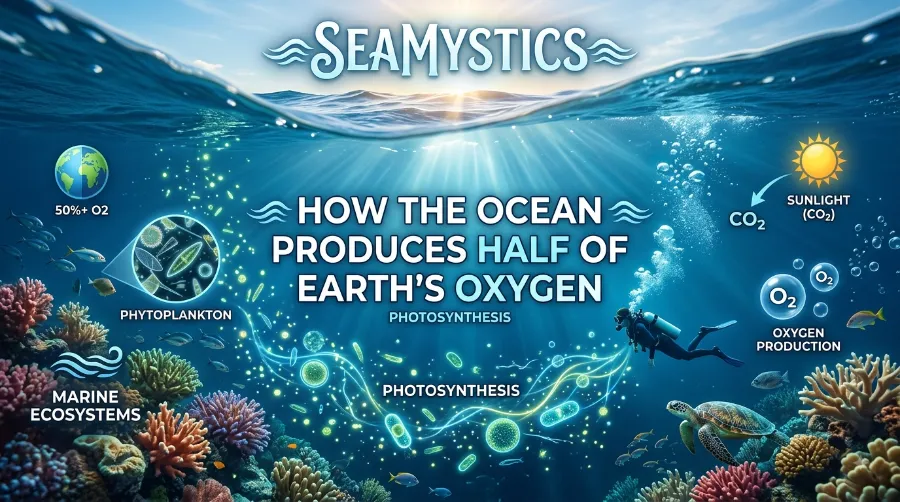

Take a breath right now. That air probably did not come from a forest. It came from the sea. Ocean oxygen production is one of the most overlooked facts in earth science. Yet it decides whether land creatures, including you, get to breathe at all. Most people picture the Amazon as the planet’s lungs. The ocean actually does far more of that work, and it has done so for hundreds of millions of years.
Ocean Pressure Explained What Happens to the Human Body at Depth
I have studied marine ecosystems for two decades. One question still surprises people the most: how much oxygen does the ocean actually make compared to trees? The honest answer changes how you see the water covering seventy one percent of this planet.
TL;DR: The ocean produces roughly fifty to eighty percent of the oxygen in Earth’s atmosphere. Tiny marine plants called phytoplankton do most of the work, not seaweed or coral. NOAA and NASA both put the figure at a minimum of fifty percent, and one species called Prochlorococcus alone supplies up to twenty percent of the oxygen humans breathe. New 2024 research even found oxygen forming in total darkness on the deep seafloor.
Key Takeaway Table
| Ocean Oxygen Fact | Data Point | Source |
|---|---|---|
| Share of Earth’s oxygen from the ocean | 50% to 80% | NOAA, NASA |
| Oxygen from Prochlorococcus bacteria alone | 5% to 20% | Woods Hole Oceanographic Institution |
| Oxygen from diatoms (1 in every 5 breaths) | About 20% | WHOI Ocean Learning Hub |
| Ocean surface coverage of Earth | 71% | NOAA |
| Depth of the sunlit “photic zone” | 200 meters (656 feet) | NOAA / Geography Realm |
| Depth where “dark oxygen” was found | 13,000 feet | Nature Geoscience, 2024 |
What Percentage of Oxygen Does the Ocean Produce?
Scientists generally agree on one number. The ocean produces at least half of the oxygen in Earth’s atmosphere. NOAA’s Ocean Service traces roughly half of all oxygen production back to the sea. Most of that credit goes to drifting plankton, not fish, whales, or coral reefs. NASA researchers set the figure even higher. They note that phytoplankton have produced at least fifty percent of atmospheric oxygen over time. Some studies push the estimate as high as eighty five percent.
That uncertainty has a simple cause. Counting trees on land is already hard. Counting microscopic organisms across 139 million square miles of open ocean is harder still. Phytoplankton populations rise and fall with the seasons, water temperature, and nutrient levels. Satellites and research vessels constantly recalculate the number as a result. Every major research body, from NOAA to NASA to Woods Hole Oceanographic Institution, agrees on the core point. Ocean oxygen production keeps land life running.
Underwater Sound Travel How Sound Moves Through the Ocean Compared to Air
This is why the claim “the ocean produces half of Earth’s oxygen” shows up so often in classrooms and documentaries. It is not an exaggeration. The Smithsonian’s Ocean Portal puts it simply: nearly every breath a person takes owes something to the sea. Tiny marine organisms have run Earth’s oxygen factory since long before the first tree grew.
What Causes Red Tide The Science Behind Toxic Algae Blooms
Phytoplankton Oxygen Facts You Probably Never Learned in School
Phytoplankton are single celled, plant like organisms that float near the ocean surface. They photosynthesize using sunlight, just like grass or trees do on land. Most of them live in the photic zone, the upper 200 meters where sunlight still reaches. They are invisible to the naked eye individually, yet they anchor nearly every marine food chain. In the process, they release enormous volumes of oxygen into the atmosphere.
How Much Water Is Actually in the Ocean?
I once watched a plankton bloom off the California coast turn miles of water a strange milky green almost overnight. It looked unremarkable from the surface. Yet a single teaspoon of that water likely held millions of individual cells. That scale explains why these organisms matter so much for ocean oxygen production.
How Light Behaves Underwater The Science of Ocean Color Zones
Prochlorococcus: The Smallest Organism With the Biggest Job
Prochlorococcus is a type of cyanobacteria. MIT researcher Sallie W. Chisholm first identified it in 1986. It may be the most important organism most people have never heard of. Roughly 20,000 cells could fit inside a single drop of seawater. Scientists estimate about 3 billion billion billion of these cells live across the world’s oceans. Together, this one bacterium produces somewhere between five and twenty percent of all the oxygen humans breathe. Both Woods Hole Oceanographic Institution and NOAA confirm that range.
Ocean Freezing Point Explained Why the Sea Freezes Differently Than Fresh Water
Diatoms and the “One in Five Breaths” Statistic
Diatoms make up another major contributor. They build delicate, glass like shells around themselves as they grow. Woods Hole researchers estimate diatoms alone account for roughly one in every five human breaths. That works out to about twenty percent of atmospheric oxygen. Diatoms tend to bloom in colder, nutrient rich waters. Coastal regions like the North Atlantic and the Southern Ocean often show dramatic seasonal blooms because of this, visible even from space.
What Is Thermohaline Ocean Circulation? Earth’s Global Conveyor Belt Explained
How Ocean Photosynthesis Actually Works
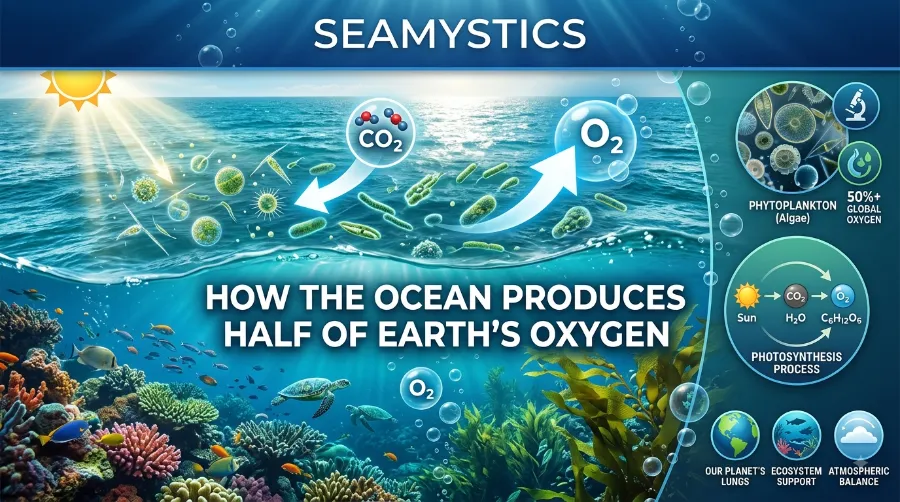
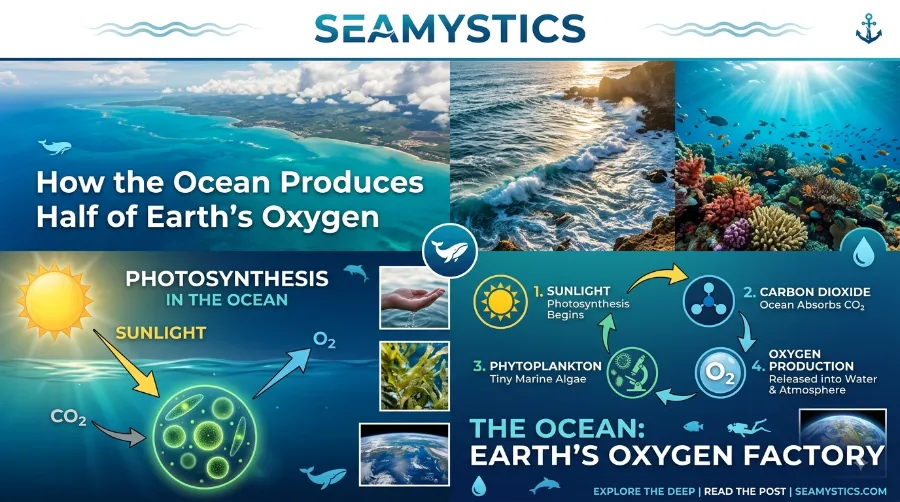
Here is a simplified breakdown of how phytoplankton convert sunlight into breathable oxygen:
- Phytoplankton absorb sunlight and carbon dioxide near the ocean’s surface.
- Chlorophyll inside their cells converts that light into chemical energy.
- This process splits water molecules apart and releases oxygen as a byproduct.
- The oxygen dissolves into seawater and later diffuses into the atmosphere.
- Meanwhile, the captured carbon feeds zooplankton, fish, and eventually larger predators.
This cycle repeats constantly across the entire sunlit layer of the ocean. That is why phytoplankton oxygen facts keep surprising people who assumed rainforests carried this job alone.
Ocean Atmosphere Oxygen Exchange: Why Trees Are Not the Main Story
Land plants get most of the credit for oxygen production. Forests are visible, and phytoplankton are not. But Woods Hole research tells a different story. Earth’s atmosphere held less than five percent oxygen until roughly 600 million years ago. Land plants did not even exist until about 470 million years ago. That timeline confirms the ocean started this process, not forests.
Why the Ocean Has Waves The Real Science Explained
Today, ocean atmosphere oxygen exchange still works both ways. Marine animals consume oxygen to breathe. Decomposing organic matter uses it too. A large share of what phytoplankton produce gets reabsorbed inside the ocean itself. NOAA notes that the ocean produces at least half of Earth’s oxygen, but marine life consumes a similar amount. That balance makes the net atmospheric contribution harder to calculate than it first appears.
That balance is shifting now. A 2018 assessment by the Global Ocean Oxygen Network found ocean oxygen levels dropped roughly two percent since the 1960s. Warmer water holds less dissolved oxygen, and nutrient runoff triggers oxygen depleting algal blooms. Both factors drive that decline. The Gulf of Mexico’s well documented dead zone shows the result. It regularly expands past 6,000 square miles each summer.
How Scientists Measure Ocean Depth Today
Real World Examples of Ocean Oxygen Production in Action
Numbers on a page can feel abstract. These documented cases show ocean oxygen production at work, in both healthy and stressed systems.
- In 2011, a Southern Ocean phytoplankton bloom stretched across hundreds of miles. NASA satellite imagery tracked the entire event. It showed how one seasonal bloom can visibly change ocean color and oxygen output.
- During Florida’s 2023 red tide events, the algae Karenia brevis caused mass fish die offs. The same organisms that produce oxygen can strip it from the water once they die in large numbers.
- The Baltic Sea now holds one of the largest human caused dead zones on Earth. Long term monitoring puts hypoxic waters there at roughly 60,000 square kilometers.
- Off Peru and Chile, the Humboldt Current supports one of the most productive phytoplankton regions on the planet. Upwelling currents deliver nutrients straight into the photic zone. Fisheries there supply roughly ten percent of the world’s wild fish catch as a result.
These examples matter for one reason. Ocean oxygen production is not a fixed number sitting in a textbook. It rises and falls with real events happening right now along coasts in the United States, Europe, and beyond.
Dark Oxygen: The Discovery That Rewrote the Rules
Marine biologists once assumed all natural oxygen came from photosynthesis, meaning it required sunlight. That assumption cracked in July 2024. Researcher Andrew Sweetman of the Scottish Association for Marine Science published new findings in Nature Geoscience. Working with Northwestern University chemist Franz Geiger, he described oxygen forming on the seafloor at roughly 13,000 feet. No sunlight reaches that depth.
Sweetman’s team recorded strange oxygen readings for about ten years during Pacific Ocean fieldwork. They eventually confirmed the pattern was real, not sensor error. Their leading theory points to polymetallic nodules acting like natural geobatteries, as the Smithsonian Ocean Portal explains. These potato sized mineral clusters may generate enough electrical charge to split seawater molecules through electrolysis. That process releases oxygen without any sunlight at all.
Eco Magazine reported that this finding challenges long held assumptions about how Earth’s oxygen forms. It also raises fresh questions about where early aerobic life may have first appeared. The scientific community is still debating the result. Nature Geoscience added an editorial note in 2026 flagging that parts of the methodology remain under review. That kind of scrutiny is a normal, healthy part of testing new science. The broader question still stands, and it connects directly to research on deep ocean life in low oxygen zones, where scientists study how organisms survive with almost no oxygen at all.
Threats to Ocean Oxygen Production
The ocean’s oxygen output is not guaranteed to stay stable. Several pressures work against it right now. A decline in ocean oxygen production would ripple through the entire planet, not just marine ecosystems.
- Rising sea surface temperatures reduce how much oxygen seawater can hold, since warm water dissolves gases less efficiently than cool water.
- Fertilizer runoff feeds explosive algal blooms. These blooms later die and decompose, consuming large amounts of dissolved oxygen.
- Ocean acidification, driven by rising atmospheric carbon dioxide, can limit how efficiently phytoplankton photosynthesize over time.
- Marine heatwaves disrupt normal growth cycles and shift entire food webs. The “Blob” event lasted from 2014 to 2016 in the North Pacific, and a milder version returned in 2023.
- Deep sea mining interest in polymetallic nodules could disturb an oxygen source scientists are only beginning to understand.
These pressures compound each other. That is part of why marine scientists now treat ocean health monitoring as seriously as climate monitoring on land. Our ocean acidification explainer breaks down the chemistry behind these threats in plain language, for readers who want more depth.
Why This Matters Even If You Live Far From the Coast
Ocean oxygen production might seem like a coastal concern only. That assumption misses the bigger picture. Atmospheric oxygen mixes globally within days to weeks. Oxygen produced off the coast of Chile can reach the air over Kansas or central Germany not long after. Everyone on this planet benefits from ocean oxygen production, no matter how far inland they live.
That fact reshapes how policymakers think about marine conservation. It increasingly gets framed as climate policy, not a separate category. Protecting phytoplankton habitats, cutting nutrient pollution, and limiting ocean warming all support the same mechanism. That mechanism keeps breathable air available for every land based creature on Earth. Our guide on everyday actions that support ocean health covers realistic steps for readers across the United States and Europe.
Frequently Asked Questions
Does the ocean really produce half of Earth’s oxygen?
Yes. NOAA and NASA both confirm the ocean produces at least fifty percent of atmospheric oxygen. Some estimates reach as high as eighty percent, depending on the study and time period measured.
What produces most of the ocean’s oxygen, plants or plankton?
Phytoplankton do, not seaweed or coral. They carry out photosynthesis across enormous stretches of open ocean, far beyond coastal zones.
Can the ocean run out of oxygen?
The ocean will not run out of oxygen entirely. Specific regions already suffer serious oxygen depletion, though, and global ocean oxygen levels have measurably declined since the 1960s due to warming and pollution.
What is dark oxygen, and is it confirmed?
Dark oxygen refers to oxygen apparently produced on the deep seafloor without sunlight. Researchers discovered it in 2024 while studying polymetallic nodules. The finding is significant, but scientists are still scrutinizing parts of it as of 2026.
Do people living far from the ocean still breathe ocean oxygen?
Yes. Atmospheric oxygen circulates globally within weeks. Oxygen generated by ocean phytoplankton reaches inland regions across the United States, Europe, and everywhere else on Earth.
Conclusion
The ocean does not just cover most of this planet. It actively keeps that planet breathable, and that fact deserves more attention than it usually gets. Nearly invisible Prochlorococcus bacteria and newly discovered dark oxygen both show how much marine systems still have to teach us. Protecting phytoplankton habitats is not just a marine biology concern. It is a direct investment in the air every person on Earth depends on. Visit Sea Mystics for more research backed marine science explainers, and see how ocean health connects to everyday life above the waterline.
References
- NOAA Ocean Service, “How much oxygen comes from the ocean?” oceanservice.noaa.gov
- NASA Science, “Oxygen Factories in the Southern Ocean,” science.nasa.gov
- Woods Hole Oceanographic Institution, “Does the ocean produce oxygen?” whoi.edu
- Smithsonian Ocean Portal, “Every Breath You Take, Thank the Ocean,” ocean.si.edu
- Sweetman et al., “Evidence of dark oxygen production at the abyssal seafloor,” Nature Geoscience, 2024
- Northwestern University News, “Deep-ocean floor produces its own dark oxygen,” news.northwestern.edu, 2024
- Eco Magazine, “The Deep Ocean Floor Produces Its Own Oxygen,” ecomagazine.com
- American Scientist, “Deep Ocean Life Where Oxygen Is Scarce,” americanscientist.org
- Global Ocean Oxygen Network (GO2NE), IUCN ocean deoxygenation assessment, 2018