
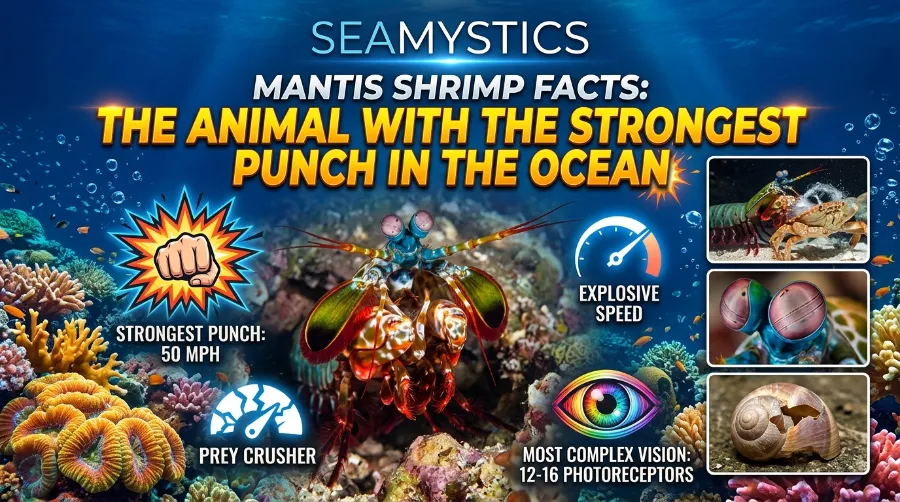

Drop a mantis shrimp into a boxing ring. It could knock out most opponents before the bell finishes ringing. That is not an exaggeration. Among the many mantis shrimp facts marine biologists have uncovered, one stands out. This small reef creature throws a punch fast enough to boil water. It hits hard enough to crack aquarium glass. It is one of the strongest ocean animal candidates, pound for pound. Its story does not stop at brute force. Its eyes, its colors, and its hunting style are just as strange. All of it is backed by real research.
TL;DR: The mantis shrimp punches with a force close to a .22 caliber bullet. It strikes at speeds up to 23 meters per second, using a club that shields itself from its own shockwave. Its eyes carry up to 16 photoreceptors, compared to a human’s three. Its shell can flash some of the brightest colors in the ocean.
Key Takeaways
| Fact Category | What Science Shows |
|---|---|
| Mantis shrimp punch speed | Up to 23 meters per second (75 feet per second) |
| Punch force | Comparable to a .22 caliber bullet, around 1,500 newtons |
| Mantis shrimp eyes | Up to 16 photoreceptor types, versus 3 in humans |
| Species count | Over 400 known species worldwide |
| Habitat | Warm, shallow reefs across the Indian and Pacific Oceans |
| Lifespan | Some species live 20 years or longer in the wild |
| Latest research | Northwestern University study on club shock protection, published in Science, February 2025 |
What Is a Mantis Shrimp
A mantis shrimp is not actually a shrimp. It belongs to a separate crustacean group called Stomatopoda. This group split off from other crustaceans roughly 400 million years ago. Because of this, it shares more with lobsters and crabs than with dinner-plate shrimp. There are over 400 recognized species. Most live in warm, shallow coastal waters across the Indian and Pacific Oceans.
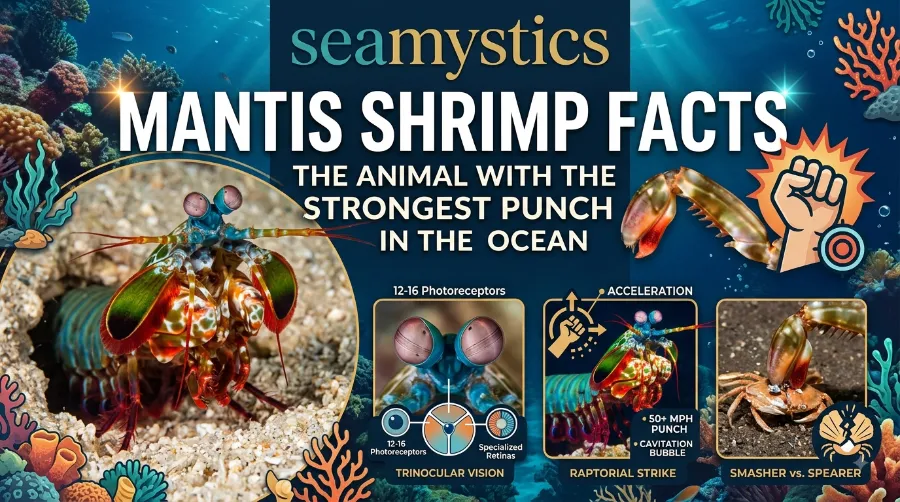
Most mantis shrimp fall into one of two hunting styles. Spearers use sharp, barbed limbs to stab soft prey like fish and worms. Smashers use blunt, club shaped limbs instead. They shatter the shells of crabs, snails, and clams. It is the smashers, especially the peacock mantis shrimp, Odontodactylus scyllarus, that made this animal famous for its punch.
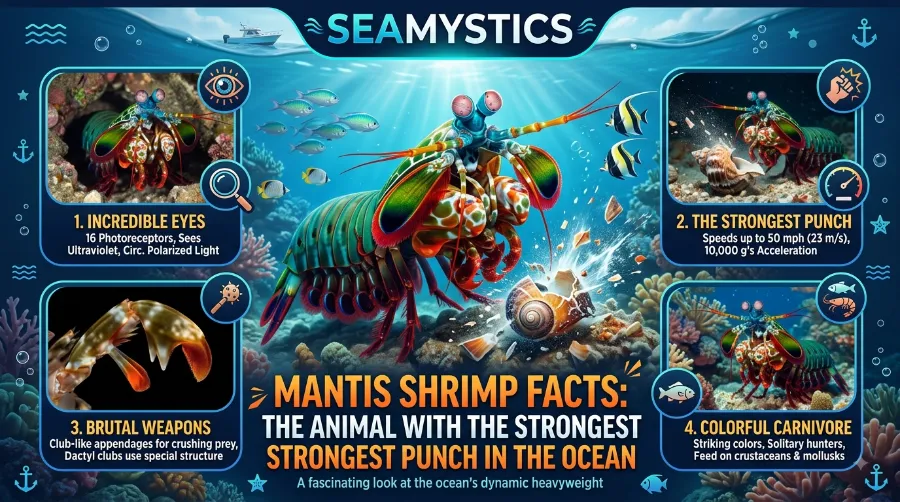
Most species measure just one to seven inches long. Yet mantis shrimp are territorial and confident. Many dig burrows in sand or coral rubble. They defend that burrow against animals many times their size, including octopuses. This mix of small body and outsized aggression explains why the punch draws so much research attention.
Mantis Shrimp Punch: The Strongest Strike in the Ocean
The mantis shrimp punch is the fact most people remember about this animal. There is good reason for that. When a smasher strikes, its dactyl club accelerates fast. It reaches roughly 23 meters per second in under three milliseconds. That speed rivals a fired bullet. It is about 50 times faster than a human blink.
How Fast and How Hard Is the Punch
Researchers measured the peacock mantis shrimp’s strike force at around 1,500 newtons. The animal itself weighs barely more than a pound and a half. For comparison, that force roughly matches the muzzle energy of a .22 caliber bullet. It comes from a fist smaller than a human thumb. Scale that force to human body weight, and a person swinging with equal relative power could punch through a steel wall.
The strike is fast enough to do something unusual. It boils the water around it. This happens through cavitation. As the club slices through water at extreme speed, it creates a zone of low pressure. Tiny vapor bubbles form in that zone. When those bubbles collapse a fraction of a second later, they release a second shockwave. A brief flash of light appears too. This effect is more commonly seen from boat propellers than living animals.
- The initial strike delivers direct mechanical force to the target.
- The cavitation bubble collapse delivers a second, almost simultaneous shockwave.
- Together, these two impacts can crack snail shells, crab exoskeletons, and even aquarium glass.
The Phononic Shield: How the Shrimp Survives Its Own Punch
For years, one question stayed open in mantis shrimp research. It was not how the animal hits so hard. It was how it avoids destroying its own limb in the process. A team led by Horacio Espinosa at Northwestern University found the answer. Their study appeared in the journal Science on February 6, 2025. Using ultrasonic laser testing, the team examined the dactyl club’s inner structure. They found a layered microstructure that works like a noise canceling barrier. It is built from solid mineral and protein rather than electronics. Researchers call this a phononic shield. It filters out the high frequency shear waves that would otherwise damage the shrimp’s own tissue.
The club’s outer layer is coated in hydroxyapatite. This is the same mineral found in human tooth enamel. It lets forward striking energy pass through toward the prey. At the same time, it resists cracks. Beneath that layer sits a twisted, plywood like arrangement of fibers, known as a Bouligand structure. This structure scatters and absorbs dangerous frequencies before they can travel back into the shrimp’s arm. Nature’s coverage of the same paper noted an earlier version had placed this structure in the wrong layer. A correction published February 10, 2025 confirmed it sits in the innermost layer instead.
This discovery matters well beyond marine biology. Engineers at institutions including UC Riverside have already studied the club’s design. They are using it as a blueprint for impact resistant helmets, body armor, and vehicle materials. A structure that survives repeated bullet level force without cracking has obvious uses on land too.
Mantis Shrimp Eyes: The Most Complex Vision System in the Animal Kingdom
The punch makes headlines. Mantis shrimp eyes keep vision scientists up at night. Humans see color using three types of photoreceptor cells, called cones. These are tuned to red, green, and blue light. Mantis shrimp carry between 12 and 16 photoreceptor types, depending on species. These are arranged in specialized rows along the middle of each compound eye.
| Trait | Human Eye | Mantis Shrimp Eye |
|---|---|---|
| Color photoreceptor types | 3 | Up to 16 |
| Detects UV light | No | Yes |
| Detects polarized light | No | Yes, including circularly polarized light |
| Eye movement | Fixed pair, both eyes work together | Each eye moves independently and can judge depth alone |
| Wavelength range detected | Roughly 400 to 700 nanometers | Roughly 300 to 750 nanometers |
Each eye divides into regions. A specialized midband strip runs through six rows of ommatidia. Rows one through four detect color across the UV and visible spectrum. Rows five and six detect polarized light instead. Almost no other animal can perceive polarized light this way. Mantis shrimp are the only known species that can detect circularly polarized light specifically.
More receptors do not always mean better color discrimination. A study published in Science in January 2014, led by Hanne Thoen, tested this directly. It found mantis shrimp are actually slower and less accurate than humans at spotting subtle color differences. A more recent 2025 study in the Journal of Experimental Biology offers one explanation. Researchers at the University of Queensland suggest the eyes work like a fast built-in scanner. They sort light into broad color categories almost instantly. This trades fine precision for speed. That tradeoff fits an animal whose survival depends on split second decisions.
Mantis Shrimp Colors: A Living Rainbow on the Reef
Mantis shrimp colors are hard to overstate. The peacock mantis shrimp alone displays electric blue, orange, red, and green across its body. The shine and texture look almost engineered. These colors are not just decoration. Scientists believe they serve several purposes. These include species recognition, territorial signaling, and attracting mates.
Mantis shrimp eyes can detect polarized light. Because of this, some of their coloration is only fully visible to other mantis shrimp. This works similarly to how a bird’s UV markings stay invisible to humans but obvious to another bird. Hidden signaling shows up elsewhere in the ocean too. Species covered in our guide to nudibranch color facts use bright coloration as a warning signal rather than camouflage. Comparing the two strategies helps explain why the ocean produces so many different approaches to color.
Camouflage focused animals take the opposite route. Our ocean animal camouflage guide breaks down strategies used by cuttlefish, octopuses, and flatfish. These species rely on blending in rather than standing out.
Is the Mantis Shrimp the Strongest Ocean Animal?
Calling any single species the strongest ocean animal depends on how you define strength. If the measure is raw punching force relative to body size, researchers widely cite the mantis shrimp as the record holder. It delivers the fastest self powered strike among all animals. If the measure is absolute crushing force, a few other predators come close or exceed it in different ways.
- Mantis shrimp: roughly 1,500 newtons of strike force from an animal under two pounds, delivered in milliseconds.
- Alpheid pistol shrimp: produces a cavitation bubble louder than most gunshots, though with far less physical force than the mantis shrimp punch.
- Saltwater crocodile: the strongest bite force of any living animal measured, at over 3,700 pounds per square inch, from a much larger, slower moving animal.
- Sperm whale: among the largest predators on Earth, generating force through sheer mass rather than speed.
What sets the mantis shrimp apart is efficiency. No other animal converts such a small amount of muscle mass into that much acceleration. That is exactly why engineers and physicists keep returning to it as a model system.
Where Mantis Shrimp Live and How They Hunt
Mantis shrimp favor warm, shallow water. This includes coral reefs, rocky crevices, and sandy or muddy burrows across the Indian and Pacific Oceans. Some species also appear in the Mediterranean and Atlantic. They are ambush predators for the most part. They stay close to a burrow entrance and wait for prey. Crabs, snails, worms, and small fish are common targets.
Aggression in the Wild and in Aquariums
Aquarium keepers know this aggression well. Smasher species sometimes arrive as accidental hitchhikers on live rock. Later, they crack the tank glass or kill other inhabitants. This is not folklore. Owners have reported cracked glass from mantis shrimp strikes for decades. The force involved lines up with the lab measurements described earlier in this guide.
Predator avoidance matters just as much as hunting for these animals. Many reef species rely on hiding rather than fighting. The mimic octopus impersonates other, more dangerous animals to avoid being eaten. The stonefish relies on venom and stillness instead of speed. Mantis shrimp take a third path. They rely on overwhelming, disproportionate force to deter or destroy anything that gets too close.
Mantis Shrimp Facts You Probably Did Not Know
- Mantis shrimp are older than dinosaurs, with fossil evidence for stomatopod ancestors dating back hundreds of millions of years.
- Some species form long term pair bonds and share a burrow with the same partner for years.
- A strike happens so fast that cameras recording thousands of frames per second are needed to capture it clearly.
- The flash of light from bubble collapse during a strike is called sonoluminescence, a physics effect also studied using sound waves in water.
- Peacock mantis shrimp have been documented taking down prey much larger than themselves, including small octopuses.
- Despite the power of each strike, mantis shrimp clubs show almost no visible wear after thousands of hits.
For more on small ocean animals defending outsized territory, see our guides on sea cucumber facts and clownfish behavior.
Frequently Asked Questions
Can a mantis shrimp punch break a human bone?
There is no confirmed scientific record of this happening. Divers and aquarium keepers have reported painful cuts and bruises from accidental strikes, so caution is generally recommended.
How strong is a mantis shrimp punch compared to a human punch?
Scaled to body weight, a mantis shrimp strike vastly outperforms a human punch. It delivers force roughly equal to a small caliber bullet, from an animal weighing under two pounds.
Why do mantis shrimp have so many photoreceptors if they see fewer colors than humans?
Research suggests the extra photoreceptors allow rapid color categorization rather than fine discrimination. This may help the animal make split second decisions while hunting or defending territory.
Are mantis shrimp dangerous to keep in a home aquarium?
Smasher species can crack standard aquarium glass and kill tankmates. They generally need specialized, reinforced tanks if kept intentionally.
What is the difference between a spearer and a smasher mantis shrimp?
Spearers use sharp, barbed limbs to stab soft bodied prey. Smashers use blunt, club shaped limbs to shatter hard shelled prey like crabs and snails.
Conclusion
This animal packs a punch that rivals a bullet. It sees the world through eyes built like nothing else in nature. Its shell wears colors most animals cannot even perceive. These mantis shrimp facts show why the species keeps drawing research funding decades after it was first studied. Size has very little to do with capability in the ocean. Some of the most advanced biological engineering on the planet fits inside a creature small enough to hide in the palm of your hand.
References
- Alderete, N. A., Sandeep, S., Raetz, S., Asgari, M., Abi Ghanem, M., and Espinosa, H. D. Science, 387, 659 to 666, 2025.
- Nature, “Mantis shrimp have the world’s fastest punch, here’s how their limbs survive,” February 2025, https://www.nature.com/articles/d41586-025-00386-8
- American Museum of Natural History, “Peacock Mantis Shrimp Facts,” https://www.amnh.org/explore/news-blogs/peacock-mantis-shrimp-facts
- Thoen, H. H., How, M. J., Chiou, T. H., and Marshall, J. Science, January 2014.
- Wang, C. J. and Marshall, N. J. Journal of Experimental Biology, 2025, https://www.ncbi.nlm.nih.gov/pmc/articles/PMC11744319/