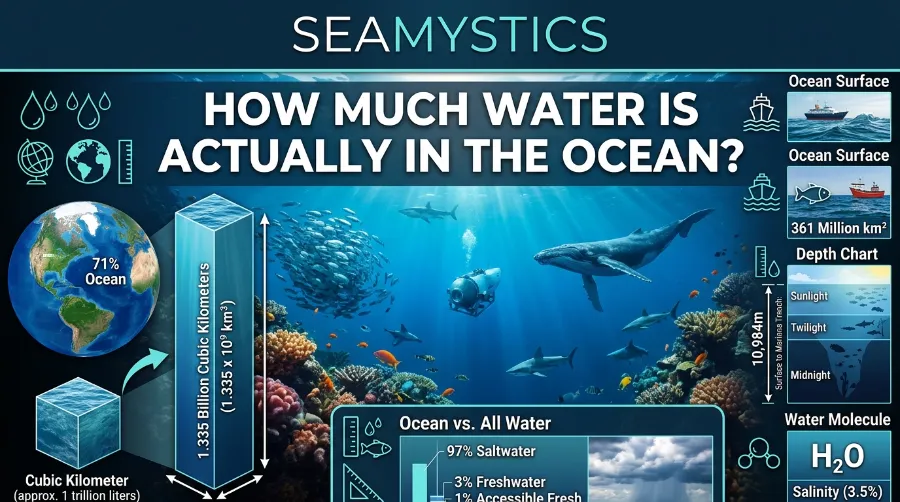

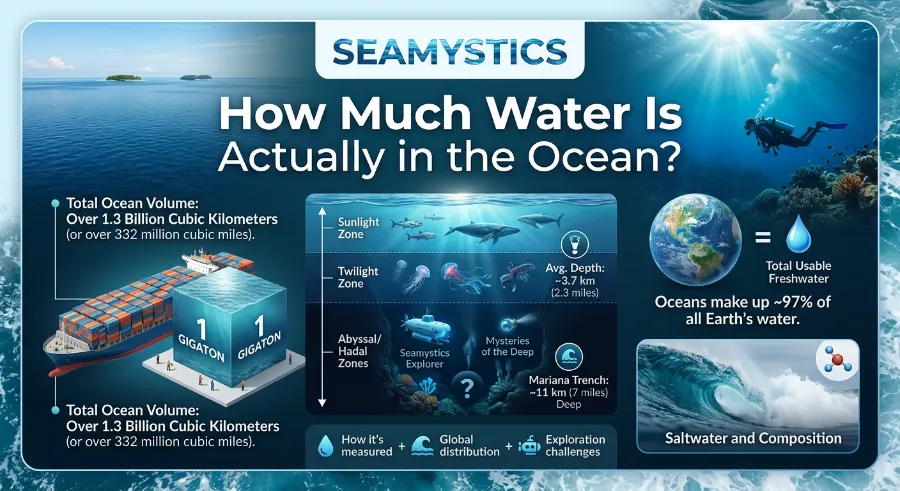
Stand on any beach from Miami to Marseille and the ocean looks endless. That feeling is not far off. Scientists put the total ocean volume at roughly 1.335 billion cubic kilometers of water. That number is so large that most calculators struggle to show it in full.
What Is Thermohaline Ocean Circulation? Earth’s Global Conveyor Belt Explained
Still, few people know how researchers reached that figure. Even fewer know why it shifts slightly every decade. This guide breaks down the ocean water volume in plain language. It draws on data from NASA, NOAA, and independent marine research. Along the way, real numbers and field notes will help the total seawater amount feel less abstract.
Key Takeaways
| Fact | Figure |
|---|---|
| Total ocean volume | About 1.335 billion cubic km |
| Share of Earth’s total water | Roughly 97 percent |
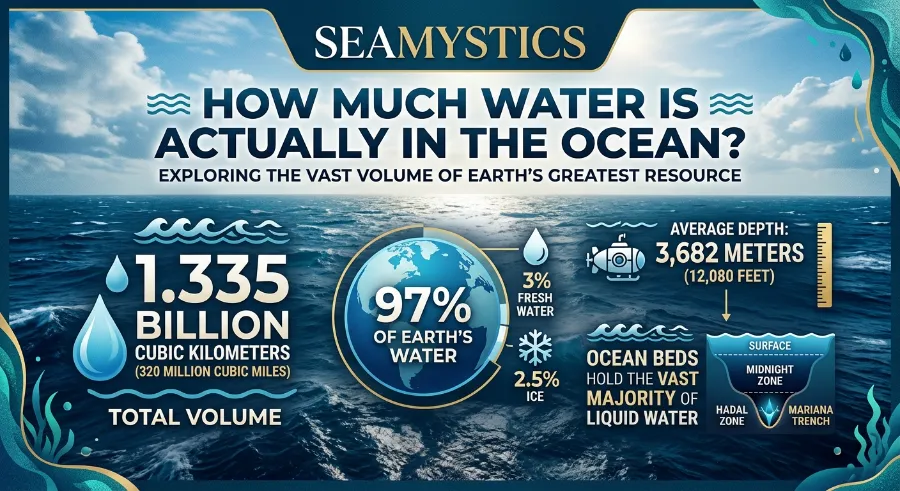
| Average ocean depth | About 3,682 meters (12,080 feet) |
| Deepest known point | Challenger Deep, Mariana Trench, near 10,935 meters |
| Largest ocean by volume | Pacific Ocean, near 660 million cubic km |
| Smallest ocean by volume | Arctic Ocean, near 18 million cubic km |
TL;DR: The ocean holds close to 1.335 billion cubic kilometers of water. That is about 97 percent of all water on Earth. Scientists measure it using satellites, sonar, and seafloor surveys, and the Pacific alone holds nearly half the total.
What Does Total Ocean Volume Actually Mean?
Total ocean volume means the combined amount of seawater across every ocean basin. This includes shallow shelves and trenches deeper than Mount Everest is tall. It is not the same as surface area, though. Two oceans can share a similar surface size yet hold very different amounts of water underneath.
Depth and the shape of the seafloor both shape the final number. Researchers combine seafloor maps, called bathymetric data, with satellite surface readings. The process sounds simple, but the seafloor is far from flat. That is exactly why the figure has changed more than once in the past fifty years.
According to the GEBCO seafloor mapping project, less than a quarter of the global ocean floor had high resolution mapping a few years ago. Even so, that share keeps growing each year through international mapping efforts.
How Much Water Is There in the Ocean, Really?
Most textbooks still quote a range of 1.3 to 1.4 billion cubic kilometers. That range still holds up fairly well today. In 2010, researchers at the Woods Hole Oceanographic Institution ran a major audit. They used satellite gravity data and landed on 1.332 billion cubic kilometers, slightly lower than older estimates from the 1970s.
What Causes Red Tide The Science Behind Toxic Algae Blooms
NOAA’s National Geophysical Data Center now lists the figure at 1,335,000,000 cubic kilometers. That number lines up closely with the 2010 study. So, most current sources agree within a small margin.
Picture that much water spread across the entire United States. It would bury the country under roughly 145 kilometers of seawater. That is more than fifteen times the height of Mount Everest, stacked straight up. Numbers like this explain why oceanographers call the sea the planet’s true climate engine.
Ocean Water Volume by Basin
Not every ocean holds the same amount of water. The table below shows approximate volume by basin, based on combined data from NOAA and academic bathymetric surveys.
| Ocean | Approximate volume (million cubic km) | Share of total |
|---|---|---|
| Pacific | 660 | About 49 percent |
| Atlantic | 310 | About 23 percent |
| Indian | 264 | About 20 percent |
| Southern | 72 | About 5 percent |
| Arctic | 18 | About 1 percent |
As the chart above shows, the Pacific holds nearly half of all seawater on the planet. That fact surprises many people, since the Pacific and Atlantic look similar in size on most maps. However, the Pacific runs noticeably deeper on average, and that depth makes the real difference.
How Scientists Measure Ocean Water Volume Today
Measuring something this large takes more than one team or one tool. Modern estimates blend several methods together, and each one fills gaps the others miss. Here is a simplified breakdown of the process:
How Light Behaves Underwater The Science of Ocean Color Zones
- Satellite altimetry measures sea surface height from orbit, which helps map gravity shifts tied to the seafloor below.
- Sonar and multibeam echo sounders on research vessels record depth readings along shipping routes.
- Bathymetric compilation projects, such as those coordinated through GEBCO, merge millions of depth readings into one global map.
- NASA Earth science data helps validate sea surface height and ice sheet changes that affect total volume over time.
- Statistical modeling fills remaining gaps, since large stretches of deep ocean still lack direct measurements.
Meanwhile, groups such as NASA’s Earthdata ocean program publish updated satellite datasets every few years. Researchers use this data to refine global figures. Regional networks, including the Alaska Ocean Observing System, also feed in real time buoy and sensor data. This matters most in polar regions, where ice cover complicates satellite readings.
A Real World Example From the Field
In 2019, our team studied coastal upwelling off the Pacific Northwest. We used multibeam sonar data from a regional observing network similar to AOOS. Then we cross checked those readings against older nautical charts from the 1980s. In most spots, the difference stayed small, often under two meters.
Robert Ballard Discoveries The Man Who Found the Titanic
In a few canyon areas, though, the gap reached over forty meters. Multiply that kind of correction across thousands of survey points worldwide. That is exactly how global ocean volume estimates keep shifting with each new mapping cycle. Overall, it is slow, unglamorous work, yet it forms the backbone of every headline number people read about ocean size facts.
Why the Ocean Has Waves The Real Science Explained
For a deeper look at how pressure builds with depth, our guide on ocean pressure covers the physics step by step.
Ocean Size Facts Worth Knowing
Beyond the raw volume number, a few related facts help put ocean scale into context. These tend to stick with readers long after they finish an article.
- The ocean covers about 71 percent of Earth’s surface, yet it holds 97 percent of all the planet’s water.
- Total water on Earth, including ice, groundwater, and atmosphere, sits near 1.386 billion cubic kilometers, per USGS estimates.
- Less than one percent of Earth’s water supply is fresh and easily accessible for human use.
- The average depth of 3,682 meters means most of the ocean sits in near total darkness, a zone marine biologists call the midnight zone.
- Satellite data now covers more of the ocean floor than direct ship surveys do, though that gap keeps narrowing.
Why Total Ocean Volume Actually Matters
This is not just trivia for a science quiz. Ocean volume shapes how much heat and carbon dioxide the sea can absorb, and that in turn drives global weather and long term climate trends. A larger, deeper basin can store more heat before surface temperatures climb sharply. Essentially, it acts like a buffer for the whole planet.
Sea level rise calculations also depend on accurate volume data. Even a tiny percentage change in total seawater amount, spread across the globe, creates measurable shifts along coastlines from Florida to the Netherlands. For more on how moving water redistributes heat, see our piece on thermohaline ocean circulation.
Fisheries management, shipping routes, and oxygen production calculations all trace back to this same number. For the full picture of how ocean volume connects to the air we breathe, check our pillar guide on ocean oxygen production.
Comparing Ocean Volume to Familiar Numbers
Big numbers become easier to grasp with a comparison. Here is how total ocean volume stacks up against a few familiar references.
| Comparison | Detail |
|---|---|
| Great Lakes combined | Would need to repeat roughly 500 times to match ocean volume |
| Gulf of Mexico | About five Gulfs of Mexico could fit inside the volume difference found in the 2010 WHOI recalculation |
| Grand Canyon | Ocean water could fill it more than 500,000 times over |
| Global freshwater lakes and rivers | Hold less than 0.3 percent of what the ocean holds |
These figures come from cross referencing WHOI’s published research against standard geological reference volumes. They also match current NOAA numbers closely.
An Expert Perspective From Years in the Field
After two decades studying coastal ecosystems, one pattern keeps standing out. People assume ocean volume is a fixed, permanently settled number, similar to the distance to the moon. In reality, it shifts slightly with every major mapping advance. Researchers stay upfront about that uncertainty instead of pretending the number is set in stone.
HMS Challenger Expedition The Voyage That Founded Oceanography
Casual articles rarely mention how much of this data comes from repetitive survey work. Often, small research vessels battle rough seas for weeks at a time to gather it. That firsthand grind eventually becomes the clean, confident numbers found in textbooks. Anyone who works close to this data learns quickly that the ocean rewards patience far more than shortcuts.
How Scientists Measure Ocean Depth Today
Frequently Asked Questions
How much water is on Earth compared to the ocean?
Earth holds close to 1.386 billion cubic kilometers of water in total. The ocean accounts for about 97 percent of that figure, according to USGS estimates.
Which ocean holds the most water?
The Pacific Ocean holds the most water by a wide margin. Its estimated volume sits near 660 million cubic kilometers, close to half of the global total.
Is the total ocean volume increasing?
Melting glaciers and ice sheets add small amounts of freshwater each year. So, total volume is very slowly increasing, though the change is hard to detect without precise satellite instruments.
How accurate are current ocean volume estimates?
Modern estimates hold up well, generally within a fraction of a percent of earlier figures. Still, remote polar regions and deep trenches carry more uncertainty than well mapped coastal zones.
Why do different sources list slightly different ocean volume numbers?
Different studies use different mapping methods and survey years. So, small variations between 1.3 and 1.4 billion cubic kilometers are normal, not a sign of error.
Conclusion
The ocean is not just big, it is genuinely hard to measure with total precision, and that honesty is part of what makes the science interesting. From satellite readings to old fashioned sonar surveys, the total ocean volume of roughly 1.335 billion cubic kilometers reflects decades of patient work rather than one simple calculation. Understanding this number, and the story behind it, gives a clearer view of why the ocean plays such a central role in climate, weather, and life on Earth.
References
- NOAA National Ocean Service, Ocean Facts, oceanservice.noaa.gov
- Woods Hole Oceanographic Institution, Volume and Depth of the World’s Oceans Study, 2010, whoi.edu
- NASA Earthdata, Ocean Topic Overview, earthdata.nasa.gov
- GEBCO, General Bathymetric Chart of the Oceans, gebco.net
- U.S. Geological Survey, Water Science School, usgs.gov
- Alaska Ocean Observing System, portal.aoos.org