
Somewhere off the coast of Florida right now, a patch of water is quietly turning the color of rust. Fish begin to float belly up along the shoreline. Beachgoers start coughing for no clear reason. This is red tide, and understanding red tide causes is the first step to understanding why it keeps coming back every year.
How Light Behaves Underwater The Science of Ocean Color Zones
Red tide is not one single event. It is the visible result of a chain reaction between algae, nutrients, sunlight, temperature, and ocean currents. Once you understand what is really happening beneath the surface, the yearly headlines about dead fish and closed beaches start to make a lot more sense.
This guide breaks down red tide explained in plain language, covers the true harmful algae bloom triggers, and separates myth from fact using real data from NOAA, Florida’s wildlife agency, and recent European research.
Why the Ocean Has Waves The Real Science Explained
Key Takeaways
| Question | Quick Answer |
|---|---|
| What is red tide? | A harmful algal bloom caused by rapid overgrowth of certain microscopic algae, often Karenia brevis in the Gulf of Mexico |
| Main red tide causes | Excess nutrients, warm water, calm winds, ocean currents, and in Florida’s case, deep offshore nutrient sources |
| Is pollution the only cause? | No. Florida red tides begin 10 to 40 miles offshore, though runoff can intensify blooms once they reach the coast |
| Biggest recent event | The 2018 Florida bloom, one of the worst in decades, killed large numbers of fish, dolphins, and manatees |
| Is it getting worse in Europe too? | Yes, Baltic Sea and North Sea algal blooms have grown more frequent, largely due to eutrophication and warming water |
| Is it dangerous to humans? | It can cause respiratory irritation, eye irritation, and shellfish poisoning in severe cases |
TL;DR: Red tide happens when certain algae species multiply out of control, usually because warm water, calm seas, and nutrient supply line up at the same time. In Florida this often starts far offshore and is not directly triggered by pollution, but runoff can make it worse once it reaches the coast. In Europe, especially the Baltic and North Seas, nutrient pollution from farming plays a much bigger starting role.
How Scientists Measure Ocean Depth Today
What Is Red Tide, Really
The term “red tide” is actually a bit misleading. Scientists prefer the phrase harmful algal bloom, or HAB, because not every bloom turns the water red and not every red-colored bloom is harmful. Still, the nickname stuck because of how dramatic these events can look from the shore.
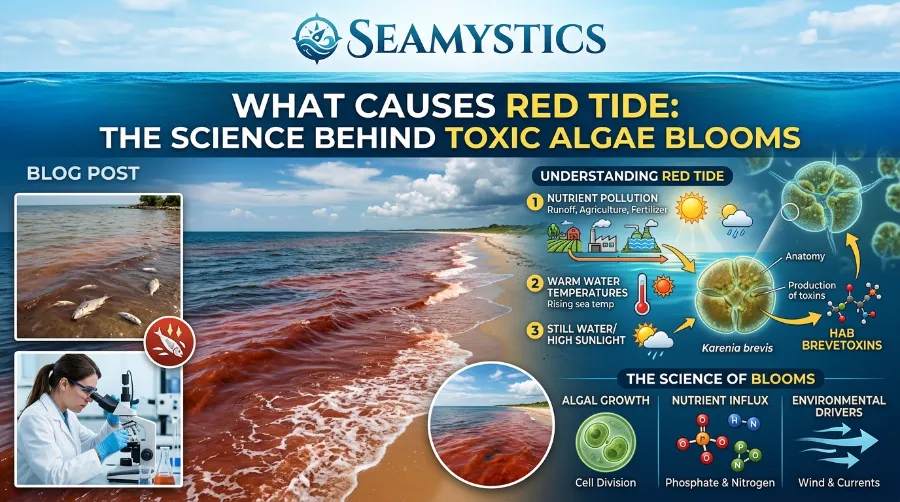
Along Florida and Texas coasts, blooms are primarily caused by the algae species Karenia brevis, a microscopic organism that can multiply so densely it becomes visible from space. Under normal conditions, this algae exists in tiny, harmless amounts. The trouble starts when conditions align to let it explode in number. Smithsonian Ocean
It helps to picture algae the way you would picture yeast in bread dough. Left alone, yeast does very little. Give it warmth, food, and time, and it multiplies rapidly. Red tide algae behave in a similar way once given the right combination of light, warmth, and nutrients.
Robert Ballard Discoveries The Man Who Found the Titanic
If you want to understand how sunlight interacts with the ocean layers where these blooms form, our guide on underwater light science covers how light penetration shapes marine ecosystems at different depths.
The Core Red Tide Causes Explained
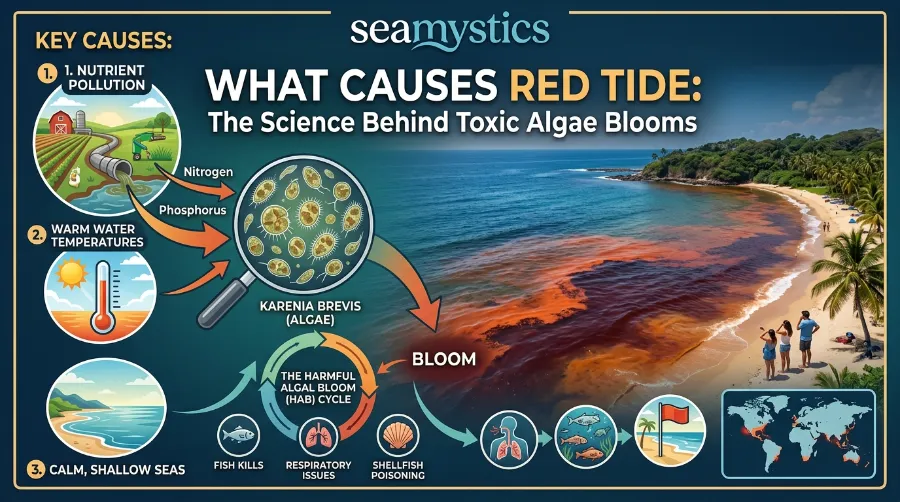
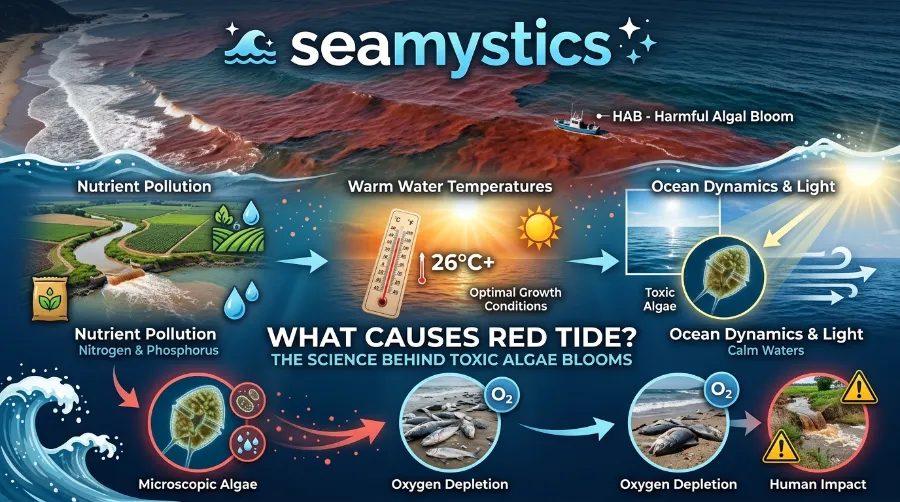
There is no single trigger. No single factor causes blooms of Karenia brevis. Blooms form as a result of interactions between biology, chemistry, and ocean currents that unite nutrients with light and carry red tide toward the beach. That said, researchers have identified the main ingredients that consistently show up before a bloom develops. The Invading Sea
1. Nutrient Availability
Algae need food just like any other organism, and their preferred nutrients are nitrogen and phosphorus. These can come from several sources, both natural and human-driven.
- Natural upwelling that lifts deep, nutrient-rich water toward the surface
- Nitrogen fixed from the atmosphere by other marine organisms such as Trichodesmium
- Decomposing marine life and plankton waste
- Fertilizer runoff from lawns, farms, and golf courses
- Leaking septic systems and sewage overflows
- Stormwater carrying pollutants from urban areas
Once a red tide bloom is transported into coastal and estuarine environments by wind and currents, it can be fueled and sustained by land-based nutrient runoff, including fertilizer, wastewater, and stormwater sources. This is an important nuance. The bloom may not start because of pollution, but pollution can absolutely make it worse once it arrives near the coast. ufl
2. Warm Water Temperatures
Most red tide organisms thrive in warm water, generally between 68 and 86 degrees Fahrenheit. As ocean temperatures climb during summer and early fall, conditions become more favorable for rapid algae reproduction. This is one reason red tide season in the Gulf of Mexico tends to run from late summer into winter.
3. Calm Winds and Stable Water
Turbulent water tends to break apart algae concentrations and mix them with cooler, deeper layers. Calm conditions do the opposite. When winds die down and the water column settles, algae stay concentrated near the surface where light and warmth are strongest, giving them ideal breeding conditions.
4. Ocean Currents and Upwelling
Periodic upwellings near the continental shelf drive nutrients up through the water column, where they are consumed by the algae. Currents then act like a conveyor belt, carrying blooms that start far offshore toward populated coastlines over the course of days or weeks. Red Tide Florida
To understand how these currents move nutrients across entire ocean basins, take a look at our piece on thermohaline ocean circulation, which explains the global conveyor system driving much of this movement.
Is Pollution Really to Blame
This is probably the most debated part of the red tide danger facts conversation, and the honest answer is more nuanced than most headlines suggest.
There is no demonstrated direct link between nutrient pollution and the formation or frequency of a Karenia brevis bloom, according to research from Mote Marine Laboratory, since Florida red tides typically develop 10 to 40 miles offshore, away from human-contributed nutrient sources. In fact, severe red tides were recorded in the mid-1900s, well before Florida’s coastlines were heavily developed, which is strong evidence that this is partly a natural phenomenon. Start1The Invading Sea
However, that does not mean human activity is irrelevant. Data from Mote suggests that nutrient runoff from land, including both natural animal waste and human fertilizer use, can serve as additional food for Karenia brevis once the bloom moves closer to shore. So pollution is less of an ignition switch and more of a fuel additive. Start1
This distinction matters for anyone trying to understand what is what causes red tide from a policy standpoint. Reducing fertilizer runoff will not stop red tide from forming, but it can reduce how severe and long-lasting a bloom becomes once it reaches populated coastlines.
Real World Examples With Dates
Numbers and dates make this topic much easier to grasp than abstract science alone.
- 2018, Florida Gulf Coast: One of the worst red tide events in decades left Florida’s coasts littered with dead fish, dolphins, and manatees, while severely damaging tourism and local economies. NOAA National Ocean Service
- 2020, Florida: By contrast, blooms that year were comparatively minor, showing how unpredictable severity can be from one year to the next. NOAA National Ocean Service
- October 2024, west coast of Florida: Following Hurricanes Helene and Milton, a large algae bloom was observed off Pasco, Pinellas, and Sarasota counties, with high nutrient concentrations in coastal waters from storm surge runoff raising concern about bloom development. PubMed
- Fall 2025 outlook, Florida: Scientists warned that warmer waters combined with nutrient-rich runoff from heavy rains and shifting ocean currents could create favorable conditions for another widespread bloom. NOAA National Ocean Service
- Summer 2024 to 2025, Baltic Sea: Toxic blue-green algae began moving toward the Swedish coast near Gotland, a recurring pattern tied to the Baltic Sea’s ongoing eutrophication problem. Wikipedia
- 2025, Baltic Sea: Blooms began appearing earlier in the season than they did fifteen years ago, shifting from mid-July arrivals to closer to midsummer. Nature
- March 2025, South Australia: A marine heatwave that had persisted since September 2024, combined with earlier nutrient input from river flooding and a coastal upwelling event, triggered a significant algal bloom. WWF Baltic
These examples show the same pattern playing out on different coastlines: warm water, nutrient supply, and calm conditions coming together at the wrong time.
How Red Tide Affects Health and Wildlife
The red tide organism in Florida produces brevetoxins that affect the central nervous system of fish and other vertebrates, causing large-scale die-offs. Wave action can break open algae cells and release these toxins into the air, leading to respiratory irritation in people nearby. The Invading SeaThe Invading Sea
Common effects include:
- Watery eyes and throat irritation near affected beaches
- Breathing difficulty, especially for people with asthma or emphysema
- Neurotoxic shellfish poisoning from eating contaminated clams or oysters
- Mass fish, dolphin, and manatee deaths along affected coastlines
- Economic losses from closed beaches and canceled tourism
In Northern Europe, cyanobacteria blooms in the Baltic Sea mainly threaten tourism by fouling bathing water and beaches, though certain toxin-producing species have caused human health concerns and occasional dog deaths. PubMed
If you are curious how these toxic blooms interact with the ocean’s normal oxygen cycle, our pillar guide on ocean oxygen production explains how dense algae growth can strip oxygen from surrounding waters and suffocate marine life.
HMS Challenger Expedition The Voyage That Founded Oceanography
Why Red Tide Seems to Be Getting Worse
This is where climate change enters the picture directly. Research on the North Sea has found that environmental changes are already associated with shifts in phytoplankton biogeography, altered species composition, and increased biomass of harmful algal bloom species over the past two decades. Eutrophication has been shown to increase both the magnitude and frequency of harmful algal blooms. ScienceDirectScienceDirect
The Baltic Sea tells a similar story. Increasingly large algal blooms there are mainly driven by eutrophication, meaning large amounts of nutrients from land-based activity flow into the sea, while climate change has further intensified blooms and disrupted the ecosystem. Eutrophying substances mostly come from agriculture, but also from wastewater treatment plants, private sewage systems, industries, and traffic emissions. WWF BalticNature
Warming water also plays a role in high-latitude blooms more broadly, as documented in recent climate and ocean research linking freshening and warming coastal waters to shifting bloom frequency.
For readers interested in how rising temperatures interact with ocean chemistry more broadly, our guide on the ocean’s freezing point explains how salinity and temperature changes ripple through marine systems.
How Scientists Track and Predict Red Tide
Modern monitoring has come a long way from simply waiting for dead fish to wash ashore.
- Satellite imagery detects chlorophyll concentrations that hint at bloom locations before they reach shore
- Water sampling measures algae cell counts directly, since blooms are officially classified once cell counts pass roughly 100,000 cells per liter
- Wind and current models forecast where an offshore bloom is likely to drift over the following days
- Public dashboards, like Florida’s real-time red tide status map, let residents check current conditions before heading to the beach
Typical background levels of the organism sit at a few hundred to a few thousand cells per liter, but a full bloom can reach anywhere from 100,000 cells per liter up to 5 million cells per liter, which gives a sense of just how explosive this growth can be. Red Tide Florida
Ocean currents play a huge role in how far and how fast a bloom travels once it forms. Our guide on ocean wave science breaks down how surface movement transports everything from nutrients to algae cells across entire coastlines.
What Can Actually Be Done
No single policy will eliminate red tide, since much of it is a natural phenomenon. But communities can reduce how severe and long-lasting coastal blooms become.
- Limiting fertilizer use on lawns and golf courses during rainy seasons
- Upgrading aging septic and sewage infrastructure to prevent leaks
- Restoring coastal wetlands, which naturally filter nutrients before they reach open water
- Supporting stricter agricultural runoff regulations, a major driver behind Baltic Sea blooms
- Staying informed through official monitoring tools before planning beach trips
Wetland restoration, stricter nutrient pollution policy, and public awareness are the main tools coastal states have to reduce the severity of red tide impacts on health, tourism, and local economies. NOAA National Ocean Service
FAQ
What is red tide in simple terms?
It is a rapid, dense overgrowth of certain algae species, often colored red or brown, that can release toxins harmful to marine life and people.
What is the main cause of red tide?
There is no single cause. Warm water, calm winds, nutrient availability, and ocean currents all need to align for a bloom to form and reach the coast.
Is red tide caused by pollution?
Not entirely. In Florida, blooms typically start far offshore, away from man-made nutrient sources, though pollution can intensify a bloom once it drifts closer to shore.
How long does red tide usually last?
It varies widely, from a few weeks to several months, depending on wind patterns, water temperature, and nutrient supply.
Is it safe to swim during a red tide event?
Health officials generally advise avoiding swimming in visibly discolored water and staying away from beaches with dead fish or reported respiratory irritation.
Is red tide only a Florida problem?
No. Similar harmful algal blooms occur in the Baltic Sea, North Sea, Gulf of Mexico, Texas coastline, and even Australian waters, though the specific algae species and triggers can differ by region.
Conclusion
Red tide is not a mystery, but it is also not as simple as blaming pollution alone. It is the product of warm water, nutrient supply, calm seas, and ocean currents working together, sometimes starting naturally far offshore and sometimes intensified by human activity once a bloom nears the coast. From the Gulf of Mexico to the Baltic Sea, the pattern keeps repeating, and as ocean temperatures continue climbing, scientists expect these events to become more frequent rather than less. Understanding the real mechanics behind red tide is the first step toward better forecasting, smarter coastal policy, and safer beach days for the people who live along these waters.
References
- Florida Fish and Wildlife Conservation Commission, Red Tide FAQ, myfwc.com/research/redtide/faq
- NOAA Ocean Service, What are red tides, oceanservice.noaa.gov
- Smithsonian Ocean, Red Tide: What is the algae species Karenia brevis, ocean.si.edu
- The Invading Sea, Florida’s recurring red tides come with ever-increasing costs, theinvadingsea.com
- Venice, FL, Red Tide Fact Sheet, venicegov.com
- UF IFAS Extension, Hurricane Hazards: Red Tide, blogs.ifas.ufl.edu
- Brandenburg et al., Limnology and Oceanography, 2025, Multiple global change factors and harmful algal blooms in the North Sea
- Harmful algal blooms and their effects in coastal seas of Northern Europe, ScienceDirect and PubMed
- WWF Baltic, Algae blooms have arrived in the Baltic Sea, wwfbaltic.org
- Wikipedia, 2025 algal bloom in South Australia
- The Marine Diaries, Red Tide Not My Vibe, themarinediaries.com
- UF IFAS Extension Escambia County, Red Tide: A Look at This Problem, blogs.ifas.ufl.edu
- START, Solutions to Avoid Red Tide, start1.org