
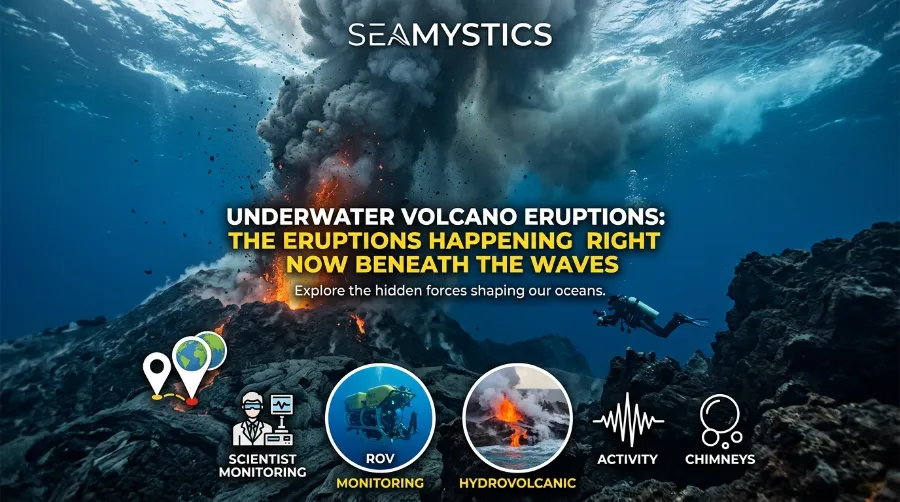

Somewhere on the ocean floor, right now, molten rock pushes through a crack in Earth’s crust. Nobody on the surface can see it happen. That is the strange truth about underwater volcano eruptions. In fact, they are the most common type of volcanic activity on the planet. Yet almost none of us will ever witness one. The Earth releases roughly three quarters of its magma beneath the sea each year, and land gets the rest. So this piece walks through where that activity happens today. Along the way, it covers how scientists catch it in the act, and what it means for the creatures living in the dark water above it.
TL;DR: Underwater volcano eruptions happen constantly along mid ocean ridges and volcanic arcs. Several sites, in fact, sit under active monitoring right now. Axial Seamount off the Oregon coast is one example, and scientists expect it could erupt sometime in mid to late 2026. Overall, these eruptions build new seafloor and feed strange chemical ecosystems around hydrothermal vents. Occasionally, one even breaks the surface with enough force to be seen from space, as Hunga Tonga proved in January 2022.
Key Takeaways
| Fact | Detail |
|---|---|
| Share of Earth’s volcanism that is underwater | About 70 to 80 percent |
| Estimated number of submarine volcanoes worldwide | Over 1 million, with roughly 75,000 rising more than 1 km above the seabed |
| Confirmed eruptions in the last 11,700 years | Only 119 documented submarine volcano eruptions |
| Deepest known eruption on record | About 4,500 meters (14,700 feet), Mariana back arc, Pacific Ocean |
| Volcano under the most active monitoring | Axial Seamount, Juan de Fuca Ridge, Oregon coast |
| Most dramatic recent eruption | Hunga Tonga-Hunga Ha’apai, January 2022, Tonga |
What Submarine Volcano Facts Actually Tell Us
Headlines often blur these terms together, so let’s define them clearly first. NOAA Ocean Exploration explains that a submarine volcano is any volcanic vent or fissure on the ocean floor that can release magma. Most, in particular, cluster along mid ocean ridges, the underwater mountain chains where tectonic plates pull apart and new crust forms nonstop. Woods Hole Oceanographic Institution notes that these ridge systems rim entire ocean basins. As a result, they produce explosive cones near subduction zones, as well as gentler, effusive shield volcanoes similar to the ones in Hawaii.
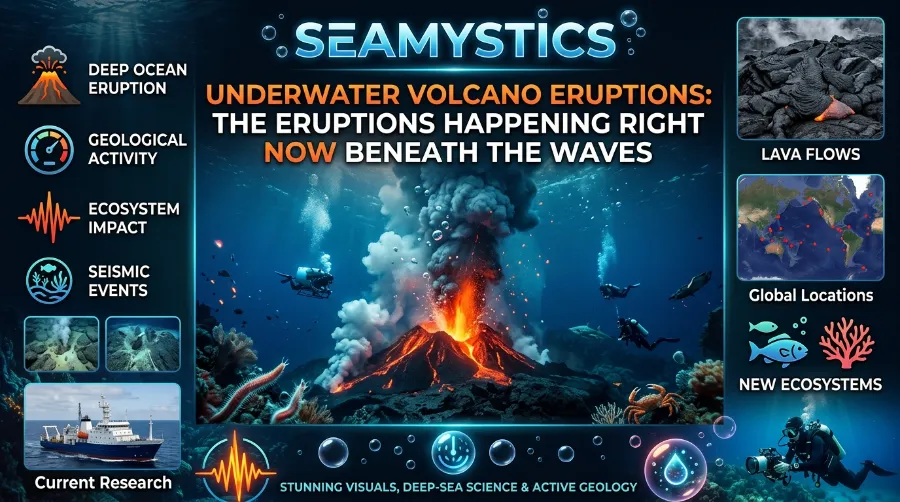
Water pressure, meanwhile, is the single factor that changes everything. Essentially, it makes an ocean volcano eruption behave very differently from a land based one. When lava meets seawater, it cools almost instantly, forming rounded, bulbous shapes called pillow lava, a texture that almost never appears on land. Past roughly 2,200 meters, water pressure grows so intense that seawater cannot boil in the normal sense. So an eruption down there produces no dramatic hiss or bubbling. Instead, it is just a slow, glowing push of rock into freezing dark water, a genuinely alien process. For that reason, understanding deep sea pressure is really the starting point for everything else that happens down there.
A few more submarine volcano facts worth holding onto:
- Scientists have formally confirmed only 119 submarine eruptions in the last 11,700 years. That is a tiny fraction of what likely happens, since scientists rarely observe them directly.
- Around 75,000 seamounts rise more than a kilometer above the surrounding seafloor, and most started out as active volcanoes before going dormant.
- Hydrothermal vents are mineral rich hot springs that cluster near many of these volcanoes. Consequently, their chemistry differs so much from ordinary seawater that entire food chains run on chemical energy instead of sunlight.
Where Active Underwater Volcanoes Are Erupting Right Now
Talking about active underwater volcanoes in the abstract is one thing. Naming the specific ones scientists watch this year is far more useful, and more interesting.
Axial Seamount, Oregon Coast
Axial Seamount sits about 480 kilometers off the coast of Oregon, submerged under roughly 1,500 meters of water on the Juan de Fuca Ridge. In fact, it is the most closely instrumented underwater volcano on Earth. Seafloor sensors have tracked its ground swelling and earthquake swarms since 1997. Since then, scientists have directly observed three eruptions there, in 1997, 2011, and 2015. Each time, researchers spotted the warning signs beforehand, since the seafloor physically inflates as magma builds up, then deflates suddenly once the volcano lets go. In late 2025, however, Live Science reported that researchers pushed back their forecast. They now expect Axial to erupt sometime in mid to late 2026, later than the earlier 2025 estimate. That new timeline rests on the pace of ground deformation and seismicity readings.
The Mystery of Disappearing Fishing Fleets in the Bermuda Region
Hunga Tonga-Hunga Ha’apai, Tonga
In January 2022, this underwater volcano did something almost no submarine eruption manages. Specifically, it broke the surface hard enough that satellites captured the blast from orbit. The blast then triggered underwater landslides near the Lau Basin, dislodging more than two square miles of sediment. As a result, the plumes swept plankton out of their normal currents and carried extra carbon and nitrogen into the deep ocean. Altogether, this eruption remains one of the clearest examples of an explosive underwater blast. An effusive eruption, by contrast, sends lava flowing steadily rather than blasting outward.
Fani Maoré, Mayotte
A new underwater volcano surfaced in the science record in 2019, off the French island of Mayotte, between Madagascar and Mozambique. Before that, residents had reported more than 1,800 small earthquakes almost daily through late 2018, including a magnitude 5.8 quake that May. Soon after, a strange, ultra low frequency seismic hum circled the globe. Researchers eventually traced it to magma draining beneath the seafloor. Finally, France’s CNRS, IPGP, and IFREMER confirmed it as the largest underwater volcanic eruption ever recorded.
Marsili and the Panarea Caldera, Mediterranean
Europe has its own active seamounts, though few people mention them alongside the Pacific’s more famous volcanoes. Marsili, for instance, hides beneath the Tyrrhenian Sea, between Sicily and the Italian mainland. It is larger than Mount Etna and ranks among the most significant underwater volcanoes in Europe, yet almost nobody outside geology circles knows its name. Nearby, the Panarea Caldera hosts hydrothermal vents that release gases and fluids reaching temperatures above 200 degrees Celsius. Because of that, researchers studying its chemistry nicknamed it the smoking land.
The Mariana Back Arc, Western Pacific
In 2024, a research team used remotely operated vehicles to document an eruption on the Mariana back arc, roughly 4,500 meters below the surface. That is deeper than Mount Rainier stands above sea level, making it the deepest confirmed underwater eruption on record. Consequently, it gave scientists a rare direct look at how volcanic activity that far down shapes ocean chemistry.
How an Ocean Volcano Eruption Reshapes Life Underwater
An ocean volcano eruption is not purely destructive, even though it often looks that way right after it happens. Instead, think of it more like a reset button for a small patch of seafloor, one that eventually produces some of the richest habitats in the ocean.
In the short term, the damage is real. Ash and rock cloud the water column, toxic gases disperse, and heat can kill nearby organisms almost instantly. Underwater eruptions can also strip oxygen from the surrounding seawater through a chemical reaction with volcanic compounds. Smithsonian Ocean researchers have linked this process to some of the mass marine die offs recorded at sites like the Lau Basin, as well as to prehistoric ocean deoxygenation events tens of millions of years ago.
Over a longer timescale, though, the picture flips:
- New crust forms. Lava cools into rock and gradually builds the seafloor outward, occasionally forming new islands.
- Hydrothermal vents appear. Cracks release mineral rich, heated water that differs chemically from the ocean around it.
- Chemosynthetic bacteria move in. These microbes convert vent chemicals into usable energy without needing sunlight.
- A food web builds from nothing. Tube worms, shrimp, and other extremophiles feed on the bacteria, and larger predators, including sharks and whales drawn to nearby seamounts, follow.
This pattern is exactly why marine biologists keep circling back to these sites. Oceana, for example, reports that volcanic activity builds hydrothermal vents that have produced numerous new species discoveries. More broadly, seamounts act as magnets for migratory species. Similarly, the same ash and mineral fallout that briefly devastates one patch of seafloor often settles elsewhere as a nutrient rich layer, not unlike the slow drift of marine snow, which constantly rains down through the water column and feeds life at every depth on its way to the bottom.
Undersea Eruption 2026 Watch: What Scientists Are Tracking Now
Axial Seamount is the clearest undersea eruption 2026 story to follow. The Ocean Observatories Initiative runs the volcano’s monitoring network and tracks ground inflation in real time. The caldera floor began swelling again almost immediately after the 2015 eruption. According to IFLScience, which tracked the buildup, the inflation rate had climbed to around 15 centimeters a year by mid 2025, with the caldera center swelling closer to 25 centimeters annually before leveling off near its pre-2015 eruption threshold. Meanwhile, seismicity spiked in step with that inflation, at times producing more than 500 small earthquakes in a single day.
Researchers currently expect the next Axial eruption sometime in mid to late 2026, though that window has already shifted once and could move again. National Geographic has called Axial’s shallow, well mapped magma chamber a rare window into how these volcanoes work, since almost no land based volcano offers that same clarity. Lessons from Axial’s monitoring, in turn, feed directly into how researchers approach other unpredictable submarine sites. The Ocean Exploration Trust and its partners, for instance, have used ROVs near the Mariana Arc to study more than 60 underwater volcanoes there and their hydrothermal systems.
How Scientists Actually Detect an Eruption
Spotting one of these events is harder than it sounds, since most happen thousands of meters down with nobody nearby. Typically, researchers rely on a mix of these methods:
- Seafloor pressure sensors that detect sudden ground deformation
- Hydrophones and seismometers that pick up earthquake swarms and low frequency rumbles
- CTD instruments that measure conductivity, temperature, and depth, since a fresh eruption changes local water chemistry
- Satellite tracking of floating pumice rafts, which can drift for months or even years after a shallow eruption
- Direct visual surveys using ROVs such as Jason, Hercules, and Orpheus, which can film active vents up close
Even with all of this technology, scientists still miss many eruptions, simply because the ocean is enormous and dark. Consider, for example, the submarine eruption in the Bismarck Sea near Papua New Guinea. Scientists only learned about it after pumice from the blast floated to the surface, which finally gave researchers their first real clue that something had happened below.
A Few Numbers Worth Sitting With
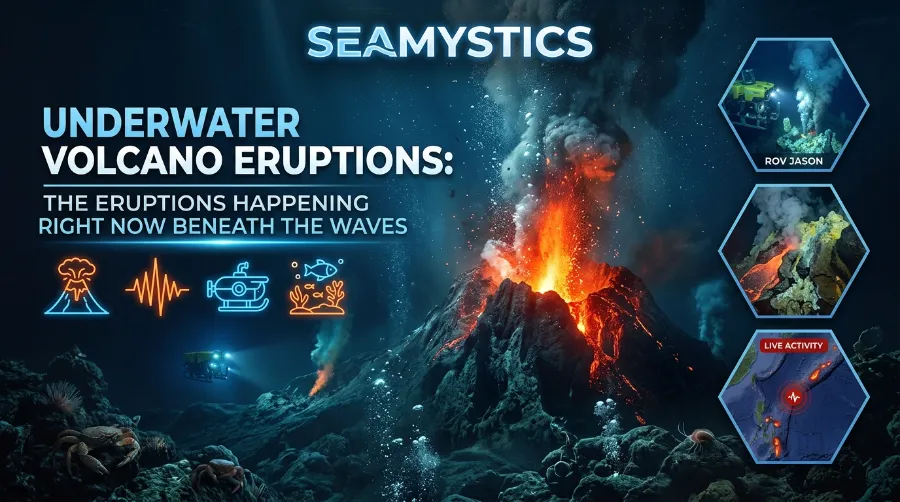
Comparing depths helps put the scale of these eruptions into perspective. The table below lines up four well documented submarine eruptions by depth.
| Eruption site | Approximate depth | Year observed |
|---|---|---|
| NW Rota-1, Mariana Islands | 555 meters | 2004 to 2005 |
| West Mata, Pacific Ocean | 1,200 meters | 2009 |
| Axial Seamount, Oregon coast | 1,500 meters | 2011, 2015 |
| Mariana back arc (deepest known) | 4,500 meters | 2024 |
Frequently Asked Questions
Are underwater volcano eruptions dangerous to humans?
Directly, rarely, since most happen far from populated coastlines and far below the surface. Indirectly, however, a shallow or unusually large eruption like Hunga Tonga can trigger tsunamis, ashfall, and pressure waves that reach land.
How often do active underwater volcanoes erupt?
It varies enormously by site. Axial Seamount, for example, has erupted three times since 1997, roughly once a decade, while many other seamounts have not erupted in thousands of years and count as dormant or extinct.
Can an ocean volcano eruption create a new island?
Yes. Shallow eruptions occasionally push enough material above the waterline to form a temporary or permanent island, though many of these erode back below the surface within months.
What is the deepest underwater volcano eruption ever recorded?
A 2024 discovery on the Mariana back arc currently holds that record, at roughly 4,500 meters below the surface.
Do underwater volcanoes affect marine life for the long term?
Both, often at the same location. The immediate aftermath can kill nearby organisms, but the same site frequently turns into a thriving hydrothermal ecosystem within years.
Conclusion
Underwater volcano eruptions rarely make headlines the way their land based cousins do, yet they shape the ocean floor every single day, largely out of sight. Axial Seamount, for instance, is closing in on its watched 2026 eruption window, while Europe’s overlooked giant, Marsili, sits quietly beneath the Tyrrhenian Sea. Together, these stories reveal how much of the planet’s most active geology happens where nobody is watching. Because monitoring technology keeps improving, scientists will likely catch more of these eruptions as they happen, rather than piecing them together afterward. That, in the end, only means there is more, not less, still to learn about what is happening beneath the waves.
References
- Oceana, “What Happens When Underwater Volcanoes Erupt?”
- Woods Hole Oceanographic Institution, “Underwater Volcanoes”
- Smithsonian Ocean, “What Happens to Sea Life When a Volcano Erupts Underwater?”
- NOAA Ocean Exploration, “Do Volcanic Eruptions Happen Underwater?”
- Live Science, “Underwater Volcano Off Oregon Coast Likely Won’t Erupt Until Mid-to-Late 2026”
- IFLScience, “Undersea Volcano Off The US West Coast Predicted To Erupt In 2025”
- National Geographic, “Underwater Volcano Offers Rare Look at Eruption in Real Time”