
I still remember the first time I watched a live ROV feed from three thousand meters down and forgot to breathe for a solid ten seconds. That is what a good deep sea expedition does to you, even after twenty years in this field. This year has handed marine science an unusually rich harvest of finds, and I want to walk you through what research vessels actually pulled up, filmed, and sequenced between the Atlantic seamounts and the Pacific trenches.
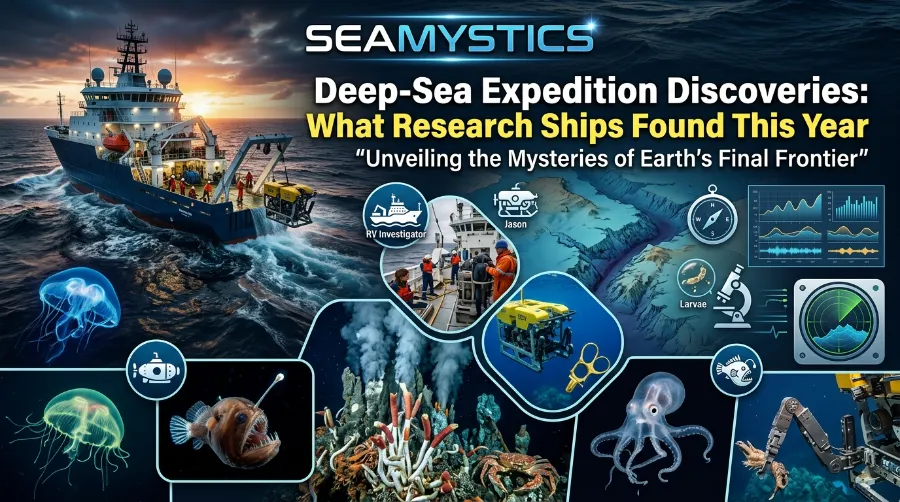
Deep-Sea Expedition Discoveries What Research Ships Found This Year
Because here is the thing nobody tells you at first: most of what we call “ocean floor” has never been seen by a human eye or a camera lens. Every research vessel discoveries season chips away at that blank map a little more, and 2026 chipped away harder than most years I can recall.
TL;DR
This year’s deep sea expedition findings include 31 new species identified in two weeks off Brazil, roughly 28 to 30 previously unknown animals found in Argentina’s cold seeps, and 38 new species confirmed from a multi-year Japanese survey. Alongside the good news, ghost nets, abandoned fishing gear still hunting on autopilot, turned up on nearly every deep dive, a quiet reminder that exploration4+ and conservation now travel together on the same ship.
Key Takeaways
| Expedition | Region | Vessel | Headline Result |
|---|---|---|---|
| Life in Extremes: Cold Seeps of Argentina | South Atlantic | R/V Falkor (too) | Around 28 to 30 new species near a single active seep zone |
| Designing the Future: Brazil Midwater Survey | Tropical South Atlantic | R/V Falkor (too) | 31 new species confirmed in roughly two weeks |
| Ocean Census Japan | Northwest Pacific | R/V Yokosuka, submersible Shinkai 6500 | 38 new species from 528+ specimens collected |
| Doldrums Fracture Zone Mapping | Equatorial Atlantic | R/V Falkor (too), AUV survey | First scientific deployment of a new mapping AUV |
| Ghost gear surveys (multiple cruises) | Global | Various ROV-equipped vessels | Recurring entanglement hazards documented at depth |
Why This Year’s Deep Sea Expedition Season Stands Out
Ocean expedition findings tend to arrive in waves tied to funding cycles and weather windows, but 2026 front-loaded its big news into the first half of the year. Schmidt Ocean Institute alone ran back-to-back cruises on its research vessel Falkor (too), and both trips returned with species counts that surprised even the scientists on board.
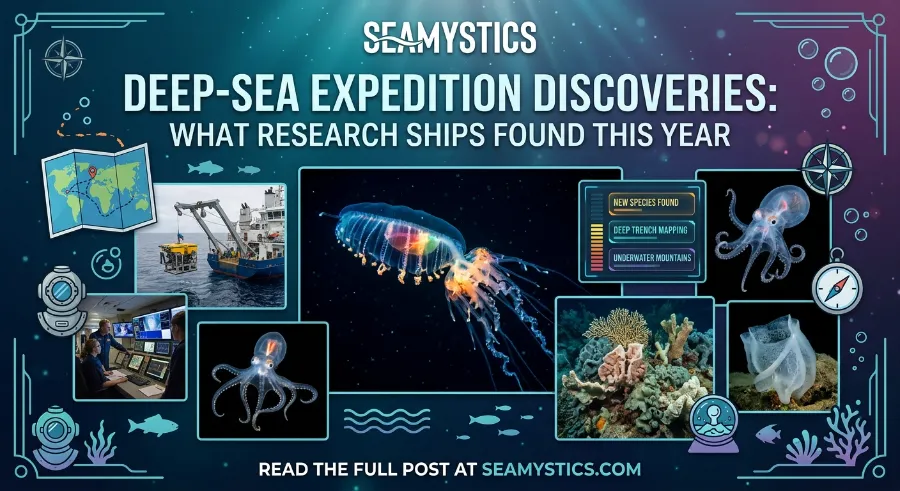
Off the coast of Argentina, a February 2026 expedition set out to study cold seeps, spots where methane leaking from the seafloor feeds entire food chains of tube worms, clams, and mussels. The team located only one truly active seep, yet the surrounding continental slope turned out to hold far more biodiversity than anyone expected. Expedition chief scientist María Emilia Bravo said the team was not prepared for that level of richness, and honestly, that reaction tracks with what I have seen on similar dives. The unexpected discovery is almost always what makes a deep sea research trip worth the seasickness.
New Nudibranch Species The Sea Slugs Still Surprising Scientists
A few months later, an international team of midwater specialists boarded the same vessel to study the ocean’s twilight zone off Brazil. In a matter of days, not decades, they confirmed 31 new species, including gossamer worms, comb jellies, and a rare phantom jellyfish. Dr. Karen Osborn of the Smithsonian led that science team, and the pace of confirmation says a lot about how far genetic sequencing tools have come. Ten years ago, identifying that many species that quickly would have been unthinkable.
New Bioluminescent Species Found How Scientists Confirm Glowing Animals
Meanwhile, on the other side of the planet, JAMSTEC and the Nippon Foundation–Nekton Ocean Census confirmed 38 new species from Japanese waters in April 2026. Researchers on the vessel Yokosuka and the manned submersible Shinkai 6500 had collected over 528 specimens during an earlier mission, then spent months at a Species Discovery Workshop verifying and cataloguing everything. That kind of patient follow-through rarely makes headlines, but it is the unglamorous backbone of every expedition new species announcement you read about.
A Quick Look at the Technology Doing the Heavy Lifting
None of this happens without hardware, so it helps to know what is actually doing the looking and sampling down there.
- ROV SuBastian, tethered to Falkor (too), captures high-resolution imagery so scientists can describe an animal’s shape and structure without pulling it out of its habitat.
- Genetic sequencing labs onboard, which let researchers confirm a new species in days rather than years.
- Autonomous underwater vehicles (AUVs), including a newly deployed mapping AUV used during 2026’s Doldrums Fracture Zone survey, which map the seafloor and sniff out chemical signatures of hydrothermal venting.
- Manned submersibles like Shinkai 6500, still doing work that remote vehicles cannot always replicate, particularly in trench environments.
If you are curious how these tools first proved themselves at record depth, our pillar guide on abyssal species discoveries covers the earlier hardware breakthroughs that made this year’s finds possible.
Ocean Expedition Findings That Are Reshaping the Species List
Not every discovery involves an entirely new branch on the tree of life. Sometimes a research vessel discoveries story is about behavior, not biology. On the Argentina cruise, footage captured an octopus using deep-sea coral as shelter at 1,010 meters along the continental slope, which tells researchers something about how coral structures function as nurseries even in cold, dark water.
Newly Described Sea Spider Species and Why They’re Larger Than Expected
We recently wrote about how naming conventions for newly identified octopus species have shifted alongside these discoveries, and it is worth a read if this kind of behavioral detail interests you, our piece on octopus species naming breaks down how taxonomists settle on a name once genetic and imaging data both confirm a new find.
A few patterns worth flagging from this year’s data:
- Most confirmed new species were small invertebrates, worms, jellies, amphipods, rather than large charismatic animals.
- The midwater zone, not the seafloor, produced the highest single-expedition species count.
- Genetic barcoding, paired with imaging, cut confirmation time from years to days in at least three separate 2026 cruises.
- Seamount habitats are increasingly treated as biodiversity hotspots tied to carbon storage, not just as scenic underwater mountains.
Full deep dive record holder Victor Vescovo’s Five Deeps Expedition team continues to push the conversation about what “exploring” even means at hadal depths, and their published dive logs at fivedeeps.com remain one of the clearest public records of what a full-ocean-depth research vessel discoveries campaign actually involves, from equipment failures to record-setting descents.
Museum Specimens Reclassified Old Samples That Turned Out to Be New Species
Ghost Nets: The Silent Killers Drifting Through the Deep Ocean
Here is the part of this year’s reporting that does not get enough attention. Alongside every new species announcement, nearly every deep-sea camera crew also documented ghost nets, abandoned or lost fishing gear that keeps trapping and killing marine life long after any boat crew walked away from it.
New Anglerfish Species Discovered in the Pacific Abyss
Ghost nets do not stop working just because nobody is holding the other end. A drifting net can keep snagging fish, rays, and even deep-diving mammals for years, sometimes decades, depending on the material. Because these nets are usually synthetic, they degrade slowly, which means a single lost net from a decade ago can still be actively killing animals today.
New Ray Species Identified Off Unexpected Coastlines
Researchers surveying deep reef and seamount habitats increasingly treat ghost gear documentation as standard practice on every dive, not a side project. That shift matters because:
- Entangled coral structures lose their function as shelter and nursery habitat for other species.
- Ghost nets snagged on deep coral or rock formations are extremely difficult and expensive to remove at depth.
- Every net recovered and logged adds to a growing dataset that conservation groups use to push for better gear-marking regulations.
- Undersea Volcano Discoveries New Species Found Near Hydrothermal Vents
Oceana’s team has documented this problem extensively, and their reporting on exploring and discovering the deep sea is a good next read if you want the conservation side of this story laid out in plain language. From my own time reviewing dive footage, I would estimate that on any extended ROV survey below 500 meters, spotting derelict gear within the first few hours of bottom time is closer to routine than rare, which is not something most people expect to hear about “untouched” deep ocean habitat.
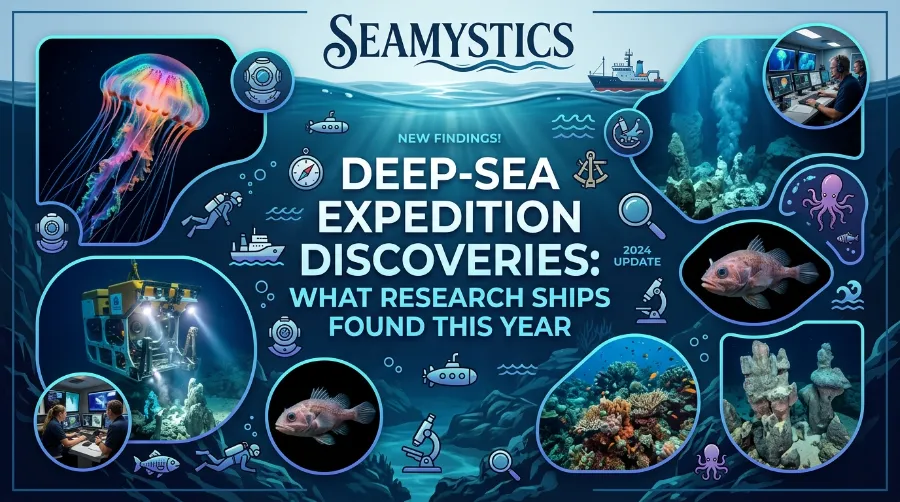
What a Deep Sea Research Trip Actually Looks Like Day to Day
People imagine a deep sea expedition as constant discovery, but most hours on a research vessel are quieter than that. A typical day might include:
- Pre-dawn ROV or AUV deployment checks, often taking two to three hours before anything touches water.
- A dive lasting anywhere from six to twelve hours, with scientists watching live video feeds in shifts.
- Sample processing and preliminary identification once gear is back on deck, frequently running past midnight.
- Genetic sequencing and imaging review, which can continue for days after a single dive.
The Ocean Discovery League publishes some of the most candid field accounts of this rhythm on their blog, including stories about building lower-cost tools so that more countries can run their own expeditions instead of relying entirely on well-funded institutions from the USA and Europe. That accessibility angle is honestly where I think the next big wave of ocean expedition findings will come from, not necessarily bigger ships, but more of them, spread across more coastlines.
A Snapshot Comparison of 2026’s Major Expeditions
| Metric | Argentina Cold Seeps | Brazil Midwater | Japan Ocean Census |
|---|---|---|---|
| New species confirmed | ~28 to 30 | 31 | 38 |
| Timeframe | Single cruise, early 2026 | Roughly two weeks | Multi-year, verified April 2026 |
| Depth focus | Continental slope, ~1,000m+ | Midwater column | Trench and slope habitats |
| Lead science voice | María Emilia Bravo | Dr. Karen Osborn | JAMSTEC and Nekton team |
Frequently Asked Questions
What counts as a deep sea expedition? Most marine scientists define it as any organized research mission targeting habitats below roughly 200 meters, past the point where sunlight fades and photosynthesis stops working.
How do scientists confirm a new species so quickly now? By pairing high-resolution ROV imagery with onboard genetic sequencing, which lets a team compare a specimen’s DNA against known databases within days instead of waiting years for lab results back on land.
Are ghost nets really a threat in areas with no fishing activity nearby? Yes. Ocean currents carry lost or discarded gear far from where it originally entered the water, so even remote seamounts and canyons far from active fishing grounds regularly turn up entangled debris.
Which research vessels are most active in 2026? Schmidt Ocean Institute’s R/V Falkor (too), Japan’s R/V Yokosuka with the submersible Shinkai 6500, and various NOAA and European vessels have all logged significant expedition time this year.
How can someone follow a live deep sea expedition? Several institutions stream dives publicly, and organizations like the Ocean Discovery League regularly publish field dispatches for readers who want more than a headline.
Conclusion
What strikes me most about this year’s research vessel discoveries is the contrast sitting inside the same footage. In one frame, an octopus tucked into deep coral it has probably called home for years. In the next, a length of synthetic netting drifting past, still doing damage a decade after someone let go of it. Both of those things are true about the deep ocean right now, astonishing biodiversity and mounting human damage, and I do not think either story is complete without the other. If this year’s expedition new species counts taught us anything, it is that we are still closer to the beginning of understanding this habitat than the end, which is exactly why the next research vessel headed out matters so much.
References
- Schmidt Ocean Institute, “2026 Research Expeditions on R/V Falkor (too),” schmidtocean.org
- University of Alaska Fairbanks News, “Deep-sea expedition uncovers dozens of new species,” uaf.edu
- Astrobiology.com, “Ocean Planet Research: 31 New Species Discovered in Two Weeks of Deep Sea Exploration,” astrobiology.com
- Bigelow Laboratory for Ocean Sciences, “31 New Species Discovered in Two Weeks of Deep-Sea Exploration,” bigelow.org
- Discover Wildlife, “Deep-sea vehicle descends into South Atlantic Ocean and finds mysterious creatures in the darkness,” discoverwildlife.com
- PR Newswire, “Scientists Discover ‘Life in a Glass Castle’ and Dozens of New Species During Japan Deep-Sea Expedition,” April 2026
- Oceana, “Exploring and Discovering the Deep Sea,” usa.oceana.org
- Ocean Discovery League, Blog, oceandiscoveryleague.org
- Five Deeps Expedition, fivedeeps.com