
Somewhere off the coast of California, a diver drops below the kelp canopy. She spots a creature that looks hand-painted. It’s frilled, glowing, and no bigger than a thumbnail. Nobody has ever named it before. This happens often. Scientists keep confirming new finds like this, and it’s exactly why the hunt for a new nudibranch species has become one of the most active corners of ocean science today.
New Nudibranch Species The Sea Slugs Still Surprising Scientists
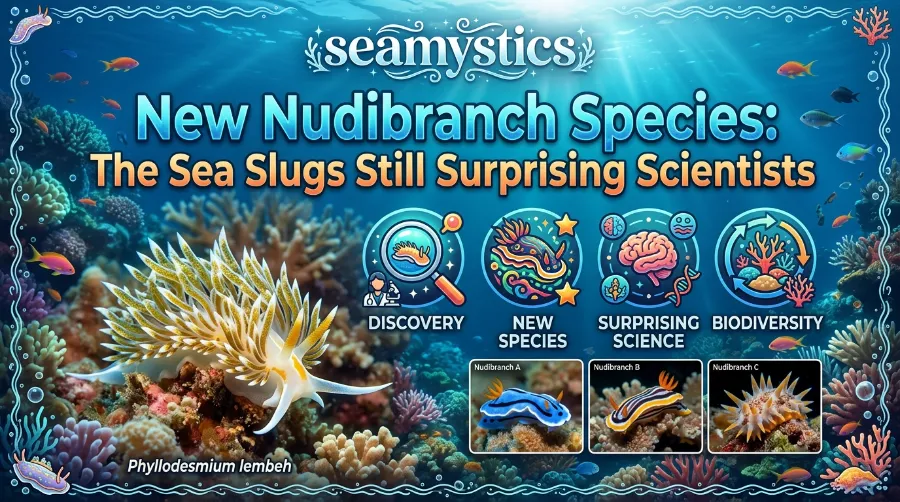
Nudibranchs are soft-bodied sea slugs. They shed their shells early in life. Instead, they rely on color, chemistry, and camouflage to survive. Researchers still describe new species at a pace that outpaces almost every other group of marine invertebrates. At Sea Mystics, we track these discoveries closely. The last two years alone have reshaped parts of the nudibranch family tree.
Key Takeaways
| Topic | What You Need to Know |
|---|---|
| Discovery rate | The California Academy of Sciences described over 70 new-to-science species in 2025, including 11 nudibranchs |
| Deep-sea find | MBARI researchers formally described a bathypelagic nudibranch, Bathydevius caudactylus, in 2024 after 20+ years of observation |
| Taxonomy shift | A 2025 study revised nudibranch classification and reinstated the order Doridida |
| Where to look | Divers keep finding new species on Indo-Pacific reefs, in California kelp forests, and in the deep midnight zone |
| Why it matters | Each new species helps scientists map ocean biodiversity before habitat loss and pollution erase it |
TL;DR: Marine biologists keep finding new nudibranch species every year. They’re turning up everywhere from shallow Indo-Pacific reefs to the pitch-black midnight zone off California. Recent finds like Cyerce basi and Bathydevius caudactylus prove that even a well-studied group of animals can still hide surprises, and a 2025 taxonomic overhaul means researchers are redrawing the sea slug family tree right now.
Why Scientists Keep Finding New Sea Slug Species
It seems strange. A creature with no shell, no real defense, and bright warning colors should be easy to spot. Yet nudibranch discovery in the ocean keeps happening, and a few practical reasons explain why.
Deep-Sea Expedition Discoveries What Research Ships Found This Year
First, most nudibranchs are tiny. Many measure under two centimeters, so even careful divers miss them on well-surveyed reefs. Second, many species look almost identical to the naked eye. Researchers can only tell them apart through DNA analysis. Third, huge stretches of ocean habitat, especially the deep sea, remain barely surveyed. One CalAcademy researcher described this pattern clearly: deep-reef expeditions keep turning up biodiversity nobody knew existed, often right alongside plastic waste nobody wants to find.
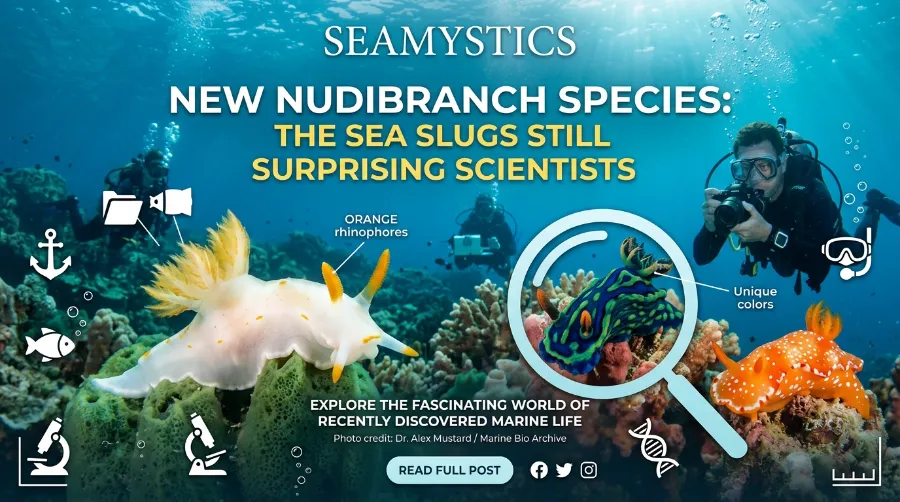
Consider Terry Gosliner. He curates invertebrate zoology at the California Academy of Sciences, and he has personally described roughly a quarter of all known sea slug species. In 2025 alone, he added 11 more to that list. His finds include a shimmering opalescent nudibranch from the Indo-Pacific and two species found only in California waters. That single figure shows the scale of the gap in our knowledge: one scientist’s career output represents a meaningful fraction of everything humanity knows about this group.
Recent New Nudibranch Species Worth Knowing
A few 2024 to 2026 discoveries stand out. They matter not just for their looks, but for what they taught researchers about where nudibranchs can survive.
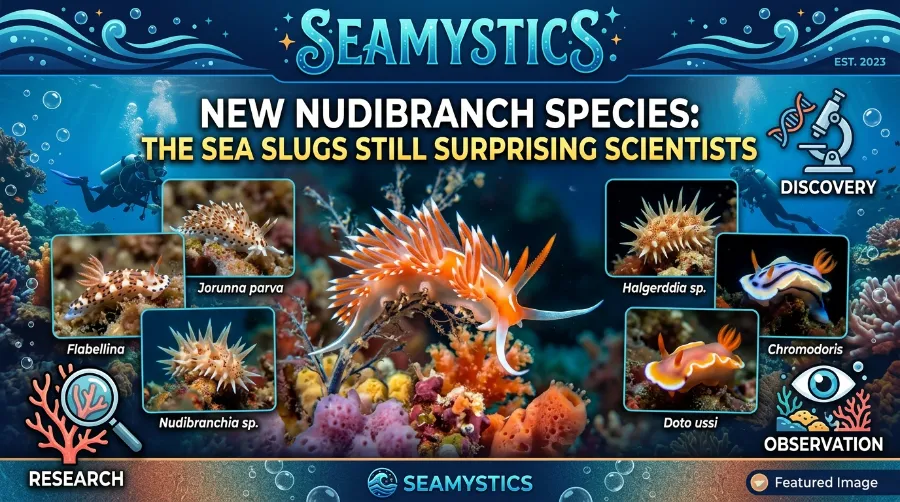
- Cyerce basi — Researchers found this newly described sea slug in the deep Indo-Pacific. Its shimmering, opalescent tissue made it one of several colorful nudibranch new finds the California Academy of Sciences announced in its 2025 species roundup.
- Doto urak — Scientists described this species in California waters only. It shows that even well-dived US coastlines still hold undocumented biodiversity.
- Bathydevius caudactylus — Researchers at the Monterey Bay Aquarium Research Institute formally described this species in 2024. They based it on more than two decades of deep-sea video observation. It lives in the bathypelagic midnight zone, between 1,000 and 4,000 meters down, and it swims by flexing a bell-shaped body. No one had documented this hunting strategy in this group before.
These finds aren’t obscure academic footnotes. They represent a live, ongoing rewrite of what scientists thought they knew about where sea slugs live and how they behave.
Museum Specimens Reclassified Old Samples That Turned Out to Be New Species
A Quiet Revolution in Nudibranch Taxonomy
Discovery only tells half the story. Classification tells the other half, and 2025 brought one of the biggest shake-ups in nudibranch taxonomy in years. Researchers Tatiana Korshunova, Karin Fletcher, and Alexander Martynov published a study on this shift. They argued that decades of lumping species together under broad, oversimplified names had hidden real evolutionary diversity. Their work reinstated the order Doridida. It also pushed back against the trend of merging distinct lineages into single catch-all groups.
New Bioluminescent Species Found How Scientists Confirm Glowing Animals
This might sound like paperwork to casual ocean lovers. For working biologists, it changes everything. Field guides, museum collections, and even citizen-science apps now have to update how they categorize what divers photograph. Expect names to shift over the next few years as researchers adopt this new framework across regional nudibranch databases.
Newly Described Sea Spider Species and Why They’re Larger Than Expected
Where New Species Are Turning Up
Discovery hotspots don’t spread evenly across the globe. A few regions consistently produce new finds:
- Indo-Pacific coral reefs — Indonesia’s Raja Ampat, Komodo, and Alor regions still rank among the richest nudibranch habitats on Earth.
- California’s kelp forests and rocky coastline — These waters prove that well-studied US coasts can still yield undescribed species.
- The deep midnight zone off the Pacific coast — Researchers barely explore this habitat. They call it one of the largest, least understood environments on the planet.
- The Maldives and Red Sea — Active regional nudibranch taxonomy databases in these areas track new records almost every year.
If you plan a dive trip specifically to spot unusual sea slugs, check our deep-sea expedition guide. It covers which regions currently show the highest documented discovery rates.
New Ray Species Identified Off Unexpected Coastlines
How Researchers Confirm a New Nudibranch Species
Spotting something unusual underwater only marks step one. Confirming it as new to science takes longer and follows a fairly consistent pattern:
- A diver or researcher photographs and collects a specimen that doesn’t match any known description.
- The team compares the specimen against existing museum records and published field guides.
- Researchers run DNA sequencing to check whether the animal is genetically distinct, not just a color variant.
- Scientists write a formal taxonomic description and submit it to a peer-reviewed journal.
- The species receives a scientific name and a spot in global databases.
This process can take years. Take Bathydevius caudactylus as an example. Researchers gathered more than two decades of deep-sea footage before they felt confident enough to publish. In this field, patience isn’t optional.
New Anglerfish Species Discovered in the Pacific Abyss
Real-World Impact Beyond the Reef
New nudibranch discoveries matter beyond divers and photographers. Each confirmed species adds a data point to global biodiversity maps, and these maps guide conservation planning, fisheries management, and reef health tracking.
Undersea Volcano Discoveries New Species Found Near Hydrothermal Vents
Researchers surveying deep-reef sites, the same places where new sea slug species turn up, have also documented plastic pollution there. They find discarded fishing line and anchor rope debris at those same depths. That overlap sends a clear message: discovery and habitat loss often happen in the same water, at the same time.
This is why documentation matters so much right now. Species that scientists have never formally described can vanish from degraded habitats before anyone even knows they existed. For a related look at how researchers handle naming conventions once a species is confirmed, see our guide on octopus species naming.
Frequently Asked Questions
How many new nudibranch species do researchers discover each year?
The number varies. Recent years show double-digit totals from single institutions alone. In 2025, the California Academy of Sciences described 11 new sea slug species as part of a broader 72-species discovery year across multiple animal groups.
Are nudibranchs endangered?
Researchers haven’t formally assessed most nudibranch species for conservation status, since population data barely exists. However, marine biologists increasingly worry about habitat degradation in the reef systems where nudibranchs live.
Why do nudibranchs look so colorful?
Their bright colors typically warn off predators. Many nudibranchs absorb toxins or stinging cells from the prey they eat, like sponges or anemones, and repurpose them for their own defense.
Where can I see nudibranchs myself?
Shallow reef systems in the Indo-Pacific, tide pools along the California coast, and cold-water dive sites in Scotland and the Red Sea all host regularly documented populations. Regional databases like the Nudibranch Domain track sightings by location.
What separates a nudibranch from a regular sea slug?
All nudibranchs count as sea slugs, but not all sea slugs count as nudibranchs. Nudibranchs belong specifically to the order Nudibranchia, and adults lack a shell while carrying exposed gills, a detail the Monterey Bay Aquarium’s opalescent nudibranch profile explains well.
Conclusion
The ocean still hides secrets, and nudibranchs keep proving it. Researchers pulled a shimmering new species from Indo-Pacific depths. They found a bell-shaped hunter thriving in total darkness off California. The last two years show that even a heavily photographed, heavily loved group of animals still has plenty left to reveal. As deep-sea surveys expand and DNA tools get cheaper, expect the pace of new nudibranch species discoveries to keep climbing. That pace brings growing urgency too: scientists need to protect these habitats before undocumented species disappear from them. Readers who want to dig deeper into how researchers confirm and name deep-sea biodiversity should check our new abyssal species guide. For detailed regional species records, browse ReefID’s Coral Triangle nudibranch guide.
References
- California Academy of Sciences, 2025 New Species Report (via Mongabay)
- Robison, B.H. & Haddock, S.H.D. (2024). Discovery and description of a remarkable bathypelagic nudibranch, Bathydevius caudactylus, gen. et. sp. nov. Deep Sea Research Part I: Oceanographic Research Papers, 214, 104414.
- Korshunova, T., Fletcher, K., & Martynov, A. (2025). Taxonomic revision of Nudibranchia, reinstating order Doridida.
- Monterey Bay Aquarium, Opalescent Nudibranch species profile
- Nudibranch Domain regional species database