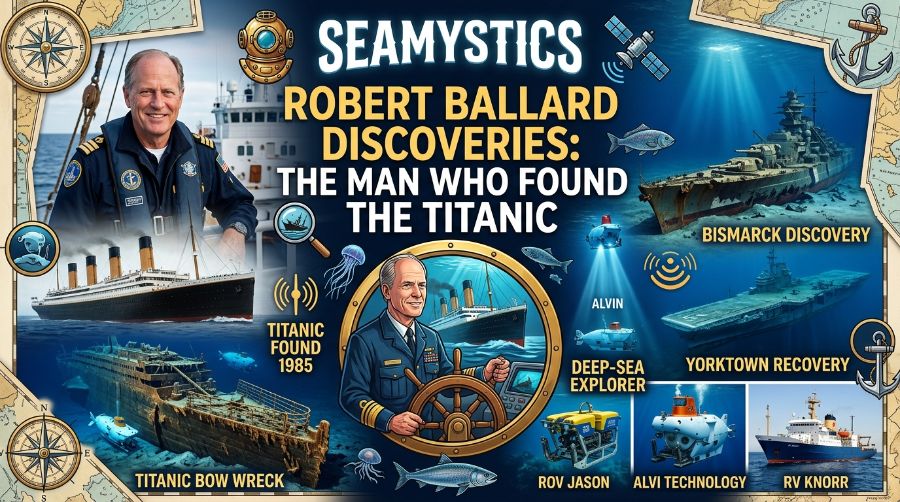

For seventy three years, the Titanic sat somewhere on the floor of the North Atlantic, and nobody knew exactly where. Then, in the early hours of September 1, 1985, a grainy image of a ship’s boiler flickered across a monitor aboard the research vessel Knorr, and the mystery ended. The man watching that screen was Robert Ballard, and this single Robert Ballard discovery would go on to reshape how the world sees deep-sea exploration.
This article walks through how he found it, what it took to get there, and the string of other discoveries that most headlines never mention.
| Key Takeaways | Details |
|---|---|
| Most famous find | RMS Titanic, located September 1, 1985, about 400 miles off Newfoundland |
| Depth of wreck | Roughly 12,600 feet (3,840 meters) below the surface |
| First major discovery | Hydrothermal vents near the Galapagos Rift, February 1977 |
| Other shipwrecks found | Bismarck, RMS Lusitania, the lost fleet of Guadalcanal, ancient Phoenician wrecks |
| Career base | University of Rhode Island, Woods Hole Oceanographic Institution, Ocean Exploration Trust |
| Born | June 30, 1942, in Wichita, Kansas |
TL;DR: Robert Ballard is the American oceanographer who located the Titanic wreck in 1985 using the Argo and Jason underwater robots, work partly funded through a secret Cold War Navy mission. Long before that, in 1977, he co-discovered hydrothermal vents that changed how scientists think about life on Earth. His career spans shipwreck archaeology, ROV engineering, and decades of ocean exploration most people have never heard about.
James Cameron’s Deepsea Challenger Dive Explained
Who Is Robert Ballard? A Short Robert Ballard Biography
Robert Duane Ballard was born on June 30, 1942, in Wichita, Kansas, and grew up in San Diego, where the Pacific Ocean sat practically at his doorstep. That closeness to the water shaped him early. He studied chemistry and geology at the University of California, Santa Barbara, graduating in 1965.
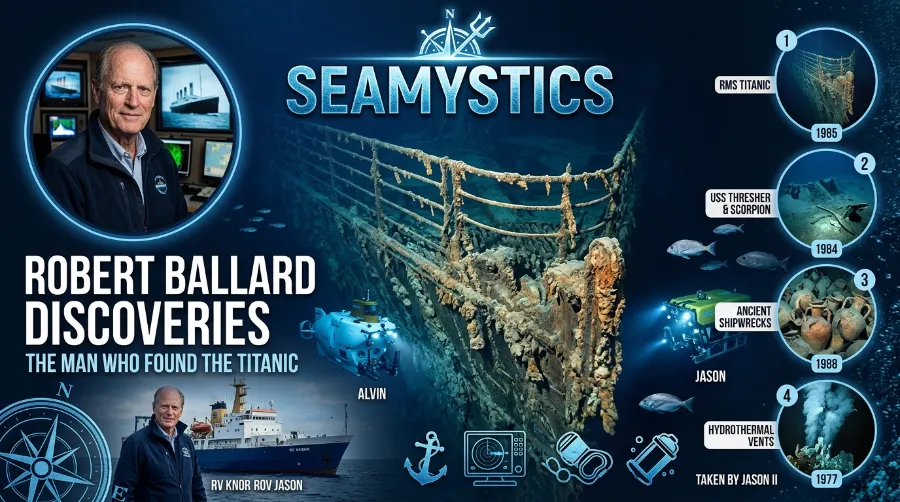
From there, his path took a military turn. He joined the Army through ROTC, served two years, then transferred into the Navy, where he later commanded a research submarine unit during the Cold War. That Navy connection would matter enormously in 1985, though almost nobody knew it at the time.
By the 1970s, Ballard had settled at the Woods Hole Oceanographic Institution in Massachusetts, working as a marine geologist. It was there, not on the Titanic project, that his first truly world-changing discovery happened.
The Discovery Nobody Expected: Hydrothermal Vents, 1977
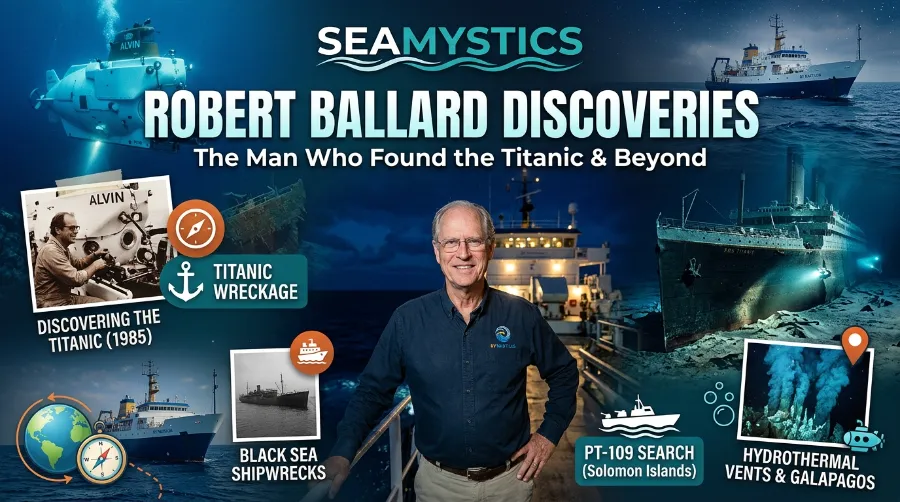
Before Ballard became “the Titanic guy,” he was part of a team hunting for something completely different: heat escaping from the ocean floor along the Galapagos Rift, about 250 miles northeast of the Galapagos Islands. On February 17, 1977, the submersible Alvin descended roughly 2,500 meters and found shimmering, mineral-rich water pouring out of cracks in the seafloor.
Eugenie Clark The Shark Lady Who Changed Marine Biology
Nobody on that expedition had thought to bring a biologist. That turned out to be a mistake, because clustered around those vents were thriving colonies of tube worms, clams, and other creatures nobody had ever documented living in total darkness, under crushing pressure, with no sunlight at all. It rewrote a basic assumption in biology: that life on Earth ultimately depends on the sun.
A few things worth noting about that expedition:
- It used ANGUS, a towed camera sled, to scout the seafloor before Alvin ever dove.
- The crew nicknamed their tracking transponders Sleepy, Dopey, and Bashful.
- Since 1977, more than 500 active hydrothermal vent fields have been mapped worldwide, a direct legacy of that first find.
This discovery gets far less attention than the Titanic, but among marine biologists, it may be the more important one. It’s a theme that runs through the wider story of famous ocean explorers, many of whom made their biggest mark on something other than what made them famous.
How Robert Ballard Found the Titanic Wreck
By 1982, Ballard was determined to locate the Titanic, but research funding for shipwreck hunting is not easy to come by. So he pitched an idea to the Navy: fund his deep-sea robotics work, and he would use it to search for two lost nuclear submarines, the USS Thresher and USS Scorpion, both sunk in the Atlantic during the 1960s. The Navy agreed, on one condition. The submarine search had to stay classified.
HMS Challenger Expedition The Voyage That Founded Oceanography
Ballard has since said that when Navy officials asked how he would explain his time at sea, his answer was simple: tell the world he was hunting for the Titanic. That cover story became the actual mission almost by accident.
He completed the submarine survey work in the summers of 1984 and used his last twelve days that August, and then again in 1985, to search for the Titanic itself. A French team using sophisticated sonar had already spent five frustrating weeks scanning a hundred-mile area without success. When the French crew left, Ballard’s team moved in with the Argo, a deep-towed camera sled built for exactly this kind of search.
Marie Tharp Mapping The Woman Who Mapped the Ocean Floor
Late in the night of August 31, 1985, wreckage debris appeared on Argo’s monitors, followed soon after by an unmistakable image of a ship’s boiler. It took roughly eight days of searching to get there, and the wreck sat about 12,600 feet below the surface, near the site suggested by the debris field.
A short list of numbers that tend to get lost in retellings:
- The Titanic sank on April 15, 1912, after striking an iceberg the night before.
- Around 1,500 people died; roughly 700 survived and were rescued by the RMS Carpathia.
- It took 73 years for anyone to locate the wreck.
- Ballard’s own first attempt to find it, back in 1977 aboard a drillship called Seaprobe, failed when the drill pipe snapped.
Robert Ballard’s Career After the Titanic
Ballard’s ocean exploration career did not stop in 1985. In 1986, he returned to the site and sent the smaller robot Jason into the wreck itself to photograph its interior, a moment many consider the true birth of remote shipwreck archaeology.
From there, his list of finds kept growing. He located the German battleship Bismarck, the RMS Lusitania, and what’s known as the lost fleet of Guadalcanal, a group of World War Two warships sunk during a brutal 1942 naval campaign in the Pacific. He also helped find some of the oldest deep-water shipwrecks ever recorded, ancient Phoenician trading vessels off the coast of Israel.
Auguste Piccard The Engineer Behind the First Deep Dives
In 2008, Ballard founded the Nautilus Exploration Program, now run through the Ocean Exploration Trust, sending the research vessel E/V Nautilus out to explore the seafloor using remotely operated vehicles and streaming footage live to schools and the public. He also holds a long-standing position as professor of oceanography at the University of Rhode Island. In many ways, his later career mirrors the arc of other pioneers covered in our piece on Jacques Cousteau’s legacy, another figure who turned deep-sea work into something the public could actually watch unfold.
Why the Titanic Discovery Still Matters
Part of what makes the 1985 discovery endure isn’t just the ship, it’s what it proved was possible. Before Argo and Jason, deep-ocean search was slow, expensive, and mostly guesswork. Ballard’s approach, towed camera sleds paired with a smaller maneuverable robot, became the blueprint for practically every deep-sea search that followed, including modern efforts to locate missing aircraft and submarines.
Don Walsh Trieste The First Man to Reach the Challenger Deep
The discovery also triggered a wave of public fascination that hasn’t really faded. The 1997 Titanic film, museum exhibits worldwide, and ongoing legal battles over salvage rights all trace back to that one September night. Ballard himself has said he regrets how commercialized the wreck site later became, and has pushed for it to be treated as a memorial and archaeological site rather than a target for souvenir hunters.
For context on how this fits into the broader story of ocean exploration, it’s worth reading how the 1870s HMS Challenger expedition first mapped the deep ocean floor, or how Sylvia Earle’s achievements pushed human diving depth records decades later. Ballard’s work sits squarely in that lineage: each generation of ocean explorers builds the tools the next one needs.
Robert Ballard Discoveries at a Glance
| Year | Discovery | Location |
|---|---|---|
| 1977 | Hydrothermal vents | Galapagos Rift, Pacific Ocean |
| 1985 | RMS Titanic | North Atlantic, ~400 miles off Newfoundland |
| 1989 | German battleship Bismarck | North Atlantic |
| 1993 | RMS Lusitania (detailed survey) | Off the Irish coast |
| 1998 | Lost fleet of Guadalcanal | Solomon Islands, South Pacific |
| 1999 | Ancient Phoenician shipwrecks | Off the coast of Israel |
Frequently Asked Questions
Who found the Titanic wreck?
Robert Ballard, an American oceanographer working with Woods Hole Oceanographic Institution and a French research team, found it on September 1, 1985.
How deep is the Titanic wreck?
The wreck sits approximately 12,600 feet (about 3,840 meters) below the ocean’s surface.
Was the Titanic search really a secret Navy mission?
Partly. Ballard’s underwater robot funding came from the Navy, on the condition he first locate two sunken nuclear submarines, a mission that stayed classified for years.
What is Robert Ballard’s most important discovery?
Public attention centers on the Titanic, but many scientists consider his 1977 hydrothermal vent discovery more scientifically significant, since it revealed life could exist without sunlight.
Is Robert Ballard still exploring the ocean?
Yes. Through the Ocean Exploration Trust and the Nautilus Exploration Program, he continues to lead expeditions and stream discoveries publicly.
Conclusion
Robert Ballard’s career refuses to fit into a single headline. He is the man who found the Titanic, yes, but he is also the geologist who helped reveal an entirely new form of life at the bottom of the sea, the engineer who built the robots that made modern shipwreck hunting possible, and the educator still streaming ocean expeditions to classrooms decades later. Taken together, his work changed both how we search the ocean and what we expect to find there.
References
- Woods Hole Oceanographic Institution, “1985 Discovery of RMS Titanic”
- Britannica, “Robert Ballard: American Oceanographer”
- CBS News, “Robert Ballard Found the Titanic Wreckage in 1985”
- History.com, “The Real Story Behind the Discovery of Titanic’s Watery Grave”
- Titanic Belfast, “Robert Ballard: The Man Behind RMS Titanic Discovery”
- Nautilus Live, “40 Years of Hydrothermal Vent Exploration”
- Lithub, “Robert Ballard: The Man Who’s Discovered More Than Just the Titanic”
- Under the C Blog, “Exploring the Deep with Dr. Robert Ballard”
- Veterans Breakfast Club, “Legendary Undersea Archeologist Robert Ballard”