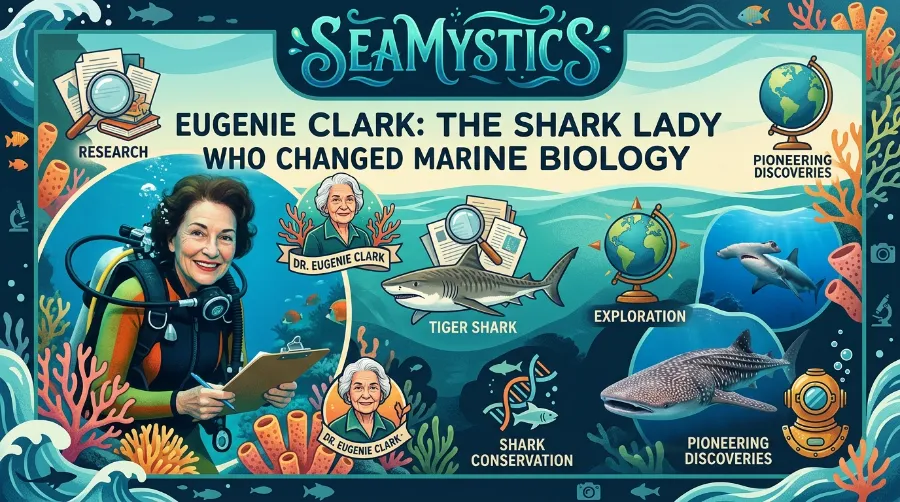

Most people who fear sharks have never met one. Eugenie Clark met thousands of them. As a result, she came away convinced they were among the most misunderstood animals on the planet. Her lifelong body of Eugenie Clark research did not just add footnotes to marine biology textbooks. It rebuilt entire chapters of them. Long before shark conservation became a hashtag, Clark was already in the water. She proved that sharks could learn, remember, and behave with far more intelligence than anyone gave them credit for.
Don Walsh Trieste The First Man to Reach the Challenger Deep
By 2015, when she passed away at age 92, she had logged more than 70 submersible dives. She had also authored over 175 scientific papers and earned a nickname that stuck for good: the Shark Lady. This piece walks through her life, her boldest discoveries, and why her work still shapes how scientists and the public think about sharks today.
Key Takeaways
| Focus Area | What You Need to Know |
|---|---|
| Full name and title | Eugenie “Genie” Clark, Ph.D., American ichthyologist (1922 to 2015) |
| Signature nickname | The Shark Lady, earned through decades of hands-on shark behavior research |
| Major institution founded | Cape Haze Marine Laboratory in 1955, later renamed Mote Marine Laboratory in 1967 |
| Career span | Over 50 years of active field research, more than 175 published papers |
| Best-known discovery | Lemon sharks can be trained and remember tasks for months, disproving the “sharks are mindless” myth |
| Species discovered | Multiple fish species, including the Red Sea Moses sole and Trichonotus nikii |
| Notable honor | Featured on a United States Postal Service stamp in 2022 for her 100th birthday |
TL;DR: Eugenie Clark research proved that sharks could learn, remember, and think in ways scientists once dismissed. Her 1955 founding of what became Mote Marine Laboratory turned shark behavior study into a serious scientific field. Her fieldwork across the Red Sea, the Caribbean, and Japan produced new species discoveries, and her decades of published research still guide shark conservation today.
Who Was Eugenie Clark? A Quick Eugenie Clark Biography
Eugenie Clark was born in New York City on May 4, 1922, to an American father and a Japanese mother. Her father died when she was an infant. Because of that, her mother raised her largely alone at first, and Clark grew up as one of the only students of Japanese heritage at her school in Woodside, Long Island. That early experience of standing apart, combined with a fascination that started on childhood visits to the New York Aquarium at Battery Park, quietly shaped the scientist she would become.
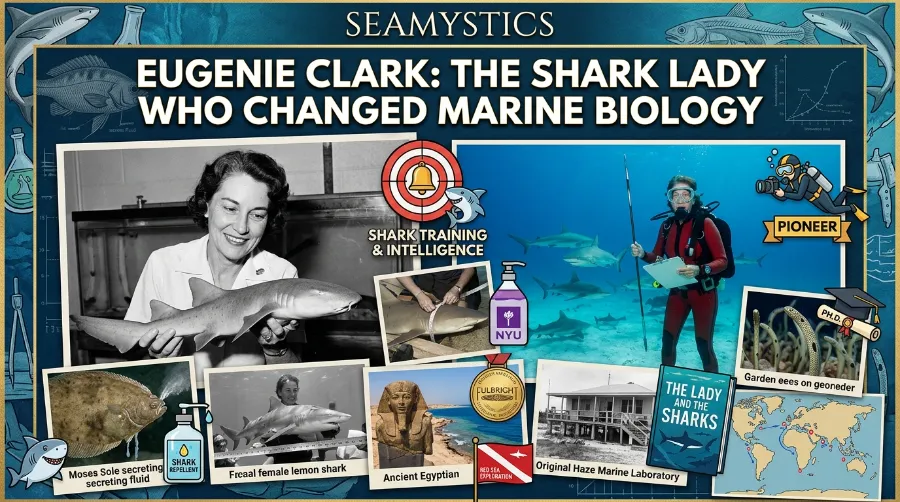
She earned a bachelor’s degree in zoology from Hunter College in 1942. From there, she wanted to continue at Columbia University. However, a professor reportedly warned her that funding a woman’s education was pointless, since she would “probably get married, have a bunch of kids, and never do anything in science.” Clark ignored the warning anyway. She completed her master’s and Ph.D. at New York University, finishing her doctorate in 1950, the same year she won a Fulbright scholarship.
That scholarship sent her to Egypt’s Red Sea coast, where she worked out of the Al-Ghardaqah Marine Biological Station. The trip later became the foundation of her 1953 memoir, Lady with a Spear, an international bestseller. It introduced everyday readers to the strange, beautiful world beneath the waves, years before scuba diving became common. For the deeper story of how pioneering ocean explorers built the field she stepped into, our guide to famous ocean explorers traces that same lineage.
Early Career and the Path Into Ichthyology
Before she became known for sharks, Clark specialized in something arguably just as risky: poisonous tropical fish. She held research positions at the Scripps Institution of Oceanography, the American Museum of Natural History, and the New York Zoological Society, now the Wildlife Conservation Society. These roles gave her access to specimens and labs that most women scientists of the 1940s and 1950s could only dream of.
Even so, she often faced quiet discrimination. She was frequently one of very few women, and the only Japanese American, in her graduate classes. Still, she pushed through. By the early 1950s, she had built a reputation as a meticulous, fearless field researcher who preferred diving herself over sending assistants down.
Founding Cape Haze: The Birth of Modern Shark Lady Scientist Research
In 1955, with funding from William H. Vanderbilt, Clark helped establish the Cape Haze Marine Laboratory in Placida, Florida. It started as essentially a one-woman operation with a single fisherman as her assistant. The lab then moved to Siesta Key in 1960, and later to Sarasota in 1978, growing the entire time.
The origin story of her shark research is almost accidental. A cancer researcher first asked Clark to help capture sharks so their livers could be studied for medical purposes. That request eventually led to the construction of a live shark pen at the lab, and Clark quickly realized she had a rare opportunity sitting in her own backyard.
By 1967, the laboratory had grown enough to earn a new name: Mote Marine Laboratory, honoring major benefactor William R. Mote. Today it runs dozens of research programs and a public aquarium, and it remains one of the most cited institutions in shark science. For context on how other ocean research hubs scaled up in similar fashion, our breakdown of the HMS Challenger expedition shows how a single voyage launched an entire discipline, much like Cape Haze launched modern shark behavior research.
The Lemon Shark Experiments That Changed the Field
Starting around 1958, Clark ran a series of experiments that remain textbook material in ichthyology courses today. Working with lemon sharks in the lab’s holding pens, she trained them to push a wooden target and ring a submerged bell to receive a food reward.
What she found upset decades of assumptions:
- Lemon sharks learned to distinguish between correct and incorrect targets within a matter of weeks.
- The sharks retained that learned behavior for months, even after the targets were removed from their environment.
- Some sharks showed individual personality differences in how quickly they learned and how they approached the target.
At the time, most people viewed sharks as little more than eating machines running on pure instinct. Clark’s data said otherwise. As a result, the scientific community started treating shark cognition as a legitimate research area rather than a curiosity.
Eugenie Clark Discoveries: New Species and Field Breakthroughs
Clark’s curiosity was never limited to one ocean or one species. Her Fulbright-funded work in the Red Sea alone produced discoveries that outlived her by decades.
- The Red Sea Moses sole (Pardachirus marmoratus): Clark identified that this flatfish secretes a natural substance that repels sharks. That finding later informed research into non-lethal shark deterrents used by divers and swimmers.
- Trichonotus nikii: A species of Red Sea sand diver fish, named after her son Nikolas and discovered during her extensive fieldwork in Egyptian waters.
- Squalus clarkae, commonly called Genie’s dogfish, a shark species later named in her honor. This cemented her legacy directly into the taxonomy of the animals she studied.
She also helped disprove a long-standing myth: the idea that sharks must keep swimming constantly to breathe. During a dive off Mexico’s Yucatán Peninsula near Isla Mujeres in 1975, Clark and her team found underwater caves where sharks appeared to be resting almost motionless. Currents of oxygen-rich, lower-salinity water flowed through the caverns and kept the animals alive. The “sleeping sharks” discovery made international headlines. Afterward, marine biologists had an entirely new behavioral category to study.
Her fascination with megafauna also produced one of her more famous personal moments. She once rode alongside a 40-foot whale shark off the California coast as it cruised at roughly three knots, an experience she later described as proof of just how gentle the largest fish in the ocean could be.
A Career Told in Numbers
| Milestone | Year | Detail |
|---|---|---|
| Born in New York City | 1922 | Daughter of an American father and Japanese mother |
| B.A. in zoology, Hunter College | 1942 | First academic step toward marine science |
| Ph.D., New York University | 1950 | Same year she received her Fulbright scholarship |
| Founded Cape Haze Marine Laboratory | 1955 | Later renamed Mote Marine Laboratory in 1967 |
| Published Lady with a Spear | 1953 | International bestseller, translated into multiple languages |
| Sleeping sharks discovery, Yucatán caves | 1975 | Disproved the myth that sharks must move constantly to breathe |
| Last documented dive | 2014 | Completed at age 92, results published January 2015 |
| Passed away in Sarasota, Florida | February 25, 2015 | Age 92, after a battle with lung cancer |
| Honored with a USPS postage stamp | 2022 | Released on what would have been her 100th birthday |
Female Shark Scientist History: Why Clark’s Story Still Matters
Clark’s career unfolded during a period when female shark scientist history barely existed as a recognized category. Schools and departments routinely steered women away from field science. In fact, the marine biology departments of the 1940s and 1950s were overwhelmingly male. Clark’s persistence, and her refusal to quietly accept the limits placed on her, eventually opened doors for the generations of women researchers who followed.
She was not alone in reshaping how the public saw ocean science. Around the same era, and in the decades after, researchers like Sylvia Earle carried that same torch forward into deep-sea exploration. If her story interests you, our profile on Sylvia Earle’s achievements picks up many of the same conservation themes Clark championed decades earlier.
Clark married five times and raised four children with her second husband. Meanwhile, she kept publishing and diving well into her senior years. She often pointed out that the idea of women needing to choose between family and science was itself a myth, and one that needed debunking just as much as the myths about sharks.
Recognition and Honors
Clark received three honorary doctoral degrees over her lifetime, along with awards from the National Geographic Society, the Explorers Club, and the Underwater Society of America. In 1996, she also won an Emmy Award for her underwater filmmaking. She wrote a dozen feature articles for National Geographic magazine and collaborated closely with underwater photographer David Doubilet on many of them, according to the Smithsonian’s profile of her career.
How Eugenie Clark Research Shapes Marine Biology Today
Modern shark conservation efforts owe a real debt to Clark’s early work. Her lemon shark learning experiments are still cited in comparative cognition research today. Meanwhile, her advocacy helped shift public shark policy away from pure fear-based management toward evidence-based conservation.
A few ways her influence still shows up in current marine science:
- Shark cognition studies at institutions worldwide now build directly on the target-training protocols Clark pioneered in the late 1950s.
- Her Moses sole research contributed to decades of follow-up work on natural and synthetic shark repellents used in diving safety gear.
- Public education campaigns about shark conservation frequently trace their messaging strategy back to Clark’s approach of replacing fear with curiosity.
Researchers writing for Sharks4Kids’ profile of Clark note that she authored or co-authored over 175 scientific papers and three books across her career. That publication record still stands out today, even by modern academic standards. This volume of work, paired with her refusal to stop diving well into her 90s, explains why her name still comes up whenever marine biologists discuss the roots of modern shark science. For a look at other deep-diving pioneers from around the same era, our piece on Auguste Piccard’s bathyscaphe covers a parallel chapter of ocean history.
Frequently Asked Questions
Why was Eugenie Clark called the Shark Lady? The nickname came from decades of hands-on shark behavior research. It started with her lemon shark training experiments in the late 1950s at Cape Haze Marine Laboratory. Her willingness to dive directly with sharks, rather than study them from a boat, cemented the name in public and scientific circles alike.
What did Eugenie Clark discover about sharks? She proved that sharks could be trained and could retain learned behavior for months. This directly challenged the old assumption that sharks operated on pure instinct. She also helped document sleeping sharks resting in underwater caves off Mexico, disproving the myth that all sharks must swim constantly to breathe.
How many species did Eugenie Clark discover? Her fieldwork, particularly in the Red Sea, led to the identification of several fish species, including the Red Sea Moses sole and Trichonotus nikii. Later, researchers named a shark species, Squalus clarkae, in her honor.
What laboratory did Eugenie Clark found? She founded the Cape Haze Marine Laboratory in 1955 in Placida, Florida. It relocated twice and was renamed Mote Marine Laboratory in 1967. It remains an active marine research center in Sarasota today.
When did Eugenie Clark die? Clark passed away on February 25, 2015, in Sarasota, Florida, at age 92, following a battle with non-smoking-related lung cancer. She had completed her final documented dive just months earlier, still at age 92.
Conclusion
Eugenie Clark spent more than half a century proving that curiosity, not fear, was the right lens for understanding sharks. Her research turned a widely feared animal into a subject of serious scientific study. At the same time, her career opened a path for women in marine biology at a time when very few doors were open. From the lemon shark pens of Cape Haze to the sleeping shark caves of the Yucatán, her fieldwork changed textbooks and, more importantly, changed minds. Explore more pioneers who shaped modern ocean science on our full library of famous ocean explorers.
References
- Britannica, “Eugenie Clark | Biography, Books, Stamp, & Facts,” https://www.britannica.com/biography/Eugenie-Clark
- National Geographic, “‘Shark Lady’ Eugenie Clark, Famed Marine Biologist, Has Died,” https://www.nationalgeographic.com/adventure/article/150225-eugenie-clark-shark-lady-marine-biologist-obituary-science
- Mote Marine Laboratory & Aquarium, “Dr. Eugenie ‘Genie’ Clark (1922-2015),” https://mote.org/staff/dr-eugenie-clark/
- NOAA Ocean Service, “Dr. Eugenie Clark (1922-2015),” https://oceanservice.noaa.gov/news/may15/eugenie-clark.html
- Smithsonian Ocean, “Eugenie Clark: The Shark Lady,” https://ocean.si.edu/ocean-life/sharks-rays/eugenie-clark-shark-lady
- Sharks4Kids, “My Science Hero: Eugenie ‘The Shark Lady’ Clark, American Ichthyologist,” https://www.sharks4kids.com/post/my-science-hero-eugenie-the-shark-lady-clark-american-ichtyologist
- Wildlife Conservation Society, “Eugenie Clark: The Shark Lady,” https://blog.wcs.org/photo/2022/03/10/eugenie-clark-the-shark-lady-sea-lion-womens-history-month/