
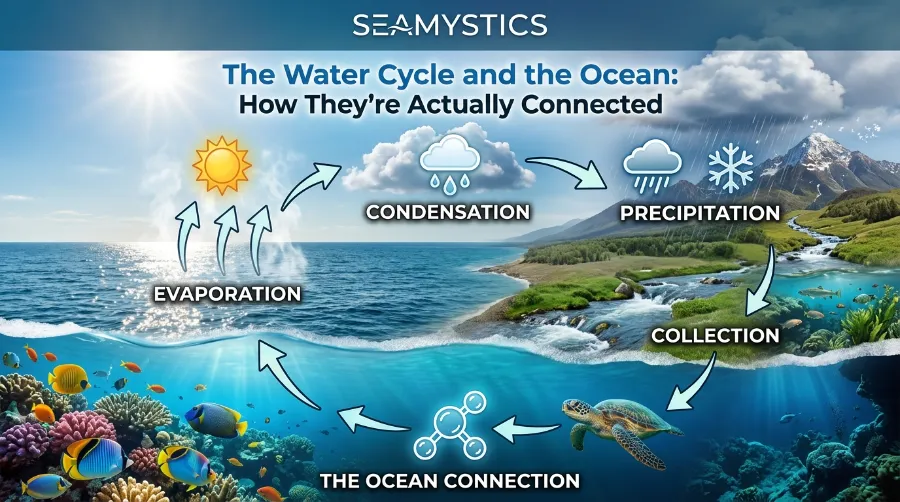

Close your eyes and picture the water cycle. Chances are you’re seeing a simple diagram: a cloud, an arrow, some rain, a river winding back to the sea. It’s the version most of us learned in grade school, and it leaves out the one detail that matters most. The ocean water cycle isn’t a side character in this story. It is the story. Nearly every drop of water falling on your roof tonight has, at some point, been part of the sea.
How Underwater Earthquakes Cause Tsunamis The Real Tsunami Formation Science
I have spent two decades reading current data, sampling water columns, and explaining ocean systems to people who assumed rain just “happened.” The gap between that simple classroom diagram and what is actually going on beneath the waves is bigger than most people realize, and closing that gap changes how you think about drought, storms, and even your own tap water.
TL;DR: The ocean water cycle explained simply: the ocean supplies about 86% of the water vapor that evaporates into our atmosphere and receives roughly 78% of all precipitation directly back. Warming seas are speeding this exchange up, which means more intense storms in some regions and deeper droughts in others.
| Quick Facts | Figure |
|---|---|
| Water held in the ocean | ~97% of Earth’s total water |
| Share of global evaporation from the ocean | ~86% |
| Share of global precipitation falling back on the ocean | ~78% |
| Increase in atmospheric moisture per 1°C of warming | ~7% |
| Water in the atmosphere at any moment | ~0.001% of Earth’s total |
What the Ocean Role in the Water Cycle Actually Looks Like
The hydrologic cycle ocean process starts with sunlight. Solar heat strikes the sea surface, and water molecules gain enough energy to break free as vapor. This single step, evaporation ocean facts tell us, accounts for the overwhelming majority of moisture entering our skies since the ocean covers 70% of Earth’s surface and contains nearly all its free water, giving it a dominant role in the global water cycle, while the atmosphere holds only a thin sliver of that total.
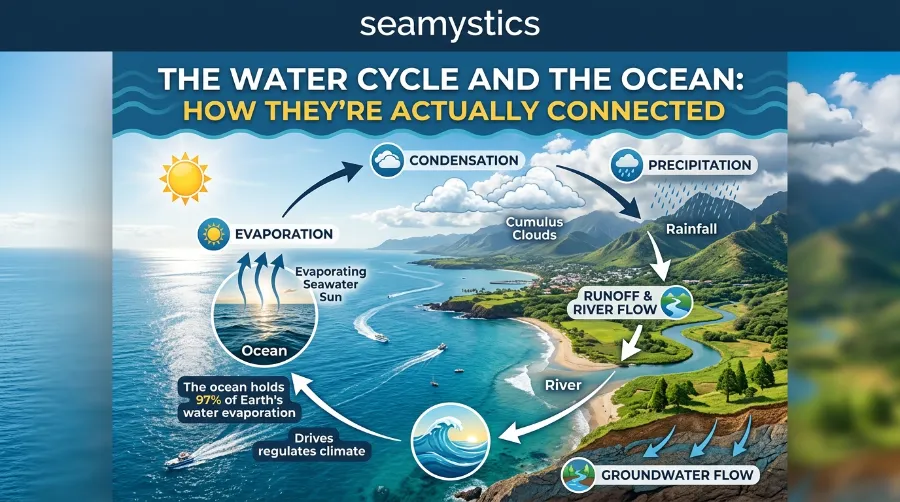
That vapor does not simply vanish upward. It rises, cools, and condenses into the clouds that eventually deliver rain or snow, whether over open water or hundreds of miles inland. According to research compiled by NOAA-affiliated salinity scientists, 86% of global evaporation and 78% of global precipitation occurs over the oceans, meaning the cycle mostly plays out at sea, with only the leftover moisture reaching continents.
Why So Much of the Cycle Happens Over Open Water
A few forces make the ocean the water cycle’s main engine rather than a minor contributor:
- Surface area: oceans cover about seven-tenths of the planet, giving heat far more liquid to act on than lakes or rivers ever could.
- Heat retention: seawater absorbs and releases heat slowly, so evaporation continues around the clock rather than spiking briefly at midday.
- Salinity feedback: as water evaporates, salt stays behind, and that changing salinity is now used by NASA and other agencies as a record of how the water cycle is operating and shifting over time. Ocean Conservancy
- Constant supply: because the ocean holds the vast majority of Earth’s water, it rarely runs short of material to convert into vapor.
How Salinity Affects Marine Life Survival
From Vapor to Rainfall: Water Cycle Explained Ocean-First
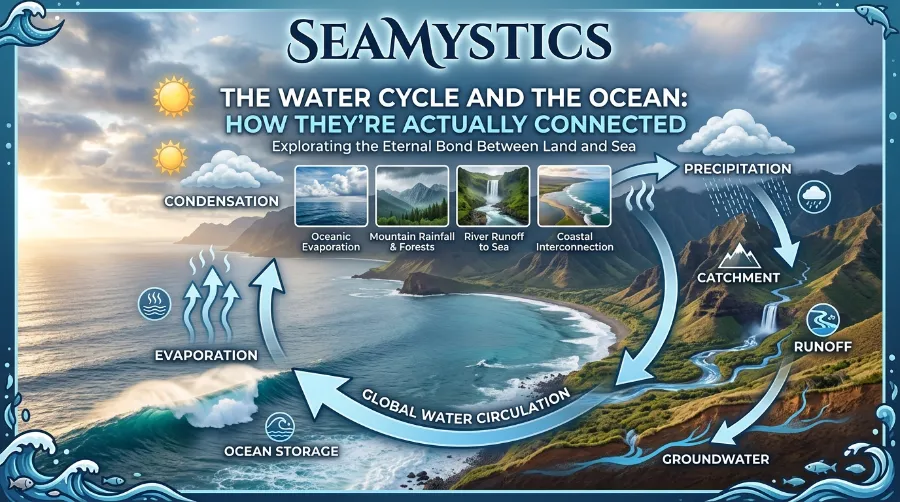
Once vapor condenses into clouds, wind patterns carry it toward land or keep it circulating over open sea. Either way, gravity eventually pulls it back down as precipitation. A portion soaks into soil and refills aquifers; another portion runs across the surface into streams, rivers, and back to the coast, closing the loop.
How Icebergs Form and Why Most of Them Stay Hidden
This isn’t an abstract process. In February 2024, an atmospheric river event pulled moisture straight off the Pacific and dumped record rainfall on Southern California, flooding streets in Los Angeles County within 48 hours. That single storm system moved more water than some rivers carry in a year, and every drop of it began as ocean evaporation days earlier off the coast.
Why the Dead Sea Isn’t Technically an Ocean The Dead Sea Science Behind the Myth
Ocean Evaporation Facts That Change How You See Storms
The scale here is genuinely hard to grasp. The ocean holds close to 1.34 billion cubic kilometers of water, and it is constantly trading portions of that volume with the sky above it. Warmer oceans intensify this exchange rather than slowing it down.
What Determines Ocean Water Temperature by Region
For every 1°C the atmosphere warms, its capacity to hold water vapor increases by roughly 7%, following the Clausius-Clapeyron relationship that meteorologists rely on for storm forecasting. That single physical rule explains why coastal storms have grown noticeably wetter over the past two decades, and why the same warming ocean that fuels evaporation also fuels stronger downpours once that moisture condenses.
What Causes Ocean Currents to Reverse Seasonally
Consider Hurricane Helene in September 2024. It intensified rapidly over the unusually warm Gulf of Mexico before making landfall in Florida’s Big Bend region, then dropped catastrophic rainfall as far inland as western North Carolina. The storm’s fuel was ocean heat and ocean moisture, not land-based weather. Events like this are becoming the clearest, most visible evidence of ocean role water cycle dynamics playing out in real time.
The Deep Circulation Most People Never Learn About
Surface evaporation gets most of the attention, but a slower, deeper current matters just as much. Cold, salty water in the North Atlantic sinks and travels along the ocean floor, eventually resurfacing thousands of miles away in the Indian and Pacific Oceans through a process called upwelling. Oceanographers call this the global conveyor belt, and it links the surface water cycle to a much longer, deeper cycle that can take a thousand years to complete a single loop.
Why Some Seas Have No Tides At All
This deep circulation regulates regional climates far beyond where the water actually evaporates. Northern Europe, for instance, stays milder than its latitude would suggest largely because of heat carried by this circulation. Slower conveyor circulation, a trend some studies have flagged over the past fifteen years, could eventually cool parts of the region even as the planet as a whole warms.
Sea Spray Science How Ocean Droplets Shape Coastal Weather
How Climate Change Is Reshaping the Ocean Water Cycle
Three shifts are worth watching closely, because they are already measurable rather than speculative:
- Wet regions are getting wetter. Areas that already receive heavy ocean-driven rainfall, like Southeast Asia and the US Gulf Coast, are seeing more intense storm totals.
- Dry regions are getting drier. Areas that depend on weaker or more distant moisture transport, including parts of the Mediterranean and the American Southwest, are seeing longer dry spells.
- Salinity patterns are shifting. Salty ocean regions are growing saltier and fresh regions fresher, a pattern scientists use as a fingerprint of a strengthening water cycle rather than a stable one.
A 2012 study published in Science found that ocean salinity data pointed to a strong intensification of the global water cycle between 1950 and 2000, a trend that more recent monitoring suggests has continued rather than leveled off.
Frequently Asked Questions
Does all rain come from the ocean?
Not all of it, but most of it starts there. Roughly 86% of evaporated water originates over the sea, though some of that moisture travels far inland before falling as rain, and some rain comes from moisture recycled by plants and soil on land.
Why does ocean evaporation matter for weather forecasting?
Meteorologists track sea surface temperatures because warmer water evaporates faster and holds more energy, both of which directly influence how intense a storm becomes once it forms.
Is the ocean water cycle speeding up because of climate change?
Yes. Warmer air holds more moisture, which increases both evaporation and the intensity of resulting precipitation, a pattern confirmed by decades of salinity and rainfall monitoring.
How long does water actually stay in the ocean before it evaporates again?
On average, an individual water molecule spends roughly 3,000 years in the ocean before evaporating, compared to just about 9 days in the atmosphere, illustrating how much slower the ocean side of the cycle moves.
Conclusion
The water cycle taught in school isn’t wrong, just incomplete. Once you see how much of it happens over open ocean, from evaporation to deep circulation to the salinity shifts scientists now track as an early warning system, it becomes clear that a healthy, stable ocean is the backbone of predictable weather everywhere on Earth. Understanding this connection matters more each year, as warming seas quietly rewrite the pace and intensity of the cycle we’ve always taken for granted.If you want to go deeper into related ocean systems, our guides on ocean salinity and climate change, how hurricanes form over warm water, and the global ocean conveyor belt explained build directly on the ideas covered here.
References
- WHOI. “Water Cycle.” Woods Hole Oceanographic Institution. https://www.whoi.edu/ocean-learning-hub/ocean-topics/how-the-ocean-works/cycles/water-cycle/
- NASA GPM. “Water Cycle.” Precipitation Education. https://gpm.nasa.gov/education/articles/nasa-earth-science-water-cycle
- NASA Ocean Salinity Science Team. “Water Cycle, Ocean Change & Climate.” https://salinity.oceansciences.org/highlights09.htm
- 1Ocean. “The Water Cycle and Its Connection to the Ocean.” https://www.1ocean.org/news/the-water-cycle-and-its-connection-to-the-ocean
- CIMI. “Water in Motion: The Freshwater Cycle.” https://cimi.org/blog/water-in-motion-the-freshwater-cycle/
- Durack, P.J., Wijffels, S.E., Matear, R.J. “Ocean Salinities Reveal Strong Global Water Cycle Intensification During 1950 to 2000.” Science 336 (2012): 455-458.
- Ocean Conservancy. “How the Water Cycle Impacts the Weather and Our Ocean.” https://oceanconservancy.org/blog/2024/03/01/how-water-cycle-impacts-weather-ocean/