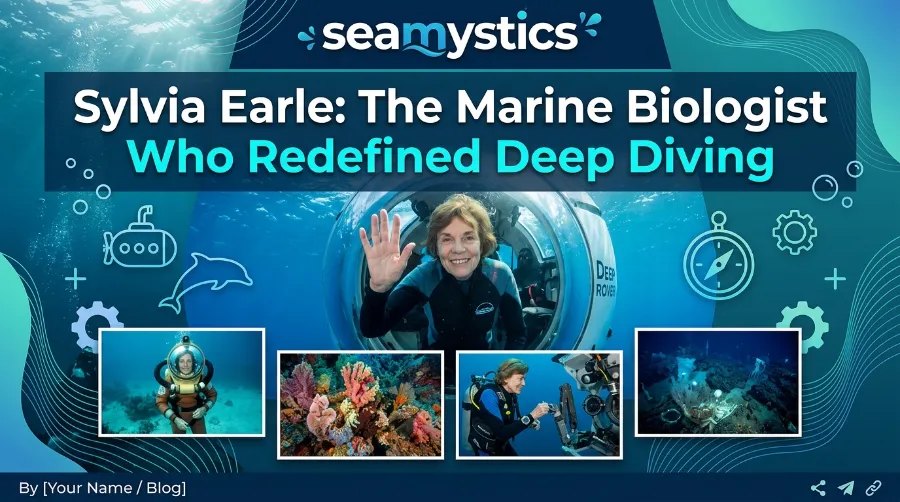

A three-year-old girl gets knocked flat by a wave on the New Jersey shore in 1938, and instead of running from the ocean, she decides she wants to know it better. That small, stubborn decision eventually produces one of the longest and most decorated careers in ocean science on record. Sylvia Earle’s achievements now span more than seven decades, a solo dive to 1,000 metres, a stint running America’s top ocean agency, and a conservation movement that protects millions of square kilometres of sea. This is the story of how a botany student from Florida became “Her Deepness,” and why her record still matters to anyone who cares about what happens beneath the waves.
Jacques Cousteau Legacy How He Changed Ocean Exploration Forever
TL;DR: Sylvia Earle is an American oceanographer who holds the record for the deepest untethered walk on the ocean floor (1,250 feet, 1979) and the deepest solo submersible dive by a woman (1,000 metres, 1985). She became NOAA’s first female chief scientist in 1990 and later founded Mission Blue, a conservation group that has now helped protect more than 57 million square kilometres of ocean through its Hope Spots network.
Eugenie Clark The Shark Lady Who Changed Marine Biology
Key Takeaways
| Achievement | Year | Detail |
|---|---|---|
| Deepest untethered ocean floor walk | 1979 | Descended 1,250 feet (381 metres) off Oahu, Hawaii, in a JIM suit |
| First all-female aquanaut team leader | 1970 | Led the Tektite II, Mission 6 team living underwater for two weeks |
| First woman as NOAA Chief Scientist | 1990 to 1992 | Oversaw the health of US federal waters |
| Deepest solo submersible dive by a woman | 1985 | Reached 1,000 metres near San Clemente Island in the Deep Rover |
| Founder of Mission Blue | 2009 | Grew from a single TED Prize wish into 168+ protected Hope Spots by 2025 |
| Total documented dive time | Ongoing | More than 7,000 hours underwater across 100+ expeditions |
A Childhood Built Near Water
Sylvia Earle was born on August 30, 1935, in Gibbstown, New Jersey, and spent her earliest years on a small farm outside Camden. Her parents were not academics, but they gave her something more useful for a future scientist: patience with the outdoors and permission to be curious. She filled jars with tadpoles from the backyard pond and wrote down what she saw, a habit that later turned into hundreds of published field notes.
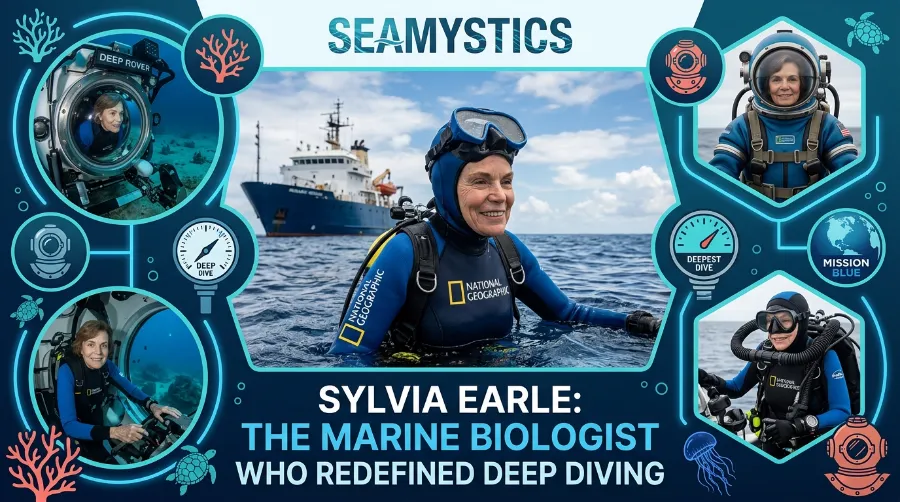
When she was 13, her family relocated to Dunedin, Florida, right on the Gulf of Mexico. The move changed everything. Instead of a pond, she now had an entire coastline to study, and she leaned into it hard enough to graduate high school at 16. This early relocation is one detail that a surprising number of profiles skip, yet it explains why her research base later shifted so firmly toward marine botany rather than freshwater biology.
Famous Ocean Explorers Everyone Should Know
Education and the First Sylvia Earle Diving Record
Earle earned a scholarship to Florida State University, where she studied botany and graduated at 19. It was during this period, around 1953, that she strapped on one of the first scuba tanks available in the United States, not long after Jacques Cousteau’s Aqua-Lung reached American shores. That single decision to get certified as a diver, rather than study marine plants only from shore or boat, set her apart from most botanists of her generation.
Robert Ballard Discoveries The Man Who Found the Titanic
By 20, she had a master’s degree in botany from Duke University. She continued research through the 1960s while raising two young children, including a 1964 stint aboard the research vessel Anton Bruun as part of a National Science Foundation expedition through the Indian Ocean. She finished her PhD in 1966, and her doctoral thesis required her to collect and classify more than 20,000 samples of algae from the Gulf of Mexico. That kind of unglamorous, repetitive fieldwork rarely makes the highlight reels, but it is exactly the kind of grinding data collection that built her scientific credibility long before the record dives made headlines.
Sylvia Earle Achievements That Rewrote the Diving Record Books
This is the section most readers are actually here for, so let’s get into the numbers.
- 1968 – First woman to dive in the Deep Diver. Four months pregnant, Earle descended 100 feet into the Bahamas in the submersible Deep Diver, becoming the first woman scientist to look out from its porthole.
- 1970 – Tektite II, Mission 6. She led the first all-female team of aquanauts, living in an underwater habitat off the Virgin Islands for two weeks while studying reef pollution. The team logged 154 species of marine plants, including 26 previously undocumented in the area.
- 1979 – The untethered depth record. Near Oahu, Hawaii, wearing a pressurized JIM suit, she walked the sea floor at 1,250 feet, planting a small American flag. No tether, no support line, just two hours alone at a depth that would crush an unprotected diver almost instantly. This is the achievement that earned her the nickname “Her Deepness.”
- 1985 – The Deep Rover solo dive. Piloting a submersible she helped design with her husband, Earle descended 1,000 metres off San Clemente Island, California, setting the women’s solo submersible depth record.
- 1990 to 1992 – NOAA Chief Scientist. She became the first woman to hold this role, overseeing federal research on the condition of United States waters during a period of growing alarm over overfishing.
Across her career, Earle has led more than 100 marine expeditions and logged over 7,000 hours underwater, the equivalent of roughly 291 straight days submerged. Few marine biologists, male or female, come close to that figure.
Sylvia Earle Ocean Conservation Work and Mission Blue
Diving records got Earle noticed. What kept her relevant for the next four decades was what she did with the attention. In 2009, she used her TED Prize to make a single wish public: a worldwide network of protected ocean areas she called Hope Spots. That wish became Mission Blue, the nonprofit she still leads.
HMS Challenger Expedition The Voyage That Founded Oceanography
The growth has been steady rather than flashy. By 2025, Mission Blue’s Hope Spots network had expanded to 168 sites across 115 countries, backed by more than 200 Hope Spot Champions and roughly 200 partner organizations, together helping safeguard over 57 million square kilometres of ocean. In early 2026, at 90 years old, Earle returned to the TED stage to argue that ocean recovery is not just possible but already happening in places where protection has been enforced long enough.
James Cameron’s Deepsea Challenger Dive Explained
Her conservation argument has always rested on a fairly simple idea: you cannot love, or vote to protect, something you have never seen. That is part of why she has spent so much of her later career on documentaries, books, and public talks rather than retreating into pure research.
- She has authored more than 200 scientific and popular publications.
- She has written or contributed to more than a dozen books, including Sea Change: A Message of the Oceans (1995).
- She has lectured in more than 80 countries.
Awards, Titles, and the “Her Deepness” Marine Biologist Legacy
Titles tend to pile up around Earle in a way that is rare even among decorated scientists. The New Yorker and New York Times both called her “Her Deepness.” The Library of Congress named her a Living Legend. Time magazine named her its first Hero for the Planet. She holds 27 honorary degrees, a figure most working scientists would consider unreachable in a single lifetime.
Marie Tharp Mapping The Woman Who Mapped the Ocean Floor
She has also sat on the boards or advisory councils of organizations ranging from the Woods Hole Oceanographic Institution to the Harte Research Institute, and her work quietly shaped a familiar piece of everyday technology: she served as an inspiration for the ocean layer built into Google Earth. If you have ever zoomed into the seafloor on a map app, you have brushed up against her influence without realizing it.
Don Walsh Trieste The First Man to Reach the Challenger Deep
It’s worth putting her career next to other giants of ocean exploration to see where she fits. Our pillar guide to famous ocean explorers puts her alongside figures like Jacques Cousteau, whose own legacy in popularizing scuba diving and undersea filmmaking actually intersected with Earle’s own career start, since it was Cousteau’s Aqua-Lung reaching the US market in 1953 that first put a scuba tank on her back.
How Her Record Compares
| Explorer | Signature Achievement | Depth or Milestone |
|---|---|---|
| Sylvia Earle | Untethered walk on ocean floor | 1,250 feet (1979) |
| Sylvia Earle | Solo submersible dive (women’s record) | 1,000 metres (1985) |
| Jacques Cousteau | Co-invented the Aqua-Lung | Popularized recreational scuba, 1943 |
| James Cameron | Solo dive to Challenger Deep | 10,908 metres (2012) |
It’s worth noting that Earle’s technology company, Deep Ocean Exploration and Research, developed the manipulator arm and tested components used in the submersible James Cameron later piloted to the Mariana Trench in 2012. Her fingerprints show up in deep-sea engineering well beyond her own dives.
Frequently Asked Questions
What is Sylvia Earle most famous for?
She is best known for holding the record for the deepest untethered walk on the ocean floor, at 1,250 feet in 1979, and for founding Mission Blue, the ocean conservation nonprofit behind the global Hope Spots network.
Why is Sylvia Earle called “Her Deepness”?
The nickname stuck after her 1979 record dive off Oahu, and it was popularized by outlets including the New Yorker and the New York Times to describe her unmatched depth of both diving experience and ocean advocacy.
How many hours has Sylvia Earle spent underwater?
More than 7,000 hours across over 100 expeditions, roughly the equivalent of 291 continuous days submerged.
Was Sylvia Earle the first woman to lead NOAA science?
Yes. She served as NOAA’s Chief Scientist from 1990 to 1992, the first woman to hold that role.
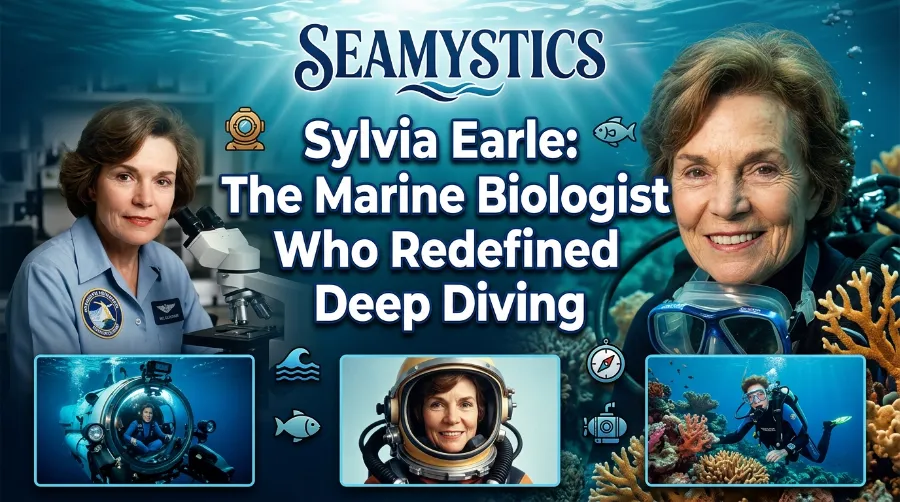
What is Mission Blue and how big is it now?
Mission Blue is the ocean conservation organization Earle founded in 2009. By 2025 its Hope Spots network had grown to 168 sites in 115 countries, protecting over 57 million square kilometres of ocean.
Auguste Piccard The Engineer Behind the First Deep Dives
Conclusion
Sylvia Earle’s achievements did not come from one lucky dive or one viral moment. They came from decades of unglamorous fieldwork, a willingness to go deeper than the rules of the day technically allowed for a pregnant scientist or a woman in a male-dominated field, and a stubborn refusal to stop advocating once the microphone got bigger. At 90, she is still on stages telling audiences that ocean recovery is possible if people act now. For anyone researching ocean exploration, her career is less a single achievement and more a working blueprint for how scientific credibility and public advocacy can reinforce each other over an entire lifetime. You can read more about explorers of her caliber in our full roundup of famous ocean explorers, or browse the rest of our marine science coverage on the Sea Mystics homepage.
References
- Britannica, “Sylvia Earle: Discoveries, Achievements, & Facts,” https://www.britannica.com/biography/Sylvia-Earle
- Guinness World Records, “Sylvia Earle: Her Deepness,” https://www.guinnessworldrecords.com/records/hall-of-fame/sylvia-earle-her-deepness
- Women’s History Museum, “Sylvia Earle Biography,” https://www.womenshistory.org/education-resources/biographies/sylvia-earle
- Duke University Graduate School, “Sylvia Earle, Face of Marine Biology, Receives Distinguished Alumni Award”
- Mission Blue, “Dr. Sylvia Earle: Founder of Mission Blue,” https://missionblue.org/the-mission/history-founder/
- Achievement.org, “Sylvia Earle,” https://achievement.org/achiever/sylvia-earle/
- Wings WorldQuest, “Sylvia Earle Explorer Profile,” https://wingswomenofdiscovery.org/explorer/earle/
- Volk Diving, “Sylvia Earle: Diving Pioneer Profile,” https://www.divevolkdiving.com/en-au/blogs/diving-knowledge/sylvia-earle-diving-pioneer-profile