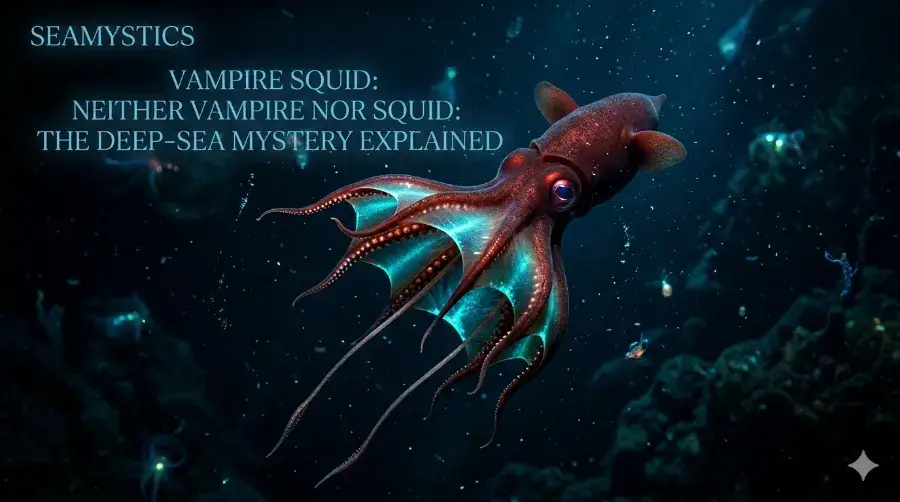

The phrase vampire squid neither vampire nor squid sounds strange at first. However, it perfectly describes one of the most unusual creatures living in Earth’s oceans. Despite its frightening name, this deep-sea animal does not drink blood, and scientists do not classify it as a true squid.
Instead, it belongs to a unique group of marine animals that share characteristics with both squids and octopuses. Furthermore, its remarkable adaptations allow it to survive in some of the harshest conditions on the planet.
Today, researchers continue to study this fascinating creature because it offers valuable insights into deep-sea evolution, survival, and biodiversity.
What Is the Vampire Squid?
The scientific name of the vampire squid is Vampyroteuthis infernalis, which means “vampire squid from hell.”
Although the name sounds terrifying, the animal is harmless to humans. In fact, it spends most of its life quietly drifting through the deep ocean.
Quick Facts Table
| Feature | Details |
|---|---|
| Scientific Name | Vampyroteuthis infernalis |
| Average Length | 15–30 cm (6–12 inches) |
| Habitat | Deep ocean (600–900 meters) |
| Lifespan | Up to 8 years |
| Diet | Marine snow, dead plankton, organic particles |
| Classification | Separate cephalopod lineage |
| Oxygen Tolerance | Extremely low oxygen environments |
Why Is the Vampire Squid Neither Vampire Nor Squid?
Many people wonder why scientists say vampire squid neither vampire nor squid.
The answer lies in biology and evolution.
It Is Not a Vampire
Unlike fictional vampires, this animal does not feed on blood.
Instead, it eats:
- Tiny organic particles
- Dead plankton
- Marine snow
- Small ocean debris
As a result, it behaves more like a deep-sea recycler than a predator.
It Is Not a True Squid
Scientists discovered that vampire squids form their own evolutionary branch.
Although they share traits with squids, they also possess features found in octopuses.
For example:
- Eight webbed arms
- Retractable sensory filaments
- Unique body structure
- Different evolutionary history
Therefore, researchers place them in a separate order known as Vampyromorphida.
Evolutionary History of the Vampire Squid
The vampire squid represents a living fossil.
Scientists estimate that its ancestors appeared approximately 300 million years ago.
Evolution Timeline
| Time Period | Event |
|---|---|
| 300 Million Years Ago | Early ancestors emerge |
| 200 Million Years Ago | Deep-sea adaptations develop |
| 100 Million Years Ago | Modern features evolve |
| Present Day | Unique survivor in deep oceans |
Because the species changed very little over millions of years, researchers consider it one of the ocean’s most ancient survivors.
Where Does the Vampire Squid Live?
The vampire squid inhabits deep ocean waters around the world.
Major Locations
- Atlantic Ocean
- Pacific Ocean
- Indian Ocean
- Mediterranean Sea
It typically lives between 600 and 900 meters below the surface.
At these depths:
- Sunlight disappears
- Temperatures remain cold
- Oxygen levels drop dramatically
Most marine animals cannot survive there. However, the vampire squid thrives in these conditions.
Deep-Sea Habitat Conditions
Environmental Comparison
| Factor | Surface Ocean | Vampire Squid Habitat |
|---|---|---|
| Sunlight | High | None |
| Oxygen | High | Very Low |
| Temperature | 15–30°C | 2–6°C |
| Pressure | Normal | Extremely High |
These conditions would challenge most animals. Nevertheless, the vampire squid has evolved specialized adaptations that make survival possible.
Amazing Adaptations for Survival
1. Low Oxygen Efficiency
One of the most impressive features is its ability to survive with very little oxygen.
Unlike most cephalopods, vampire squids have:
- Slow metabolism
- Specialized blood proteins
- Efficient oxygen transport systems
Consequently, they can inhabit oxygen minimum zones where predators struggle to survive.
2. Bioluminescence
The vampire squid can produce light.
Special organs called photophores generate glowing blue lights across its body.
Scientists believe these lights help:
- Confuse predators
- Communicate
- Provide camouflage
3. Energy Conservation
The deep sea contains limited food resources.
Therefore, the vampire squid conserves energy by:
- Moving slowly
- Floating rather than swimming
- Reducing unnecessary activity
This strategy helps maximize survival.
What Does the Vampire Squid Eat?
Unlike aggressive predators, vampire squids consume organic material drifting through the ocean.
Scientists call this material “marine snow.”
Main Food Sources
- Dead algae
- Tiny crustaceans
- Fecal particles
- Plankton remains
- Organic debris
Using long sensory filaments, they collect food and transport it toward their mouths.
As a result, they perform an important cleaning role within deep-sea ecosystems.
How Does the Vampire Squid Defend Itself?
Many deep-sea predators hunt in darkness.
Therefore, survival requires creative defenses.
Defensive Techniques
Bioluminescent Displays
When threatened, the vampire squid produces flashing lights.
These lights can confuse predators long enough for escape.
Inside-Out Cloak
The animal can turn its webbed arms inside out.
This behavior creates a dramatic cloak-like appearance.
Consequently, predators may become startled and retreat.
Sticky Light Particles
Instead of releasing ink like most squids, vampire squids eject glowing mucus particles.
This unique defense distracts attackers.
Vampire Squid vs True Squid
| Feature | Vampire Squid | True Squid |
|---|---|---|
| Blood Feeding | No | No |
| Habitat | Deep Ocean | Various Depths |
| Ink Sac | Absent | Present |
| Evolutionary Group | Vampyromorphida | Teuthida |
| Bioluminescence | Extensive | Limited |
| Diet | Marine Snow | Predatory |
The comparison clearly shows why scientists separate vampire squids from true squids.
Population and Conservation Status
Current research suggests that vampire squid populations remain relatively stable.
However, scientists continue monitoring them because deep-sea ecosystems face increasing threats.
Emerging Concerns
- Deep-sea mining
- Ocean warming
- Plastic pollution
- Ocean acidification
Protecting deep-ocean habitats will become increasingly important over the coming decades.
Latest Research Findings (2025–2026)
Marine researchers continue discovering new information about vampire squid biology.
Recent Highlights
| Research Area | Key Finding |
|---|---|
| Oxygen Use | Exceptional efficiency in low oxygen zones |
| Genetics | Ancient evolutionary lineage confirmed |
| Feeding Behavior | Greater reliance on marine snow than previously believed |
| Deep-Sea Ecology | Important recycler of ocean nutrients |
Researchers believe studying these animals may help explain how life adapts to extreme environments.
Chart: Vampire Squid Survival Advantages
| Adaptation | Survival Benefit |
|---|---|
| Bioluminescence | Predator avoidance |
| Slow Metabolism | Energy conservation |
| Oxygen Efficiency | Survival in dead zones |
| Webbed Arms | Defense and feeding |
| Sensory Filaments | Food collection |
Visual Representation
Bioluminescence      ██████████ 95%
Oxygen Efficiency    ██████████ 95%
Energy Conservation  █████████  90%
Defense Mechanisms   ████████   85%
Food Collection      ████████   85%
Interesting Facts About Vampire Squids
Here are some surprising facts:
- They can survive where many fish cannot.
- Their ancestors lived alongside dinosaurs.
- They produce light but not ink.
- They rarely chase prey.
- They occupy one of the deepest habitats among cephalopods.
- They represent a unique evolutionary branch.
Because of these traits, marine biologists often describe them as one of the ocean’s most unusual creatures.
Frequently Asked Questions
Is the vampire squid dangerous to humans?
No. The vampire squid is completely harmless to humans and lives far below recreational diving depths.
Why is it called a vampire squid?
Its dark color and cloak-like webbing inspired the name. However, it does not drink blood.
Is the vampire squid actually a squid?
No. Scientists classify it in its own unique evolutionary group.
How deep does the vampire squid live?
Most individuals live between 600 and 900 meters below the ocean surface.
What does the vampire squid eat?
It primarily consumes marine snow, organic particles, and plankton remains.
Can vampire squids glow?
Yes. They use bioluminescent organs to produce blue light for defense and camouflage.
Conclusion
The vampire squid neither vampire nor squid remains one of the most fascinating animals in the ocean. Although its name suggests a frightening predator, it is actually a peaceful deep-sea survivor with extraordinary adaptations. Moreover, its ability to thrive in dark, oxygen-poor waters continues to amaze scientists worldwide. As research advances, this mysterious creature will likely reveal even more secrets about life in Earth’s deepest oceans.