
The ocean remains one of the least explored places on Earth. Among its strangest residents is the Yeti crab, a remarkable species that survives in one of the harshest environments known to science. Unlike most crabs, this unusual creature grows thick hair-like structures on its claws. Even more surprising, it uses these structures to cultivate bacteria that serve as a food source.
you can read more related articles like sea mystries from our blog.
Scientists first discovered the Yeti crab in 2005 near hydrothermal vents in the Pacific Ocean. Since then, researchers have uncovered fascinating details about its behavior, biology, and ecological importance. As a result, the Yeti crab has become one of the most studied deep-sea animals in modern marine science.
What Is a Yeti Crab?
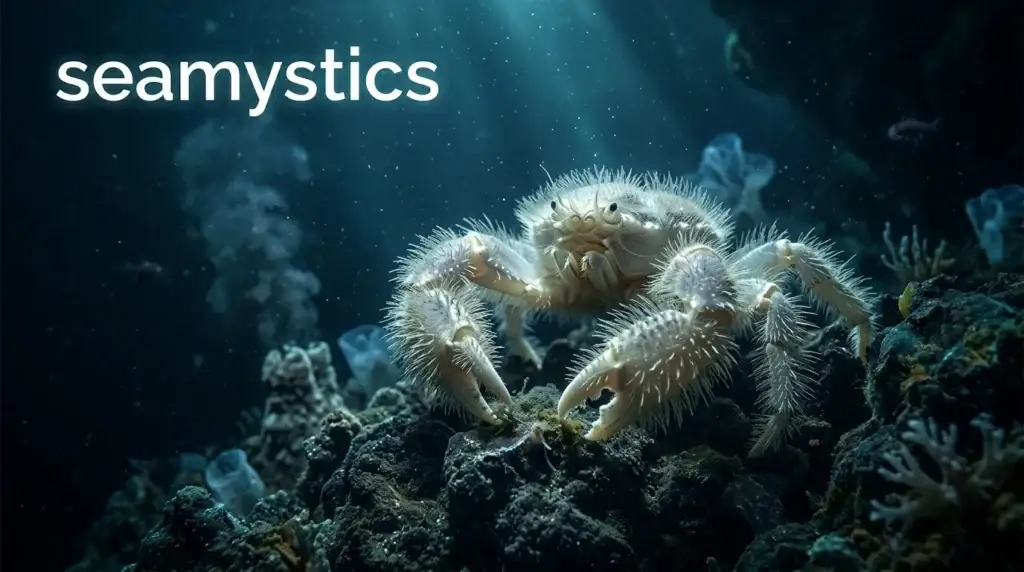
The Yeti crab belongs to the family Kiwaidae, a group of crustaceans adapted to extreme deep-sea environments. Its name comes from the dense setae, or hair-like filaments, covering its claws and limbs. These structures give the crab a furry appearance similar to the legendary Yeti.
Quick Facts About the Yeti Crab
| Feature | Details |
|---|---|
| Scientific Family | Kiwaidae |
| First Discovered | 2005 |
| Habitat | Hydrothermal vents and cold seeps |
| Average Length | 15 cm (6 inches) |
| Depth Range | 1,000–2,600 meters |
| Main Food Source | Bacteria grown on claws |
| Distribution | Pacific, Southern, and Antarctic Oceans |
Scientists have identified several species, including:
- Kiwa hirsuta
- Kiwa puravida
- Kiwa tyleri
Each species has adapted to unique deep-sea conditions.
How the Yeti Crab Farms Bacteria on Its Claws
The most fascinating feature of the Yeti crab is its ability to farm bacteria. The crab waves its hairy claws through chemical-rich water near hydrothermal vents. Consequently, bacteria grow on the filaments that cover the claws.
These bacteria convert chemicals such as hydrogen sulfide into energy through chemosynthesis. Unlike plants, they do not need sunlight.
The Farming Process
- The crab positions itself near vent openings.
- Chemical-rich water flows around its claws.
- Beneficial bacteria colonize the hair-like structures.
- The bacteria multiply over time.
- The crab harvests and eats the bacterial growth.
This relationship helps the crab survive where traditional food sources are scarce.
Why Hydrothermal Vents Matter
Hydrothermal vents are cracks in the ocean floor that release extremely hot, mineral-rich water. Temperatures can exceed 350°C (662°F), although surrounding seawater remains near freezing.
Characteristics of Hydrothermal Vents
| Feature | Value |
|---|---|
| Water Temperature | Up to 350°C |
| Ocean Depth | 1,000–4,000 meters |
| Sunlight Availability | None |
| Energy Source | Chemical compounds |
| Biodiversity | Extremely high |
Because sunlight cannot reach these depths, life depends on chemosynthesis rather than photosynthesis.
Deep-Sea Ecosystem Around the Yeti Crab
The Yeti crab shares its habitat with several unusual species.
Common Deep-Sea Neighbors
- Giant tube worms
- Vent shrimp
- Deep-sea mussels
- Vent fish
- Sea anemones
Together, these organisms create thriving ecosystems around hydrothermal vents.
Deep-Sea Food Web
| Organism | Role |
|---|---|
| Chemosynthetic Bacteria | Primary producers |
| Yeti Crab | Consumer |
| Vent Fish | Predator |
| Larger Deep-Sea Species | Top predators |
As a result, bacteria form the foundation of the entire ecosystem.
Adaptations That Help the Yeti Crab Survive
Life thousands of meters below the ocean surface presents many challenges. Nevertheless, the Yeti crab possesses several remarkable adaptations.
1. Specialized Hair-Like Setae
These structures provide a large surface area for bacterial growth.
2. Reduced Eyesight
Many Yeti crab species have poor vision because sunlight never reaches their environment.
3. Heat Tolerance
The crab can survive dramatic temperature differences between vent water and surrounding seawater.
4. Efficient Feeding Strategy
Instead of searching for food, the crab grows food directly on its body.
Where Scientists Have Found Yeti Crabs
Researchers have discovered Yeti crabs in several regions worldwide.
| Region | Species |
|---|---|
| Pacific Ocean | Kiwa hirsuta |
| Costa Rica Margin | Kiwa puravida |
| Southern Ocean | Kiwa tyleri |
The Antarctic species, Kiwa tyleri, gained attention because thousands gather around vent systems in dense clusters.
Population Density Around Antarctic Vents
Researchers observed extraordinary concentrations of Yeti crabs near Antarctic hydrothermal vents.
Estimated Density
| Area | Crabs per Square Meter |
|---|---|
| Typical Deep Sea | Less than 1 |
| Antarctic Vent Areas | Up to 700 |
This density ranks among the highest ever recorded for deep-sea crustaceans.
Yeti Crab Discovery Timeline
Important Milestones
| Year | Event |
|---|---|
| 2005 | First Yeti crab discovered |
| 2006 | Scientific description published |
| 2010 | New species identified |
| 2015 | Antarctic populations studied |
| 2022 | Advanced genetic research expanded |
| 2025 | Ongoing deep-sea biodiversity surveys |
These discoveries continue to reshape our understanding of ocean ecosystems.
Why the Yeti Crab Is Important to Science
Scientists value the Yeti crab for several reasons.
Understanding Extreme Life
The species demonstrates how animals survive in environments once considered uninhabitable.
Studying Chemosynthesis
Research helps explain ecosystems that operate without sunlight.
Exploring Life Beyond Earth
Many astrobiologists study hydrothermal vent organisms because similar conditions may exist on moons such as:
- Europa
- Enceladus
Therefore, Yeti crab research may contribute to future space exploration.
Latest Research and Discoveries
Recent deep-sea expeditions continue to reveal new information about vent ecosystems.
Research Focus Areas
| Research Topic | Importance |
|---|---|
| Genetics | Evolutionary history |
| Microbiome Studies | Bacterial partnerships |
| Climate Impact | Habitat changes |
| Deep-Sea Mining Effects | Conservation planning |
Researchers increasingly emphasize protecting hydrothermal vent habitats from human activities.
Population and Research Trend Chart
Scientific Publications About Yeti Crabs
| Year | Estimated Studies Published |
|---|---|
| 2005 | 2 |
| 2010 | 15 |
| 2015 | 35 |
| 2020 | 55 |
| 2025 | 80+ |
The growing number of studies highlights the scientific importance of this species.
Threats Facing Deep-Sea Ecosystems
Although the deep sea seems remote, human activities can still affect it.
Major Threats
- Deep-sea mining
- Ocean warming
- Chemical pollution
- Habitat disruption
- Biodiversity loss
Consequently, scientists advocate stronger conservation measures.
Fascinating Facts About the Yeti Crab
- It was unknown to science before 2005.
- It farms food on its own body.
- Some species live near Antarctic waters.
- It survives without sunlight.
- Dense populations can exceed hundreds per square meter.
- Its habitat contains toxic chemicals that would kill many animals.
Frequently Asked Questions
What does a Yeti crab eat?
A Yeti crab primarily eats bacteria that grow on its hairy claws. It may also consume organic particles found near hydrothermal vents.
Why is it called a Yeti crab?
Scientists named it after the mythical Yeti because its claws appear furry due to dense hair-like filaments.
Where do Yeti crabs live?
They live near hydrothermal vents and cold seeps in deep ocean environments.
How deep can Yeti crabs live?
Most species inhabit depths between 1,000 and 2,600 meters below the ocean surface.
Are Yeti crabs endangered?
Scientists continue studying their populations. However, deep-sea mining could pose future risks to their habitats.
Conclusion
The Yeti crab is one of the most extraordinary animals ever discovered in the deep ocean. Its ability to farm bacteria on its own claws demonstrates nature’s incredible creativity and adaptability. Furthermore, ongoing research continues to reveal valuable insights into deep-sea ecosystems, evolution, and even the possibility of life beyond Earth. As scientists explore the ocean’s depths, the Yeti crab remains a powerful reminder of how much remains undiscovered beneath the waves.