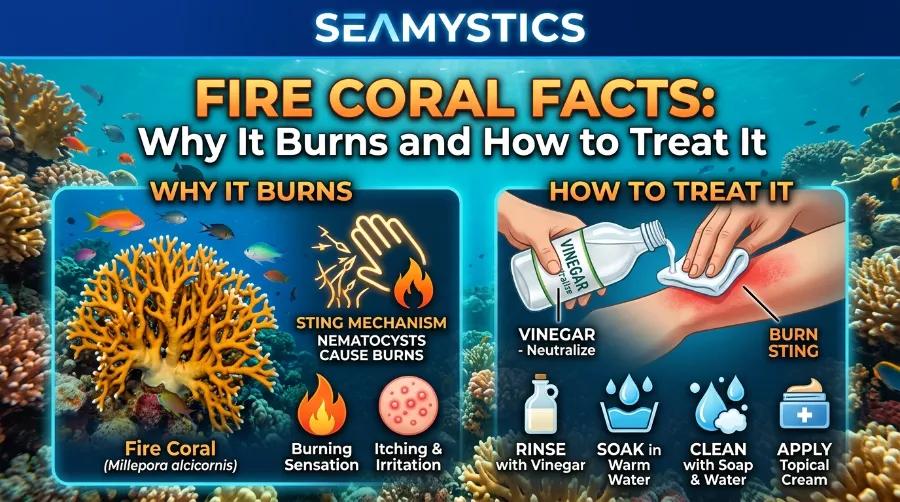

Your shin brushes something that looks like a harmless clump of yellow twigs, and within seconds your skin is on fire. That is the calling card of fire coral, and understanding the real fire coral facts is the difference between a five minute annoyance and a ruined dive trip. Fire coral is not actually a coral at all, and that single fact explains almost everything about why it stings the way it does. In this guide, written for divers and snorkelers across the United States and Europe, we will walk through identification, the science of the burn, proven sting treatment, and the honest fire coral danger facts that most travel blogs skip over.
Key Takeaways
| Fact | Detail |
|---|---|
| What it really is | A hydrozoan (relative of jellyfish), not a true coral |
| Where it lives | Florida, the Caribbean, the Red Sea, and the Indo-Pacific |
| Onset of pain | Usually within 5 to 30 minutes of contact |
| Duration | A few hours to about two weeks, depending on exposure |
| First step in treatment | Rinse with seawater, never fresh water |
| Best neutralizer | Vinegar (acetic acid) or isopropyl alcohol |
| Danger level | Rarely serious, but allergic reactions can occur |
TL;DR: Fire coral is a hydrozoan, closely related to jellyfish, that delivers a burning sting through thousands of microscopic nematocysts. Treat a sting by rinsing with seawater, applying vinegar or alcohol to deactivate the venom, and removing any leftover fragments with tweezers. Most reactions clear up within a week or two, though a small number of people need medical attention for allergic symptoms.
What Is Fire Coral, Really?
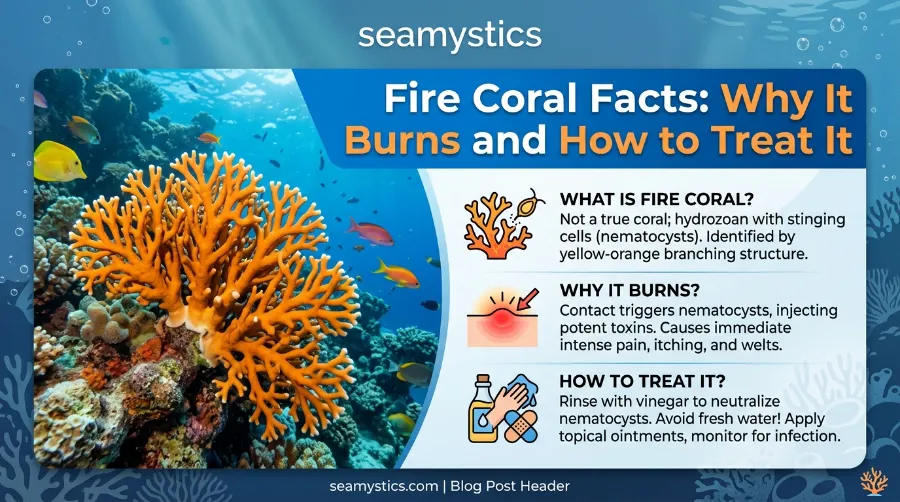
Fire coral belongs to the genus Millepora, and despite the name, it sits in the class Hydrozoa rather than Anthozoa, which is where true stony corals belong. That makes it considerably closer, in evolutionary terms, to a jellyfish or a Portuguese man o’ war than to the brain and star corals it often grows beside. If that sounds surprising, you are not alone. Most first time divers assume anything that looks calcified and reef-like must be a true coral, and fire coral is built to exploit exactly that assumption. grandbay-puntacana
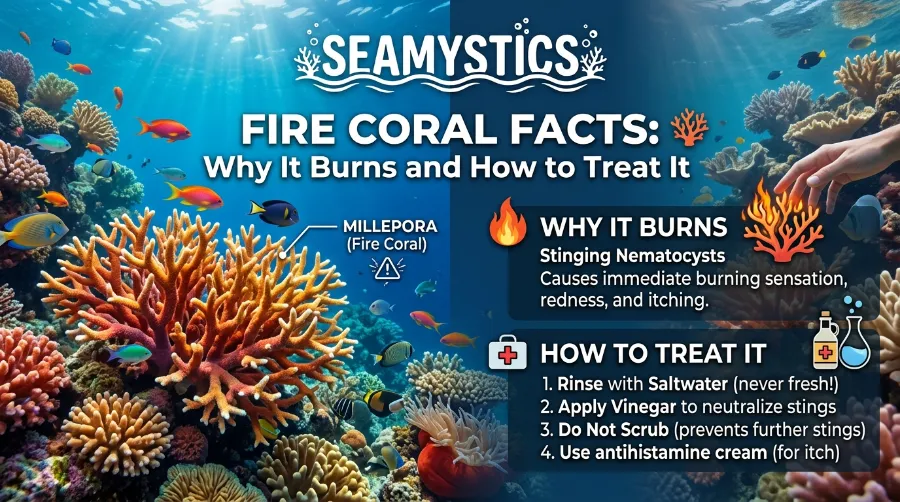
The genus name itself is a clue. Millepora means thousand pores, and the surface really is covered in thousands of tiny openings of two different types. Consequently, one set of pores houses feeding polyps, while a second, more dangerous set houses the defensive polyps that fire the stinging cells. This division of labor is unusual among reef organisms and is a big part of why fire coral facts surprise even experienced divers. grandbay-puntacana
For readers who want to compare it against other venomous ocean residents on the same reef, our guide to box jellyfish facts covers a related but far more dangerous relative, and the Portuguese man o’ war facts page breaks down a cousin species that shares a similar stinging mechanism.
Fire Coral Identification: What to Look For
Learning fire coral identification is genuinely the single best form of prevention. According to dive naturalists who study Caribbean reefs, the most reliable field marker is a distinctly smooth surface with no visible polyp cups, combined with a consistent mustard-yellow to golden-brown color and pale cream or white branch tips. Once a diver has spotted that combination once, it becomes easy to recognize from a distance. grandbay-puntacana
Three growth forms show up again and again on Caribbean and Red Sea reefs:
- Branching fire coral grows in upright, finger-like branches and frequently encrusts over gorgonian sea fans, creating a striking but hazardous mesh pattern.
- Blade or plate fire coral forms flat, thin sheets that resemble lettuce coral from a distance.
- Box or encrusting fire coral spreads flat across rock, dead coral, or even old pilings and ropes.
Divers photographing reef life in Egypt should pay particular attention. A 2026 dive guide covering Hurghada reefs noted that fire coral thrives there because the Red Sea’s warm water and strong currents suit it especially well, which is one reason Red Sea liveaboard briefings almost always include a fire coral warning before the first dive. bulletspeedboats
Fire Coral vs Coral: The Real Difference
The fire coral vs coral debate comes down to biology, not appearance. True stony corals are anthozoans, and their surface is organized into visible cups called corallites, each holding a single polyp. Fire coral’s surface, by contrast, hides its polyps inside pores you can barely see without a macro lens.
| Feature | Fire Coral (Millepora) | True Stony Coral |
|---|---|---|
| Class | Hydrozoa | Anthozoa |
| Closest relatives | Jellyfish, man o’ war | Sea anemones |
| Surface texture | Smooth, fuzzy nematocyst hairs | Visible polyp cups |
| Sting severity | Immediate burning pain | Usually mild or none |
| Common colors | Mustard yellow, tan, cream tips | Highly variable |
A 2018 case report and management review in Wilderness and Environmental Medicine described fire coral contact as producing immediate burning pain caused by venom discharge from numerous tiny nematocysts positioned on the outside of the organism, which is a different mechanism than most true corals, whose stinging cells are far weaker and rarely felt by humans at all. nih
Fire Coral Danger Facts: Why It Burns
The burning sensation is not folklore, and it is not purely psychological either. Fire coral is, first and foremost, a predator that uses its venom to quickly disable small fish, mollusks, and crustaceans, and human skin simply gets caught in the crossfire. i133
Two separate mechanisms combine to create the pain:
- Chemical injury. Thousands of nematocysts fire venom loaded with proteins that irritate nerve endings and skin cells on contact.
- Physical injury. Fire coral also has a sharp, calcified external skeleton that scrapes the skin, so the wound is often a combination sting and abrasion, which slows healing. Wikipedia
In terms of timeline, most people notice an immediate burning sensation or stinging pain within five to thirty minutes of skin contact, followed by a red rash with raised welts and itching. A field-focused scuba education blog adds useful real world context, noting that the pain from a fire coral encounter can last anywhere from two days to as long as two weeks, depending on how long the skin was in contact and how many nematocysts fired. Severe systemic reactions, including nausea, vomiting, shortness of breath, muscle spasms, low blood pressure, and in extremely rare cases cardiovascular failure, are possible but uncommon, and they represent a medical emergency when they occur. Fire Coral Cuts, Stings, Rash, Symptoms, Treatment & First Aid +2
For divers who want to understand how fire coral compares with other high-risk marine stingers commonly mentioned alongside it, the blue ringed octopus and cone snail venom guides on this site cover organisms whose venom is far more dangerous, even though the animals themselves are smaller and easier to overlook.
Fire Coral Sting Treatment: What Actually Works
If you get stung, resist the urge to panic. Fire coral sting treatment protocols recommended by marine biology and dive safety organizations converge on a fairly consistent set of steps, and following them in order genuinely reduces both the pain and the healing time. Wikipedia
- Rinse with seawater immediately. Avoid fresh water, because it will increase the pain by triggering unfired nematocysts to release more venom. liveabout
- Apply vinegar or isopropyl alcohol. This step helps deactivate the toxin still on the skin and is considered the single most effective home treatment.
- Remove any remaining coral fragments with tweezers or a strip of tape, rather than your bare fingers.
- Keep the area still. Movement can cause the venom to spread further into surrounding tissue. Wikipedia
- Manage the itching and pain with an over-the-counter hydrocortisone cream and, if needed, ibuprofen or acetaminophen, while watching closely for any signs of infection.
Here is where a genuinely useful, less commonly mentioned field observation applies. Dive instructors who deal with fire coral stings regularly note that heat is nearly as effective as vinegar for a fresh sting. Applying heat to the affected area also helps inactivate the venom, which is why many dive boats carry a thermos of hot, not scalding, water alongside their vinegar bottle. In practice, this combination approach, cool the panic first with seawater, then apply heat or vinegar within the first hour, tends to shorten the burning phase noticeably compared with vinegar alone. drizz
Textile Cone Snail vs Geography Cone: Comparing the Deadliest Shells
When to Seek Medical Attention
Most fire coral encounters resolve without a doctor’s visit, but there are clear warning signs that should never be ignored. Seek professional care if you notice swelling of the face, lips, or throat, difficulty breathing, dizziness, or a rash that spreads well beyond the original contact area. Open wounds near a fire coral rash carry a real risk of complication and even tissue death if left untreated, so any sting involving broken skin and later redness or warmth deserves a look from a physician familiar with marine injuries. padi
Real World Case: A 2018 Clinical Report
It helps to see how this plays out in an actual medical setting rather than only in dive shop folklore. A published case report described a 30 year old recreational diver who developed a fire coral sting on her left anterior thigh, and clinicians managing the case relied on saltwater irrigation, careful nematocyst removal, and supportive care for the resulting pain, dermatitis, and itching. The report also noted that systemic toxicity from fire coral is rare but documented, which lines up with what dive medicine specialists report anecdotally: the vast majority of stings are painful and memorable, not dangerous. nih
How to Avoid Fire Coral in the First Place
Prevention is genuinely easier than treatment. A few habits go a long way on any reef trip to Florida, the Caribbean, or the Red Sea:
- Wear a full wetsuit or dive skin, even in warm water, since most stings happen to exposed forearms, hands, and shins.
- Practice strong buoyancy control so you are never tempted to steady yourself against the reef.
- Treat any mustard-colored, smooth-surfaced branching growth as fire coral until proven otherwise.
- Brief new snorkelers and children before entering the water, since they are the most common victims.
Readers researching other reef hazards before a trip may also find our guides on the stingray sting facts and weever fish facts useful, since both are frequently confused with fire coral injuries by first time visitors comparing symptoms online. And if sustainable, low impact diving is part of your travel planning, our sustainable seafood guide has broader context on reef friendly ocean choices.
Fire Coral Facts: Frequently Asked Questions
Is fire coral actually a coral?
No. Despite the name, fire coral is a hydrozoan, more closely related to jellyfish than to true stony corals.
How long does a fire coral sting last?
Typically a few hours to two weeks, depending on exposure time and how quickly it was treated.
Should I use vinegar or fresh water on a fire coral sting?
Always use vinegar or seawater. Fresh water can trigger unfired stinging cells and make the pain worse.
Can a fire coral sting be dangerous?
Serious reactions are rare, but allergic responses involving breathing difficulty require immediate medical attention.
Where is fire coral most commonly found?
Florida, the Caribbean, Bermuda, the Red Sea, and much of the Indo-Pacific, usually on shallow reef crests with strong current.
Quick Knowledge Check
1. Fire coral is most closely related to which animal?
A) Sea anemone
B) Jellyfish
C) Starfish
Answer: B, Jellyfish. Fire coral belongs to the class Hydrozoa, the same class as jellyfish and the Portuguese man o’ war.
2. What should you never rinse a fire coral sting with?
A) Seawater
B) Vinegar
C) Fresh water
Answer: C, Fresh water. It can cause remaining stinging cells to fire, increasing pain.
3. How soon after contact does the burning sensation usually start?
A) Within 5 to 30 minutes
B) After 24 hours
C) Immediately, with no delay ever reported
Answer: A, Within 5 to 30 minutes for most people, though onset time can vary.
4. Which growth form of fire coral often encrusts over sea fans?
A) Box fire coral
B) Branching fire coral
C) Plate fire coral
5. What is the primary color pattern used to identify fire coral in the field?
A) Bright purple with black spots
B) Mustard yellow to tan with pale white tips
C) Deep red with green stripes
Conclusion
Fire coral earns its name honestly, and the fire coral facts covered here show why respect, not fear, is the right response. It is not a true coral, its sting comes from a genuinely different biological system than most reef life, and its treatment protocol is simple enough to remember before your next dive briefing. Learn the mustard yellow, white tipped look, keep vinegar in your dive bag, and rinse with seawater first if contact happens. Understanding fire coral identification and fire coral sting treatment turns a potentially trip-ruining encounter into a minor, well-managed inconvenience.
References
- Wikipedia, Fire coral
- PubMed, Millepora species (Fire Coral) Sting: A Case Report and Review of Recommended Management
- Grand Bay Punta Cana, Fire Coral Stings Divers
- Discover Wildlife, Fire Coral
- Reef Smart Guides, Fire Coral
- PADI Pros, Stopping the Sting
- emedicinehealth.com, Fire Coral Cuts, Stings, Rash, Symptoms, Treatment & First Aid