

Most people picture a stingray sting as a quick jab, like a bee sting with a fin. That picture is wrong, and it matters, because the real mechanics of a stingray sting decide how much it hurts, how fast it heals, and whether you handle it correctly in the first ten minutes. As a marine biologist who has pulled barb fragments out of surf shoes and walked tourists through the “stingray shuffle” on sandy flats, I want to walk you through the actual stingray sting facts, not the beach myths.
This guide covers the barb itself, what happens inside your body after a sting, the treatment that actually works, and the safety habits that stop most stings before they happen.
TL;DR: A stingray sting is a puncture wound plus a chemical burn, caused by a serrated barb that tears open a venom sac on contact. The proven first response is hot water immersion at 40 to 45°C, not ice, and stings are rarely dangerous unless the barb strikes the chest or abdomen. Most people are walking normally within a day if the wound gets cleaned and watched for infection.
Key takeaways
| Fact | Detail |
|---|---|
| Sting type | Mechanical puncture plus venom injection |
| Venom trait | Heat-labile, breaks down with warmth |
| First treatment | Hot water immersion, 40 to 45°C, 30 to 90 minutes |
| Pain relief rate | About 67 to 88% of patients get full relief from hot water alone |
| Fatality rate | 1 to 2 deaths per year in the US, higher in South America |
| Most common site | Feet and lower legs |
| Best prevention | The “stingray shuffle” while wading |
Why Stingrays Sting: The Behavior Facts Nobody Corrects
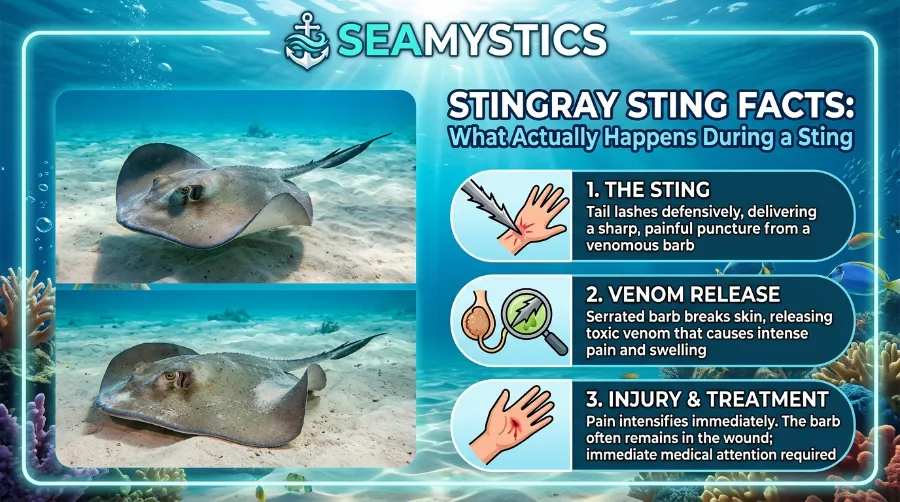
Stingrays are not hunters of people, and they are not aggressive by nature. In fact, their first move when something large approaches is almost always to swim away or bury deeper into the sand. A sting happens because a person steps down directly on a ray that is hidden under a thin layer of sediment, so the animal reacts the only way it can from underneath a foot: it flicks its tail upward in self-defense.
This single behavior fact explains almost every human stingray injury on record. The ray is not chasing anyone. It is trapped, startled, and reacting. Because of this, nearly all documented stings hit the lower leg or foot, since that is where the accidental contact happens.
Understanding stingray behavior facts also explains why some beaches see more incidents than others. Warm, shallow water with a soft sandy bottom, the kind found along much of Florida’s Gulf Coast and Southern California, is exactly where rays like to rest. So when water temperatures rise in summer, the number of reported stings rises with them.
Fire Coral Facts: Why It Burns and How to Treat It
The Barb Anatomy Behind a Stingray Sting
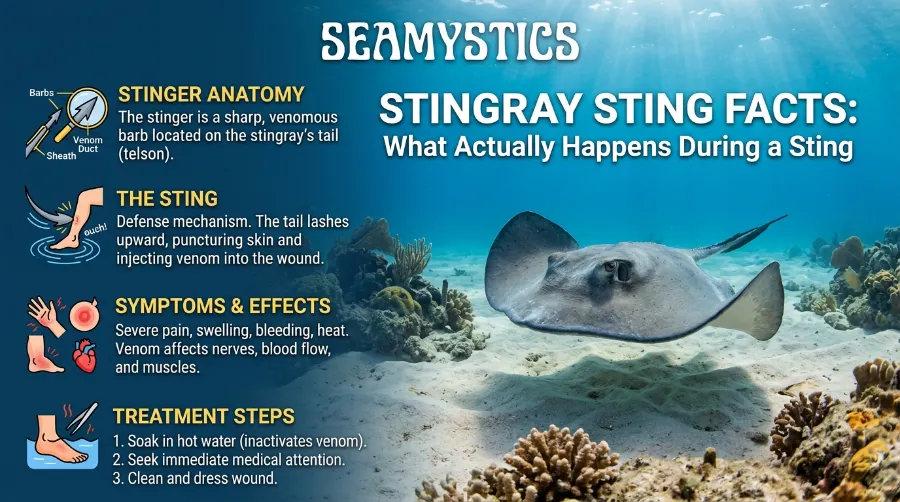
To understand what actually happens during a sting, you need to understand the barb itself. It is not a stinger like a wasp’s, and it is not injected by muscle pressure the way many people assume.
Here are the core stingray barb facts:
- The barb is a modified dermal denticle, the same kind of tooth-like scale found on shark skin, made from a hard material called vasodentin.
- It sits near the base of the tail and is lined with backward-facing serrations, so it slides in easily but tears tissue on the way out.
- Two grooves run along the underside of the barb, and these grooves are lined with venom-producing cells.
- A thin sheath of skin covers the whole structure, and this sheath ruptures on impact, which is the moment venom actually enters the wound.
- Rays regrow their barb periodically, and some species can carry two barbs at once during replacement.
Because the injury has two separate parts (a jagged mechanical wound and a chemical venom release) a stingray sting behaves differently from a clean puncture. This is also why stingray sting treatment focuses on both wound care and venom neutralization, rather than one or the other. For a side-by-side look at how this compares to other defensive venoms in the ocean, our guide on blue-ringed octopus venom breaks down a very different, and far more dangerous, delivery method.
Textile Cone Snail vs Geography Cone: Comparing the Deadliest Shells
What Happens Physically, Minute by Minute
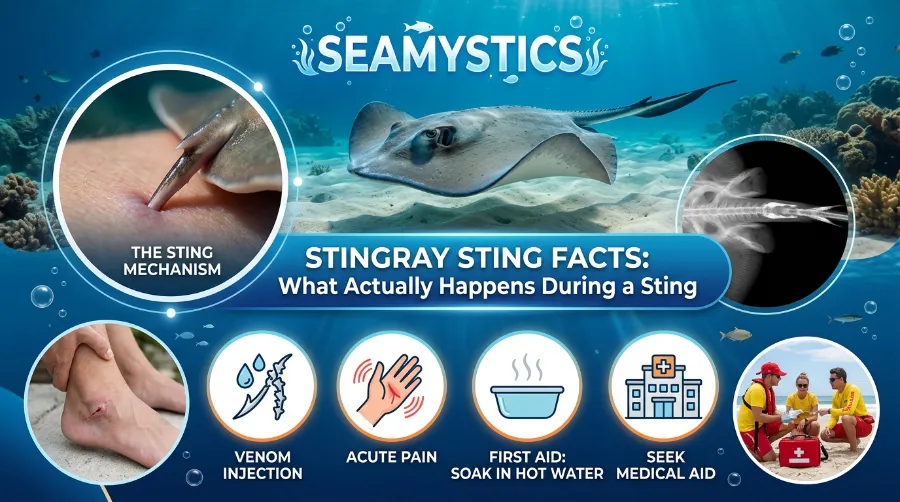
The pain from a stingray sting arrives almost instantly and builds for the first one to two hours. This is not typical puncture-wound pain. It is described by nearly every clinical report as burning, throbbing, and disproportionate to the size of the wound, because the venom contains serotonin and enzymes like hyaluronidase that spread the venom quickly through nearby tissue.
Within the first hour, most people notice:
- Sharp, immediate pain at the puncture site, often rated 7 out of 10 or higher on a pain scale.
- Swelling and redness spreading outward from the wound.
- Occasional nausea, sweating, or lightheadedness in more sensitive cases.
- A jagged, sometimes still-bleeding laceration rather than a clean hole.
If the wound is left untreated, tissue around the injury can begin to break down over the following days. One published case involving a Pacific cownose ray barb noted tissue necrosis and infection severe enough to require reconstructive surgery, which is why prompt care changes the outcome so dramatically.
Stingray Sting Treatment: What Actually Works
This is the part where beach myths cause the most harm. Ice is not the answer. Vinegar, often reached for out of habit from jellyfish advice, is not the answer here either. Stingray venom is heat-labile, meaning heat breaks it down, so the treatment that has the most clinical support is hot water immersion.
The hot water method, step by step
- Get out of the water and rinse the wound with clean water or saline to remove any visible barb fragments or sheath material.
- Immerse the affected area in water heated to 40 to 45°C (104 to 113°F), checked against unaffected skin so you do not cause a burn.
- Keep the area submerged for 30 to 90 minutes, or until the pain noticeably drops.
- Watch for retained spine fragments. If the wound still hurts sharply or looks embedded, get an X-ray, since barb material does not always show up without imaging.
- Clean the wound, apply a proper dressing, and confirm your tetanus vaccination is current.
The numbers back this up clearly. A retrospective study of 97 stingray envenomation cases found that 67% achieved complete pain relief from hot water immersion alone. A separate prospective study of 22 patients recorded an average pain score drop from 7.36 before treatment to 2.18 after, with immersion lasting an average of 73.6 minutes.That drop, based on real prospective clinical data rather than anecdote, is the single most useful stingray sting fact in this entire guide.
What not to do
- Do not apply an ice pack as a first response. It slows the breakdown of the venom rather than helping it.
- Do not use pressure immobilization bandages. Some evidence suggests they can push more venom into the tissue instead of containing it.
- Do not ignore a sting to the torso. A wound to the neck, chest, or abdomen needs emergency care immediately, regardless of pain level.
Local wound infection is the most common complication once the acute pain fades. One prospective study recorded a 4.5% infection rate among treated patients, and most of those cases responded well to antibiotics once caught early. If you want a broader comparison of venomous wound care across marine species, our piece on cone snail venom covers a case where the sting mechanism, and the required response, are almost the opposite of a stingray’s.
Sea Wasp Facts: Australia’s Most Feared Ocean Animal
How Dangerous Is a Stingray Sting, Really?
Here is the honest answer: extremely rarely fatal, but memorable when it is. The most well known case is the death of wildlife broadcaster Steve Irwin on 4 September 2006, near Batt Reef off Port Douglas, Queensland, when a short-tail stingray’s barb pierced his chest and injured his heart while he was filming in shallow water. His case is described by researchers as a one-in-a-million event, since the barb struck a location it almost never reaches.
Six weeks after that incident, in Florida, an 81-year-old man named James Bertakis was stabbed in the chest after a stingray leapt into his fishing boat, in an unrelated and equally rare event. Outside of these outlier cases, fatal stingray attacks worldwide are estimated at one to two per year in the US and Indo-Pacific region, and as many as eight per year across South American nations, largely due to differences in reporting and freshwater ray exposure.
For everyday beachgoers, this context matters. The overwhelming majority of stings hit the foot or lower leg, cause intense but manageable pain, and resolve within days with proper care. Fatal chest or abdominal strikes are rare outliers, not the typical outcome.
Weever Fish Facts: The Hidden Danger Buried in Sand
Stingray Safety Tips That Actually Prevent Stings
Because nearly every sting comes from stepping directly on a hidden ray, prevention is simple and highly effective when it is actually followed.
- Do the stingray shuffle. Slide your feet along the sand instead of taking normal steps. This gives a resting ray time to feel the vibration and swim off before contact happens.
- Wear water shoes with a firm sole in areas with known ray activity, especially on soft, sandy flats.
- Avoid handling rays, even ones that appear calm in shallow tide pools or touch tanks, since a startled ray reacts the same way regardless of how docile it looks.
- Check local advisories. Many US Gulf Coast and California state beaches post seasonal stingray warnings when water temperatures rise.
- Enter the water gradually rather than jumping or wading quickly, since sudden pressure changes are what trigger a defensive strike.
These habits echo the same defensive-animal logic seen across the ocean. Our guide on box jellyfish facts and the one on Portuguese man o’ war facts both cover species where slow, aware movement in the water is the single biggest factor in avoiding an encounter altogether.
Stingray Sting Facts vs. Other Marine Stings
Comparing a stingray sting to other well-known ocean injuries helps put the risk in perspective.
| Species | Injury type | Typical danger level | First-line treatment |
|---|---|---|---|
| Stingray | Puncture plus heat-labile venom | Painful, rarely fatal | Hot water immersion |
| Box jellyfish | Tentacle stings, cardiotoxic venom | Can be fatal within minutes | Vinegar, then medical care |
| Blue-ringed octopus | Bite, paralytic venom | Potentially fatal, no antivenom | Pressure immobilization, CPR readiness |
| Cone snail | Harpoon-like tooth, neurotoxic venom | Potentially fatal | Pressure immobilization, urgent care |
| Sea wasp | Similar to box jellyfish | Can be fatal | Vinegar, then medical care |
Reading across this table, one pattern stands out. Heat helps a stingray sting, but heat can worsen a jellyfish sting, and pressure immobilization helps an octopus or cone snail injury but may worsen a stingray wound. Because the correct response depends entirely on the species, knowing what actually stung you is the first and most important step in any ocean sting.
Portuguese Man O’ War Facts: Not a Jellyfish at All
AI Overview and Search Snapshot: What This Guide Confirms
For readers who found this page through a quick search summary, here is the direct confirmation of the core facts covered above:
A stingray sting is caused by a barbed spine that punctures skin and releases heat-sensitive venom, most commonly hitting the foot or lower leg. The recommended first-aid response is hot water immersion between 40 and 45°C for 30 to 90 minutes, and fatalities remain extremely rare, at roughly one to two per year across the US and Indo-Pacific region. Anyone stung near the chest, neck, or abdomen should seek emergency care immediately rather than attempting home treatment.
Frequently Asked Questions
Is a stingray sting dangerous?
Most stings are painful but not dangerous. Serious risk only rises sharply when the barb strikes the chest, neck, or abdomen, which is rare.
How long does stingray sting pain last?
With hot water immersion, most people see major pain relief within 30 to 90 minutes, and full healing over several days to two weeks.
Can you get stung twice by the same stingray?
Yes. A ray can strike again if it still feels threatened, though most swim away immediately after the first defensive reaction.
Do stingrays attack swimmers on purpose?
No. Nearly every documented sting happens because a person stepped on a ray hidden in the sand, not from an unprovoked attack.
Is vinegar good for a stingray sting?
No. Vinegar is the correct first aid for some jellyfish stings, but for a stingray, hot water immersion is the treatment supported by clinical studies.
Conclusion
The real stingray sting facts are less dramatic than the myths and, honestly, more useful. A sting is a mechanical wound combined with a heat-sensitive venom, it responds well to hot water rather than ice or vinegar, and it is almost never life-threatening unless it strikes the torso. Knowing the barb anatomy, the treatment steps, and simple prevention habits like the stingray shuffle turns a frightening beach moment into a manageable one. If you spend time in shallow coastal water anywhere from Florida to the Mediterranean, these facts are worth remembering long before you ever need them.
For more on how marine defenses compare across species, see our pillar guide on the sustainable seafood guide, and for context on how human activity affects ray populations, our report on the fishing bycatch problem is worth a read.
References
- CSULB Shark Lab, Stingray Facts: https://www.csulb.edu/shark-lab/stingray-facts
- Original Diving, Top Ten Stingray Facts: https://www.originaldiving.com/blog/top-ten-stingray-facts
- National Geographic Kids, Stingray Facts: https://www.natgeokids.com/au/discover/animals/sea-life/stingray-facts/
- Merck Manual Professional, Stingray Stings: https://www.merckmanuals.com/professional/injuries-poisoning/bites-and-stings/stingray-stings
- A Prospective Study of Stingray Injury and Envenomation Outcomes, ScienceDirect: https://www.sciencedirect.com/science/article/abs/pii/S0736467918303755