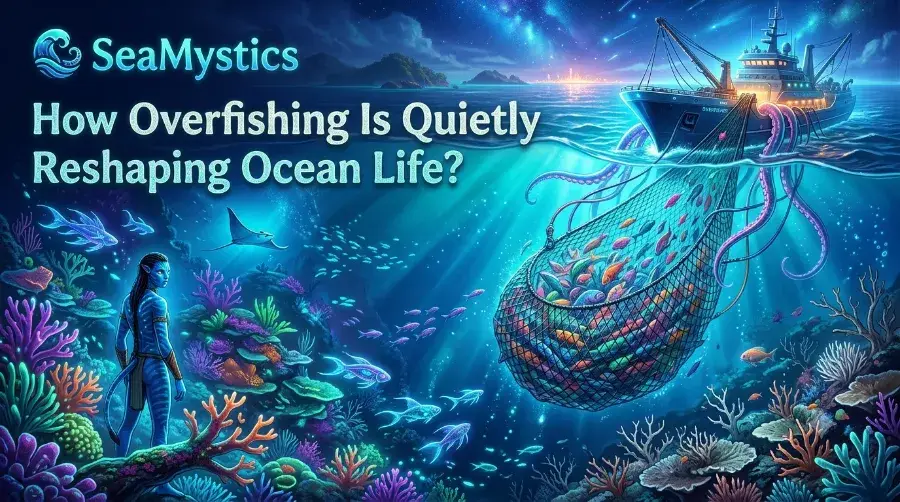

Every year, millions of tons of fish leave the world’s oceans. While seafood supports livelihoods and feeds billions of people, the growing demand has created a hidden crisis beneath the waves. Many fish populations can no longer recover as quickly as they disappear. As a result, marine ecosystems are changing in ways that are easy to overlook but difficult to reverse.
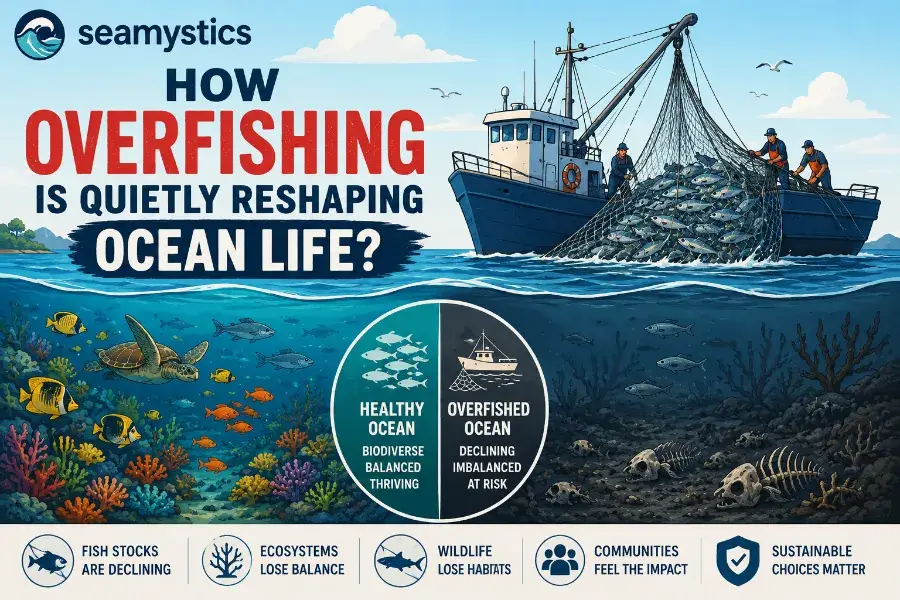
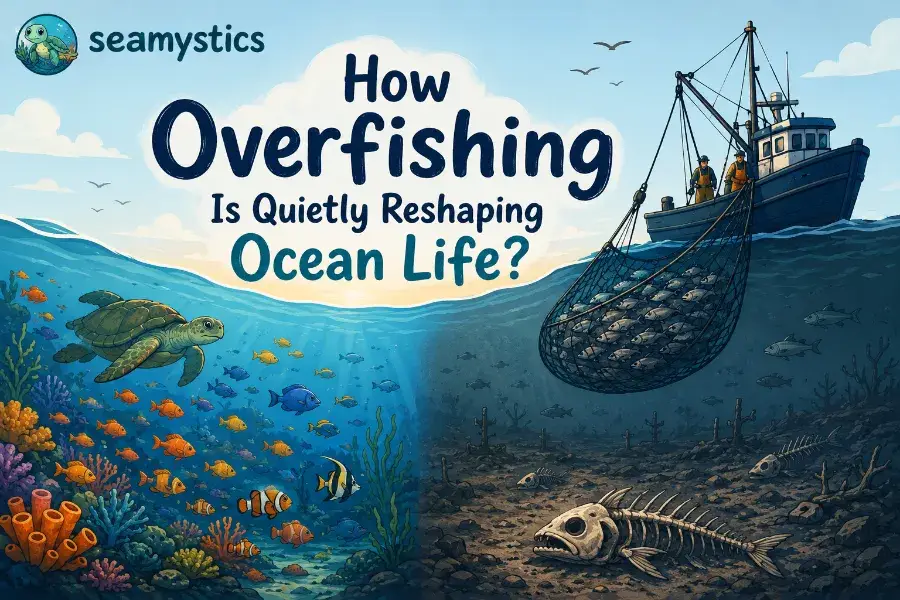
The overfishing effects ocean life extend far beyond fewer fish in the sea. Coral reefs lose important grazers,h seabirds struggle to find food, sharks disappear from food chains, and coastal communities face growing economic pressure. Scientists now agree that overfishing is one of the leading causes of marine biodiversity loss, alongside climate change and pollution.
At Sea Mystics, our goal is to explain ocean science in simple language. Drawing on current marine research and decades of fisheries studies, this guide explores how overfishing reshapes ocean ecosystems, why it matters to everyone, and what solutions already show promising results.
you can read our blog how to protect oceans
Key Takeaways
| Topic | Key Insight |
|---|---|
| Main Threat | Overfishing removes fish faster than populations can recover. |
| Global Impact | More than one-third of assessed fish stocks are harvested beyond sustainable levels. |
| Ecosystem Effect | Entire marine food webs become unstable when key species decline. |
| Human Impact | Coastal jobs, food security, and local economies suffer. |
| Solution | Sustainable fisheries, marine protected areas, stronger monitoring, and responsible seafood choices help restore fish populations. |
What Is Overfishing?
Overfishing happens when people catch fish faster than the species can reproduce. Healthy fish populations naturally replace themselves over time. However, excessive harvesting breaks this balance.
Modern fishing vessels travel farther offshore, stay at sea longer, and use advanced technology to locate large schools of fish. Although these innovations improve efficiency, they also increase pressure on marine ecosystems.
Several fishing methods contribute to the problem:
- Industrial trawling
- Longline fishing
- Purse seine fishing
- Illegal, unreported, and unregulated (IUU) fishing
- Harvesting juvenile fish before they reproduce
When these practices continue without effective management, fish populations shrink year after year.
Why Scientists Are Concerned About the Overfishing Effects Ocean Life
Marine ecosystems work like interconnected networks. Every species plays an important role. Small baitfish feed larger predators. Predators keep prey populations balanced. Herbivorous fish prevent algae from overwhelming coral reefs.
When one important species declines, the effects spread across the ecosystem.
For example:
- Fewer sharks allow mid-level predators to increase.
- More mid-level predators consume excessive shellfish.
- Shellfish populations decline.
- Water quality worsens because shellfish naturally filter seawater.
This chain reaction illustrates why marine biologists often describe oceans as living systems rather than collections of individual species.
How Overfishing Changes Marine Food Webs
Food webs remain healthy because energy flows through many connected species. Removing too many fish interrupts this balance.
Large Predators Continue to Decline
Species such as tuna, sharks, and swordfish reproduce slowly. Because they mature later in life, their populations recover more slowly than smaller fish.
Research over recent decades shows significant declines in several large ocean predators across heavily fished regions.
Reef Ecosystems Lose Natural Protection
Parrotfish and surgeonfish eat algae that compete with coral. When these fish become scarce, algae spread rapidly across reefs, reducing coral growth and biodiversity.
Healthy reefs support thousands of marine species, making herbivorous fish essential for reef survival.
Current Global Picture
| Indicator | Recent Estimate |
| Fish stocks harvested sustainably | About 62% |
| Fish stocks harvested unsustainably | About 38% |
| People depending on seafood for protein | More than 3 billion |
| Global fisheries and aquaculture jobs | More than 600 million |
These numbers show why fisheries management has become one of the world’s most important conservation priorities.
Text Chart: Growing Pressure on Ocean Fisheries
Unsustainably Fished Stocks

1990   ███████████
2000   ███████████████
2010   ███████████████████
2020   ███████████████████████
2025   ████████████████████████
The long-term trend highlights increasing pressure on marine resources despite improvements in fisheries management in several regions.
Conclusion
The story of our oceans is still being written, and the choices we make today will shape marine life for decades to come. The overfishing effects ocean life reach far beyond shrinking fish populations. They disrupt food webs, damage coral reefs, endangered marine species weaken coastal economies, and reduce food security for millions of people. Although these challenges are serious, they are not beyond repair.
Encouragingly, many fish populations have shown signs of recovery where science-based fishing limits, marine protected areas, and responsible fisheries management are in place. Governments, researchers, fishing communities, seafood businesses, and consumers all have a role to play. Choosing sustainably sourced seafood, supporting conservation policies, and protecting critical marine habitats can help restore the balance of our oceans.
At Sea Mystics, we believe that understanding marine science is the first step toward meaningful conservation. Every informed decision whether made by policymakers or everyday consumers can contribute to healthier oceans. By working together, we can protect marine biodiversity, strengthen coastal communities, and ensure that future generations inherit oceans rich with life rather than depleted by overfishing.