
The ocean covers more than 70% of our planet, yet many of its most iconic creatures are disappearing faster than ever. From whales larger than school buses to tiny porpoises found in a single stretch of water, marine species face growing pressure from human activity, climate change pollution,and habitat loss.
The latest endangered marine species list reveals a troubling reality. Many animals that once thrived across vast oceans now survive in small populations. Some have only a few hundred individuals left. Others hover on the edge of extinction.
As a marine biologist, I often tell students that ocean conservation is not just about saving wildlife. It is about protecting entire ecosystems that support fisheries, coastal economies, and global biodiversity. Understanding which species are at risk is the first step toward meaningful action.
you can read our blog how to protect oceans
Key Takeaways
| Key Finding | Latest Status |
|---|---|
| Most endangered marine mammal | Vaquita porpoise |
| Estimated vaquita population | Fewer than 30 individuals |
| North Atlantic right whale population | Approximately 380–384 whales |
| Major threats | Bycatch, climate change, ship strikes, pollution |
| Most threatened fish group | Sharks and rays |
| Shark and ray extinction risk | About one-third threatened |
| Best conservation tools | Marine protected areas, fishing reforms, habitat protection |
Why Marine Species Are Disappearing
Ocean ecosystems have changed dramatically during the past century.
Industrial fishing, plastic pollution, warming oceans, and habitat destruction affect nearly every marine environment. While some species adapt, others struggle to survive.
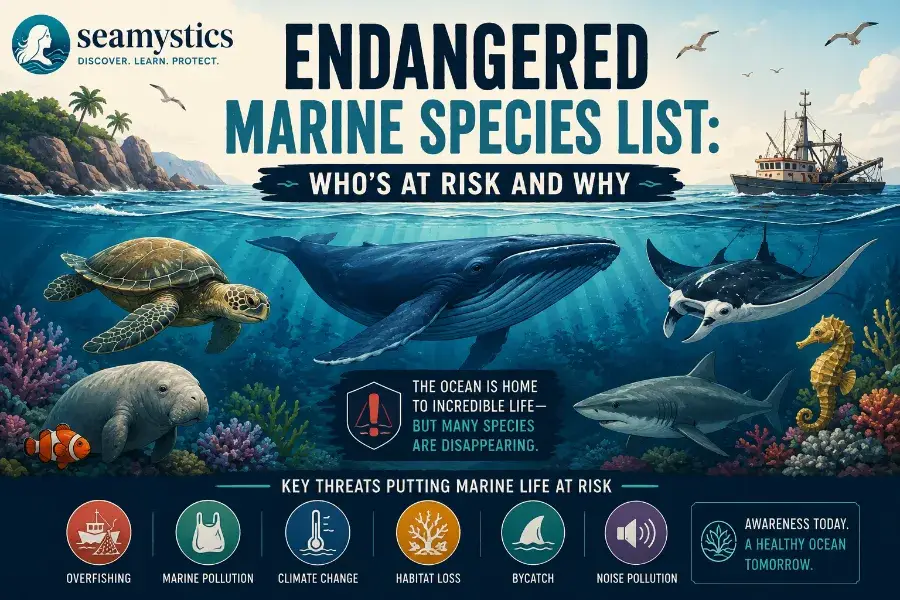
Several factors drive population declines:
- Accidental capture in fishing gear
- Ship collisions
- Climate change
- Ocean warming
- Coral reef loss
- Plastic pollution
- Illegal wildlife trade
- Coastal development
As a result, conservation organizations regularly update global assessments to identify species most at risk.
Understanding Conservation Categories
The International Union for Conservation of Nature (IUCN) uses several categories to measure extinction risk.
| Category | Meaning |
| Vulnerable | High risk of decline |
| Endangered | Very high risk of extinction |
| Critically Endangered | Extremely high risk of extinction |
| Extinct in the Wild | Survives only in captivity |
| Extinct | No living individuals remain |
Species appearing on an endangered marine species list usually fall into the Endangered or Critically Endangered categories.
Endangered Marine Species List: The Most At-Risk Ocean Animals
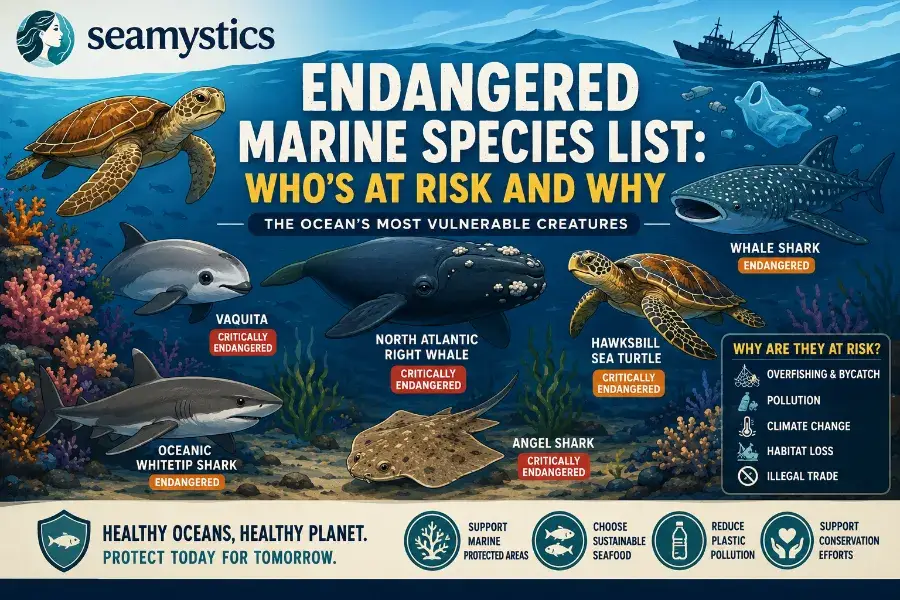
1. Vaquita (Phocoena sinus)
The vaquita is currently the world’s most endangered marine mammal.
Found only in Mexico’s northern Gulf of California, this small porpoise has suffered catastrophic declines because of illegal gillnet fishing.
Population Snapshot
| Metric | Estimate |
| Population in 1997 | Around 600 |
| Current population | Fewer than 30 |
| Conservation status | Critically Endangered |
The primary threat is accidental entanglement in fishing nets targeting totoaba fish. Scientists warn that every remaining individual is critical for the species’ survival.
Why It Matters
The vaquita demonstrates how quickly a species can approach extinction when conservation measures arrive too late.
2. North Atlantic Right Whale
The North Atlantic right whale remains one of the most endangered large whale species on Earth.
Commercial whaling nearly eliminated the species during the nineteenth century. Today, new threats have replaced harpoons.
Current Population
| Indicator | Latest Estimate |
| Total population | Approximately 380–384 |
| Reproductive females | About 70 |
| Trend | Slight improvement |
Researchers have reported modest population growth in recent years. However, entanglement in fishing gear and vessel strikes remain major causes of injury and death.
Main Threats
- Fishing gear entanglement
- Ship strikes
- Habitat changes
- Ocean noise
- Climate-driven shifts in prey
Despite encouraging signs, the species remains highly vulnerable.
3. Hawksbill Sea Turtle
The hawksbill sea turtle is famous for its beautiful shell pattern.
Unfortunately, that beauty became one of its greatest threats.
For decades, illegal trade targeted hawksbills for jewelry and decorative products.
Key Threats
- Illegal wildlife trade
- Coral reef degradation
- Plastic pollution
- Coastal development
- Climate change
Because hawksbill turtles depend heavily on healthy coral reef ecosystems, widespread reef decline directly affects their future.
4. Kemp’s Ridley Sea Turtle
The Kemp’s ridley sea turtle is the rarest sea turtle species in the world.
Although conservation efforts have improved nesting numbers since the 1980s, the species remains endangered.
Recovery Challenges
- Bycatch in fisheries
- Oil spills
- Coastal habitat loss
- Ocean pollution
Strong protection programs have prevented extinction, yet recovery remains fragile.
5. Whale Shark
The whale shark is the largest fish on Earth.
Some individuals exceed 40 feet in length. Despite their enormous size, these gentle filter feeders face increasing threats.
Why Populations Are Declining
- Vessel collisions
- Plastic ingestion
- Fishing pressure
- Habitat disruption
Because whale sharks reproduce slowly, population recovery can take decades.
Chart: Major Threats Facing Marine Species
| Threat | Relative Impact |
| Overfishing & Bycatch | ██████████ 35% |
| Climate Change | ████████ 25% |
| Habitat Loss | ██████ 15% |
| Pollution | █████ 12% |
| Ship Strikes | ███ 8% |
| Illegal Trade | ██ 5% |
Source: Combined analysis from NOAA, IUCN, and marine conservation reports.
6. Oceanic Whitetip Shark
Once among the most common sharks in tropical oceans, the oceanic whitetip shark has experienced dramatic declines.
Scientists estimate population reductions exceeding 90% in some regions.
Primary Causes
- Commercial fishing
- Shark fin trade
- Bycatch
The species now serves as a powerful example of how quickly ocean predators can disappear.
7. Angel Shark
The angel shark resembles a ray more than a traditional shark.
Once widespread across European waters, it has nearly vanished from much of its historic range.
Bottom trawling remains the greatest threat because these sharks spend much of their lives on the seafloor.
Why Sharks and Rays Face Exceptional Risk
Recent global assessments show that roughly one-third of sharks, rays, and chimaeras face extinction threats. Overfishing and accidental capture remain the biggest drivers.
Shark Conservation Challenges
- Slow reproduction
- Late maturity
- High fishing pressure
- Global demand for fins and meat
As a result, many shark populations recover very slowly even after protections are introduced.
Conclusion
The latest endangered marine species list highlights a growing challenge for ocean conservation. From the critically endangered vaquita and North Atlantic right whale to vulnerable sea turtles and declining shark populations, many marine animals face unprecedented pressure from human activities and environmental change. Overfishing, bycatch, pollution, habitat destruction, and climate change continue to threaten species across every major ocean.
Despite these challenges, there is still hope. Strong conservation policies, marine protected areas, sustainable fishing practices, and international cooperation have already helped several species begin to recover. Every successful recovery proves that action works when governments, scientists, industries, and communities work together.