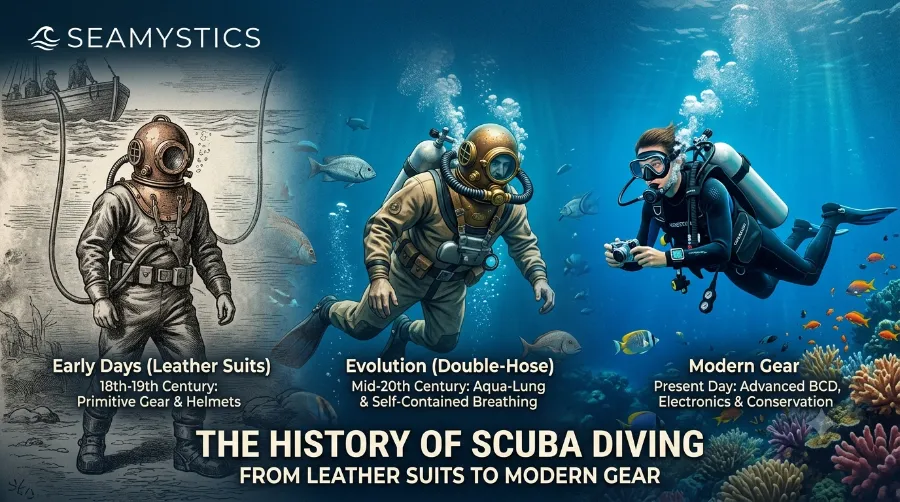

The ocean has always inspired curiosity. For centuries, people dreamed of exploring the underwater world for treasure, science, and adventure. However, breathing beneath the surface remained the biggest challenge. The history of scuba diving tells an incredible story of invention, courage, and scientific progress. From heavy leather suits and simple air hoses to lightweight scuba equipment with advanced computers, every breakthrough has made underwater exploration safer and more accessible.
Today, millions of recreational divers explore coral reefs, shipwrecks, and marine life across the world. Meanwhile, marine biologists, underwater archaeologists, military teams, and rescue divers rely on modern scuba technology every day. Understanding how scuba diving evolved helps us appreciate the remarkable engineering behind today’s equipment and the pioneers who transformed an impossible dream into reality.
Key Takeaways
| Topic | Key Information |
|---|---|
| Primary Keyword | History of Scuba Diving |
| First Diving Equipment | Leather suits with surface air supply |
| Major Breakthrough | Self-contained scuba system developed in the 1940s |
| Famous Inventors | Jacques Cousteau and Émile Gagman |
| Modern Features | Dive computers, buoyancy control, lightweight regulators |
| Main Users Today | Recreational divers, scientists, military, rescue teams |
| Biggest Benefit | Safe underwater breathing without surface air hoses |
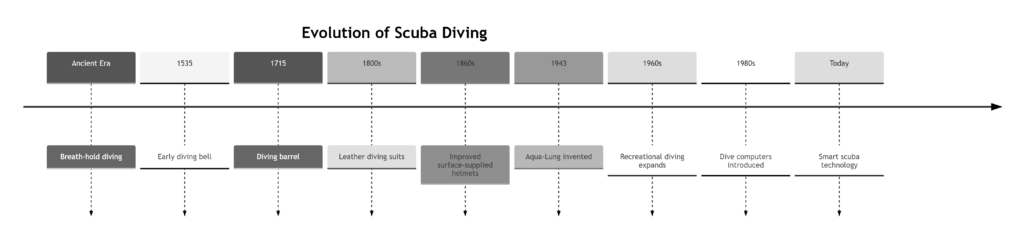
A Timeline of Major Scuba Diving Milestones
| Year | Event | Importance |
|---|---|---|
| Ancient Greece | Free divers collected sponges | First recorded underwater work |
| 1535 | Early diving bell developed | Allowed longer underwater stays |
| 1715 | John Lethbridge created diving barrel | Improved underwater salvage |
| Early 1800s | Heavy leather diving suits appeared | Better protection underwater |
| 1860s | Surface-supplied helmets improved | Longer and safer dives |
| 1943 | Aqua-Lung invented | Birth of modern scuba diving |
| 1960s | Recreational diving expanded | Diving became popular worldwide |
| 1980s | Dive computers introduced | Improved dive planning and safety |
| Today | Smart dive gear and digital technology | Greater safety and accessibility |
Why the Ocean Inspired Early Diving
People have explored underwater environments for thousands of years. Ancient civilizations relied on free diving to collect pearls, harvest sea sponges, recover valuable cargo, and gather seafood. These divers had no breathing equipment. Instead, they depended entirely on breath-holding skills, physical fitness, and experience.
Historical records suggest that sponge divers in the Mediterranean regularly descended to depths of more than 20 meters. Although these dives lasted only a few minutes, they demonstrated remarkable endurance and inspired inventors to search for better underwater breathing methods.
Furthermore, ancient military forces also recognized the value of underwater operations. Divers cut enemy anchor ropes, inspected ships, and carried out surprise missions beneath the surface. These dangerous tasks encouraged centuries of experimentation with underwater equipment.
The First Attempts to Breathe Underwater
Inventors quickly realized that remaining underwater required a continuous air supply. As a result, early engineers experimented with enclosed chambers and breathing devices.
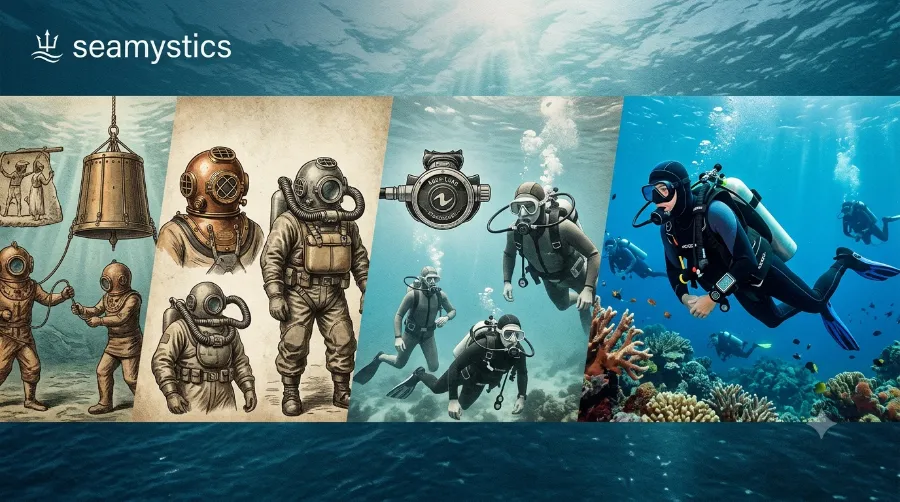
One of the earliest successful inventions was the diving bell. This large inverted chamber trapped air when lowered underwater. Divers could briefly enter the bell to breathe before continuing their work.
Although the system had many limitations, it represented a major technological breakthrough.
Early Diving Bells
Diving bells offered several advantages.
- Divers stayed underwater much longer.
- Workers recovered cargo from shipwrecks.
- Engineers inspected underwater structures.
- Salvage operations became more efficient.
However, serious problems remained.
- Limited oxygen supply
- Poor visibility
- Heavy construction
- Restricted movement
- Short operating time
Despite these challenges, diving bells laid the foundation for future underwater technology.
Leather Diving Suits Changed Everything
As underwater work increased during the eighteenth and nineteenth centuries, inventors needed equipment that offered both protection and mobility. This demand led to the development of the first leather diving suits.
These suits covered the diver from head to toe. Thick leather protected against cold water while metal helmets connected to long air hoses supplied fresh air from the surface.
Although these suits looked impressive, they weighed well over 80 kilograms when fully equipped. Consequently, divers required support crews on boats to operate the air pumps.
Main Features of Early Leather Suits
| Feature | Purpose |
|---|---|
| Leather suit | Protected the diver from cold water |
| Copper helmet | Supplied breathing air |
| Surface air hose | Delivered continuous oxygen |
| Lead boots | Helped divers stay on the seabed |
| Weighted belt | Improved underwater stability |
Because movement remained slow, these divers mainly worked on shipwreck recovery, bridge construction, harbor maintenance, and underwater engineering projects.
The Rise of Surface-Supplied Diving
During the nineteenth century, engineers greatly improved diving helmets and pumping systems. Air pumps became more reliable, while helmets provided clearer vision and better communication.
As a result, underwater work expanded rapidly.
Professional divers now helped build:
- Bridges
- Harbors
- Dams
- Underwater pipelines
- Naval facilities
Furthermore, governments began training military divers for specialized underwater missions.
These improvements also supported scientific research. Marine scientists finally had more time to observe fish, coral reefs, and underwater ecosystems directly rather than relying on samples collected from boats.
Challenges Faced by Early Divers
Even with improved equipment, diving remained extremely dangerous.
Several risks threatened every dive.
Common Hazards
- Equipment failure
- Poor visibility
- Strong currents
- Limited communication
- Cold water
- Heavy equipment
- Air hose damage
Moreover, divers knew very little about pressure-related illnesses. Conditions such as decompression sickness often caused severe injuries because scientists had not yet fully understood how pressure affected the human body.
Nevertheless, every successful dive taught engineers valuable lessons. These experiences directly influenced future inventions that would eventually lead to modern scuba systems.
Marine Science Benefited from Better Diving Equipment
The improvement of underwater technology did more than support commercial diving. It also transformed marine biology.
Researchers could now spend longer periods observing marine animals in their natural habitats. Instead of relying solely on specimens brought to the surface, scientists began studying fish behavior, coral reefs, sea grasses, mollusks, and underwater ecosystems directly.
Consequently, marine conservation efforts became much stronger. Scientists collected more accurate data, identified new species, and improved their understanding of ocean biodiversity.
These early scientific expeditions marked the beginning of modern underwater research, paving the way for the revolutionary invention that would soon change diving forever.
The Birth of Modern Scuba Diving
The biggest turning point in the history of scuba diving came during the early 1940s. Until then, most divers depended on heavy helmets and long air hoses connected to the surface. Although those systems worked for commercial jobs, they limited movement and made underwater exploration difficult.
Everything changed in 1943 when French naval officer and explorer Jacques Cousteau partnered with engineer Émile Gagman. Together, they created the Aqua-Lung, the world’s first practical self-contained underwater breathing apparatus (SCUBA). Their invention allowed divers to carry compressed air on their backs instead of relying on surface hoses. This breakthrough transformed underwater exploration forever. It also laid the foundation for modern recreational diving. Today, nearly every scuba regulator follows the same basic principles developed by Cousteau and Gagman. Modern materials and engineering have improved the design, but the concept remains remarkably similar. Their invention remains one of the most important milestones in diving history. It also inspired decades of innovation in marine science and underwater exploration.
Why the Aqua-Lung Was Revolutionary
Unlike earlier diving systems, the Aqua-Lung offered true freedom underwater.
Major advantages included:
- Complete freedom of movement
- No surface air hose
- Smaller and lighter equipment
- Longer underwater exploration
- Greater safety
- Easier underwater photography
- Improved scientific research
Because of these advantages, underwater exploration expanded rapidly after World War II.
Jacques Cousteau Inspired a New Generation
Following the success of the Aqua-Lung, Jacques Cousteau devoted his life to exploring and protecting the oceans. His documentaries introduced millions of people to underwater ecosystems that very few had ever seen.
His famous research vessel, Calypso, became a symbol of marine exploration. During the 1950s and 1960s, Cousteau and his team documented coral reefs, deep-sea habitats, sharks, whales, and countless marine species.
Moreover, his films encouraged governments and conservation groups to protect fragile ocean environments. Many marine biologists today credit Cousteau as the person who inspired their careers.
Cousteau’s Lasting Contributions
| Contribution | Impact on Diving |
|---|---|
| Aqua-Lung development | Created modern scuba diving |
| Underwater documentaries | Popularized ocean exploration |
| Marine conservation | Raised public awareness |
| Scientific expeditions | Improved marine research |
| Underwater photography | Brought the ocean into people’s homes |
Recreational Diving Becomes a Global Sport
During the 1950s and 1960s, scuba diving shifted from military and commercial work to recreational adventure. Improved equipment became more affordable, while diving clubs introduced proper safety training.
As tourism expanded, popular diving destinations welcomed thousands of visitors each year.
Some of the world’s best diving locations include:
- Great Barrier Reef
- Red Sea
- Belize Barrier Reef
- Blue Hole
- Raja Ampath
- Galápagos Marine Reserve
Today, recreational diving contributes billions of dollars to coastal tourism while supporting marine conservation through education and eco-tourism.
Diving Training Became More Professional
As scuba diving gained popularity, proper training became essential. Divers needed to understand breathing techniques, buoyancy, underwater navigation, emergency procedures, and equipment maintenance.
Several internationally recognized organizations established standardized certification systems.
Popular Training Organizations
| Organization | Founded | Main Role |
|---|---|---|
| Professional Association of Diving Instructors | 1966 | Recreational diver training |
| Scuba Schools International | 1970 | Global scuba certification |
| National Association of Underwater Instructors | 1959 | Diver education and safety |
| British Sub-Aqua Club | 1953 | UK diver training |
These organizations continue to improve safety standards worldwide through instructor education, updated teaching materials, and emergency training.
Scuba Gear Continued to Improve
Although the Aqua-Lung revolutionized diving, engineers never stopped improving equipment. Every decade introduced lighter, safer, and more reliable technology.
Evolution of Modern Scuba Equipment
| Equipment | Early Version | Modern Version |
|---|---|---|
| Air Tank | Steel cylinder | Lightweight aluminum or composite |
| Regulator | Basic demand valve | Balanced multi-stage regulator |
| Diving Suit | Heavy rubber | Flexible wetsuits and dry suits |
| Buoyancy Control | None | Buoyancy Control Device (BCD) |
| Navigation | Compass only | Digital compass and dive computer |
| Lighting | Basic lamps | Powerful LED dive lights |
As a result, today’s divers enjoy greater comfort and improved underwater mobility.
The Introduction of Dive Computers
One of the most important technological advances arrived during the 1980s with the development of dive computers.
Previously, divers relied on printed dive tables to estimate safe ascent times. While effective, these tables required careful calculations and left little room for error.
Modern dive computers automatically monitor:
- Depth
- Bottom time
- Water temperature
- Ascent speed
- Remaining no-decompression limit
- Surface interval
- Dive log history
Because these devices constantly calculate nitrogen absorption, they significantly reduce the risk of decompression sickness when used correctly.
Underwater Photography Entered a New Era
As camera technology improved, underwater photography became much more accessible.
Early photographers struggled with bulky waterproof housings and limited film capacity. Today, compact digital cameras and action cameras allow divers to capture stunning images with minimal effort.
Marine scientists also benefit from high-resolution underwater imaging. Researchers use photographs and videos to monitor coral bleaching, identify fish species, document shark populations, and study marine ecosystems over time.
Consequently, photography has become one of the most valuable tools in marine conservation.
Commercial Diving Continued to Expand
While recreational diving flourished, commercial diving also experienced major growth.
Professional divers now work in industries such as:
- Offshore oil and gas
- Renewable offshore wind farms
- Underwater construction
- Bridge inspection
- Pipeline maintenance
- Search and rescue
- Scientific expeditions
- Archaeological excavation
Many of these projects require specialized equipment and advanced training beyond recreational scuba certification.
Scuba Diving and Marine Conservation
Today, scuba diving plays a vital role in protecting the oceans.
Marine biologists rely on scuba equipment to:
- Survey coral reefs
- Monitor endangered species
- Restore damaged ecosystems
- Remove ghost fishing nets
- Study climate change impacts
- Track invasive marine species
Citizen science programs also encourage recreational divers to report wildlife sightings and reef health, helping researchers collect valuable data across the globe.
Real-Life Example: Coral Reef Restoration
In recent years, marine restoration projects have shown how scuba divers can make a measurable difference.
For example, volunteer divers have helped transplant thousands of healthy coral fragments onto damaged reefs in regions such as the Caribbean and Florida. These efforts support biodiversity, improve fish habitats, and strengthen reef resilience against environmental stress.
Modern Scuba Gear Makes Diving Safer Than Ever
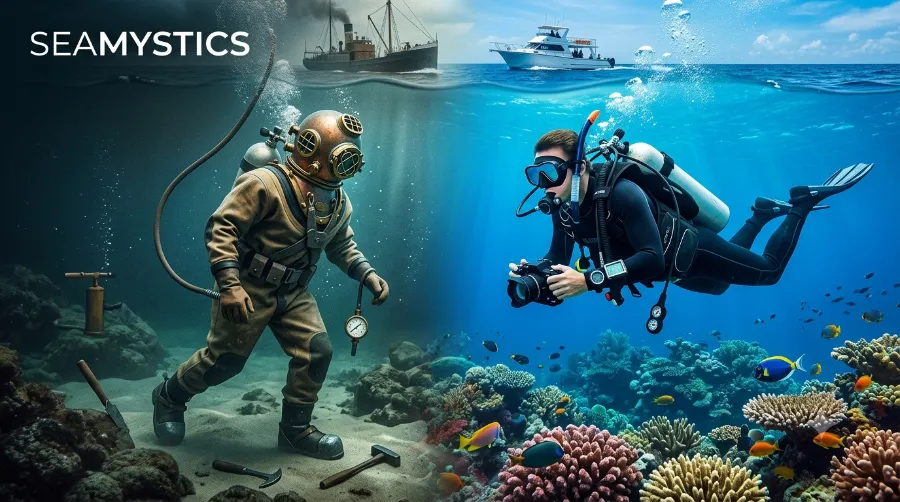
Modern scuba equipment looks very different from the heavy leather suits and copper helmets used centuries ago. Today, manufacturers focus on safety, comfort, and performance. As a result, divers can spend more time underwater while reducing many of the risks faced by earlier generations.
Every piece of equipment works together as part of a complete life-support system. Therefore, proper maintenance and training remain just as important as the equipment itself.
Essential Modern Scuba Equipment
| Equipment | Purpose | Modern Improvement |
|---|---|---|
| Mask | Clear underwater vision | Tempered glass with low-volume design |
| Regulator | Delivers air from the tank | Balanced first and second stages |
| Buoyancy Control Device (BCD) | Controls floating and sinking | Lightweight, adjustable air cells |
| Dive Computer | Tracks dive data | Real-time decompression calculations |
| Air Cylinder | Stores breathing gas | Lightweight aluminum and composite options |
| Fins | Improves swimming efficiency | Flexible materials with better propulsion |
| Exposure Suit | Protects against cold | Stretch neoprene and advanced drysuits |
| Alternate Air Source | Backup breathing system | Standard safety feature on all recreational setups |
Because each component serves a specific purpose, divers complete equipment checks before every dive.
Safety Has Improved Dramatically
Early divers faced dangers that modern equipment has greatly reduced. Better training, improved regulators, and advanced dive computers now help divers make informed decisions underwater.
Even so, safe diving depends on following established procedures.
Basic Scuba Safety Checklist
Before entering the water, every diver should:
- Inspect all equipment.
- Test the regulator and alternate air source.
- Confirm the air tank is fully opened.
- Review the dive plan with a buddy.
- Check weather and water conditions.
- Monitor air supply throughout the dive.
- Ascend slowly and perform a safety stop when required.
These simple habits significantly reduce the likelihood of diving accidents.
Recreational Diving by the Numbers
Scuba diving has grown into a global activity enjoyed by millions of people. While exact participation varies by country and year, industry organizations estimate continued growth driven by marine tourism and improved access to training.
Global Recreational Diving Overview
| Category | Estimated Value |
|---|---|
| Certified recreational divers worldwide | 6–9 million |
| New certifications issued annually | Hundreds of thousands |
| Popular certification age | 10 years and older (program dependent) |
| Common recreational depth limit | 18–40 meters (training dependent) |
| Typical recreational dive time | 40–60 minutes |
| Most common water temperature for tropical diving | 24–29°C (75–84°F) |
Key Insight: Modern certification programs and standardized equipment have made scuba diving one of the safest adventure sports when divers follow training guidelines.
Commercial and Scientific Diving Continue to Grow
Scuba technology now supports many industries beyond recreation.
Major Uses of Modern Scuba Diving
| Field | Typical Tasks |
|---|---|
| Marine Biology | Species surveys, reef monitoring, habitat mapping |
| Underwater Archaeology | Shipwreck documentation and artifact recovery |
| Search and Rescue | Missing person and evidence recovery |
| Public Safety | Harbor inspections and emergency response |
| Offshore Energy | Pipeline inspection and maintenance |
| Underwater Construction | Bridge and dam repairs |
| Environmental Conservation | Coral restoration and marine debris removal |
Because of these diverse applications, scuba diving continues to play an important role in science, engineering, and environmental protection.
How Technology Is Changing Scuba Diving
Innovation has accelerated over the last two decades. Manufacturers now combine electronics, lightweight materials, and digital monitoring to improve diver safety and convenience.
New Technologies Include
- Wireless air integration
- GPS surface tracking
- Digital dive logs
- Smartphone synchronization
- High-efficiency regulators
- Lightweight carbon-fiber cylinders (specialized use)
- Rechargeable LED dive lights
- Improved thermal protection materials
As these technologies mature, divers gain more information during every dive without adding unnecessary complexity.
Comparison: Then vs. Now
| Feature | Early Diving Equipment | Modern Scuba Equipment |
|---|---|---|
| Air Supply | Surface hose | Self-contained cylinder |
| Suit Material | Leather and canvas | Neoprene or trilaminate |
| Helmet | Heavy copper | Lightweight mask |
| Communication | Hand signals only | Hand signals plus specialized communication systems for some professional divers |
| Mobility | Very limited | Excellent |
| Dive Planning | Experience and simple tables | Digital dive computers |
| Safety | High risk | Much improved with training and technology |
| Comfort | Low | High |
This comparison highlights how far scuba diving has advanced over the past two centuries.
Scuba Diving Supports Marine Conservation
Modern scuba divers do much more than explore beautiful reefs. Many also participate in conservation projects that directly benefit marine ecosystems.
Divers Help By
- Removing abandoned fishing gear
- Recording coral bleaching
- Counting fish populations
- Monitoring sea turtle nesting areas
- Reporting invasive species
- Cleaning underwater habitats
- Supporting scientific surveys
These activities provide researchers with valuable information that would otherwise be difficult to collect.
Real-Life Example: Coral Restoration Success
Coral restoration projects have expanded significantly in recent years. Divers cultivate healthy coral fragments in underwater nurseries before transplanting them onto damaged reefs.
In several restoration programs, thousands of coral colonies have been successfully replanted. Although restoration cannot replace protecting natural reefs, it helps damaged ecosystems recover more quickly when combined with conservation measures.
Key Innovations That Changed Diving Forever
| Innovation | Why It Matters |
|---|---|
| Diving Bell | Extended underwater work |
| Surface Air Pump | Continuous breathing |
| Copper Diving Helmet | Better protection |
| Leather Diving Suit | Improved insulation |
| Aqua-Lung | Independent underwater breathing |
| Buoyancy Control Device | Easier depth control |
| Dive Computer | Better safety calculations |
| Digital Navigation | Improved dive planning |
Each invention built upon earlier discoveries, creating the reliable equipment divers use today.
Mermaid Timeline Chart
Growth of Scuba Diving Equipment

Did You Know?
- A recreational scuba tank typically contains compressed air, not pure oxygen.
- Many tropical dives take place between 10 and 30 meters.
- Good buoyancy control helps protect fragile coral reefs.
- Divers breathe normally underwater rather than holding their breath.
- Modern dive computers update depth information every few seconds.
Looking Ahead
Researchers continue to develop lighter equipment, smarter dive computers, and environmentally friendly materials. Artificial intelligence, wearable sensors, and improved underwater communication systems may further enhance diver safety and scientific research in the coming years.
These advancements show that the history of scuba diving is still being written. Every new innovation builds on centuries of exploration
What is the history of scuba diving?
The history of scuba diving dates back thousands of years to ancient free divers who harvested sponges, pearls, and seafood. Over time, inventors developed diving bells, leather diving suits, surface-supplied helmets, and eventually the Aqua-Lung in 1943. That invention made modern scuba diving possible.
Who invented modern scuba diving?
Modern scuba diving began with the invention of the Aqua-Lung by Jacques Cousteau and Émile Gagnan in 1943. Their self-contained breathing system allowed divers to move freely underwater without being connected to the surface by an air hose.
Why were early diving suits made from leather?
Leather was strong, durable, and offered some protection against cold water and abrasion. Although these suits were extremely heavy, they helped commercial divers work underwater before lightweight synthetic materials became available.
What does SCUBA stand for?
SCUBA stands for Self-Contained Underwater Breathing Apparatus. Unlike surface-supplied systems, scuba equipment lets divers carry their own breathing gas in a compressed air cylinder.
How has scuba diving improved over time?
Scuba diving has advanced through better regulators, buoyancy control devices, dive computers, lighter cylinders, safer exposure suits, and improved training standards. Together, these innovations have made diving more comfortable, efficient, and much safer than in the past.
Is scuba diving safe today?
Yes. Recreational scuba diving is considered a safe adventure activity when divers receive proper training, maintain their equipment, dive within certification limits, and follow established safety procedures.
Why is scuba diving important for marine science?
Marine scientists use scuba equipment to study coral reefs, fish populations, underwater habitats, seagrass meadows, and marine ecosystems directly. Scuba diving also supports conservation projects, habitat restoration, and long-term environmental monitoring.
Conclusion
The history of scuba diving is a remarkable journey of innovation, determination, and scientific discovery. What began with simple breath-hold dives and heavy leather suits has evolved into sophisticated life-support systems that allow people to explore the underwater world with confidence. Every generation of inventors improved safety, mobility, and reliability, making scuba diving more accessible than ever before.
Today, scuba diving is much more than a recreational activity. It supports marine biology, underwater archaeology, conservation, engineering, public safety, and scientific research around the world. As technology continues to advance, future divers will benefit from smarter equipment, better environmental monitoring, and even safer underwater exploration. At the same time, every responsible dive reminds us that protecting the ocean is just as important as discovering it.
References
For readers who would like to explore the subject further, these trusted resources provide additional information:
- National Oceanic and Atmospheric Administration (NOAA) Ocean Exploration
- Smithsonian Ocean Portal
- Professional Association of Diving Instructors (PADI)
- Divers Alert Network (DAN)
- UNESCO Ocean Literacy Portal
Related Articles
Strengthen your understanding of marine biology by exploring these related resources on Sea Mystics:
/coral-reef-ecosystems-explained/marine-conservation-guide/deep-sea-creatures/how-coral-reefs-are-formed/ocean-food-web-guide
Author
Dr. Rabica is a marine biologist and science writer with more than 20 years of experience studying coral reefs, coastal ecosystems, and marine biodiversity. At Sea Mystics, she transforms complex ocean science into practical, engaging articles that help readers understand and protect the world’s oceans.