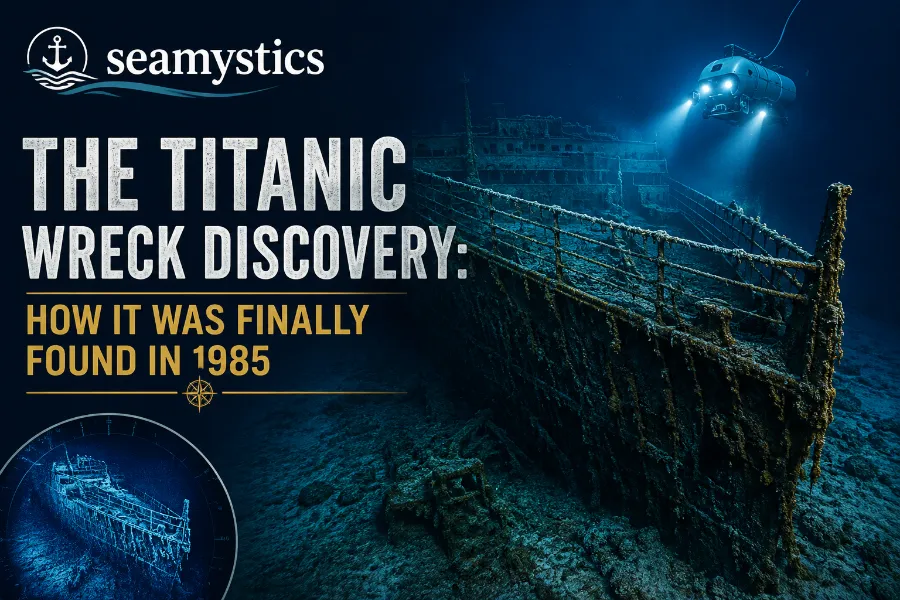

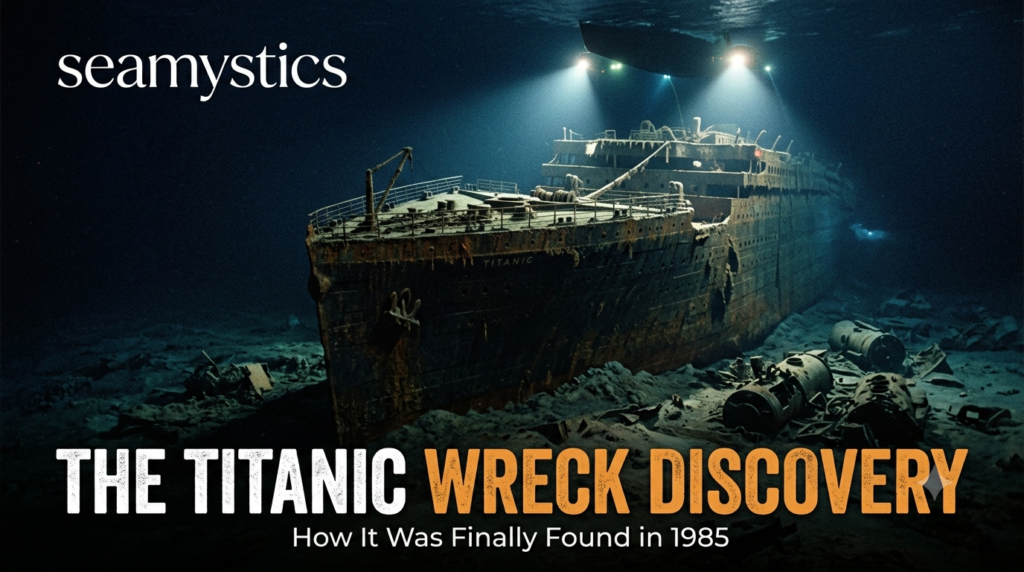
For more than 73 years, the world’s most famous shipwreck remained hidden beneath the icy waters of the North Atlantic Ocean. Many people believed finding the Titanic would be impossible because of its incredible depth and the harsh conditions on the seafloor. However, in 1985, a team of determined scientists finally located the wreck, changing marine science forever. The Titanic wreck discovery history is more than an exciting mystery. It also shows how technology, teamwork, and scientific curiosity can solve challenges once thought impossible.
Today, the Titanic continues to attract researchers, historians, engineers, and millions of curious readers. Moreover, every expedition reveals new details about the ship, the marine ecosystem around it, and the effects of time on one of history’s most famous disasters.
you read our blog about history of scuba diving
Key Takeaways
| Topic | Details |
|---|---|
| Primary Keyword | Titanic wreck discovery history |
| Ship Name | RMS Titanic |
| Discovery Date | September 1, 1985 |
| Discovery Team | Dr. Robert Ballard and Jean-Louis Michel |
| Depth | About 3,800 meters (12,500 feet) |
| Ocean | North Atlantic Ocean |
| Technology Used | Argo deep-sea camera system |
| Historical Importance | Revolutionized deep-sea exploration |
| Current Status | Protected underwater cultural heritage |
Why the Titanic Still Fascinates the World
More than a century after the disaster, the Titanic remains one of the most studied shipwrecks in history. Its tragic voyage, remarkable engineering, and heartbreaking loss of life continue to inspire books, documentaries, and scientific expeditions.
Several factors explain why public interest has never faded:
- It represented the most advanced passenger ship of its time.
- More than 1,500 people lost their lives during the disaster.
- The wreck remained hidden for over seven decades.
- Scientists continue discovering new information during each expedition.
- Marine life has transformed the wreck into a unique deep-sea habitat.
As a result, the Titanic has become both a historical monument and an important scientific research site.
What Happened to the Titanic?
The Maiden Voyage
The RMS Titanic began its maiden voyage on April 10, 1912, departing from Southampton, England. Its destination was New York City in the United States. At that time, it was the largest passenger ship ever built and symbolized modern engineering.
The ship carried approximately 2,224 passengers and crew. People from different social classes boarded the vessel, hoping for a safe journey across the Atlantic Ocean.
However, events unfolded very differently.
The Night of the Disaster
Late on April 14, 1912, the Titanic struck an iceberg in the North Atlantic. Although the crew attempted to avoid the collision, the iceberg tore open several compartments below the waterline.
Consequently, water flooded into the ship faster than engineers had expected. During the following hours, the vessel gradually filled with seawater.
At approximately 2:20 a.m. on April 15, the Titanic broke apart and disappeared beneath the ocean surface.
Sadly, more than 1,500 people lost their lives, making it one of the deadliest maritime disasters in modern history.
Why Was Finding the Titanic So Difficult?
Many people assume scientists simply sailed to the accident site and located the wreck. In reality, the search proved incredibly difficult.
Several major challenges delayed the discovery.
1. Extreme Ocean Depth
The Titanic rests nearly 3,800 meters (12,500 feet) below the ocean surface.
At this depth:
- Water pressure exceeds 5,500 pounds per square inch
- Sunlight cannot reach the seabed
- Temperatures remain close to freezing
- Human divers cannot survive without specialized vehicles
Therefore, ordinary diving equipment could never reach the wreck.
2. Vast Search Area
Although distress signals gave investigators a general location, they did not provide the exact sinking position.
After the ship disappeared, ocean currents carried debris across many kilometers. Consequently, search teams had to examine thousands of square kilometers of the Atlantic Ocean.
Finding the wreck resembled searching for a single building in an enormous underwater desert.
3. Limited Technology
During the early and mid-1900s, underwater exploration technology remained very limited.
Scientists lacked:
- High-resolution sonar
- Deep-sea robots
- Powerful underwater cameras
- Advanced navigation systems
- Computerized mapping software
As a result, several search attempts ended without success.
Early Searches Before 1985
The search for Titanic began long before its eventual discovery.
Throughout the 1960s and 1970s, several researchers proposed different methods for locating the wreck.
Some experts suggested using advanced sonar.
Others believed magnetic sensors could detect the ship’s massive steel hull.
Unfortunately, available technology simply wasn’t good enough.
Furthermore, searching at extreme depths required expensive equipment that very few organizations possessed.
Because of these obstacles, many experts believed the Titanic might never be found.The Turning Point in Ocean Exploration
By the early 1980s, deep-sea exploration experienced rapid technological progress.
New underwater vehicles could survive crushing ocean pressure.
Scientists also developed sophisticated imaging systems capable of photographing the seafloor from great distances.
Meanwhile, improvements in satellite navigation helped research vessels remain accurately positioned during long expeditions.
These breakthroughs finally created an opportunity to solve one of the world’s greatest underwater mysteries.
Dr. Robert Ballard’s Vision
American oceanographer Dr. Robert Ballard believed that earlier search efforts focused on the wrong target.
Instead of looking directly for the ship itself, Ballard proposed searching for the debris field surrounding the wreck.
This idea came from studying previous shipwrecks.
When large ships sink, they usually scatter thousands of objects across the ocean floor. Furniture, dishes, machinery, luggage, and structural components often spread over several kilometers.
Therefore, finding scattered debris could lead researchers directly to the main wreck site.
Although the strategy sounded simple, proving it required new technology and careful planning.
A Historic Partnership
To improve the chances of success, American and French research teams agreed to work together.
The French expedition first mapped large portions of the search area using advanced side-scan sonar.
Afterward, Ballard’s American team prepared to conduct a visual search using an innovative underwater camera system.
Rather than competing, both teams shared scientific knowledge and coordinated their efforts.
This international cooperation became one of the defining strengths of the 1985 expedition.
Technology That Changed Everything
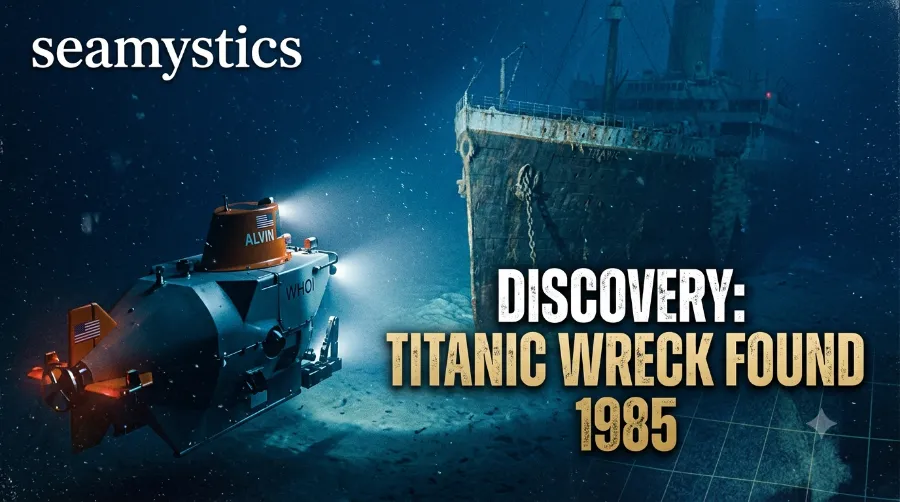
One of the expedition’s greatest advantages was a revolutionary deep-sea imaging system called Argo.
Unlike earlier equipment, Argo could travel just above the ocean floor while transmitting thousands of photographs back to the research vessel in real time.
Instead of relying only on sonar images, scientists could actually see objects resting on the seabed.
This breakthrough dramatically increased the chances of finding the Titanic.
The next stage of the expedition would soon make history.
How the Titanic Was Finally Found in 1985
By the end of August 1985, weeks of searching had tested the team’s patience. Day after day, the research vessel crossed the North Atlantic while the Argo camera system scanned the dark ocean floor. Although the crew remained hopeful, they knew that finding the Titanic depended on both careful planning and a bit of luck.
Then, everything changed.
September 1, 1985: The Historic Discovery
In the early hours of September 1, 1985, scientists aboard the research vessel noticed something unusual on their video monitors. Instead of seeing only mud and rocks, the cameras revealed a large metal object resting on the seabed.
Soon afterward, more objects appeared.
The team identified pieces of coal, sections of the ship’s hull, and large steel boilers. These clues confirmed they had located the long-lost RMS Titanic.
After more than 73 years, one of history’s greatest maritime mysteries had finally been solved.
The discovery became international news within hours. Newspapers, television stations, and scientific organizations around the world celebrated the achievement.
The First Clue: A Massive Debris Field
Interestingly, the expedition did not locate the ship itself first.
Instead, researchers found a huge debris field spread across the ocean floor.
This debris included:
- Coal from the ship’s engines
- Pieces of metal plating
- Personal belongings
- Kitchen equipment
- Broken furniture
- Shoes
- Bottles
- Ship machinery
These scattered objects formed a trail that stretched for nearly 5 kilometers (3 miles).
Following this underwater trail eventually led scientists to the Titanic’s two main sections.
Ballard’s strategy had worked exactly as planned.
Why the Debris Field Was So Important
The debris field told scientists much more than simply where the ship rested.
It also explained how the Titanic sank.
For decades, many experts believed the vessel had reached the ocean floor in one piece.
However, the scattered wreckage suggested something very different.
Researchers concluded that:
- The ship broke apart before reaching the seabed.
- Thousands of objects separated during the descent.
- Strong underwater forces spread the debris over a wide area.
Later expeditions confirmed this theory through detailed mapping and photography.
Discovering the Bow
After following the debris trail, the cameras finally revealed one of the most unforgettable sights in marine exploration history.
The bow section of the Titanic appeared standing upright on the seabed.
Although covered with rust and marine organisms, many recognizable features remained visible.
Scientists observed:
- The famous anchor
- Railings
- Deck structures
- Cargo hatches
- Large chains
- The ship’s name area, though badly damaged
The image stunned everyone aboard the research vessel.
Many crew members described the moment as emotional because they realized they were looking at one of history’s most significant shipwrecks.
Finding the Stern
Later exploration uncovered the stern section, located about 600 meters (2,000 feet) from the bow.
Unlike the relatively intact bow, the stern had suffered catastrophic damage.
During the sinking, trapped air and structural stress caused the rear portion to twist and collapse violently.
As a result, researchers found:
- Crushed steel beams
- Broken engines
- Twisted propeller shafts
- Collapsed decks
- Scattered machinery
The condition of the stern helped engineers better understand the final moments of the disaster.
How Argo Made the Discovery Possible
Without the Argo camera system, finding Titanic would have remained extremely difficult.
Instead of searching directly for a massive ship in complete darkness, Argo photographed the seafloor continuously while being towed behind the research vessel.
Key Features of Argo
| Feature | Benefit |
|---|---|
| High-resolution cameras | Captured clear images in darkness |
| Powerful lights | Illuminated the deep ocean floor |
| Long towing cable | Allowed operation nearly 4 km below the surface |
| Real-time image transmission | Scientists viewed discoveries immediately |
| Stable movement | Produced consistent photographic surveys |
This technology represented one of the biggest advances in underwater exploration during the 1980s.
Who Found the Titanic?
Although Dr. Robert Ballard became the public face of the expedition, the discovery resulted from international teamwork.
The expedition combined American and French expertise.
Key Members
| Scientist | Role |
|---|---|
| Dr. Robert Ballard | Expedition leader and oceanographer |
| Jean-Louis Michel | French deep-sea exploration leader |
| French IFREMER team | Sonar mapping |
| Woods Hole Oceanographic Institution | Research coordination |
| U.S. Navy support | Technology and logistics |
The partnership demonstrated how scientific cooperation can solve problems that no single organization could accomplish alone.
A Discovery That Changed Marine Science
Finding the Titanic accomplished far more than solving a famous mystery.
It transformed several areas of ocean research.
Scientists realized that advanced underwater robots could safely explore places humans could never reach.
As a result, researchers began studying:
- Deep-sea volcanoes
- Hydrothermal vents
- Ocean trenches
- Ancient shipwrecks
- Previously unknown marine habitats
Many modern underwater vehicles trace their development back to lessons learned during the Titanic expedition.
What Scientists Learned About the Sinking
The wreck answered many long-standing questions.
Researchers confirmed that the Titanic broke into two large sections before reaching the seabed.
They also discovered that the bow landed gently compared with the stern, which struck the ocean floor with tremendous force.
These findings helped engineers recreate the ship’s final hours more accurately than ever before.
Updated Understanding of the Disaster
| Before Discovery | After Discovery |
|---|---|
| Titanic sank mostly intact | Ship split into two major sections |
| Wreck location uncertain | Exact coordinates identified |
| Limited knowledge of breakup | Detailed evidence confirmed structural failure |
| Few underwater photographs | Thousands of high-quality images collected |
Marine Life Around the Titanic
Despite the extreme conditions, scientists found a surprising variety of life.
These organisms include:
- Deep-sea bacteria
- Sea anemones
- Brittle stars
- Amphipods
- Shrimp
- Crustaceans
- Specialized microbes
Perhaps the most fascinating discovery was the presence of reticles.
Reticles resemble rusty icicles hanging from the ship’s steel surfaces.
However, they are not simply rust.
Instead, they consist of bacteria that slowly consume iron.
Over time, these microorganisms gradually weaken the wreck’s structure.
Consequently, researchers estimate that large portions of the Titanic will eventually collapse as natural biological processes continue.
Why Researchers Continue Visiting the Wreck
Even today, scientists regularly return to study Titanic because every expedition produces new information.
Current research focuses on:
- Monitoring structural changes.
- Studying deep-sea microbial life.
- Creating detailed 3D digital models.
- Measuring corrosion rates.
- Protecting historical artifacts.
- Understanding long-term preservation.
These ongoing studies benefit both marine biology and underwater archaeology.
Timeline of Major Events
| Year | Event |
|---|---|
| 1912 | Titanic sinks after striking an iceberg |
| 1912–1984 | Numerous unsuccessful search attempts |
| 1985 | Wreck discovered by Ballard and Michel’s teams |
| 1986 | First crewed dives document the wreck in detail |
| 1995 | Extensive photographic surveys completed |
| 2010 | Advanced robotic mapping begins |
| 2022 | High-resolution digital imaging improves documentation |
| 2023–2025 | Continued monitoring reveals increasing structural decay |
Internal Links
- Read more about deep-sea exploration: /deep-sea-guide
- Learn how underwater robots work: /rov-explained
- Explore famous shipwrecks: /historic-shipwrecks
-
Why the Titanic Wreck Is Slowly Disappearing
Although the discovery of the Titanic amazed the world, the ship has not remained unchanged. Every year, the wreck becomes weaker as nature slowly breaks it down. Scientists have closely monitored its condition for decades, and recent surveys show that some iconic parts of the ship have already collapsed.
The deep ocean may seem calm, yet it is constantly changing. Tiny organisms, ocean currents, and chemical reactions all play a role in the Titanic’s gradual decay. As a result, researchers believe future generations may never see the wreck in the condition it appears today.
The Role of Rust-Eating Bacteria
One of the biggest threats to the Titanic comes from microscopic life.
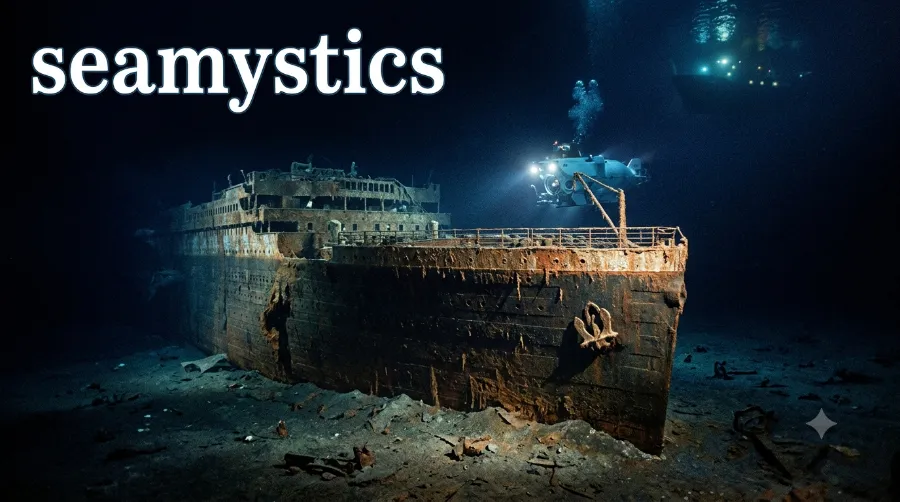
Scientists discovered colonies of bacteria living on the ship’s steel surfaces. These microorganisms create rusticles, which look like rusty icicles hanging from the wreck.
However, rusticles are much more than ordinary rust. They contain bacteria that feed on iron and slowly weaken the ship’s structure.
Over time, this natural process causes:
- Steel plates to become thinner
- Railings to collapse
- Decks to weaken
- Interior rooms to disappear
- Large sections of the hull to break apart
Because of this biological activity, the Titanic continues to change every year.
Ocean Conditions Also Damage the Wreck
Bacteria are only one part of the story.
Several environmental factors speed up the ship’s deterioration.
Main Causes of Decay
Factor Effect on the Titanic Saltwater Accelerates corrosion Ocean pressure Weakens damaged structures Deep-sea currents Move sediment and debris Iron-eating bacteria Consume steel Natural chemical reactions Increase rust formation Together, these forces slowly erase one of history’s most famous shipwrecks.
Latest Research and Expeditions (2023–2026)
Modern technology has allowed scientists to study the Titanic in ways that were impossible in 1985.
Instead of relying only on photographs, researchers now use advanced underwater robots, laser scanners, and high-resolution imaging systems.
These tools create detailed digital models of the wreck without disturbing it.
Major Recent Discoveries
Recent expeditions have revealed several important findings:
- Parts of the captain’s quarters have continued to collapse.
- More railings have disappeared because of corrosion.
- Rusticles have spread across additional sections of the ship.
- Sediment now covers areas that were once clearly visible.
- New marine organisms continue to colonize the wreck.
Researchers compare modern images with photographs taken decades ago. Consequently, they can measure exactly how much the ship changes over time.
The First Full-Size Digital Scan
One of the most exciting developments came when researchers produced a full-scale 3D digital model of the Titanic.
Thousands of underwater images combined to create a detailed “digital twin” of the wreck.
This virtual model allows scientists to:
- Study the wreck without repeated dives.
- Measure structural changes.
- Preserve historical information.
- Test new scientific theories.
- Share the wreck with researchers worldwide.
The digital model also helps historians better understand how the ship broke apart during its final moments.
Why the Titanic Matters to Marine Biology
Although many people think of the Titanic as a historical site, marine biologists see it differently.
The wreck functions as an artificial reef deep beneath the Atlantic Ocean.
Countless marine species now live on or around the ship.
Scientists study this ecosystem to understand how life survives in one of Earth’s most extreme environments.
Marine Life Found Near the Titanic
Organism Importance Bacteria Break down iron Sea anemones Attach to metal surfaces Brittle stars Feed on organic matter Amphipods Important scavengers Deep-sea shrimp Part of the local food web Crustaceans Colonize protected areas Each expedition reveals additional species adapted to life in complete darkness.
Should Artifacts Be Removed?
This question has sparked debate for decades.
Some historians support recovering carefully selected artifacts because they preserve history before the wreck disappears.
Others argue the Titanic should remain untouched as a memorial to the more than 1,500 people who lost their lives.
Arguments for Artifact Recovery
- Preserves important historical objects
- Allows museum exhibitions
- Supports scientific research
- Prevents complete loss through corrosion
Arguments Against Artifact Recovery
- Disturbs a historic gravesite
- Removes items from their original context
- May damage fragile structures
- Raises ethical concerns
Today, many researchers favor limited scientific recovery while protecting the wreck itself.
International Protection of the Titanic
The Titanic is now recognized as an important part of global maritime heritage.
Several countries cooperate to protect the site from:
- Unauthorized salvage
- Commercial exploitation
- Physical damage
- Unregulated tourism
Modern expeditions follow strict scientific guidelines to reduce their impact on the fragile wreck.
Research Data
Titanic Wreck Timeline
Year Event 1912 Titanic sinks 1985 Wreck discovered 1986 First crewed exploration 1996 Detailed mapping expands 2010 Robotic surveys increase 2022 High-resolution imaging completed 2023 Full digital twin released 2025 Ongoing monitoring of structural changes Titanic Facts and Figures
Category Data Length 269 meters (882 feet) Width 28 meters (92 feet) Gross Tonnage 46,328 tons Passengers and Crew About 2,224 Lives Lost More than 1,500 Depth of Wreck Approximately 3,800 meters Years Hidden 73 years Discovery Date September 1, 1985 Chart: Timeline of Major Milestones
1912  █ Titanic sinks

1985  ██████████ Wreck discovered

1986  █ First crewed dive

1995  ██ Detailed surveys

2023  █████ Digital twin completed

2025  ██ Ongoing preservation research
Chart: Factors Contributing to Wreck Decay
Iron-eating bacteria     ██████████████████ 40%

Saltwater corrosion      ████████████ 25%

Ocean currents           ████████ 15%

Pressure                 ██████ 10%

Other natural factors    █████ 10%
Lessons the Titanic Taught the World
The Titanic’s discovery has influenced many scientific fields. Researchers continue to apply lessons learned from the expedition to modern ocean exploration.
Key contributions include:
- Improved underwater robotics.
- Better deep-sea mapping techniques.
- Advances in marine archaeology.
- Greater understanding of deep-ocean ecosystems.
- Improved preservation of underwater cultural heritage.
- More accurate historical reconstructions.
- Better international scientific cooperation.
Because of these advances, today’s ocean explorers can study the deep sea with greater precision than ever before.
Related Guides
Continue learning with these Sea Mystics articles:
- /deep-ocean-ecosystems
- /how-submersibles-work
- /greatest-shipwrecks-in-history
Was the Titanic really found in 1985?
Yes. The wreck of the RMS Titanic was officially discovered on September 1, 1985, by a joint American-French expedition led by Dr. Robert Ballard and Jean-Louis Michel. The team used the deep-sea camera system Argo to locate the wreck nearly 3,800 meters (12,500 feet) below the surface of the North Atlantic Ocean.
How deep is the Titanic wreck?
The Titanic lies at a depth of approximately 3,800 meters (12,500 feet). At this depth, the water pressure is about 380 times greater than at sea level, making it impossible for human divers to reach without specialized deep-sea submersibles.
Why did it take 73 years to find the Titanic?
Several factors delayed the discovery:
- The wreck rested in one of the deepest parts of the North Atlantic.
- Early search technology was not advanced enough.
- The search area covered thousands of square kilometers.
- Ocean currents scattered debris across a wide region.
- Deep-sea exploration remained extremely expensive until the 1980s.
Advances in underwater imaging and robotics finally made the discovery possible in 1985.
Did the Titanic sink in one piece?
No. Modern research confirms that the Titanic broke into two main sections before reaching the ocean floor. The bow and stern now rest about 600 meters (2,000 feet) apart, connected by a large debris field containing thousands of artifacts.
Can people visit the Titanic wreck?
Only trained crews using certified deep-sea submersibles can safely visit the wreck. Due to the extreme depth, high pressure, and fragile condition of the site, these expeditions are rare, costly, and carefully regulated.
Is the Titanic disappearing?
Yes. Scientists estimate that the wreck is gradually deteriorating because of:
- Iron-eating bacteria
- Saltwater corrosion
- Ocean currents
- Natural chemical reactions
- Structural collapse over time
Researchers continue to monitor these changes using remotely operated vehicles and high-resolution digital mapping.
Conclusion
The Titanic wreck discovery history is one of the greatest achievements in marine exploration. When scientists finally located the wreck on September 1, 1985, they solved a mystery that had lasted more than seven decades. More importantly, the discovery transformed deep-sea science, underwater archaeology, and robotic exploration.
Today, the Titanic serves as both a historical memorial and a remarkable underwater laboratory. Each new expedition improves our understanding of deep-ocean ecosystems, shipwreck preservation, and advanced exploration technology. Although the wreck continues to deteriorate naturally, modern digital mapping and scientific research ensure that its story will remain available for future generations. The Titanic reminds us that the ocean still holds countless mysteries waiting to be explored—and that curiosity, innovation, and international cooperation can uncover even the deepest secrets.
Further Reading (Internal Links)
Explore more articles from Sea Mystics:
- /deep-sea-exploration-guide
- /marine-archaeology-basics
- /deep-ocean-creatures-explained
These guides expand on deep-sea ecosystems, underwater technology, and the science behind famous shipwrecks.
About the Author
Dr. Rabica is a marine biologist and science writer with over 20 years of experience studying deep-sea ecosystems, marine biodiversity, and underwater exploration. Through Sea Mystics, Dr. Rabica translates complex ocean science into practical, engaging articles that help readers understand and appreciate the hidden world beneath the waves.