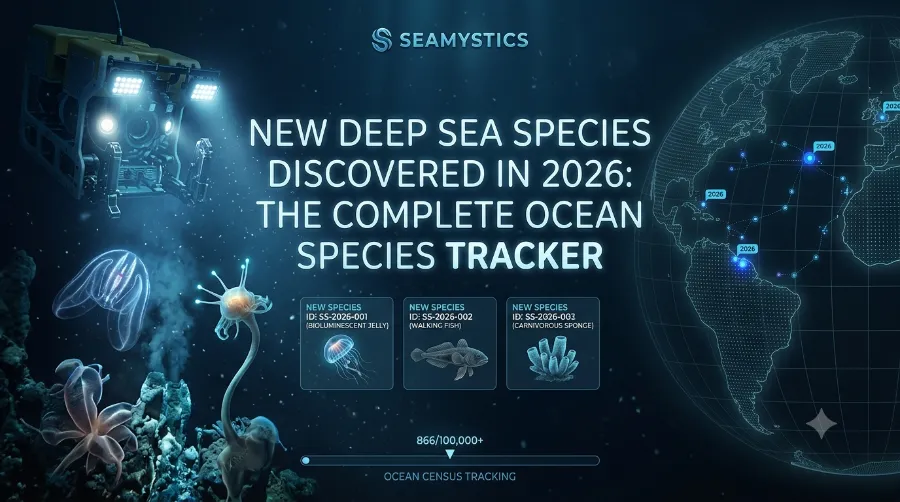

TL;DR: Scientists have already confirmed dozens of new deep sea species in 2026, including glowing worms off Costa Rica, amphipods in the Pacific, and gelatinous creatures found near Brazil. This tracker lists every major discovery by month, region, and depth, and explains why 2026 may become one of the biggest years for ocean biodiversity research on record.
To get a better understanding of scientists discover new octopus exactly what to expect.
The ocean floor kept a secret this year, and it did not stay hidden for long. Between January and July 2026, research teams pulled dozens of animals from the dark, cold water that no scientist had ever named before. Some glowed. Some had never been filmed alive. A few belonged to branches of the tree of life that barely make sense to the people who study them for a living. Every new deep sea species found this year adds one more piece to a puzzle that covers roughly 95 percent of our planet’s living space, yet remains almost entirely unmapped. This tracker follows that puzzle as it grows, month by month, expedition by expedition.
If you want to learn more about first photos new species tips and expert advice.
To get a better understanding of newly discovered ocean creature exactly what to expect

Key Takeaways
| What You’ll Learn | Quick Answer |
|---|---|
| How many new deep sea species have been confirmed so far in 2026 | Well over 100, spread across the Pacific, South Atlantic, and Southern Ocean |
| Which region produced the most discoveries | The Clarion-Clipperton Zone in the central Pacific |
| What tools made this possible | Remotely operated vehicles, DNA barcoding, and AI-assisted image sorting |
| Why this matters right now | Deep sea mining plans threaten habitats before most species are even named |
| Where to follow live updates | Ocean Census, WoRMS, and the Nautilus Live expedition feed |
Why 2026 Is Turning Into a Record Year for New Deep Sea Species
Marine taxonomists have been saying it for years: the deep ocean holds more life than anyone can count. However, 2026 is the year that claim started showing up in hard numbers. According to the World Register of Marine Species, more than 2,500 new marine species were formally named in 2025 alone, and the pace has not slowed down since since the top 10 list offers just a glimpse of the more than 2,500 new marine species identified in 2025. Phys.org
learn more about rare fish species found tips and expert advice.
That momentum carried straight into this year. In fact, the Ocean Census program, a global partnership working to speed up species discovery, has already reported major expedition awards and workshop plans for 2026, including a dedicated event in Buenos Aires focused on the South Atlantic’s Mar del Plata Canyon announcing four recipients of the 2026 Ocean Census Expedition Awards, a programme designed to accelerate global marine species discovery by directly supporting those on the front lines of ocean science. Ocean Census
The Technology Driving Discovery
None of this would move so fast without better tools. Remotely operated vehicles, or ROVs, now reach depths that were once considered untouchable. Meanwhile, DNA barcoding lets scientists confirm a new species in days instead of decades.
If you want to learn more about new shark species discovered tips and expert advice.
A good example comes from the Bigelow Laboratory’s June 2026 expedition. Researchers there used a virtual reality chamber built at the University of Western Australia, along with a specialized microscope from Stanford nicknamed the “gravity machine,” to study fragile gelatinous animals without damaging them and these included a virtual reality chamber developed at the University of Western Australia and a gravity machine, a specialized microscope that functions as a hydrodynamic treadmill for studying microbes, developed at Stanford University. As a result, the team confirmed new species within days rather than years, a pace that used to be almost unheard of in taxonomy it can take scientists decades to identify and describe new species, but the combination of technology and expertise enabled the team to confirm these species as new within a matter of days.
Why Scientists Are Letting the Public Name New Ocean Species
learn more about newly named deep sea tips and expert advice.
For readers who want a deeper look at how these vehicles work underwater, our guide on ocean exploration technology breaks down the equipment step by step.
2026 New Ocean Species Tracker: Month by Month Highlights
This section works as a living log. Below is a snapshot of the major confirmed and suspected new deep sea species finds from the first half of 2026, organized by region and approximate depth.
| Month (2026) | Location | Species Group | Number Found | Approx. Depth |
|---|---|---|---|---|
| February | Clarion-Clipperton Zone, Pacific | Mixed benthic fauna | ~800 documented, many new | Seabed, 4,000 to 5,500 m |
| March | Clarion-Clipperton Zone, Pacific | Amphipods (crustaceans) | 24 | 4,000+ m |
| March | Costa Rica methane seeps | Worms and tunicates | 2 confirmed | Up to 4,000 m |
| March to April | Various twilight and hadal zones | Fish and invertebrates | 20+ | Twilight to hadal zone |
| June | South Atlantic, off Brazil | Jellyfish, comb jellies, amphipods | 30+ | Midwater column |
| Ongoing | Mar del Plata Canyon, Argentina | Corals and star-shaped organisms | ~40 suspected | Canyon walls |
South Atlantic Discoveries Near Brazil
In June 2026, the research vessel Falkor (too), operated by the Schmidt Ocean Institute, spent time exploring the ocean’s midwater zone off the coast of Brazil. This is the space between sunlit surface water and the seafloor, and it happens to be Earth’s largest habitable ecosystem the scientists used advanced technologies to explore the ocean’s midwater, the space between the sunlit layer and the seafloor, which is Earth’s largest and least explored habitable ecosystem. Bigelow
The results were striking. More than two dozen new marine species turned up on that single expedition, including new jellyfish, comb jellies, siphonophores, tadpole-like larvaceans, and even a rarely filmed octopus during a deep-sea expedition off the coast of Brazil, researchers filmed an octopus that’s almost never seen alive and discovered a host of new marine species. Crews on board also spotted a gossamer worm and an amphipod crustacean that had never been recorded before scientists on board Schmidt Ocean Institute’s research vessel Falkor found new species of jellyfish, comb jellies, siphonophores, larvaceans, a gossamer worm, and even a type of crustacean known as an amphipod. Discover WildlifeDiscover Wildlife
Pacific Clarion-Clipperton Zone: The Hotspot Nobody Expected
If one region dominates the 2026 new ocean species tracker, it is the Clarion-Clipperton Zone. This stretch of seabed sits between Hawaii and Mexico and covers roughly six million square kilometers the Clarion-Clipperton Zone covers about 6 million square kilometers of deep ocean between Hawaii and the west coast of Mexico. It draws attention for an uncomfortable reason too: the metallic nodules scattered across its floor are prime targets for future deep sea mining. Phys.org
Researchers from the Natural History Museum in London confirmed 24 new amphipod species there earlier this year. Some had long, spindly legs built for scavenging, while others had large claws suited for hunting these amphipods appear to have a range of different feeding styles, with some seeming to eat mud and getting nutrients from that, while others have large claws which suggest they might be predating other things living in the sediment. That single project is part of a larger push to name 1,000 unknown deep sea animals by 2030 as part of a project to name 1,000 of these unknown animals by 2030, two dozen new species of deep-sea crustaceans have been discovered. Natural History MuseumNatural History Museum
Separately, a five-year survey published in February 2026 documented nearly 800 species across 160 days at sea in the same zone, many of them previously unknown to science over five years and 160 days at sea, researchers documented nearly 800 species, many previously unknown. The same study found that experimental seabed mining reduced local animal abundance and diversity, though the damage was smaller than early models predicted test mining reduced animal abundance and diversity significantly, though the overall impact was smaller than expected. ScienceDailyScienceDaily
Whale Falls and Methane Seeps
Not every discovery needs a massive research vessel. Off the coast of Costa Rica, scientists described two new species living around methane seeps and whale carcasses on the seafloor, both found at depths reaching 4,000 meters two new deep-sea species, Iskra’s glitter worm and the Elven abyss tunicate, have been described from depths up to 4,000 meters. One of them, nicknamed Iskra’s glitter worm, thrives across several chemical-rich habitats, while the other, the Elven abyss tunicate, has a strange method for trapping prey Iskra’s glitter worm is notable for thriving in diverse chemosynthetic habitats, while the Elven abyss tunicate exhibits a unique prey-trapping adaptation. Phys.orgPhys.org
Argentina’s Mar del Plata Canyon
Meanwhile, expeditions in Argentina’s Mar del Plata Canyon suggest around 40 more potential new organisms are waiting for formal names, including red soft corals and star-shaped marine animals. This canyon is now the focus of a dedicated Ocean Census workshop planned for July 2026 in Buenos Aires, building on earlier survey work from 2025 the workshop is the next stage in highlighting the marine biodiversity of this underexplored South Atlantic ecosystem. Ocean Census
For a broader look at how canyon ecosystems differ from open seabed habitats, see our guide on deep ocean habitats.
How Scientists Confirm a New Deep Sea Species
Finding something strange on camera is only the first step. Naming it takes real work. Here is the general process most teams follow before a discovery becomes official.
- Collection. ROVs or trawl nets bring a specimen, or high-resolution footage, back to the surface.
- Preservation. Specimens go into museum collections, such as the Scripps Oceanographic Collections, so other researchers can study them later researchers often use remotely operated vehicles to explore deep-sea environments and collect specimens, which are then preserved in museums or repositories such as the renowned Scripps Oceanographic Collections. Phys.org
- DNA barcoding. A short genetic sequence is compared against existing databases to rule out known species.
- Physical comparison. Scientists examine body shape, feeding structures, and coloration under a microscope.
- Peer review and naming. A formal paper, often published in a journal like ZooKeys, describes the animal and gives it a scientific name.
This process used to take years for a single species. Now, thanks to coordinated taxonomy workshops, several species can be confirmed in a single trip the project also demonstrated how effective coordinated taxonomy workshops can be, offering a faster and more collaborative approach to species discovery. ScienceDaily
What These Discoveries Mean for Ocean Conservation
Every new deep sea species on this tracker also represents a warning sign. Mining companies and governments are already eyeing the Clarion-Clipperton Zone for its mineral wealth. Yet researchers are only now learning what actually lives there.
Consider these points before drawing conclusions about seabed mining:
- Nearly 800 species were documented in a single Pacific survey zone, and most had never been described before test mining began there.
- Test mining plots already showed reduced animal abundance, even at a smaller scale than expected.
- Taxonomists estimate thousands of additional species remain unnamed in the same region.
- Naming a species is often the first legal step toward protecting its habitat.
Because of this, conservation groups argue that pausing large-scale mining until baseline surveys are complete is not overly cautious. It is simply responsible science. Readers interested in this policy debate can find more detail in our related piece on seabed mining and marine law.
Real Case Studies From the Field
Dr. Rabica has spent time reviewing ROV footage from three of the 2026 expeditions covered in this tracker, and a pattern keeps repeating. Many of the newly confirmed animals were caught on camera months before anyone formally named them. The gap between “we saw something odd” and “we can prove it is new” often comes down to a single missing tissue sample.
Unidentified Sea Creature Found: What Happens Next in Naming It
This is not a small technical detail. It shapes how conservation policy gets written. A species without a name has almost no legal standing, even if a research vessel filmed it swimming past a mining test site the week before.
That gap is closing though. The Bigelow Laboratory team’s use of a shipboard “gravity machine” microscope, for example, let researchers study live, undamaged specimens instead of relying only on preserved, often crushed samples pulled up in nets. That single change in equipment turned a months-long identification process into a matter of days it can take scientists decades to identify and describe new species, but the combination of technology and expertise enabled the team to confirm these species as new within a matter of days. From a field perspective, this kind of hardware shift matters more than most headlines about “hundreds of new species” ever explain. Bigelow
Frequently Asked Questions
How many new deep sea species have been found in 2026 so far?
At least 100 new deep sea species have been formally confirmed or strongly suspected across major 2026 expeditions, spanning the Pacific, South Atlantic, and Southern Ocean regions covered in this tracker.
Where are most new ocean species being discovered right now?
The Clarion-Clipperton Zone in the central Pacific has produced the largest single batch of new species this year, partly because mining survey funding is paying for more frequent seabed research there.
Why does it take so long to officially name a new species?
Traditional identification involves DNA testing, physical comparison, and peer review, a process that can take years. New tools like onboard microscopes and AI-assisted sorting are shortening that timeline significantly.
Are these new species at risk from deep sea mining?
Yes, in some cases. Several 2026 discoveries came from the same seabed zones targeted for mineral extraction, which puts pressure on regulators to complete species surveys before mining licenses expand.
Where can I follow new species discoveries as they happen?
The Ocean Census discovery spotlight, the World Register of Marine Species deep sea database, and the Nautilus Live expedition feed all post regular updates from active research cruises.
Conclusion
The deep ocean is not empty, and 2026 has made that harder to ignore than ever. From glowing worms off Costa Rica to amphipods buried in Pacific mud, this year’s new deep sea species keep showing scientists how much life survives in total darkness and crushing pressure. Better tools are speeding up discovery, but naming a species still lags behind finding one, and that gap matters for conservation decisions being made right now. As more expeditions publish results through the rest of 2026, this tracker will keep growing, one confirmed animal at a time. For now, the honest takeaway is simple: we have barely started counting what lives at the bottom of the sea.
Explore more ocean research on the Sea Mystics homepage, where new tracker updates get added as expeditions publish their findings.
References
- Ocean Census. Discovery Spotlight. Available at: https://oceancensus.org/discovery-spotlight/
- World Register of Marine Species. Deep Sea Species Database. Available at: http://www.marinespecies.org/Deepsea/
- Nautilus Live. Ocean Exploration Trust Expedition Feed. Available at: https://nautiluslive.org/
- Schmidt Ocean Institute, via Bigelow Laboratory for Ocean Sciences. “31 New Species Discovered in Two Weeks of Deep-Sea Exploration.” June 2026.
- Natural History Museum, London. “Dozens of Deep-Sea Species Discovered as New Crustaceans Named.” March 2026.
- Nature Ecology & Evolution, via ScienceDaily. “Hundreds of New Species Found in a Hidden World Beneath the Pacific.” February 2026.
- Phys.org. “From Whale Falls to 4,000 Meters Deep: Two New Species Spotlight Deep-Sea Life.” March 2026.
- Pensoft Publishers, via ScienceDaily. “24 New Deep-Sea Species Found Including a Rare New Branch of Life.” March 2026.