
Bottlenose Dolphin Facts: The Ocean’s Most Studied Marine Mammal
Picture a gray fin cutting through a calm bay at sunrise. Soon after, a mother and her calf surface side by side, breathing in sync. I have watched that scene hundreds of times, and it still stops me every time. Because of decades of field work, these bottlenose dolphin facts show an animal far more complex than the smiling cartoon most people know.
TL;DR: The common bottlenose dolphin (Tursiops truncatus) is the most studied dolphin on Earth. In short, it lives in tight social groups, calls its friends by whistle “names,” uses tools, and can live past 50 years. However, ghost nets, pollution, and disease still threaten many local groups.
Key Takeaways
| Topic | Quick fact |
|---|---|
| Scientific name | Tursiops truncatus |
| Adult length | About 6 to 13 feet (2 to 4 m) |
| Weight | Roughly 300 to 1,400 pounds (150 to 650 kg) |
| Lifespan | 40 to 50 years, with some females past 60 |
| Pregnancy | About 12 months |
| Speed | Bursts near 20 mph (32 km/h) |
| Conservation status | Least Concern (IUCN), but local groups face real threats |
| Main threats | Fishing gear, ghost nets, chemical pollution, disease |
What Is a Bottlenose Dolphin?
A bottlenose dolphin is a toothed whale in the dolphin family. Scientists place it in the same big group as orcas, spinner dolphins, and pilot whales. As a result, you can think of it as a medium sized cousin in a very large family.
Porpoise Dolphin Differences: The Real Porpoise vs Dolphin Facts Explained
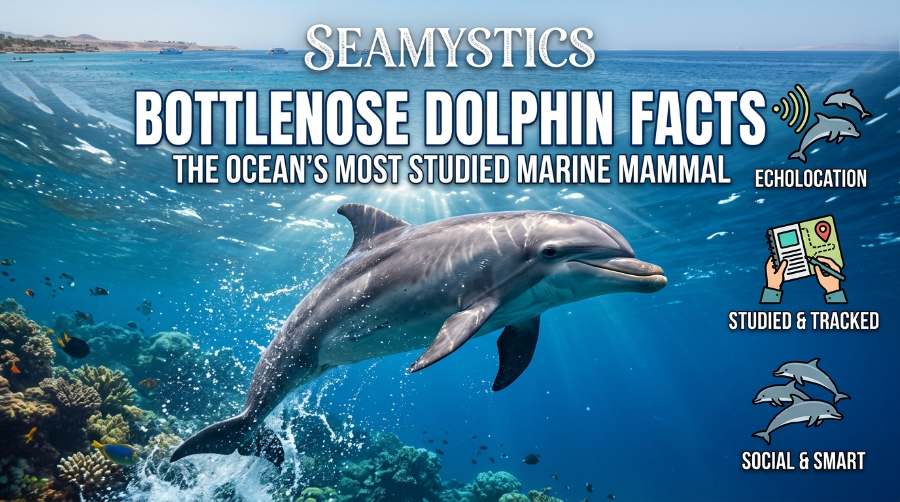
Body and Looks
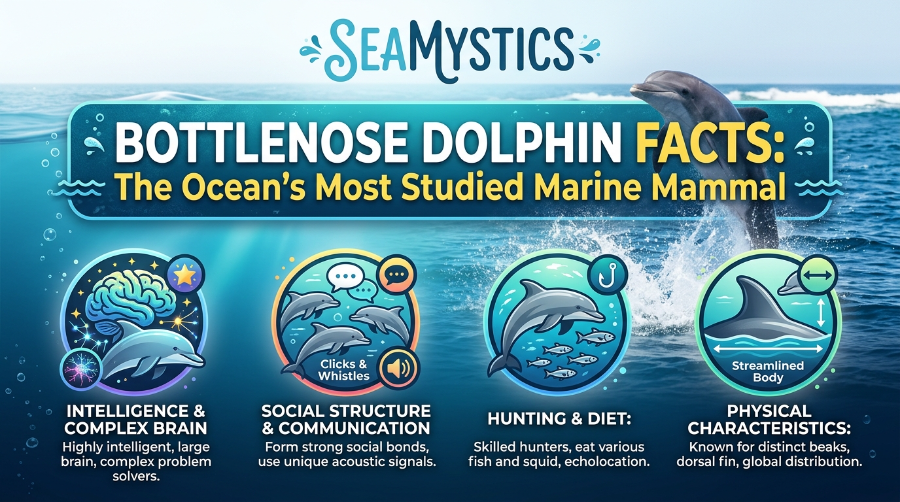
The name comes from the short, thick beak, which looks like the neck of a bottle. Most adults are gray on top and lighter on the belly. This color pattern works as camouflage, since prey and predators both see a darker back from above and a paler belly from below.
Like all mammals, dolphins breathe air, so they must surface every few minutes. A single blowhole sits on top of the head. In addition, each dolphin has about 80 to 100 cone-shaped teeth. These teeth grab fish, but they never chew.
Dolphin Species Guide: Every Type of Dolphin in the Ocean
Two Main Species
Scientists now split the group into two main species. First, the common bottlenose dolphin lives in most warm and temperate seas. Second, the Indo-Pacific bottlenose dolphin (Tursiops aduncus) lives in warm waters around the Indian Ocean and western Pacific. Although they look alike, DNA and body shape show clear differences.
Many people also ask if dolphins are fish. They are not. Instead, dolphins are warm-blooded mammals that give birth to live young and feed their calves milk.
Bottlenose Dolphin Facts Every Reader Should Know About Size and Lifespan
Size and age tell a lot about how a dolphin lives. Therefore, it helps to look at both before we move on to behavior.
How Big Do They Get?
Size changes a lot by region. For example, dolphins in cold water tend to grow bigger, because extra body mass keeps heat in. Atlantic dolphins off Scotland often look much bulkier than those in the warm Gulf of Mexico. Meanwhile, males usually grow a little larger than females.
Spinner Dolphin Facts: Why They Leap and Spin
Lifespan and Calves
In Sarasota Bay, Florida, researchers have followed wild dolphins since 1970. That is the longest running study of a wild dolphin group anywhere. Over the years, the team has recorded females living past 60, which shows how long these animals survive when conditions stay healthy.
Calves grow slowly, so mothers invest a lot of time. After about 12 months of pregnancy, a mother nurses her calf for 18 months to two years. Some calves stay close for up to six years. In my own survey work, I learned to spot a mother and calf pair quickly, because the calf swims tucked against her flank. Scientists call this echelon swimming, and it saves the calf energy while keeping it safe.
More Body Facts
Here are a few more body facts worth knowing:
- Speed: Short bursts reach about 20 mph, but cruising speed is much lower.
- Diving: Most dives stay shallow, yet some reach more than 500 meters (1,600 feet).
- Sleep: Only one half of the brain rests at a time, so the dolphin can keep breathing.
- Skin: The outer layer renews very quickly, which helps reduce drag in the water.
For a quick reference on other species, our dolphin species guide covers size, range, and status side by side.
Where Bottlenose Dolphins Live in the US, UK, and Europe
Bottlenose dolphins live in nearly every ocean except the polar seas. Still, the best places to see them depend on where you live.
United States
In the United States, you can find them from Cape Cod down the Atlantic coast, around Florida, and across the Gulf of Mexico. Some also live along the California coast. While some groups stay in bays and estuaries all year, others roam far offshore.
Nearshore and offshore dolphins are not the same. Coastal dolphins are often smaller and stay within a home range of a few dozen miles. In contrast, offshore dolphins grow larger and dive deeper to hunt squid and fish. Because of this split, the National Oceanic and Atmospheric Administration manages them as separate stocks. You can read the agency’s species profile on the NOAA Fisheries bottlenose dolphin page.
Dolphin Echolocation Science: How Dolphins See With Sound
UK and Europe
Europe and the UK have strong populations too. For instance, Scotland’s Moray Firth and Cardigan Bay in Wales both hold resident groups that people can watch from shore. Ireland’s Shannon Estuary also supports a well known group.
One famous case is Fungie, a lone dolphin who lived near Dingle, Ireland, from 1983 until he vanished in October 2020. Tourists came from around the world to see him. As a result, his story shows how much a single animal can shape a local community.
Dolphin or Porpoise?
Many readers wonder about the difference between a dolphin and a porpoise. Harbour porpoises, which also swim in UK waters, are smaller. They have a blunt face, a triangle fin, and spade-shaped teeth. By comparison, bottlenose dolphins have a longer beak, a curved fin, and cone-shaped teeth.
Bottlenose Dolphin Behavior: Social Lives, Play, and Teamwork
Bottlenose dolphin behavior looks simple from a boat. However, it hides a layered social life that researchers are still mapping.
A Fluid Social World
Scientists describe dolphin groups as a fission-fusion society. Small groups split apart and join again during the day. In other words, friends meet, hunt, rest, and part ways in changing patterns.
Mothers, calves, and young females often form nursery groups. Males, on the other hand, tend to form pairs or trios. In Shark Bay, Australia, researchers have tracked male teams that work together to herd a female. Even more surprising, some teams join with other teams, which creates alliances inside alliances. Few animals outside humans show this behavior.
Play
Play is a big part of daily life. Dolphins ride bow waves, toss seaweed, and blow bubble rings. Young animals play the most. Personally, I think play teaches real skills, since a calf that practices chasing a feather may hunt better later.
Hunting Methods
Hunting also shows teamwork. Here are four well documented methods:
- Mud ring feeding: In the Florida Keys, a dolphin circles in shallow water and flicks its tail to make a ring of mud. Fish then jump to escape and land near waiting dolphins.
- Cooperative fishing: In Laguna, Brazil, dolphins herd fish toward local fishermen’s nets and signal with a head or tail slap. As a result, both sides catch more fish.
- Strand feeding: In parts of South Carolina and Georgia, groups push fish onto mud banks, slide up for a quick meal, and wriggle back into the water.
- Sponge tool use: In Shark Bay, some dolphins wear a sea sponge over the beak to protect it while they search the seafloor.
Young dolphins learn these tricks from others. Because of this, scientists call them cultural traditions. A dolphin in one bay may use a trick that its neighbors never learn.
Dolphin Communication Signals: Do They Have Names for Each Other?
Bottlenose Dolphin Intelligence: What the Research Really Shows
Bottlenose dolphin intelligence draws huge attention, so let’s separate fact from hype. To begin, the dolphin brain weighs about 1,500 to 1,600 grams, a bit more than a human brain. It also has a large, folded cortex. Still, size alone does not prove smart behavior, so researchers test it with experiments.
Signature Whistles
The strongest evidence involves signature whistles. Each dolphin develops its own whistle within the first year of life. Later, friends learn that whistle and use it to call that individual. A 2013 study by Stephanie King and Vincent Janik found that wild dolphins answered when researchers played back a copy of a friend’s whistle. In plain words, they respond to something very close to a name.
Mirror Tests
Dolphins also pass mirror tests. In a 2001 study, Diana Reiss and Lori Marino marked dolphins with ink on body parts they could not see. Afterward, the animals swam to a mirror and checked the marks. This behavior suggests self-awareness, a trait that few species show.
Echolocation
Echolocation adds another layer. A dolphin sends out fast clicks and listens for the echoes. With this sense, it can find a small fish in murky water or tell if an object is solid or hollow. I once watched a dolphin locate a fish buried in sand, and the speed shocked me. No tool I use in the field comes close.
What We Still Don’t Know
Even so, I want to stay honest about the limits. Nobody has decoded a dolphin language, and many claims online go too far. What we can say is that dolphins learn, plan, remember friends for decades, and solve new problems.
Orca Pod Structure: How Killer Whale Families Actually Work
Common Dolphin Species: How the Bottlenose Compares
The family Delphinidae has about 40 species, so it helps to know the main groups. People often mix up the common dolphin species with the bottlenose. For example, the short-beaked common dolphin is smaller, has an hourglass pattern on its sides, and travels in huge, fast groups.
(Place your bar chart here.) It shows that the bottlenose is one of the largest beaked dolphins, and only Risso’s dolphin grows longer.
| Species | Where you may see it | Easy way to tell it apart |
|---|---|---|
| Common bottlenose dolphin | US coasts, UK, Ireland, Mediterranean | Short thick beak, plain gray body |
| Short-beaked common dolphin | Atlantic, Mediterranean, California | Hourglass pattern on the sides |
| Atlantic spotted dolphin | Gulf Stream, Bahamas | Spots that increase with age |
| Pacific white-sided dolphin | North Pacific, US West Coast | Bold white and gray sides |
| Risso’s dolphin | Deep water, UK west coast | Scarred, pale body with a blunt head |
| Spinner dolphin | Tropical seas | Leaps and spins in the air |
For a deeper breakdown, visit the full dolphin species guide on Sea Mystics. In addition, the Frames of Nature bottlenose dolphin overview shows how the animal looks in the wild.
Dolphin Research Facts: Three Case Studies That Changed What We Know
Good science needs long timelines. Therefore, these dolphin research facts matter most when they come from decades of data.
Case 1: Sarasota Bay, Florida (1970 to Today)
The Sarasota Dolphin Research Program has followed several generations of one wild community. Each year, the team briefly catches dolphins for health exams and then releases them. After 50 years, this work has revealed lifespans, friendships, and the ways mothers teach calves. Few studies on land animals match that depth.
Case 2: The 2013 to 2015 Mid-Atlantic Die-Off
A morbillivirus outbreak swept along the US East Coast. According to NOAA, more than 1,600 bottlenose dolphins stranded during that time, far above the normal rate. Consequently, teams improved their stranding response, because the event showed how fast disease can spread through tight social groups.
Case 3: The 2010 Gulf Oil Spill
After the Deepwater Horizon spill in April 2010, scientists studied dolphins in Barataria Bay, Louisiana. Many animals had lung disease and low stress hormones, which signals poor health. Years later, researchers still saw low calf survival in the area. This case taught me that pollution can harm a dolphin group long after the headlines fade.
My Field Takeaway
My own notes lead to one simple opinion. Long studies beat quick ones. A single sighting tells you almost nothing, but ten years of the same faces show who is related, who is sick, and who has gone missing.
Ghost Nets and Other Threats to Bottlenose Dolphins
The IUCN Red List labels the common bottlenose dolphin as Least Concern, and you can check the current listing on the IUCN Red List website. That label sounds comforting. Yet it hides local trouble, because some coastal groups are small and each death matters.
Ghost Nets and Bycatch
Fishing gear is the leading danger. Active nets can tangle dolphins, which scientists call bycatch. In addition, lost or dropped gear, known as ghost nets, keeps catching animals for years because nothing stops it from drifting. A 2018 study in Scientific Reports by Laurent Lebreton and colleagues found that fishing nets made up about 46 percent of the mass of the Great Pacific Garbage Patch.
Ghost gear does not only trap dolphins. It also drags across reefs and breaks into tiny plastic pieces that enter the food chain. To learn more, read our guide on ghost nets and the deep ocean.
Other Threats at a Glance
| Threat | How it harms dolphins | What helps |
|---|---|---|
| Ghost nets and bycatch | Entanglement, drowning, injury | Gear marking, net recovery, escape devices |
| Chemical pollution | Weak immune system, poor calf survival | Cleaner runoff, tighter limits |
| Disease outbreaks | Mass strandings | Fast response, health monitoring |
| Boat strikes and noise | Injury, stress, lost hunting success | Speed limits, quiet zones |
| Habitat loss | Less food, less safe space | Protected areas |
Fortunately, people are acting. In the UK and Europe, groups like Whale and Dolphin Conservation track bycatch and push for safer gear. Meanwhile, the US Marine Mammal Protection Act of 1972 makes it illegal to harass or harm wild dolphins. As a result, many groups have recovered.
How to Watch and Help Bottlenose Dolphins the Right Way
Dolphin watching can connect you with nature. Even so, it needs care.
Learn Before You Go
Guides at Newport Whales and Dolphins Plus share simple facts that help beginners know what they are seeing. Reading them first makes your trip more enjoyable.
Boat Tour Rules
Follow these steps on any tour:
- Choose a licensed operator that follows local viewing rules.
- Stay at least 50 yards away from wild dolphins, and never chase them.
- Keep engines slow and steady near groups with calves.
- Never feed wild dolphins, because feeding changes their hunting habits and puts them at risk.
- Take all trash home, and pick up any fishing line you see.
Help From Land
You can also help without a boat. Join a beach cleanup, report a stranded dolphin to your local hotline, and choose seafood from fisheries that use dolphin-safe gear. Together, these small actions add up quickly.
Why You Can Trust These Findings
I write this guide as a working marine biologist, and I base every claim on published studies or on what I have seen at sea. Whenever I use a number, I link or name the source. Likewise, when I share an opinion, I say so. You should expect that standard from any science writer, and you can read more of our work on Sea Mystics.
Frequently Asked Questions
How long do bottlenose dolphins live?
Most live 40 to 50 years in the wild. In Sarasota Bay, however, some females have passed 60.
How smart are bottlenose dolphins?
They rank among the smartest animals studied. For example, they use signature whistles, pass mirror tests, and learn tool use from others.
What do bottlenose dolphins eat?
They eat fish, squid, and shrimp. On average, an adult needs about 15 to 30 pounds of food each day.
Do dolphins sleep?
Yes, but only half the brain sleeps at a time. This lets the dolphin keep breathing and watching for danger.
Are bottlenose dolphins endangered?
The species is listed as Least Concern worldwide. Even so, some local groups face serious threats from nets, pollution, and disease.
Conclusion
These bottlenose dolphin facts show an animal with deep social bonds, learned traditions, and a strong sense of self. Decades of research in places like Sarasota Bay, Shark Bay, and Cardigan Bay have taught us far more than any single sighting could. At the same time, ghost nets, pollution, and disease still put real pressure on local groups. If you care about these animals, learn what they need, watch them with respect, and support clean and safe fishing.
Quick Quiz: Test What You Learned
- What is the scientific name of the common bottlenose dolphin?
a) Delphinus delphis
b) Tursiops truncatus
c) Orcinus orca - How do dolphins sleep?
a) Both halves of the brain at once
b) One half of the brain at a time
c) They never sleep - What do some Shark Bay dolphins wear on their beaks to hunt?
a) A shell
b) A stick
c) A sea sponge - True or false: Dolphins use signature whistles that work like names.
- Name one major threat to bottlenose dolphins today.
Answers: 1) b. 2) b. 3) c. 4) True. 5) Any one of these works: ghost nets, bycatch, pollution, disease, boat strikes.
References
- NOAA Fisheries, Common Bottlenose Dolphin species profile
- IUCN Red List of Threatened Species, Tursiops truncatus
- King, S. L. and Janik, V. M. (2013). Bottlenose dolphins can use learned vocal labels to address each other. PNAS
- Reiss, D. and Marino, L. (2001). Mirror self-recognition in the bottlenose dolphin. PNAS
- Krützen, M. et al. (2005). Cultural transmission of tool use in bottlenose dolphins. PNAS
- Lebreton, L. et al. (2018). Evidence that the Great Pacific Garbage Patch is rapidly accumulating plastic. Scientific Reports
- Sarasota Dolphin Research Program, long-term study summaries
- Schwacke, L. H. et al. (2014). Health of common bottlenose dolphins after the Deepwater Horizon oil spill. Environmental Science and Technology