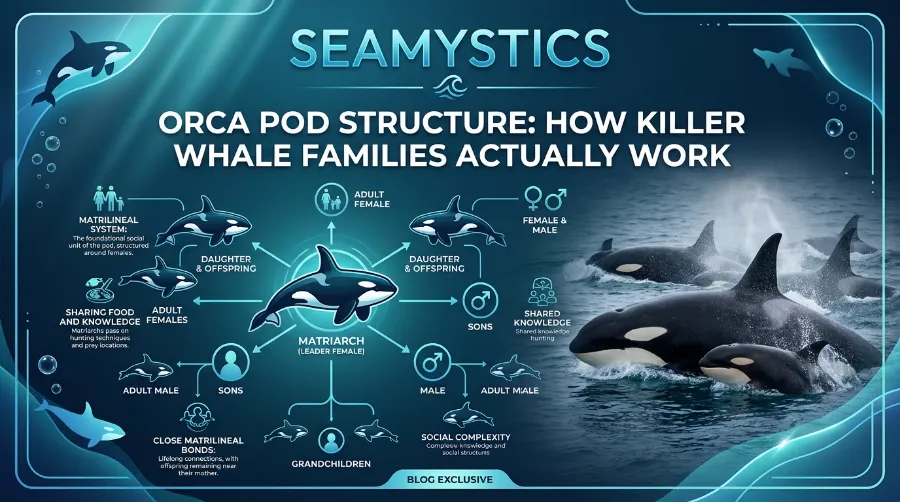

Orca Pod Structure: How Killer Whale Families Actually Work
Picture a 100 year old grandmother leading her sons, daughters, and grandchildren through cold water to find salmon. She does not have a map. She has memory, and her family trusts it. That is the heart of orca pod structure, and it is stranger and more touching than most people expect.
TL;DR: Resident orca pods are built around mothers. Sons and daughters stay with their mother for life, and the oldest female usually leads. This family bond shapes how orcas hunt, talk, mate, and survive.
Key Takeaways at a Glance
| Topic | Quick Fact |
|---|---|
| Basic unit | A matriline: a mother and all her descendants |
| Leader | Usually the oldest female, called the matriarch |
| Do young orcas leave? | Resident orcas almost never leave their mother’s group |
| Female lifespan | About 50 years on average, up to 80 or 90 |
| Male lifespan | About 30 years on average, up to 50 or 60 |
| Pod size | Often 5 to 50 whales, depending on the ecotype |
| Main risk | Loss of older females, food shortages, noise, and pollution |
What Is an Orca Pod?
An orca pod is a stable group of killer whales that travel, hunt, and rest together. Most pods are family units. Members share blood, habits, and even a “language” of calls.
Porpoise Dolphin Differences: The Real Porpoise vs Dolphin Facts Explained
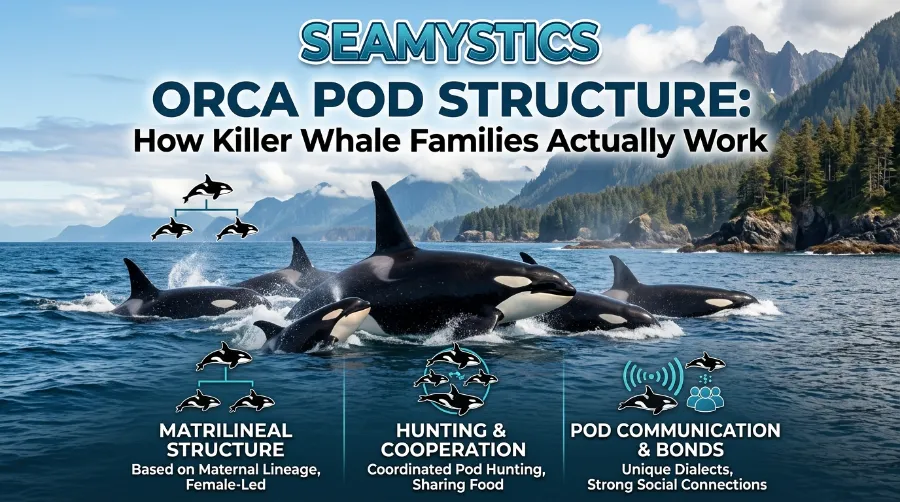
People often say “killer whale pods” as if all pods work the same way. They do not. A fish eating pod in Washington State lives very differently from a seal hunting group off California. We will compare them below.
For a quick overview from a respected conservation group, see Whale and Dolphin Conservation’s guide to orca pods. It covers the basics well.
The Orca Family Structure: From Matriline to Community
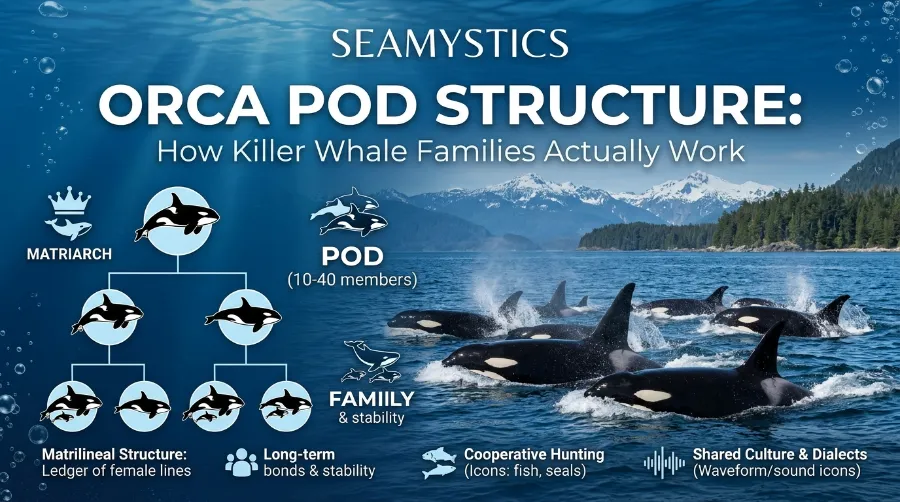
Scientists describe orca family structure as a set of nested layers. Each layer is bigger than the last. Think of it like a family tree stacked inside a village.
Here is the order from smallest to largest:
- Matriline: One mother and her children, grandchildren, and great grandchildren. Usually 2 to 9 whales.
- Pod: One or more related matrilines that travel together most of the time.
- Clan: Several pods that share a similar set of calls. They have a common ancestor far back in time.
- Community: Clans and pods that share the same home waters, but may not mix often.
The matriline is the real engine. Pods can split and merge over decades, but a calf stays with its mother. Researchers have watched resident orcas for more than 50 years, and no one has recorded a resident whale leaving its mother’s group for good.
That fact surprises many readers. In most mammals, young males or females move away to find new groups. Resident orcas break that rule.
Why Orcas Stay Home
Staying has clear benefits. Mothers share food with grown sons and daughters. They also teach them where fish gather and when. A young whale learns a living map from the whales who made it.
I often tell readers to think of a pod as a school and a family at the same time. Calves learn by watching. Adults pass along skills that no gene can carry.
River Dolphin Facts: The Freshwater Cousins of Ocean Dolphins
Orca Matriarch Facts That Change How You See Leadership
The matriarch is the oldest female in the group, and often the most experienced. She does not give orders with force. She sets direction by example, and the group follows her lead.
Here are orca matriarch facts worth knowing:
- Female orcas can live 80 to 90 years in the wild.
- Many stop having calves in their 30s or 40s but keep living for decades.
- Pregnancy lasts about 15 to 18 months, which is longer than a human pregnancy.
- A mother nurses her calf for up to two years or more.
- Matriarchs often lead the group toward food during hard years.
Granny and the Power of Age
The best known matriarch was a whale scientists called Granny, also known as J2. She belonged to J pod, part of the Southern Resident community in the Pacific Northwest. Researchers estimated she was around 105 years old when she was last seen in late 2016. Her real age is debated, but she certainly lived through most of the twentieth century.
Granny was a living archive. Her family knew coastal waters because she did.
The Menopause Mystery
Very few animals go through menopause. Humans do. A few toothed whales do too, including orcas. Scientists asked a simple question: why would evolution keep older females alive when they cannot have calves?
A 2015 study led by Lauren Brent and colleagues, published in Current Biology, gave a strong clue. Older female orcas led the group more often when salmon were scarce. The group followed them because they remembered where food was.
Later research added another piece. In 2012, a team led by Emma Foster found that adult sons faced a much higher risk of death after their mother died. For sons older than 30, the risk jumped to about eight times higher in the year after her death. Younger sons also faced a higher risk. A mother’s care does not end when her children grow up.
My own reading of this work has changed how I explain orcas to students. I no longer say the older females are “past their usefulness.” I say they are the group’s memory and its safety net.
Dolphin Communication Signals: Do They Have Names for Each Other?
Orca Social Behavior: How Pods Talk, Share, and Bond
Orca social behavior is rich and constant. Pods touch, rub, chase, and play. They also speak. Understanding these habits explains why the family works so well.
A Language Passed From Mother to Calf
Every pod uses a set of calls that sounds like a local accent. Scientists call these dialects. A calf learns its pod’s calls from its mother and relatives. Biologist John Ford documented this in the early 1990s by recording resident pods off British Columbia.
Dialects work like a family name. They help whales know who is nearby, even when they cannot see each other.
Pods in the same clan share some calls. Pods from different clans do not. That difference matters when it is time to find a mate.
Sharing Food
Resident orcas often share salmon with relatives. A mother may catch a fish and let her calf eat part of it. Adults share with other adults, too. This habit helps the whole group stay fed, even when hunting is hard.
If you want a deeper look at orca food culture, the Animals Around the Globe feature on orca pods explains how teamwork helps orcas thrive.
Who Mates With Whom?
Orcas avoid mating inside their own pod. That sounds simple, but it takes smart signals. Whales appear to use their different dialects to tell relatives from non relatives. Males mate with females from other pods, then return to their mother’s side. Calves are born into the mother’s group.
This system keeps families close while keeping the gene pool healthy.
Dolphin Echolocation Science: How Dolphins See With Sound
Not All Killer Whale Pods Are the Same
Scientists describe several orca ecotypes, which are groups with different diets, habits, and culture. The type of food they hunt shapes how big their pods are and how they behave.
| Feature | Resident | Transient (Bigg’s) | Offshore |
|---|---|---|---|
| Main prey | Fish, mostly salmon | Marine mammals, such as seals | Fish, mostly sharks |
| Typical group size | 5 to 50 | 1 to 7 | Up to 50 or more |
| Noise level | Very vocal | Quiet while hunting | Little known |
| Young leave mother? | Almost never | Some males may leave | Unknown |
| Home range | Coastal, predictable | Wide, unpredictable | Open ocean |
Look closely at the transient column. Mammal hunters are small groups because seals have sharp hearing. A big, loud group would scare them away. So transient orcas hunt quietly in tiny teams. Their orca family structure is looser than that of residents.
This is a great example of how food shapes society. The same species can build very different family lives.
The NOAA Fisheries killer whale page gives a solid overview of these groups and their legal status in the United States.
The Southern Residents: A Family in Trouble
The Southern Resident killer whales live in the waters of Washington State and British Columbia. They have three pods: J, K, and L. Together they form one clan and one community.
Their story is one of the clearest case studies we have. Researchers know almost every individual by sight, name, and number. The Center for Whale Research has counted them every year since 1976.
Dolphin Species Guide: Every Type of Dolphin in the Ocean
Here is how their numbers have changed:
| Year | Approximate Population | What Happened |
|---|---|---|
| 1995 | About 98 | Recent peak after years of recovery |
| 2005 | About 88 | Listed as endangered in the United States |
| 2018 | 74 | Lowest count in decades |
| Recent years | About 73 to 75 | Still far below the 1990s peak |
Most experts point to three main problems:
- Too little Chinook salmon, the main food of this group.
- Boat noise, which makes it harder to find fish with echolocation.
- Pollution, because toxic chemicals build up in their fat and pass to calves in milk.
Tahlequah’s Tour of Grief
In July 2018, a Southern Resident mother named Tahlequah, also known as J35, gave birth to a calf that died within hours. She carried the body for 17 days and about 1,000 miles (1,600 km). People around the world watched. For many readers it was the first time they felt how deep orca family bonds go.
The event also showed what poor food and stress can do to a pod. Researchers noted that several pregnancies in this population failed in those years. Hunger hurts the next generation first.
Orca Pods Around Europe
Readers in the United Kingdom and Europe often ask whether orcas live near them. They do. Here are three examples.
Norway and Iceland. Orcas follow herring in winter. Many of these whales use group hunting to herd fish into tight balls. Each family seems to pass on its own hunting style.
The Strait of Gibraltar. A small, critically endangered group of around 40 orcas lives here. They feed mostly on bluefin tuna. Since 2020, some of them have interacted with sailboats, often pushing or ramming rudders. Scientists are still studying why. A common view is that it began as play or stress, and then spread through social learning inside the group.
The west coast of Scotland. The West Coast Community is a tiny group once seen around the Hebrides. In 2016, a female named Lulu was found dead on the island of Tiree. She was tangled in fishing rope. The group now has no breeding females, so it will not recover on its own. This case reminds us that lost gear and lines can break a pod apart.
For more reading on fishing line hazards, see our piece on ghost nets in the deep ocean when it goes live.
Spinner Dolphin Facts: Why They Leap and Spin
How Orca Pods Compare to Dolphin Families
Orcas are the largest members of the dolphin family. That is easy to forget, because they look so different from small dolphins. Their social lives share some common ground, though.
Bottlenose dolphins also live in groups, but their groups change often. Members come and go in what scientists call fission fusion societies. Orca matrilines are far more stable. If you want to compare, read our guide to bottlenose dolphin facts and our full dolphin species guide.
The contrast is useful. It shows that two relatives can build very different family systems.
What Field Studies Teach Us About Reading a Pod
You do not need to be a scientist to read a pod like one. Researchers who keep photo catalogs follow a simple checklist. Here is a version anyone can use during a whale watch:
- Count the whales. Is it a group of three or a group of twenty?
- Look for size differences. Big dorsal fins mean adult males. Curved, smaller fins usually mean females and young.
- Notice the order. Calves stay close to their mother’s side.
- Listen. Loud, constant calls suggest a fish eating group. Silence often suggests a mammal hunter.
- Watch the oldest female. She often sets the direction.
When I read through photo ID records, one pattern repeats. The older females rarely stray from their sons. An adult male may travel a mile away to feed, but he drifts back to his mother’s side. That bond is stronger than any other tie in the pod.
Evidence Based Opinions: What the Data Tell Us
Here are three points I feel strongly about, based on the studies above.
First, protecting old whales matters as much as protecting calves. The data show that older females lead during hard years and that sons depend on their mothers even as adults. Losing one old whale can hurt a whole family.
Second, a pod is a living culture. Dialects, hunting styles, and travel routes are learned. If a pod disappears, its knowledge disappears too. A new group cannot just “refill” the same habitat.
Third, small changes in food and noise add up. Orcas do not need to be hunted to decline. Less salmon, more boats, and more toxins can reduce births over time. The numbers for the Southern Residents show this clearly.
How You Can Help Orca Families
You can make a real difference, even from far away. Try these steps:
- Choose sustainable seafood, and ask where your fish comes from.
- Pick whale watching companies that follow distance rules.
- Support groups that restore salmon rivers.
- Reduce plastic and fishing line waste near shores.
- Share accurate facts with friends and family.
The Planet Forward story on orca pods is another good source if you want to hear from people who work close to these whales.
Frequently Asked Questions
How big is a typical orca pod?
Resident pods usually have 5 to 50 whales. Transient groups are much smaller, often 1 to 7.
Who leads an orca pod?
The oldest female, called the matriarch, usually leads. She guides the group to food using her memory.
Do male orcas leave their mothers?
Resident males stay with their mothers for life. They mate with females from other pods, then return home.
How do orcas talk to each other?
They use clicks, whistles, and calls. Each pod has its own set of calls, like a family accent.
Why do orcas live so long after menopause?
Researchers think older females help their family survive. They share knowledge about food and protect their grown children.
Are all killer whale pods endangered?
No. Some populations are healthy. Others, like the Southern Residents and the Strait of Gibraltar group, are at high risk.
How do orcas find food in the dark or in noisy water?
They use echolocation. Loud boats can block these clicks, which makes hunting harder.
Conclusion
Orca pod structure is built on one simple idea: family comes first. Mothers lead, sons stay, grandmothers guide, and calves learn everything from the group. Every layer, from the matriline to the clan, shows how deep these bonds go.
The same bonds also make orcas fragile. When food falls short or noise rises, a whole family feels it. By learning how these pods work, we can protect them better. Start by sharing what you learned today, because every informed reader helps.
Quick Quiz: Test What You Learned
1. Who usually leads a resident orca pod?
A) The largest male
B) The oldest female
C) The youngest calf
2. What is a matriline?
A) A group of unrelated whales
B) A mother and all her descendants
C) A type of whale call
3. Which orca ecotype hunts in small, quiet groups?
A) Resident
B) Transient (Bigg’s)
C) Offshore
4. True or False: Resident orca sons usually leave their mothers when they become adults.
5. True or False: Each orca pod has its own set of calls, like an accent.
Answers: 1) B. 2) B. 3) B. 4) False. They usually stay for life. 5) True.
References
- Brent, L. J. N., et al. (2015). Ecological knowledge, leadership, and the evolution of menopause in killer whales. Current Biology.
- Foster, E. A., et al. (2012). Adaptive prolonged postreproductive life span in killer whales. Science, and related work on the death of mothers and adult sons.
- Ford, J. K. B. (1991). Vocal traditions among resident killer whales in coastal waters of British Columbia. Canadian Journal of Zoology.
- Center for Whale Research. Southern Resident killer whale census data.
- NOAA Fisheries. Killer whale species profile.
- Whale and Dolphin Conservation. What is an orca pod?
- Animals Around the Globe. Orca pods: the social structures behind their success.
- Planet Forward. Orca pod cast.