
Dolphin Species Guide: Every Type of Dolphin in the Ocean
You probably picture one gray, smiling animal when someone says “dolphin.” The real list is much bigger, and it includes pink river dwellers, black and white hunters the size of a bus, and tiny coastal dolphins that fit in a small boat. This dolphin species guide walks you through all of them in plain words. I wrote it the way I explain dolphins to new volunteers on the water.
TL;DR: Scientists recognize about 40 to 44 living dolphin species, depending on how they group them. Most are oceanic dolphins in the family Delphinidae, and a handful are river dolphins. Orcas are the largest dolphin, and the Maui dolphin is among the smallest and rarest.
Key Takeaways
| Question | Short answer |
|---|---|
| How many dolphin species exist? | About 40 to 44. World Animal Protection lists 42. |
| What is the largest dolphin? | The orca, at up to about 30 feet |
| What is the smallest dolphin? | Hector’s and Maui dolphins, around 4 to 5.5 feet |
| Are porpoises dolphins? | No. They are a separate family |
| Which dolphin is most common? | The common bottlenose dolphin |
| Which dolphin is closest to extinction? | The Maui dolphin, with roughly 54 left in the latest estimate I know |
How Many Dolphin Species Are There?
The honest answer is “about 42, but it depends.” The Society for Marine Mammalogy keeps the official list, and its taxonomy committee reviews it every year. You can see the current version on the Society for Marine Mammalogy species list.
Spinner Dolphin Facts: Why They Leap and Spin
Numbers change because scientists keep testing DNA. A group once called one species can turn out to be two. For example, NOAA scientists have proposed that the coastal form of common bottlenose dolphins along the U.S. East Coast is a different species from the offshore form. They suggest calling it Tamanend’s bottlenose dolphin. You can read the full story in this NOAA Fisheries feature. noaa
So when a site says “how many dolphin species,” check the date and the source. A 2015 page and a 2025 page can both be right and still give different numbers. I use a range of 40 to 44 and explain why.
Bottlenose Dolphin Facts: The Ocean’s Most Studied Marine Mammal
Dolphin Species List: Types of Dolphins at a Glance
Most types of dolphins fall into three groups. The table below shows how they split.
| Group | Rough number of species | Where they live | Example |
|---|---|---|---|
| Oceanic dolphins (Delphinidae) | About 38 to 40 | Oceans and coasts worldwide | Bottlenose dolphin |
| River dolphins | 4 to 6, depending on the list | Rivers and estuaries in Asia and South America | Amazon river dolphin |
| Porpoises (not dolphins) | 7 | Coastal and cold waters | Harbor porpoise |
Oceanic Dolphins
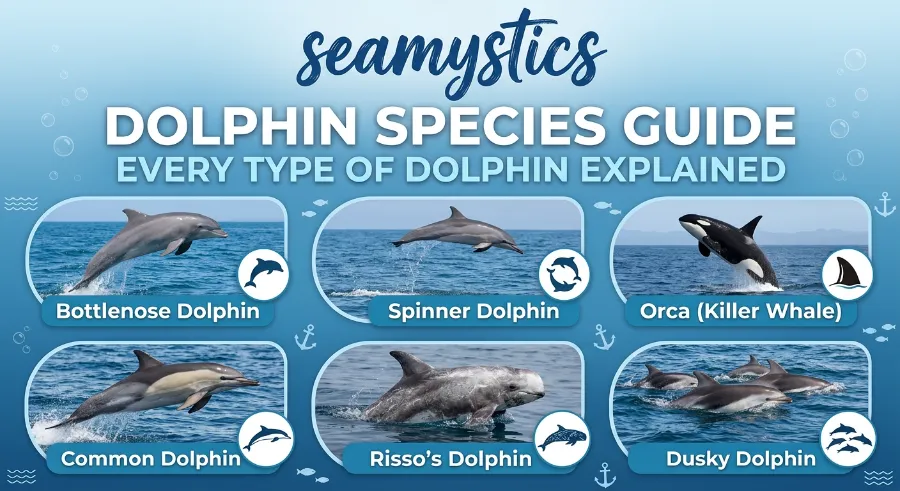
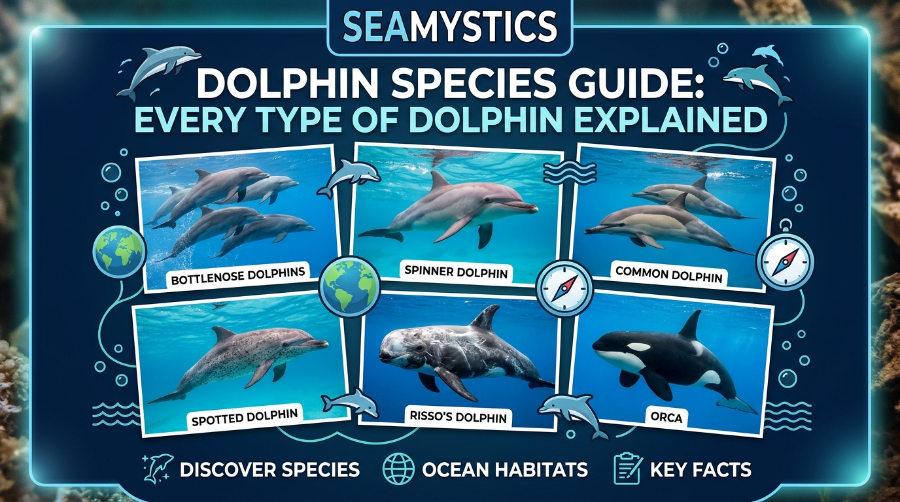
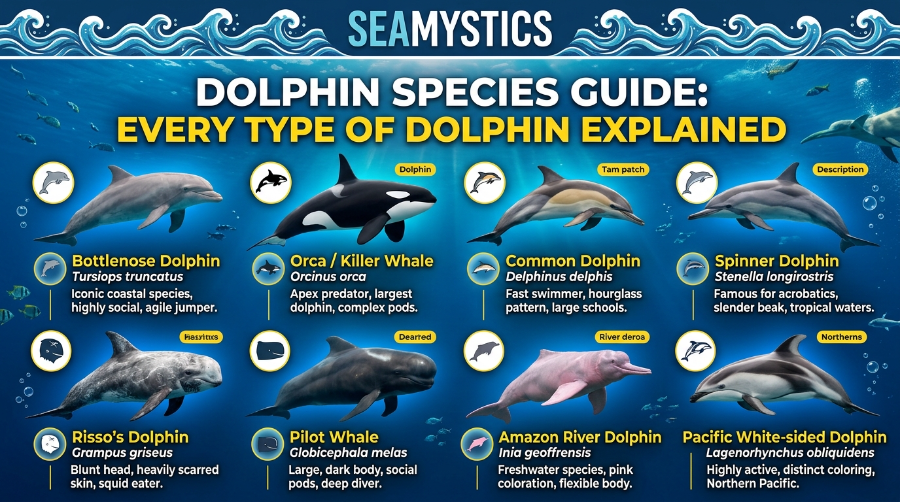
This is the biggest group, and it holds the animals most people know. It includes bottlenose, common, spotted, spinner, striped, and dusky dolphins. It also includes orcas and pilot whales, which scientists classify as dolphins even though the names say “whale.”
River Dolphins
River dolphins look different from ocean dolphins. They have long thin beaks, small eyes, and flexible necks. Several live in muddy water, so they rely on sound more than sight. The Ganges, Indus, Amazon, and La Plata dolphins are the main examples.
Porpoises Are Not Dolphins
People mix these up all the time. Porpoises have a triangle-shaped fin, a rounder face, and spade-shaped teeth. Dolphins have a curved fin and a beak. The vaquita, which many people call the smallest dolphin, is actually a porpoise.
River Dolphin Facts: The Freshwater Cousins of Ocean Dolphins
Ocean Dolphin Types You Are Most Likely to See
I will not list all 40 here, because a long list is hard to remember. These are the ocean dolphin types you are most likely to meet in the US, the UK, and Europe. I also link to our pillar guide on marine mammals for the full set.
Common Bottlenose Dolphin
This is the star of aquarium shows and coastal tours. Adults grow 6 to 12 feet long and swim over 12 miles per hour. They live in warm and cool waters in every ocean except the polar seas. NOAA Fisheries tracks them stock by stock in US waters.
Short-Beaked and Long-Beaked Common Dolphins
Look for the hourglass pattern on the side. It is yellow in front and gray behind. These dolphins travel in large, fast groups, sometimes hundreds at once. Both forms appear off California, and the Monterey Bay Whale Watch dolphin page shows them next to other local species.
Spinner and Spotted Dolphins
Spinner dolphins leap and twist in the air several times in a row. Scientists think the spins help them signal to each other or shake off parasites. Atlantic spotted dolphins start life with plain skin and grow spots as they age. That detail helps when you try to age a pod from a boat.
Orca
The orca is the largest dolphin, and it is a true dolphin, not a whale. Males can pass 30 feet and weigh up to about 6 tonnes. Different orca groups eat different food. Some hunt fish, and others hunt seals. They also speak slightly different “dialects,” which is why researchers call these groups ecotypes.
Risso’s Dolphin
Risso’s dolphins look scarred. Their gray bodies carry white scratch marks from squid bites and fights with each other. They have a blunt head with no beak. I always tell new observers to look for the pale, battered body, because nothing else looks quite like it.
Pilot Whales and False Killer Whales
These animals have “whale” in the name but belong to the dolphin family. Pilot whales have a round, bulging forehead and form tight family groups. False killer whales are slimmer and often share fish with fishers in Hawaii and Brazil. Both strand in groups more often than most dolphins do.
Cool-Water Dolphins
White-beaked dolphins live in the North Atlantic and often show up off Scotland and Ireland. Pacific white-sided and dusky dolphins like cooler water too. They are playful and acrobatic. If you see a fast, jumpy group in cold water, it is probably one of these.
Dolphin Size Comparison: From Tiny to Huge
Size is the easiest way to sort dolphin species in the field. The chart below shows rough maximum lengths. Lengths vary by region and sex, so treat these as a guide and not a hard rule.
Porpoise Dolphin Differences: The Real Porpoise vs Dolphin Facts Explained
River Dolphin Types and Why They Matter
River dolphins are the most threatened dolphins on Earth. Dams, fishing nets, and boat traffic split their homes into small pieces. Their numbers show the problem clearly.
| Species | Home | Status (IUCN) | Key fact |
|---|---|---|---|
| Baiji (Yangtze river dolphin) | China | Functionally extinct | A 2006 survey found none |
| Indus river dolphin | Pakistan, India | Endangered | About 2,000 remain |
| Ganges river dolphin | India, Nepal, Bangladesh | Endangered | Nearly blind, steers by sound |
| Amazon river dolphin | South America | Endangered | Pink adults, flexible neck |
| La Plata dolphin (franciscana) | Brazil, Uruguay, Argentina | Vulnerable | Lives in coastal waters, not only rivers |
Statuses change, so check the IUCN Red List before you cite any of them. The baiji is the clearest lesson here. A six-week search of the Yangtze in late 2006 found no animals, and scientists declared the species functionally extinct. It was the first large dolphin lost to human activity in modern times.
How to Use This Dolphin Species Guide in the Field
Identifying a dolphin at sea takes practice. When I train new observers, I give them a simple order to follow. It works from a boat, from a cliff, or from a beach.
- Check the size first. Is the animal about the length of a kayak, a small car, or a bus?
- Look at the head. A clear beak points to bottlenose, common, or spotted dolphins. A round, blunt head points to Risso’s dolphins or pilot whales.
- Study the dorsal fin. A tall, straight fin often means an orca. A curved fin is typical for most others.
- Note the color pattern. Look for an hourglass, spots, white patches, or scars.
- Watch the behavior. Spinning, bow riding, and tight family travel all give clues.
- Write down the place and date. Range alone rules out many species.
Take a photo of the dorsal fin whenever you can. Researchers use fin nicks and scars like fingerprints. Many photo-ID catalogs rely on tourist images, so your picture may help a real study.
Dolphin Communication Signals: Do They Have Names for Each Other?
Real Case Studies That Show How Different Dolphins Are
Numbers are useful, but stories show how dolphins really live. These three cases come from published research, and they changed how scientists think about dolphin species.
Shark Bay, Australia: Dolphins That Use Tools
In Shark Bay, some bottlenose dolphins break off sea sponges and wear them on their beaks. The sponge protects the nose while they search the rough seafloor for fish. Researchers first described this in the 1990s. Mothers pass the skill to their daughters, so it works like a family tradition.
Laguna, Brazil: Dolphins and Fishers Working Together
Near Laguna, bottlenose dolphins herd mullet toward fishers standing in shallow water. The dolphins give a signal, and the fishers cast their nets. A 2012 study found that fishers caught more fish when dolphins joined them. This is one of the few known cases of wild animals and people hunting as a team.
Bay of Biscay, Europe: Common Dolphins in Trouble
Common dolphins face a different problem in Europe. Fishing nets in the Bay of Biscay trap thousands of them every year, according to estimates from the International Council for the Exploration of the Sea. In several recent winters, large numbers of dead dolphins washed up on French beaches. France has tested seasonal fishing pauses to cut the losses. I see this case as proof that a “common” species can still be in trouble when no one tracks bycatch well.
What I Have Learned From Working With Dolphin Data
After two decades around marine mammals, a few lessons come up again and again. First, the most common dolphins get the least study, because people assume they are fine. Second, one species name can hide several groups with different needs. Third, local numbers matter more than global ones.
The bottlenose dolphin proves this well. The species as a whole is not threatened. Still, small groups, like the one in Scotland’s Moray Firth, with a couple of hundred animals, can decline fast if their food or water quality changes. A “Least Concern” label does not protect a single local pod.
I also think the field underrates simple tools. Photo-ID catalogs, boat logs, and citizen photos often tell us more than expensive surveys do. That is why I ask readers to share sightings with local research groups.
Dolphin Echolocation Science: How Dolphins See With Sound
Conservation Status of Popular Dolphin Species
| Species | IUCN status | Main threat |
|---|---|---|
| Common bottlenose dolphin | Least Concern | Bycatch, pollution, noise |
| Short-beaked common dolphin | Least Concern | Bycatch in gillnets and trawls |
| Orca | Data deficient as one species | Prey loss, pollution, boat noise |
| Maui dolphin | Critically Endangered | Gillnets and trawling |
| Hector’s dolphin | Endangered | Gillnets |
| Irrawaddy dolphin | Endangered | Nets, habitat loss |
The Maui dolphin has the clearest warning. The most recent estimate I know of counts about 54 animals older than one year, so every single loss hurts. New Zealand scientists update that number, so check their latest report before you share it.
Where to See Dolphins in the US, UK, and Europe
You do not need a plane ticket to a tropical island. Many types of dolphins live close to major coasts. Choose operators who keep a safe distance and never feed the animals.
- United States: Monterey Bay in California, the Florida Keys, and the Gulf coast all offer regular sightings. For a ranger-led look at local pods, start with a nearby marine center.
- United Kingdom: The Moray Firth in Scotland, Cardigan Bay in Wales, and Cornwall host bottlenose, common, and Risso’s dolphins.
- Europe: The Azores, the Strait of Gibraltar, and the Bay of Biscay are strong spots for common and striped dolphins.
If you want a visitor-focused read before you go, the Dolphins Plus blog is a friendly place to start. For our own trip planning tips, see our dolphin watching checklist and the main Sea Mystics home page.
Orca Pod Structure: How Killer Whale Families Actually Work
Simple Ways You Can Help Dolphins
Small choices add up, and the most useful ones are easy. Here is what I tell people who ask.
- Pick seafood caught with dolphin-safe methods.
- Never feed or chase wild dolphins.
- Cut single-use plastic, which breaks into pieces that harm marine life.
- Report stranded or injured animals to your local rescue group right away.
- Share clear photos of dorsal fins with research groups.
Frequently Asked Questions
How many dolphin species are there in the world?
About 40 to 44, depending on the taxonomy list. The Society for Marine Mammalogy updates its list each year, so the number can shift.
What is the largest type of dolphin?
The orca. Males can pass 30 feet in length.
What is the smallest dolphin?
Hector’s and Maui dolphins, at roughly 4 to 5.5 feet.
Are dolphins and porpoises the same?
No. Porpoises have a triangular fin and spade-shaped teeth, while dolphins have a curved fin and cone-shaped teeth.
Which dolphin species is most endangered?
The Maui dolphin and the Yangtze baiji, which is now functionally extinct, are the clearest examples.
Conclusion
Dolphins are far more varied than most people think. From the huge orca to the tiny Maui dolphin, each species has its own size, habitat, and set of problems. Use this dolphin species guide as a field checklist: start with size, check the head, then look at the fin, color, and place. The more you notice, the more you will see, and the more you can help the animals that need it.
About the author: Dr. Rabica is a marine mammal ecologist with a PhD in marine biology and more than 20 years of field and teaching experience. She writes for Sea Mystics to turn real research into clear, useful guides.
References
- Society for Marine Mammalogy. List of Marine Mammal Species and Subspecies.
- NOAA Fisheries. Common Bottlenose Dolphin species profile.
- NOAA Fisheries. Bottlenose dolphins along the East Coast proposed to be a different species.
- World Animal Protection US. Dolphins 101.
- Monterey Bay Whale Watch. Dolphins and Porpoise of Monterey Bay.
- IUCN Red List of Threatened Species.
- International Council for the Exploration of the Sea. Bycatch advice for common dolphins in the Bay of Biscay.
- Daura-Jorge et al. (2012). Biology Letters, on cooperative fishing between dolphins and fishers in Laguna, Brazil.