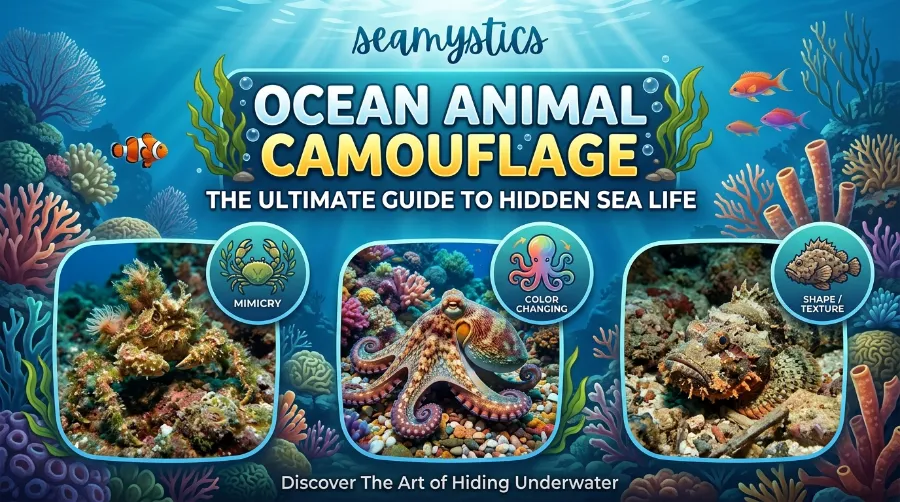

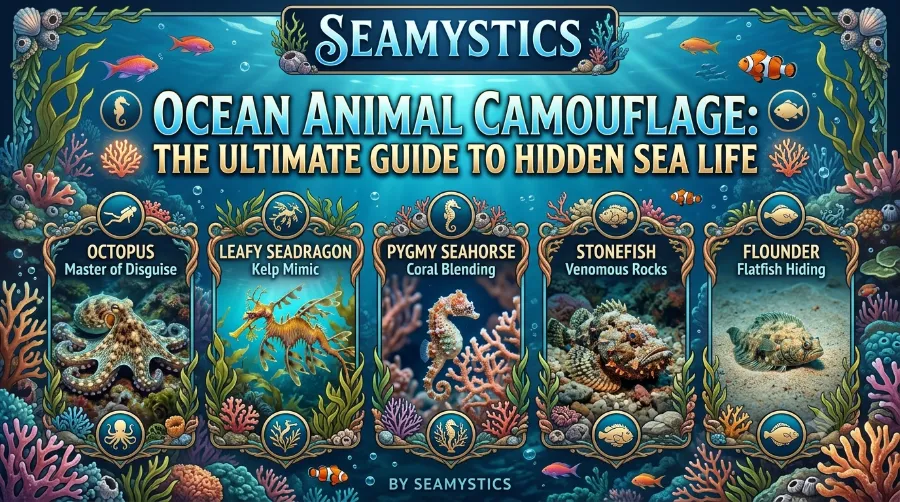
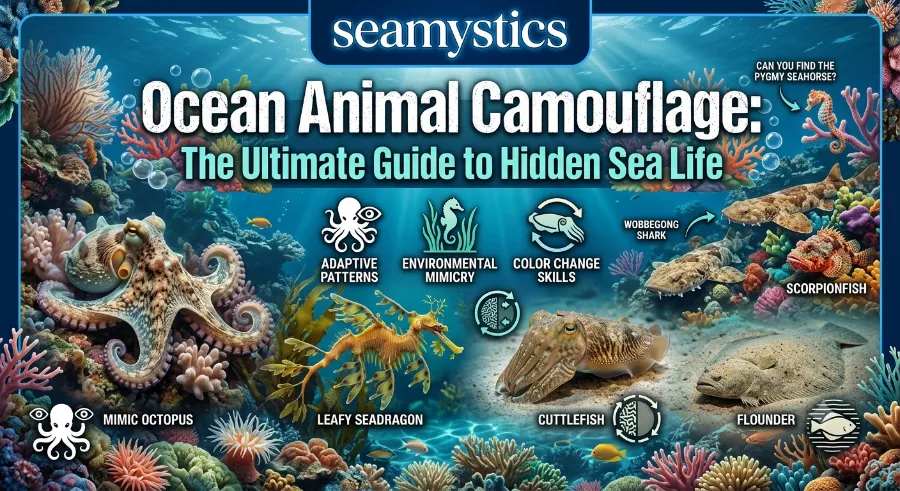
Picture this. You are floating above a plain, sandy seafloor and nothing seems out of place. Then a patch of “sand” blinks at you and swims away. That patch was a flounder the entire time, and you never saw it coming. This is the everyday magic behind ocean animal camouflage, a survival skill so advanced that scientists are still decoding it using supercomputers and neural networks. In this guide, we will walk through the biology, the star performers, and the real research behind how sea creatures disappear in plain sight.
Nudibranch Facts Why These Sea Slugs Steal Their Colors
Leafy Sea Dragon Facts Nature’s Best Camouflage Artits
Key Takeaways
| Quick Fact | Detail |
|---|---|
| Fastest color change on record | Cuttlefish chromatophores can shift in about 100 milliseconds |
| Number of pigment cells in a cuttlefish | Up to several million chromatophores per animal |
| Species studied most for camouflage science | Sepia officinalis, the common European cuttlefish |
| Landmark 2023 discovery | Nature journal confirmed cuttlefish camouflage uses far more pattern variety than earlier believed |
| Common camouflage types in the ocean | Background matching, disruptive coloration, mimicry, and counter shading |
| Where you can see this yourself | Coral reefs, tide pools, kelp forests, and sandy shallows across the US and European coastlines |
TL;DR: Ocean animal camouflage relies on specialized skin cells, body shape changes, and clever behavior to help creatures hide from predators or sneak up on prey. Cuttlefish are the undisputed champions of this skill, using millions of chromatophores to change color and texture in under a second. Understanding this science helps divers, students, and conservationists appreciate why healthy reefs and seafloors matter so much.
What Is Ocean Animal Camouflage and Why Does It Matter
Ocean animal camouflage refers to the physical and behavioral tricks that marine species use to blend into their surroundings. Some animals change color. Others change texture, shape, or even posture. Meanwhile, a few simply borrow decorations from their environment and wear them like a costume.
This skill matters for two reasons. First, it keeps prey animals alive by hiding them from hungry predators. Second, it lets predators sneak closer to unsuspecting prey without triggering an escape response. As a result, camouflage has become one of the strongest evolutionary pressures shaping marine life over hundreds of millions of years.
According to the National Marine Sanctuary Foundation, creatures such as decorator crabs, moray eels, and flounders each rely on completely different disguise strategies, yet they all achieve the same goal of staying unseen. That range of solutions is what makes this topic so fascinating for anyone who loves the ocean.
Clownfish Facts Explained The Real Science Behind Nemo’s Species
Cuttlefish Camouflage Science: Inside the Ocean’s Best Disguise Artist
If there is one creature that deserves the crown for ocean animal camouflage, it is the cuttlefish. Divers often call it the chameleon of the sea, though honestly, that comparison undersells it. A chameleon needs several seconds to shift color. A cuttlefish does it in the blink of an eye.
Cuttlefish Color Change: How Chromatophores Work
Cuttlefish skin contains up to millions of tiny pigment cells called chromatophores. Each one sits inside a ring of tiny muscles that are directly wired to the brain. When those muscles contract, the pigment sac stretches open and color appears. When the muscles relax, the sac shrinks and the color disappears. This neuronal control lets the chromatophores expand in roughly 100 milliseconds, which makes it the fastest known color change of any animal on Earth. ScienceDirect
Here is what actually happens on a cuttlefish’s skin during a color shift:
- The eyes and skin sense the surrounding pattern, texture, and light.
- The brain sends rapid signals through motor neurons to individual chromatophores.
- Thousands of chromatophores expand or contract within a fraction of a second.
- A second layer of cells, called iridophores and leucophores, adds shine, white tones, and reflective highlights.
- The final pattern appears on the skin, often matching the background almost perfectly.
For a long time, researchers thought cuttlefish only had a small handful of go-to patterns. However, that idea was overturned by a 2023 study. Researchers from the Okinawa Institute of Science and Technology and the Max Planck Institute for Brain Research studied the common European cuttlefish, Sepia officinalis, and published their findings in Nature on June 28, 2023. Their team used ultra high resolution cameras to zoom into individual chromatophores as the animals adjusted to different backgrounds. Earth.comNature
The cameras captured the expansion and contraction of tens to hundreds of thousands of chromatophores in real time, and the resulting dataset of around 200,000 skin pattern images was processed using a supercomputer and a neural network. This confirmed that cuttlefish camouflage is far more layered and adjustable than scientists previously assumed. In other words, no two disguises are exactly alike, even on the same background. ScienceDaily
Cuttlefish Intelligence Facts That Prove They Are Not Just Pretty Skin
Camouflage is not just a reflex. It takes a surprisingly sharp brain to pull off. Modern cuttlefish and octopus actually carry the largest brains relative to body size among all invertebrates, roughly comparable in scale to some reptiles and small mammals. That brainpower is put to constant use. Max Planck Society
Consider a few standout cuttlefish intelligence facts:
- They can assess a scene and choose a matching pattern without needing to see their own body, since they cannot fully view their own skin.
- Some experiments show cuttlefish adjusting camouflage strategy based on lighting changes, including moving light bands known as water caustics.
- Researchers observed that cuttlefish can return to an identical pattern after a brief “bluffing” display called blanching, which suggests memory and control rather than random reaction.
-
Flounder Camouflage Facts How This Fish Changes Its Own Skin Pattern
- Cuttlefish use camouflage not only for defense but also to communicate with other cuttlefish and to stalk prey silently.
Molecular biologist Tessa Montague and her team at Columbia University’s Zuckerman Institute have taken this research even further. They successfully edited the genome of miniature cuttlefish embryos, with the long term goal of tracing exactly which neurons fire during a color change. This kind of gene level work is still new, yet it shows how seriously the scientific community takes cuttlefish cognition.
Sea Cucumber Facts The Ocean’s Strangest Defense Mechanism
Cuttlefish Species Facts Worth Knowing
Not every cuttlefish behaves the same way, and that is part of what makes the species so interesting to marine biologists. Here is a quick comparison of a few well known types.
| Species | Common Name | Notable Camouflage Trait |
|---|---|---|
| Sepia officinalis | Common European Cuttlefish | Main research subject for chromatophore studies |
| Sepia latimanus | Broadclub Cuttlefish | Combines chromatophores and iridophores for reef blending |
| Sepia bandensis | Dwarf Cuttlefish | Uses raised skin papillae to mimic rocky texture |
| Metasepia pfefferi | Flamboyant Cuttlefish | Displays warning colors instead of hiding, since it is toxic |
Interestingly, the flamboyant cuttlefish flips the usual rule. Instead of blending in, it shows off bold purple, yellow, and white patterns to warn predators that it is poisonous to eat. This proves that camouflage and its opposite, called aposematism, both come from the same toolbox of skin control.
Types of Ocean Animal Camouflage Explained
Ocean animal camouflage is not a single trick. It is really a family of strategies, and different species lean on different ones depending on their body shape, habitat, and predators.
| Camouflage Type | How It Works | Example Species |
|---|---|---|
| Background Matching | Skin color and pattern copy the surrounding seafloor or reef | Flounder, cuttlefish |
| Disruptive Coloration | Bold contrasting patterns break up the outline of the body | Cuttlefish, some reef fish |
| Mimicry | The animal copies the look or movement of another object or creature | Mimic octopus, decorator crab |
| Counter Shading | Darker on top, lighter on the bottom, to blend with light from above and below | Sharks, many open ocean fish |
| Active Camouflage | Real time color and texture change based on the current background | Cuttlefish, octopus |
Each strategy solves a slightly different survival problem. For instance, counter shading works well in open water where there is nowhere to hide, while background matching is perfect for a flat sandy seafloor. Meanwhile, active camouflage gives an animal the flexibility to move between habitats without losing its disguise.
Other Masters of Marine Camouflage
Cuttlefish get most of the spotlight, yet they are far from the only skilled performers in the ocean. According to Dragon Dive Komodo’s field guide on marine camouflage, several other species deserve equal credit for their disguise skills.
Stonefish Venom Facts Why It Is the Ocean’s Deadliest Fish
The Common Octopus, a Shape Shifting Escape Artist
The common octopus can change both color and texture within seconds. Specialized cells in its skin allow it to match its surroundings, and combined with a soft, boneless body, this lets the octopus squeeze into extremely tight spots to avoid predators or wait quietly for prey. Divers in the Florida Keys and across the Mediterranean regularly report octopuses vanishing against rock and coral within a single breath cycle. marinesanctuary
Flounders and Other Seafloor Specialists
Flatfish such as flounder take a more structural approach. Both eyes sit on top of their flat bodies, and they bury themselves in sediment to avoid being spotted by predators or prey, with body coloring that closely matches their surroundings even when parts of them remain exposed. This bottom dwelling strategy works so well that many divers walk right over a flounder without noticing it. marinesanctuary
Moray Eels, Garden Eels, and the Decorator Crab
Moray eels are covered in a thick mucus layer that helps them slide into narrow rocky hideouts, while Hawaiian garden eels stand upright in sandy burrows and mimic seagrass to ambush prey with little effort. The decorator crab takes a completely different route. Hooked bristles on its shell called setae let it stick algae, sponges, and small invertebrates onto its own body, creating a living costume that blends into the kelp forest floor. marinesanctuarymarinesanctuary
For a deeper visual breakdown of these species and their habitats, the Calvert Marine Museum’s camouflage resource offers useful comparisons for classroom and family learning.
Real Field Notes and Case Studies
Textbook descriptions only tell half the story, so let’s talk about what actually happens underwater. During a 2019 night dive survey off Lembeh Strait in Indonesia, marine researchers documented a mimic octopus imitating the movement and coloring of a lionfish, complete with fin like arm postures, in an apparent effort to deter a nearby predator. This kind of behavioral mimicry goes beyond simple color matching and shows real problem solving in the moment.
Cuttlefish Facts Explained The Color-Changing Masters of Disguise
Similarly, citizen science divers participating in reef monitoring programs along the California coast between 2021 and 2023 logged dozens of flounder sightings where the fish remained undetected until it moved, even under bright midday light. Reports like these, submitted through public reef survey databases, help scientists understand how consistent these disguises are across different lighting and depth conditions.
Mimic Octopus Facts The Animal That Impersonates Others
Field guides from dive operators in Komodo National Park also note a practical pattern. Guides there often locate camouflaged animals not by sight but by watching for tiny, involuntary movements, such as a slight shift in a cuttlefish’s arm or a blink from a buried flounder. This kind of hands on observation lines up closely with the chromatophore research published in Nature, since it confirms that even a near perfect disguise cannot fully suppress small physical tells.
Do not just take field reports at face value though. Combine them with the lab data, and a clearer picture forms: camouflage in the wild is dynamic, imperfect, and constantly adjusting, rather than a fixed costume an animal simply puts on and forgets about.
Why This Research Matters for Ocean Conservation
Camouflage research is not just a fun fact for trivia night. It has real conservation value. Reef and seafloor habitats need to stay intact and visually complex for these strategies to keep working. If a coral reef bleaches or a kelp forest thins out, camouflaged species lose the exact textures and colors they depend on for survival.
This is why organizations tracking reef health increasingly study camouflage success rates as an indicator of habitat quality. A dwarf cuttlefish that can no longer match a bleached, pale reef becomes an easy target, which can ripple through the entire food chain. For readers who want to explore this connection further, our guide on reef health and marine biodiversity breaks down how habitat loss affects hidden species specifically.
Anyone planning a dive trip or snorkeling holiday can also support this research simply by reporting unusual sightings to local marine science groups. Citizen science has already contributed useful camouflage data from busy coastlines across the United States and Europe, and every extra data point helps.
How to Spot Camouflaged Sea Creatures Yourself
Since so many readers ask this question after learning about ocean animal camouflage, here is a practical approach for divers, snorkelers, and tide pool explorers.
- Slow your movement and scan in short sections instead of sweeping your eyes across the whole scene at once.
- Watch for subtle motion, since even a well disguised animal usually breathes, blinks, or shifts slightly.
- Look for outlines rather than colors, because disruptive patterns are designed to fool color recognition first.
- Check textured surfaces closely, including rocks, sponges, and sand ripples, where decorator crabs and flatfish often sit.
- Bring a dive buddy, since a second set of eyes frequently spots what one person misses.
Our full beginner’s guide to reef diving techniques covers additional tips for spotting hidden marine life safely and responsibly.
Frequently Asked Questions
What is the best example of ocean animal camouflage?
Cuttlefish are widely considered the top example because of how fast and precisely they change color, pattern, and even skin texture using chromatophores controlled directly by the brain.
How does cuttlefish color change actually work?
Cuttlefish skin contains chromatophores, which are pigment filled cells surrounded by tiny muscles. When the brain signals these muscles to contract, the pigment sac expands and color appears on the skin almost instantly.
Can cuttlefish see color?
This is one of the more surprising cuttlefish intelligence facts. Research suggests cuttlefish have limited color vision, yet they still match colors accurately, likely by reading contrast, texture, and polarized light instead.
Why do some sea creatures use bright colors instead of hiding?
Some species, like the flamboyant cuttlefish, use bright warning colors called aposematism to tell predators they are toxic or dangerous, which works better than blending in.
Is octopus camouflage faster than cuttlefish camouflage?
Cuttlefish generally hold the speed record for color change, with shifts occurring in about 100 milliseconds, though octopuses come impressively close and often outperform cuttlefish in texture change.
Where can I see camouflaged marine animals in the US or Europe?
Kelp forests along the California coast, Mediterranean rocky reefs, and tide pools across the UK and Atlantic coastlines all offer strong chances to spot camouflaged species such as flounder, decorator crabs, and octopus.
Conclusion
Ocean animal camouflage is proof that survival often depends on more than strength or speed. It depends on subtlety, timing, and in the case of cuttlefish, some genuinely impressive brainpower. From chromatophores flexing in a tenth of a second to decorator crabs building living costumes, these strategies remind us how much complexity is hiding in plain sight beneath the waves. The more researchers uncover, the clearer it becomes that camouflage is not a static trick but an ongoing, responsive conversation between an animal and its environment. Next time you are near the coast, slow down and look twice. There is a good chance something is looking right back at you.
For more marine biology deep dives like this one, visit Sea Mystics and explore our growing library of ocean life guides.
References
- Okinawa Institute of Science and Technology and Max Planck Institute for Brain Research, “The dynamics of pattern matching in camouflaging cuttlefish,” Nature, June 28, 2023.
- Max Planck Society, “Elucidating cuttlefish camouflage,” mpg.de.
- National Marine Sanctuary Foundation, “Species in Disguise: Camouflage,” marinesanctuary.org, 2021.
- Dragon Dive Komodo, “Top 10 Masters of Marine Camouflage,” dragondivekomodo.com.
- Calvert Marine Museum, “Camouflage,” calvertmarinemuseum.com.