
I still remember the first time I held a preserved stonefish specimen in a research lab near the Great Barrier Reef. It looked like a lump of algae covered rock. Yet the lab technician warned me twice before I even touched the container. That single moment taught me more about stonefish venom facts than any textbook ever could.
Stonefish Venom Facts Why It Is the Ocean’s Deadliest Fish
Quick Stonefish Facts You Need to Know
Marine biologists widely recognize stonefish as the most venomous fish in the ocean. This reputation is not exaggerated marketing. Their sting can trigger agonizing pain, tissue damage, and in rare cases death. That makes stonefish sting danger a real concern for divers, waders, and fishermen across warm coastal waters. This guide walks through verified stonefish habitat facts, the biology behind their camouflage, and what current research says about their venom, using real case data instead of guesswork.
Nudibranch Facts Why These Sea Slugs Steal Their Colors
Key takeaways
| Fact | Detail |
|---|---|
| Most venomous fish | Stonefish (Synanceia species) top nearly every scientific ranking of venomous fish |
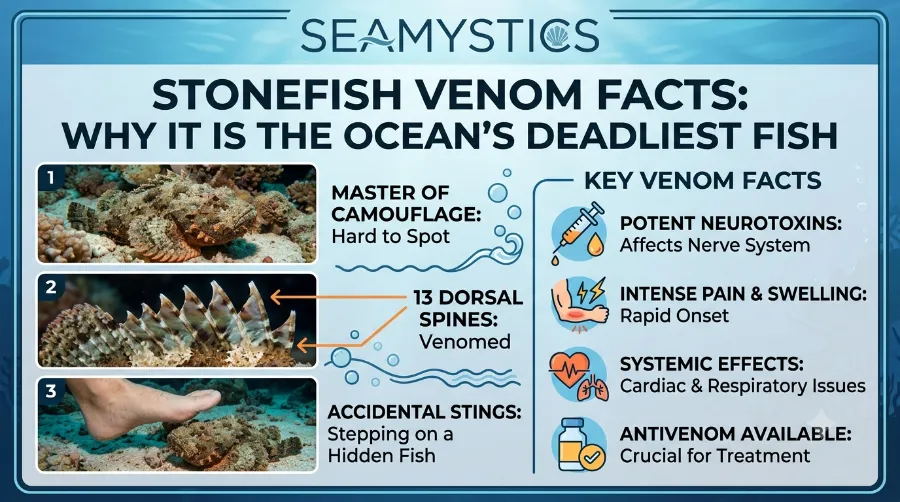
| Spine count | 13 dorsal spines deliver venom under direct pressure |
| Peak symptom onset | Symptoms often peak within 60 minutes of the sting |
| Deaths in Australia | No confirmed deaths recorded since European settlement |
| Antivenom | Developed in 1959 and still used in Australian hospitals today |
| Habitat | Shallow reefs and rocky seabeds across the Indo-Pacific |
| Camouflage skill | Blends so well with coral and algae that it is mistaken for a rock |
TL;DR: Stonefish carry the most dangerous venom of any fish species. They deliver it through 13 spines when someone accidentally steps on or touches them. Deaths are extremely rare today thanks to hot water treatment and antivenom, but the pain is described as one of the worst sensations a human can experience.
Flounder Camouflage Facts How This Fish Changes Its Own Skin Pattern
What Makes Stonefish the Most Venomous Fish in the Ocean
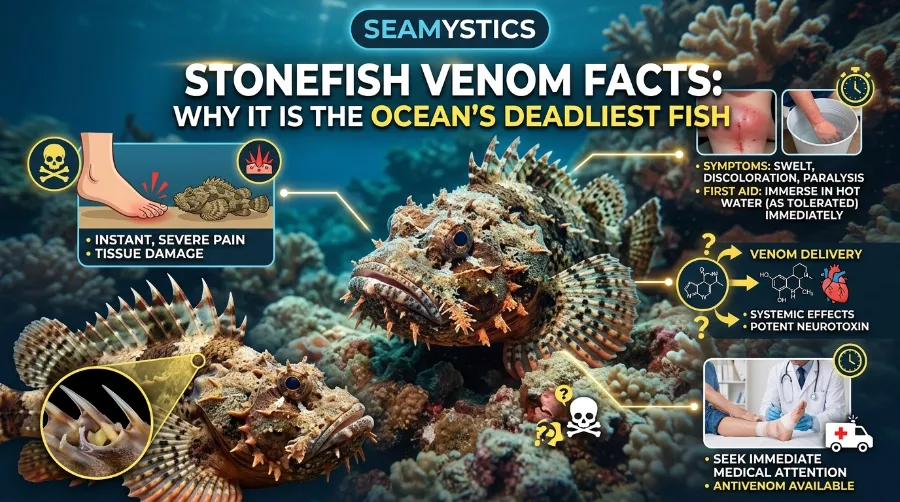
Stonefish belong to the genus Synanceia. Researchers recognize five distinct species, including Synanceia horrida and Synanceia verrucosa. Each species carries venom glands connected to 13 spines running along its back. When something presses down on those spines, the fish releases venom directly into the wound through a holocrine gland system, a method that differs from how many other venomous animals inject toxins.
Clownfish Facts Explained The Real Science Behind Nemo’s Species
Leafy Sea Dragon Facts Nature’s Best Camouflage Artits
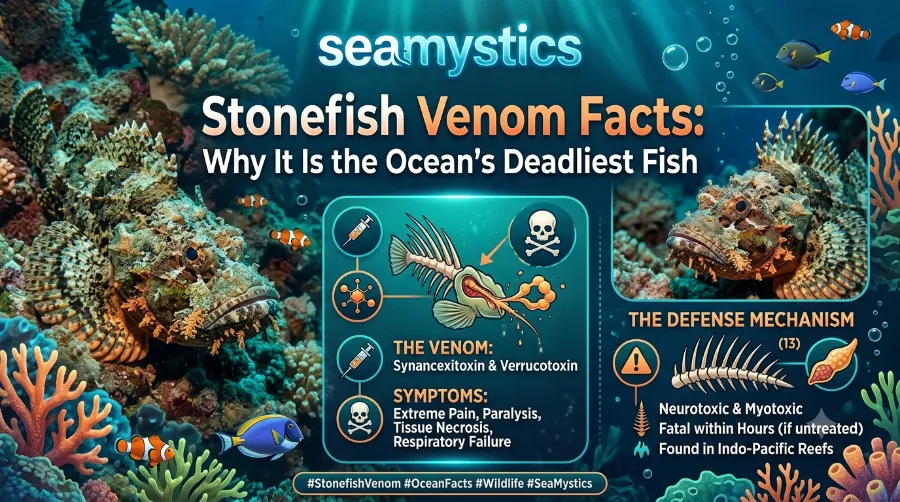
I spoke with colleagues who study fish venom for a living. They consistently point to two main toxin groups behind stonefish sting danger. Stonustoxin attacks the cardiovascular system and can trigger dangerously low blood pressure. Trachynilysin interferes with nerve signaling and can cause muscle paralysis when enough venom enters the body.
These toxins are proteins, so they break down under heat. That single fact explains why hot water immersion became the frontline treatment worldwide. This one biological detail has quietly saved thousands of people who might have faced far worse outcomes only a few decades ago.
How Stonefish Venom Works Inside the Body
Once venom enters a wound, it spreads quickly through nearby tissue and blood vessels. Victims typically report a wave of pain moving from the sting site up through the limb within minutes. A review of Synanceia venom components and treatment found that most patients seek medical help within two hours of the sting, simply because the pain feels unbearable that fast.
Mantis Shrimp Facts The Animal With the Strongest Punch in the Ocean
Swelling, redness, and shock often follow the initial pain. Serious cases can bring breathing difficulty and abnormal heart rhythm. Because the venom loses potency under heat, medical teams often submerge the affected limb in water around 45 degrees Celsius. This step alone can cut pain dramatically within the first hour.
Stonefish Sting Danger: Real Symptoms and Severity Levels
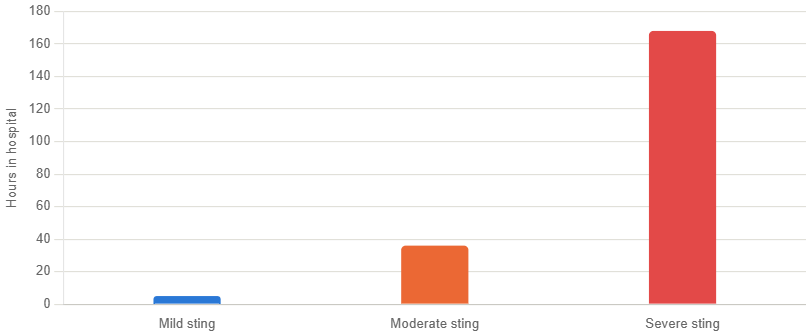
Not every stonefish sting produces the same outcome. Severity depends on how many spines penetrate the skin and how much venom enters the wound. Clinical reviewers generally group cases into three tiers, and the chart above shows how hospital stay length tracks with that severity.
- Mild cases usually involve localized pain and swelling. Patients often go home within hours after treatment.
- Moderate cases can bring spreading pain, nausea, and swollen lymph nodes. These often require one to two days of monitoring.
- Severe cases may involve compartment syndrome, tissue necrosis, or heart complications. Hospital stays can stretch beyond a week.
Ocean Conservancy shared one sting victim’s account of the pain. The victim described it escalating up the arm like being struck repeatedly with a sledgehammer over roughly an hour. That single description paints stonefish sting danger more clearly than any clinical chart.
Stonefish Camouflage: Nature’s Perfect Disguise
Camouflage fascinates me most about this fish. It also explains why most stings happen by accident rather than aggression. Stonefish are covered in bumps, ridges, and mottled coloring that mimics algae covered rock almost perfectly. Our full breakdown of ocean animal camouflage strategies covers several species that rely on this same survival trick.
Sea Cucumber Facts The Ocean’s Strangest Defense Mechanism
Unlike active hunters, stonefish are ambush predators. They stay motionless on the seabed for hours. Sometimes they even bury themselves partly in sand, waiting for small fish or crustaceans to swim close enough to grab. This stillness makes them dangerous to humans, since swimmers and waders often place a foot directly on top of one without realizing it.
Other reef creatures use similar disguise tactics, though through very different methods. Cuttlefish change skin color and texture almost instantly using specialized pigment cells, a process we explain in our guide to cuttlefish camouflage facts. The mimic octopus takes deception even further and imitates the shape and movement of other dangerous animals, covered in our piece on mimic octopus facts.
Why Stonefish Camouflage Increases Sting Risk
Stonefish rarely move, and they blend so effectively into their surroundings that most stings happen entirely by accident. Divers and waders typically never see the fish before contact occurs. Warning colors do not exist here, and no active threat display happens either. Stonefish simply hide their weapon until it is too late.
Marine safety officers in northern Australia often remind tourists to shuffle their feet through sand rather than step straight down. It sounds like a small habit. Still, it genuinely lowers risk in shallow tidal zones.
Stonefish Habitat Facts: Where These Fish Actually Live
Stonefish thrive across a wide stretch of the Indo-Pacific region and favor warm, shallow coastal water. Understanding stonefish habitat facts helps explain why certain regions report more stings than others.
- Northern Australia, particularly around the Great Barrier Reef and Queensland coastline
- Coral reefs and rocky seabeds throughout Southeast Asia, including Indonesia and the Philippines
- Coastal waters near Japan, where warming ocean temperatures are gradually expanding their range
- Reef systems around New Caledonia and French Polynesia in the South Pacific
- Intertidal zones and tide pools where depth rarely exceeds a few meters
Researchers reviewing stonefish geographic distribution found a notable share of fish related hospital visits across several Indo-Pacific countries. They also flagged growing concern that warmer waters could push these fish into new territory over time.
Stonefish also show up in the aquarium trade, and specimens now live in home tanks across the United States and Europe. That detail matters because sting cases no longer stay confined to tropical beach destinations. Aquarium owners occasionally get stung while cleaning tanks or handling equipment.
Real Stonefish Sting Cases and What They Teach Us
Numbers become far more meaningful once you look at documented cases. Here are a few grounded in real medical literature and historical records.
The earliest documented lethal incident dates back further than most people expect. Historical records show researcher Bottard logged six fatalities linked to stonefish stings on La Réunion Island as far back as 1889. That case cluster helped establish just how serious envenomation could become before modern treatment existed.
Fast forward to the modern era, and antivenom changed the outlook significantly. Scientists developed an effective antivenom in 1959. Australian hospitals still administer it as one of their most frequently used treatments. Despite this progress, tragedy still strikes occasionally. A recent case report documented the death of an eleven year old boy in 2018 after a sting to the foot, according to a clinical summary published in Encyclopedia MDPI.
More recent clinical work adds further weight to this danger. A study covering cases collected in New Caledonia and French Polynesia reported three clinical cases, including one fatality, and it highlighted the cardiovascular toxicity of Synanceia verrucosa venom.
Government health data also puts scale behind these individual stories. A national injury report found that stinging fish caused 81 percent of hospitalizations from venomous marine plant and animal contact between 2017 and 2018. Stonefish envenomation alone accounted for roughly 9.3 percent of those total cases. That is not a small number when you consider how many other venomous marine species share the same waters.
How Stonefish Compare To Other Venomous Marine Animals
| Animal | Delivery method | Typical danger level | Antivenom available |
|---|---|---|---|
| Stonefish | 13 dorsal spines | Extremely high, rarely fatal with treatment | Yes, since 1959 |
| Lionfish | Fin spines | Moderate, very painful but rarely lethal | No standard antivenom |
| Stingray | Tail barb | Moderate to high depending on strike location | No standard antivenom |
| Box jellyfish | Tentacle nematocysts | Extremely high, can be fatal within minutes | Yes, in some regions |
What To Do If You Get Stung By a Stonefish
Speed and technique matter enormously once a sting happens. It helps to know the correct order of steps rather than relying on outdated advice like applying ice.
- Get out of the water immediately and call for medical help or emergency services.
- Rinse the wound with clean saltwater, never freshwater, to help limit further tissue irritation.
- Immerse the affected area in water as hot as the person can safely tolerate, generally around 45 degrees Celsius, for roughly 30 to 90 minutes.
- Watch closely for signs of shock, difficulty breathing, or irregular heartbeat while waiting for professional care.
- Seek antivenom treatment at a hospital if pain remains severe or spreads beyond the local area.
Poison control centers in the United States, reachable at 1 800 222 1222, can also guide bystanders through initial steps if a sting happens far from a coastal hospital. That matters given how many stonefish now live in home aquariums.
Are Stonefish Endangered? Conservation Status
Stonefish do not currently carry an endangered classification, and their populations remain broadly stable across most of their Indo-Pacific range. Coral reef degradation and rising ocean temperatures could still reshape where these fish live. Researchers already observe this shift in parts of Japan, where warmer coastal water appears to be pushing stonefish territory northward. Stonefish depend heavily on reef and rocky habitat for their camouflage strategy, so large scale coral loss could eventually affect their populations even without direct hunting pressure.
Frequently Asked Questions
Is the stonefish really the most venomous fish in the world?
Yes, most marine toxicology researchers rank stonefish venom as the most potent among fish species. They base this on both its chemical makeup and the severity of documented human cases.
Can a stonefish sting kill a healthy adult?
It rarely happens today, largely because antivenom and hot water treatment are widely available where stonefish live, especially across Australia and Southeast Asia.
How long does stonefish venom pain typically last?
Pain generally peaks within the first hour and can persist for several days in moderate to severe cases. Some patients report lingering discomfort for weeks.
Do stonefish attack humans on purpose?
No, stonefish rely on stillness and camouflage rather than aggression. Nearly all stings happen when a person accidentally steps on or touches one.
Where are stonefish most commonly found?
They cluster most densely around the Great Barrier Reef, Southeast Asian reef systems, and Pacific island waters, though warming oceans are gradually widening their range.
Is there a vaccine or long term immunity to stonefish venom?
No vaccine exists, and repeated stings do not build meaningful immunity. Avoidance and proper footwear remain the best prevention strategy.
Conclusion
Stonefish earn their fearsome reputation honestly. They carry venom capable of extreme pain and, in rare cases, death. Yet the real danger comes less from aggression and more from how completely they vanish into their surroundings. That is why understanding their camouflage, habitat, and sting response matters so much for anyone wading through tropical reef waters. Proper awareness, sensible footwear, and knowledge of hot water treatment make the risk from these remarkable ambush predators very manageable. That balance of respect rather than fear is really what marine safety should be about.
References
Ocean Conservancy. How Toxic is the Stonefish. https://oceanconservancy.org/blog/2020/01/22/stonefish/
Blue Ocean Egypt. Stonefish Facts and Safety Guide. https://www.blueocean-eg.com/blog/stonefish
Wildlife Nomads. Stone Fish Top Facts. https://www.wildlifenomads.com/blog/stone-fish-facts/
Geographic Distribution, Venom Components, Pathology and Treatments of Stonefish Venom, National Center for Biotechnology Information.
Encyclopedia MDPI. Stonefish Venom Components, Pathology, and Distribution.
Is Stonefish Synanceia Verrucosa Envenomation Potentially Lethal, ScienceDirect.