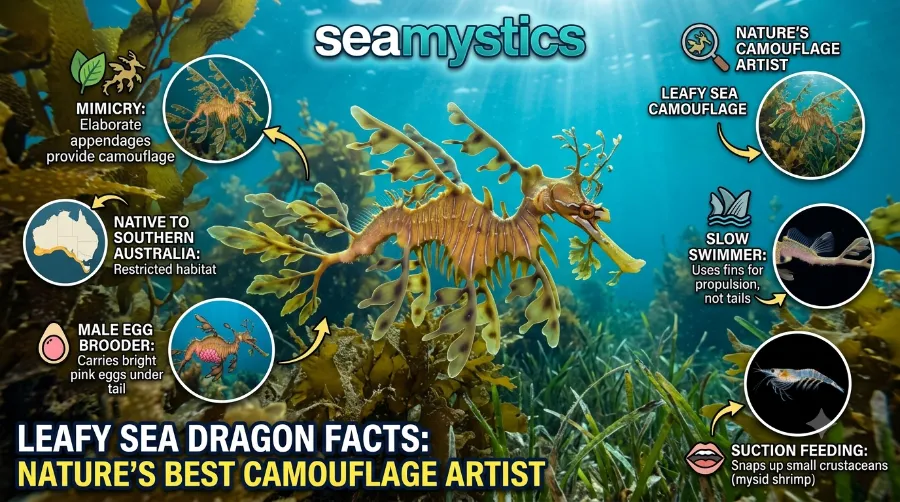

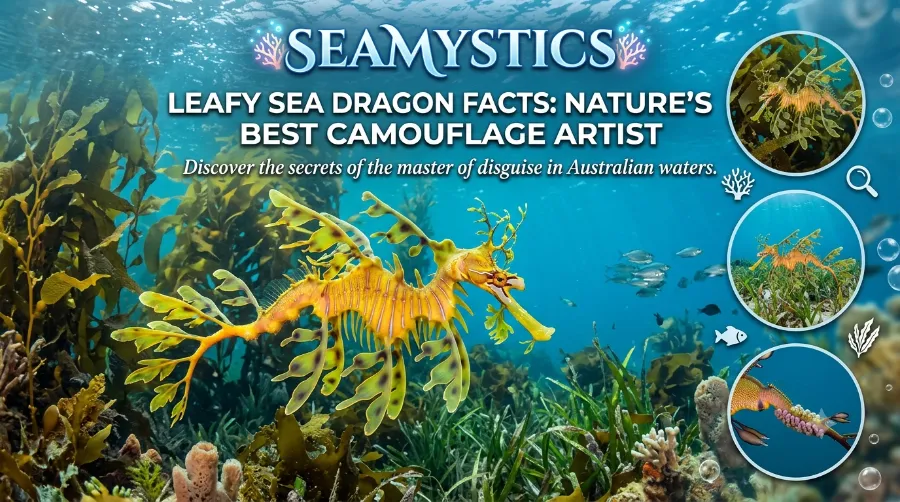
Picture a piece of seaweed that suddenly swims away. That is your first encounter with a leafy sea dragon, and honestly, most divers need a second look before they believe their own eyes. This gentle fish drifts through the kelp forests of South Australia wearing a costume so convincing that even trained marine biologists sometimes swim right past one. In this guide, we will walk through real leafy sea dragon facts, cover leafy seadragon habitat in detail, and explain why this creature remains one of the ocean’s most quietly brilliant survivors.
Flounder Camouflage Facts How This Fish Changes Its Own Skin Pattern
Key Takeaways
| Fact | Detail |
|---|---|
| Scientific name | Phycodurus eques |
| Family | Syngnathidae (same family as seahorses and pipefish) |
| Where found | South and West Australian coastal waters only |
| Average size | 18 to 24 inches (45 to 60 cm) |
| Conservation status (2025) | Near Threatened, IUCN Red List |
| Unique trait | Leaf-shaped skin appendages used for camouflage |
| Reproduction | Males carry and hatch the eggs |
| Lifespan | Up to 10 years in the wild |
TL;DR: The leafy sea dragon is a slow-moving relative of the seahorse found only in Australian waters, and it survives almost entirely through camouflage rather than speed or strength. Males carry fertilized eggs on their tails for four to six weeks, and the species was reclassified as Near Threatened in 2025 due to habitat loss and illegal collection. Its leaf-like skin flaps are not fins at all, they exist purely to help it disappear into kelp and seagrass.
What Is a Leafy Sea Dragon?
The leafy sea dragon, known scientifically as Phycodurus eques, belongs to the same family as seahorses, called Syngnathidae. It shares that seahorse relative status with pipefish too, though it looks nothing like its tiny cousins at first glance. Its body stretches thin and bony, covered in ridges of skin that mimic drifting fronds of kelp.
Nudibranch Facts Why These Sea Slugs Steal Their Colors
Unlike a seahorse, the leafy sea dragon cannot curl its tail around anything. It has no prehensile grip, so it simply drifts with the current, letting the ocean do most of the work. This passive movement style actually strengthens its disguise, because real seaweed sways the same way.
A Seahorse Relative With a Twist
Even though people often group seahorses and sea dragons together, the two behave quite differently underwater. Seahorses tend to anchor themselves to coral or grass using their tails. Sea dragons, on the other hand, swim freely using tiny transparent fins along their back and neck, which beat so fast that they are nearly invisible to the naked eye.
Clownfish Facts Explained The Real Science Behind Nemo’s Species
According to detailed profiles from the Monterey Bay Aquarium, these fins move at roughly 350 beats per minute, yet they push the animal forward at barely any noticeable speed. That combination, fast fins and slow travel, is part of what makes the leafy sea dragon such an unusual member of the fish world. If you enjoy comparing camouflage strategies across marine species, our pillar guide on ocean animal camouflage breaks down several other examples in detail.
Stonefish Venom Facts Why It Is the Ocean’s Deadliest Fish
Leafy Seadragon Habitat: Where These Australian Sea Dragons Live
Every wild leafy sea dragon habitat sits along the southern and western coastlines of Australia, and nowhere else on earth. This makes the species endemic, meaning it cannot simply relocate if conditions change. Rapid Bay, Edithburgh, and Victor Harbor in South Australia remain the most reliable spots for sightings, according to long-term diver records and the Wikipedia entry on Phycodurus eques.
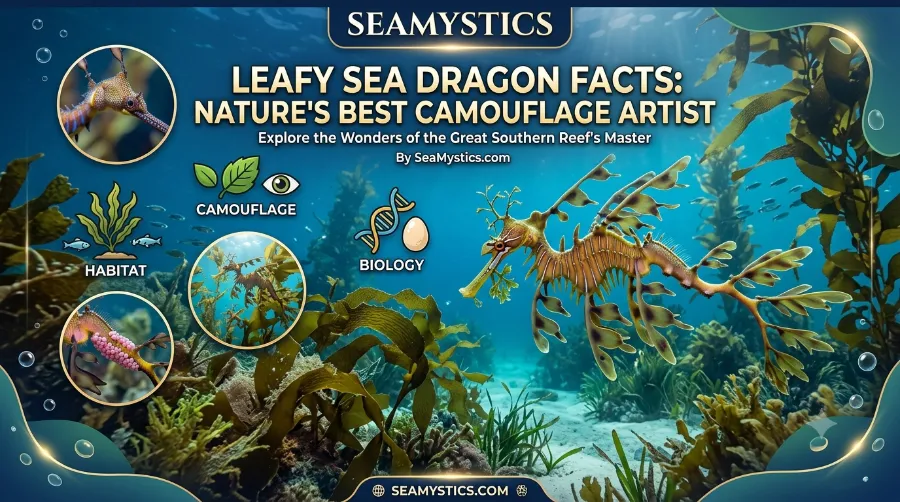
These Australian sea dragons prefer shallow, sheltered waters, typically between 3 and 50 meters deep. They favor areas thick with kelp forests, seagrass meadows, and rocky reefs, since these environments supply both food and cover.
Here is a quick breakdown of preferred habitat zones:
- Kelp forests along rocky reef edges, where sunlight still reaches the seafloor
- Sandy patches near seagrass beds, used for feeding and resting
- Sheltered bays with mild currents, which protect fragile fin structures
- Depths between 3 and 50 meters, based on regional water clarity
| Habitat Zone | Depth Range | Primary Vegetation | Common Sighting Locations |
|---|---|---|---|
| Rocky reef kelp beds | 3 to 15 m | Giant kelp, brown algae | Rapid Bay, South Australia |
| Seagrass meadows | 5 to 25 m | Posidonia seagrass | Edithburgh, South Australia |
| Deep sand patches | 25 to 50 m | Sparse algae | Western Australian coastline |
Because their range is so narrow, any disruption to these habitats hits the population hard. A 2025 review published through the IUCN Seahorse, Pipefish and Seadragon specialist group noted continued pressure from coastal construction and stormwater runoff, both of which reduce kelp density along the South Australian coast.
Sea Dragon Facts That Prove They Are Camouflage Masters
When people search for sea dragon facts, camouflage almost always tops the list, and for good reason. This is not simple color matching like a chameleon. The leafy sea dragon builds actual physical structures on its body that copy the exact shape of surrounding plant life.
Leafy Appendages Explained
Those flowing, leaf-shaped flaps covering its body are not fins, and they serve no role in swimming. They exist purely as decoration, evolved over millions of years to mimic drifting kelp fronds and seaweed strands. Predators like larger fish rely on shape recognition to hunt, so a body that looks like a plant simply does not register as prey.
Sea Cucumber Facts The Ocean’s Strangest Defense Mechanism
The California Academy of Sciences notes that these appendages can vary in number and shape between individuals, almost like a fingerprint. Some sea dragons develop longer, more elaborate leaf structures depending on their specific habitat conditions. You can read more detailed anatomical breakdowns on the Cal Academy leafy seadragon page.
Color Changing and Slow Movement Skills
Beyond its leafy shape, this fish can also shift its coloring slightly, ranging from olive green to golden brown, depending on diet, water temperature, and stress levels. This is subtler than a cuttlefish’s dramatic color flash, which you can explore further in our cuttlefish facts guide, but it works toward the same survival goal.
Slow, drifting movement completes the disguise. A leafy sea dragon rarely swims in a straight line. Instead, it sways gently with the current, mimicking the natural back-and-forth motion of kelp fronds caught in the tide.
Here are three camouflage traits that set the leafy sea dragon apart from other masters of disguise:
- Physical leaf-shaped appendages that mimic real seaweed, rather than relying only on color
- Extremely slow, drifting locomotion that copies plant movement in ocean currents
- Subtle color shifts tied to habitat and stress, which sharpen the illusion further
For comparison, the mimic octopus takes a completely different route, actively imitating other dangerous animals rather than plants. Our mimic octopus facts guide covers that behavior in depth if you want to see how varied ocean camouflage strategies really are.
Reproduction: The Pregnant Fathers of the Ocean
One of the most talked about sea dragon facts involves reproduction, and it flips the usual script. Male leafy sea dragons carry the eggs, not the females. This trait is shared across the wider seahorse and pipefish family, but sea dragons take it a step further with a specialized brood patch.
Here is how the process generally unfolds each breeding season, which typically runs from late August through January:
- The female produces up to 250 bright pink eggs during courtship dances that can last several hours
- She transfers the eggs directly onto the male’s tail, where fertilization happens during the handoff
- The eggs attach to a spongy, cup-textured brood patch on the underside of his tail
- He carries them for roughly four to six weeks, supplying oxygen through tiny blood vessels
- Hatchlings emerge fully independent, feeding first on a yolk sac and then on zooplankton
Breeding programs at facilities like the Ocean Rider Seahorse Farm in Hawaii have documented successful leafy sea dragon mating and hatching events, offering researchers rare data on captive reproduction patterns. Coral Magazine covered one such event in detail, which you can read about on their leafy sea dragon mating coverage. These captive successes matter because wild leafy sea dragon habitat remains difficult and expensive to monitor consistently.
Predators, Threats, and Real Conservation Numbers
Adult leafy sea dragons face few natural predators, largely because their camouflage works so well. Occasionally, larger fish will attempt an attack, but the leathery, bony plates covering the sea dragon’s body make it a poor meal even when spotted. Hatchlings face far greater risk, since they lack full-size camouflage and armor until they mature.
Human activity poses the bigger threat by far. As of July 2025, the IUCN Red List reclassified the species from Least Concern to Near Threatened, citing habitat degradation, coastal development, and illegal collection for the aquarium trade. This shift matters, since it reflects a genuine decline noticed across multiple monitoring programs rather than a minor administrative update.
| Threat Category | Impact Level | Primary Cause |
|---|---|---|
| Coastal development | High | Port and marina construction near kelp beds |
| Illegal aquarium collection | Moderate to High | High black market demand for rare marine species |
| Climate related stress | Growing | Rising sea temperatures affecting kelp density |
| Pollution and runoff | Moderate | Urban stormwater entering shallow reef zones |
For comparison, the stonefish faces almost the opposite problem, being feared rather than sought after, which changes how conservation groups approach public education. Our guide on stonefish venom facts touches on how public perception shapes protection efforts for different species.
South Australia has taken this seriously. Since the leafy sea dragon serves as the state’s official marine emblem, local law fully protects it, and divers caught handling or collecting the species face real penalties. Programs like DragonSearch also encourage citizen scientists to report sightings, which helps researchers track population trends without relying solely on expensive survey dives.
Why Divers and Researchers Travel Across the World for One Sighting
Speaking with dive operators along South Australia’s coast reveals a consistent pattern. Most confirm that even experienced divers with hundreds of logged dives often spend an entire trip without spotting a single leafy sea dragon. This rarity, combined with the animal’s almost otherworldly appearance, drives a steady stream of dedicated eco-tourism to spots like Rapid Bay Jetty.
Marine researchers studying this species face similar challenges. Tagging or tracking a leafy sea dragon proves difficult, since traditional tagging methods risk damaging its fragile skin appendages. Instead, many research teams rely on photo identification, since the leaf pattern on each individual is unique enough to tell them apart over time, much like fingerprinting.
This slow, patient research style has produced genuinely useful data. A 2025 study published in Reviews in Fish Biology and Fisheries highlighted persistent knowledge gaps around seadragon movement patterns, recommending expanded photo ID databases across dive tourism regions. That kind of citizen science collaboration, between everyday divers and academic researchers, has quietly become one of the most effective conservation tools available for this species.
Comparing the Leafy Sea Dragon to Other Camouflage Experts
The ocean holds no shortage of disguise specialists, yet the leafy sea dragon stands apart through pure structural mimicry. While a cuttlefish changes color almost instantly using specialized skin cells, the sea dragon relies on a fixed, permanent shape that never needs to react in real time.
The mimic octopus takes a bolder approach entirely, actively copying the movement and posture of venomous animals to scare off predators. Meanwhile, the leafy sea dragon simply blends in and waits, betting everything on patience rather than performance. Both strategies work, though they represent very different evolutionary paths toward the same goal of survival.
| Species | Camouflage Method | Reaction Speed | Habitat |
|---|---|---|---|
| Leafy sea dragon | Physical leaf-shaped body structures | Passive, always active | Australian kelp forests |
| Cuttlefish | Rapid skin color and texture change | Near instant | Global temperate and tropical waters |
| Mimic octopus | Active behavioral mimicry of other species | Fast, situational | Indo-Pacific sandy seafloors |
Frequently Asked Questions
Is the leafy sea dragon endangered?
As of 2025, it holds Near Threatened status on the IUCN Red List, which sits one step below Vulnerable. It is not currently classified as endangered, but the trend is moving in a concerning direction.
What do leafy sea dragons eat?
They primarily eat mysid shrimp and other small crustaceans, using a long, tube-shaped snout to suck prey in whole, since they have no teeth at all.
Can you keep a leafy sea dragon as a pet?
No, wild collection is illegal in Australia, and captive care requires extremely specialized equipment and expertise, which only a handful of accredited aquariums and breeding facilities can provide.
How long do leafy sea dragons live?
They typically live between 6 and 10 years in the wild, though exact lifespan data remains limited due to how difficult long-term tracking proves in their natural habitat.
Are leafy sea dragons dangerous to humans?
Not at all. They have no venom, no bite, and no defensive weapons beyond their disguise, making them completely harmless to divers and swimmers.
Conclusion
The leafy sea dragon proves that survival does not always depend on speed, strength, or sharp teeth. Sometimes patience and disguise carry a species further than any weapon could, and this quiet Australian fish has spent millions of years perfecting exactly that approach. As coastal development and warming waters continue reshaping its narrow habitat, the choices made by local governments, divers, and everyday ocean lovers will likely decide whether future generations get to spot one drifting through the kelp themselves.
References
- Monterey Bay Aquarium. Leafy Sea Dragon Species Profile. https://www.montereybayaquarium.org/animals-the-ocean/animals-a-to-z/leafy-sea-dragon
- California Academy of Sciences. Leafy Seadragon Explore Science Page. https://www.calacademy.org/explore-science/leafy-seadragon
- Coral Magazine. Leafy Sea Dragons Mating at Ocean Rider Seahorse Farm, 2013. https://www.coralmagazine.com/2013/04/10/leafy-sea-dragons-mating-at-ocean-rider-seahorse-farm/
- IUCN Red List of Threatened Species, Phycodurus eques assessment, July 2025.
- Reviews in Fish Biology and Fisheries. Improving Conservation Outcomes for Seadragons: Data, Knowledge Gaps, and Future Directions, 2025.
- Wikipedia. Leafy Seadragon. https://en.wikipedia.org/wiki/Leafy_seadragon