
Plastic pollution has become one of the biggest threats facing our oceans. Every year, millions of tons of plastic enter marine ecosystems, affecting wildlife, fisheries, tourism, and even human health. While many people have seen photos of floating plastic bottles or littered beaches, the real story goes much deeper. Tiny plastic particles now appear in the deepest ocean trenches, Arctic ice, seafood, and even the air we breathe.
As a marine biologist, I have watched research evolve from studying visible debris to tracking microscopic plastic particles across entire ocean ecosystems. The latest findings from 2025 and 2026 reveal that ocean plastic pollution remains a growing challenge despite increased awareness and cleanup efforts. how to protect our ocean read this blog
Key Takeaways: Ocean Plastic Pollution Facts in 2026
| Key Fact | Latest Finding |
|---|---|
| Plastic entering aquatic ecosystems annually | 19–23 million tonnes |
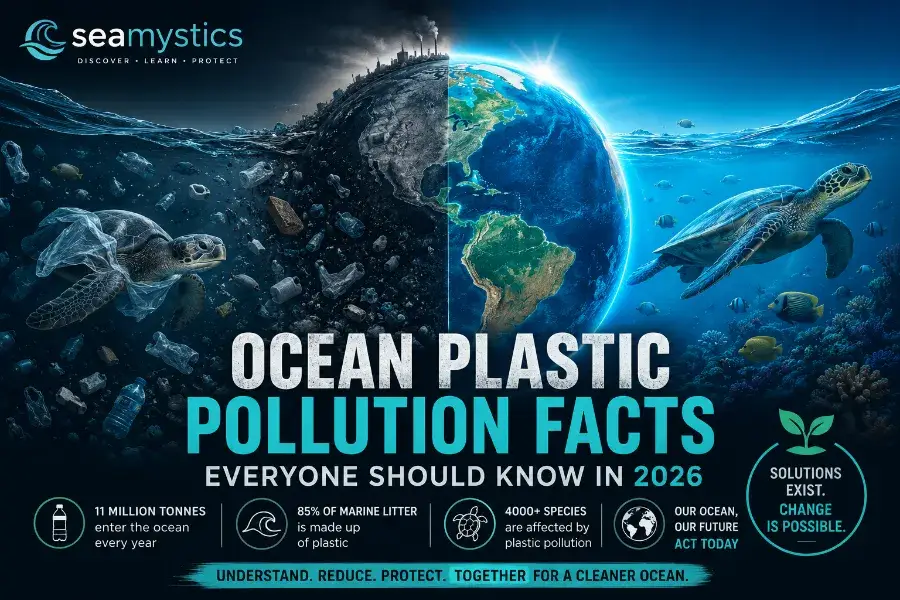
| Plastic entering oceans each year | Around 11 million tonnes |
| Plastic already present in oceans | 75–199 million tonnes |
| Share of marine litter made of plastic | At least 85% |
| Microplastics in environment (2020 estimate) | 2.7 million tonnes |
| Projected ocean plastic accumulation by 2040 | 76 million tonnes |
| Projected ocean plastic accumulation by 2060 | 141 million tonnes |
| Main source of ocean plastics | Land-based waste |
| Most common plastic waste type | Single-use plastics |
| Marine species affected | More than 4,000 species |
Data sources include UNEP, OECD, IMO, and recent scientific assessments.
What Is Ocean Plastic Pollution?
Ocean plastic pollution refers to plastic waste that enters seas, rivers, coastal environments, and marine ecosystems. This pollution includes:
- Plastic bottles
- Food packaging
- Fishing gear
- Plastic bags
- Synthetic fibers
- Microplastics
- Industrial plastic pellets
Once plastic enters the ocean, it rarely disappears completely. Instead, sunlight, waves, and weather break larger items into smaller pieces.
As a result, plastic can remain in marine environments for hundreds of years.
Why Ocean Plastic Pollution Matters More Than Ever
Many people assume plastic pollution is mainly an environmental issue. However, its effects extend far beyond wildlife.
Plastic pollution now affects:
- Food security
- Tourism industries
- Commercial fisheries
- Coastal economies
- Human health
- Climate resilience
According to the United Nations Environment Programme, between 19 and 23 million tonnes of plastic waste leak into aquatic ecosystems every year.
Furthermore, researchers continue finding plastic contamination in new locations each year.
The Most Important Ocean Plastic Pollution Facts for 2026
1. Millions of Tonnes of Plastic Enter Oceans Every Year
One of the most alarming statistics remains unchanged.
Scientists estimate that approximately 11 million tonnes of plastic enter the ocean annually. Without stronger interventions, this number could rise significantly in coming decades.
To visualize that amount:
- More than 30,000 tonnes per day
- Over 1,250 tonnes every hour
- Roughly 20 tonnes every minute
2. Plastic Makes Up Most Marine Litter
Plastic is no longer a minor component of marine debris.
Current estimates suggest plastics account for at least 85% of all marine litter worldwide.
This dominance occurs because plastic is:
- Lightweight
- Durable
- Cheap to produce
- Slow to degrade
Consequently, plastic accumulates much faster than natural materials.
3. The Ocean Already Contains Massive Amounts of Plastic
Scientists estimate that oceans currently contain between 75 and 199 million tonnes of plastic waste.
Much of this pollution is hidden beneath the surface.
Researchers have discovered plastic waste in:
- Deep-sea trenches
- Polar regions
- Coral reefs
- Seafloor sediments
- Coastal wetlands
Therefore, visible trash represents only a fraction of the total problem.
4. Microplastics Are Everywhere
Microplastics measure less than 5 millimeters in size.
These particles come from:
- Broken plastic debris
- Synthetic clothing
- Tire wear
- Cosmetic products
- Industrial pellets
A UNEP assessment estimated that 2.7 million tonnes of microplastics entered the environment in 2020, and that amount could double by 2040.
Microplastic Sources
| Source | Contribution |
| Synthetic textiles | High |
| Tire wear | High |
| Packaging breakdown | Moderate |
| Fishing gear | Moderate |
| Industrial pellets | Moderate |
5. Thousands of Marine Species Encounter Plastic
Plastic pollution affects more than 4,000 marine species through ingestion, entanglement, habitat damage, and chemical exposure.
Commonly affected animals include:
- Sea turtles
- Dolphins
- Whales
- Seabirds
- Sharks
- Coral species
For example, sea turtles frequently mistake floating plastic bags for jellyfish.
As a result, many suffer intestinal blockages that can become fatal.
How Plastic Travels Through the Ocean
Plastic rarely stays where it enters the water.
Instead, ocean currents transport debris across vast distances.
Major Plastic Pathways
Cities
   ↓
Rivers
   ↓
Coastal Waters
   ↓
Ocean Currents
   ↓
Gyres
   ↓
Deep Ocean
Research shows that approximately 80% of marine plastic pollution originates on land.
Therefore, effective solutions must begin before waste reaches waterways.
The Great Pacific Garbage Patch Explained
The Great Pacific Garbage Patch remains one of the most recognized symbols of ocean pollution.
Contrary to popular belief, it is not a floating island of trash.
Instead, it consists of:
- Floating debris
- Fishing gear
- Microplastics
- Fragmented plastic particles
Ocean currents concentrate this waste within a large region of the North Pacific Ocean.
Many pieces are so small they cannot be seen easily from boats.
Ocean Plastic Pollution and Human Health
Scientists once believed plastic pollution only threatened marine life.
Today, evidence suggests human exposure occurs regularly.
Researchers have detected microplastics in:
- Seafood
- Drinking water
- Salt
- Air
- Human blood
- Human tissues
Although scientists continue studying long-term health impacts, concerns include:
- Inflammation
- Chemical exposure
- Cellular stress
Consequently, reducing plastic pollution benefits both marine ecosystems and public health.
Which Items Pollute Oceans Most Often?
Beach cleanup surveys consistently identify several common items.
Top Plastic Pollutants
| Rank | Item |
| 1 | Plastic bottles |
| 2 | Bottle caps |
| 3 | Food wrappers |
| 4 | Plastic bags |
| 5 | Cigarette filters |
| 6 | Fishing gear |
| 7 | Straws |
| 8 | Foam containers |
Single-use products remain the largest contributors.
Therefore, reducing disposable plastic consumption can create immediate benefits.
Ocean Plastic Pollution Trends in 2026
The latest research presents a mixed picture.
Awareness has improved substantially. However, plastic production continues to rise globally.
Global Plastic Outlook
| Year | Estimated Ocean Plastic Accumulation |
| 2025 | Current accumulation continues |
| 2040 | 76 million tonnes |
| 2060 | 141 million tonnes |
Source: OECD projections.
Visual Trend Chart
Ocean Plastic Accumulation

2040 | ############################ 76 Mt
2060 | ######################################################## 141 Mt
The chart highlights why prevention remains more effective than cleanup alone.
Recent Discoveries Scientists Are Watching
Several discoveries from recent years have changed our understanding of marine pollution.
Nanoplastics in the North Atlantic
A major study identified approximately 27 million tonnes of nanoplastics in the North Atlantic Ocean. These particles are smaller than one micrometer and may penetrate biological tissues more easily than larger plastics.
Deep-Sea Plastic Accumulation
Scientists now recognize that the seafloor acts as one of the world’s largest plastic sinks. Large quantities of debris settle into deep ocean basins and underwater canyons.
These findings demonstrate that much ocean plastic remains hidden from view.
What Governments Are Doing
Countries increasingly recognize plastic pollution as a global issue.
Current actions include:
- Plastic bag restrictions
- Deposit return systems
- Extended producer responsibility programs
- Improved recycling systems
- Global treaty negotiations
The United Nations continues work toward an international plastics agreement aimed at reducing pollution across the entire plastic life cycle.
What Individuals Can Do
Large-scale policy changes matter. Nevertheless, personal choices also help reduce plastic leakage.
Practical Steps
- Carry a reusable water bottle.
- Use reusable shopping bags.
- Avoid unnecessary packaging.
- Support businesses reducing plastic waste.
- Join local cleanup events.
- Recycle correctly.
- Reduce single-use plastics.
Small actions become powerful when millions of people adopt them.
For additional scientific information:
- UNEP Plastic Pollution Portal
- OECD Plastics Research Program
- International Maritime Organization Marine Litter Initiative
Frequently Asked Questions
What percentage of ocean litter is plastic?
Plastic accounts for at least 85% of marine litter globally.
How much plastic enters the ocean every year?
Most estimates place annual inputs around 11 million tonnes, although broader aquatic ecosystem leakage reaches 19–23 million tonnes.
Are microplastics dangerous?
Scientists continue studying health effects. However, microplastics can transport chemicals and enter food webs.
Which animals suffer most from plastic pollution?
Sea turtles, seabirds, whales, dolphins, fish, and coral ecosystems experience significant impacts.
Can ocean plastic pollution be reversed?
Yes, but success requires prevention, waste management improvements, policy action, and cleanup efforts working together.
Conclusion
The latest ocean plastic pollution facts reveal a challenge that extends far beyond visible litter. Plastic now reaches remote coastlines, deep-sea habitats, marine food webs, and even human bodies. Although awareness continues to grow, millions of tonnes of waste still enter aquatic ecosystems every year.
The encouraging news is that solutions already exist. Better waste management, smarter product design, stronger policies, and everyday consumer choices can significantly reduce future pollution. If governments, industries, and individuals act together, the next decade could become a turning point for ocean health.
References
- United Nations Environment Programme (UNEP) – Plastic Pollution
- OECD Plastics Outlook
- International Maritime Organization (IMO) Marine Litter Resources
- Our World in Data – Plastic Pollution Research
- IUCN Plastic Pollution Issue Brief
- UNEP Microplastics Research Update
- Recent North Atlantic Nanoplastics Study
- United Nations Sustainable Development Resources