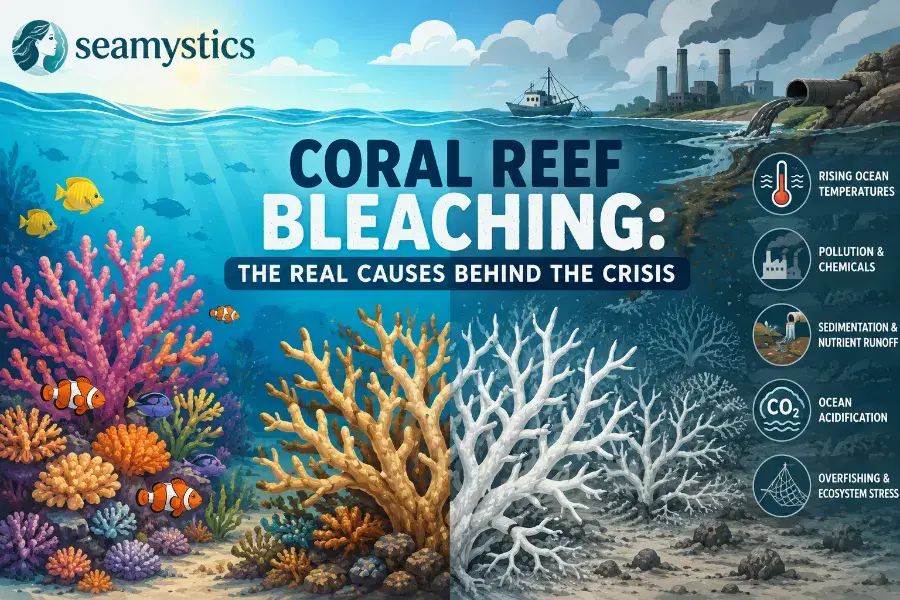

Coral reefs are often called the rainforests of the sea. They cover less than 1% of the ocean floor, yet they support nearly 25% of all marine species. However, many of these vibrant ecosystems are turning white at an alarming rate.
The problem is coral bleaching. While many people know bleaching is happening, fewer understand the true reasons behind it. The reality is more complex than a single environmental issue. Rising ocean temperatures remain the leading threat, yet pollution, ocean acidification, overfishing, and local stressors also play major roles.
In this guide, we will explore the coral reef bleaching causes driving today’s crisis, examine the latest scientific findings, and discuss what can still be done to protect these extraordinary ecosystems.
Key Takeaways
| Topic | Key Fact |
|---|---|
| Main Cause | Ocean warming is the leading driver of coral bleaching |
| Latest Global Data | Around 84% of the world’s coral reef area experienced bleaching-level heat stress during the recent global event |
| Secondary Causes | Pollution, sedimentation, ocean acidification, UV exposure, and harmful chemicals |
| Most Vulnerable Regions | Great Barrier Reef, Caribbean, Florida Keys, Indian Ocean reefs |
| Recovery Possible? | Yes, if stress decreases quickly and coral tissue survives |
| Long-Term Solution | Reducing greenhouse gas emissions and improving local reef management |
What Is Coral Reef Bleaching?
Coral bleaching occurs when corals become stressed and expel the tiny algae living inside their tissues.
These algae, called zooxanthellae, provide:
- Up to 90% of a coral’s energy
- Bright colors
- Essential nutrients
Without these algae, corals turn white. This is known as bleaching.
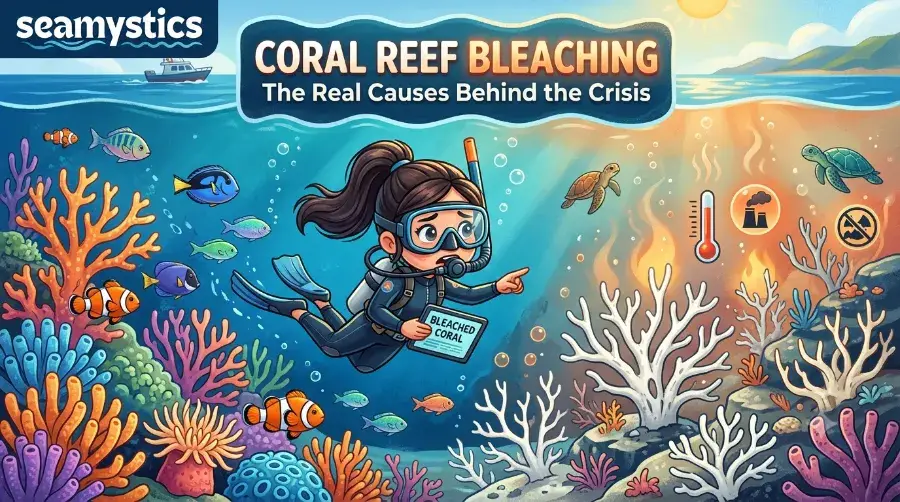
A bleached coral is not immediately dead. However, if stressful conditions continue for weeks or months, starvation, disease, and mortality often follow.
Why Coral Reefs Matter More Than Most People Realize
Coral reefs support ecosystems, economies, and coastal communities.
Ecological Benefits
- Habitat for thousands of marine species
- Nursery grounds for fish
- Biodiversity hotspots
Economic Benefits
According to marine conservation studies, reefs contribute billions of dollars annually through:
- Tourism
- Fisheries
- Coastal protection
Human Protection
Healthy reefs absorb wave energy and reduce storm damage during hurricanes and tropical storms.
Without reefs, many coastal communities become more vulnerable to erosion and flooding.
Coral Reef Bleaching Causes Explained
Understanding the root causes helps explain why bleaching events are becoming more common.
1. Rising Ocean Temperatures (The Biggest Threat)
The most important factor behind coral bleaching is rising sea temperature.
Corals live within a narrow temperature range. Even a sustained increase of just 1–2°C above normal summer temperatures can trigger bleaching.
When water becomes too warm:
- Coral metabolism becomes stressed.
- Algae produce harmful oxygen compounds.
- Corals expel the algae.
- Bleaching begins.
Scientists have identified ocean warming as the primary global driver of modern bleaching events.
Example: Florida Reef Crisis
In 2023, some Florida reef areas recorded temperatures exceeding 95°F (35°C), with certain shallow locations surpassing 100°F (37.8°C). These conditions caused severe bleaching and mortality.
Chart: Main Causes of Coral Bleaching
| Cause | Estimated Contribution to Global Bleaching Risk |
|---|---|
| Ocean Warming | 70–80% |
| Ocean Acidification | 8–10% |
| Pollution | 5–8% |
| Sedimentation | 3–5% |
| UV Radiation | 2–4% |
| Chemical Exposure | 1–3% |
Source synthesis based on NOAA, reef monitoring programs, and peer-reviewed marine research.
2. Climate Change Intensifies Marine Heatwaves
Climate change does not merely raise average temperatures.
It also creates:
- Longer heatwaves
- More frequent heatwaves
- More intense heatwaves
Historically, severe bleaching events were relatively rare. Today, many reefs experience bleaching every few years.
The world’s fourth global bleaching event became the largest on record, affecting approximately 84% of global reef areas exposed to bleaching-level heat stress.
Global Bleaching Events Timeline
| Year | Event |
|---|---|
| 1998 | First global bleaching event |
| 2010 | Second global bleaching event |
| 2014–2017 | Third global event |
| 2023–2025 | Fourth and largest event recorded |
Source: NOAA Coral Reef Watch.
3. Ocean Acidification Weakens Coral Growth
The ocean absorbs roughly one-quarter of human-produced carbon dioxide emissions.
As CO₂ enters seawater:
- Ocean chemistry changes
- Water becomes more acidic
- Coral skeleton formation slows
Although acidification does not directly cause every bleaching event, it weakens reef resilience and reduces recovery capacity.
Why This Matters
Corals build skeletons from calcium carbonate.
Acidic water makes this process harder, leaving reefs weaker and more vulnerable to heat stress.
4. Pollution and Nutrient Runoff
Pollution remains a major local stressor.
Common pollution sources include:
- Agricultural fertilizers
- Sewage discharge
- Industrial waste
- Urban runoff
Excess nutrients encourage algae blooms.
These blooms:
- Block sunlight
- Reduce oxygen levels
- Increase disease risk
As a result, corals become less able to survive temperature stress.
For more on marine pollution, see our guide: /ocean-pollution-guide
5. Sedimentation from Coastal Development
Construction near coastlines often increases sediment entering reefs.
Examples include:
- Dredging projects
- Land clearing
- Road construction
- Poor agricultural practices
Sediment settles on coral surfaces and blocks sunlight.
Because corals rely heavily on photosynthesis, excessive sediment can significantly increase bleaching risk.
6. Increased Solar Radiation and UV Exposure
Sunlight is essential for coral health.
However, excessive solar radiation can become harmful when water temperatures are already elevated.
Research shows that high UV exposure combined with warming temperatures creates additional oxidative stress inside coral tissues.
This combination often accelerates bleaching during heatwaves.
7. Harmful Chemicals and Sunscreen Ingredients
Popular tourist destinations sometimes experience localized bleaching linked to chemical contamination.
Certain chemicals found in some sunscreen products may:
- Damage coral larvae
- Promote disease
- Increase bleaching susceptibility
Although warming remains the dominant threat, chemical pollution can worsen coral stress in heavily visited reef areas.
8. Overfishing and Ecosystem Imbalance
Healthy reefs depend on ecological balance.
Herbivorous fish help control algae growth.
When overfishing removes these species:
- Algae spread rapidly
- Coral recruitment declines
- Recovery slows
Therefore, overfishing indirectly increases reef vulnerability.
How Bleaching Happens: Step-by-Step
Stage 1: Environmental Stress
Water temperatures rise beyond normal limits.
Stage 2: Algae Become Damaged
Photosynthesis produces harmful compounds.
Stage 3: Coral Expels Algae
The coral removes its symbiotic partners.
Stage 4: Bleaching Occurs
The coral appears white.
Stage 5: Survival or Death
If conditions improve quickly, recovery is possible.
If stress continues, mortality increases dramatically.
Case Study: Great Barrier Reef.


Recent surveys found extensive bleaching during the 2024 marine heatwave.
At one monitored reef:
| Metric | Observation |
|---|---|
| February 2024 Bleaching | 66% of colonies |
| April 2024 Bleaching | 80% of colonies |
| Mortality by July | More than 50% of bleached colonies |
Some coral species experienced mortality rates approaching 95%.
Which Coral Species Are Most Vulnerable?
Not all corals respond equally.
Highly Vulnerable
- Acropora corals
- Branching corals
- Fast-growing reef builders
More Resilient
- Massive brain corals
- Boulder corals
- Some deep-sea water species
Scientists continue studying heat-resistant coral strains that may help future restoration efforts.
Can Coral Reefs Recover?
Yes—but recovery requires time and favorable conditions.
Successful recovery depends on:
- Reduced heat stress
- Good water quality
- Healthy fish populations
- Absence of disease outbreaks
Some reefs recover within a decade.
Others may require several decades.
Repeated bleaching events make recovery increasingly difficult.
What Scientists Are Doing Right Now
Marine researchers worldwide are testing innovative solutions.
Current Strategies
- Coral gardening
- Assisted evolution
- Heat-resistant coral breeding
- Reef restoration nurseries
- Improved monitoring systems
NOAA recently expanded bleaching alert systems because heat events now exceed previous prediction models.
Latest Data: The State of Global Coral Reefs
Global Coral Bleaching Snapshot
| Indicator | Latest Findings |
|---|---|
| Global Reef Area Impacted | ~84.4% |
| Countries Reporting Bleaching | 83+ |
| Ocean Basins Affected | Pacific, Atlantic, Indian |
| Current Status | Largest bleaching event on record |
| Main Driver | Ocean warming |
Source: NOAA Coral Reef Watch, 2026 update.
What Can Individuals Do?
Many people feel powerless. Fortunately, individual actions still matter.
Practical Steps
- Reduce carbon emissions where possible
- Support sustainable seafood
- Use reef-safe sunscreen
- Reduce plastic waste
- Support marine conservation programs
- Choose responsible tourism operators
Even small changes contribute to healthier oceans.
Frequently Asked Questions
What is the main cause of coral bleaching?
The primary cause is elevated ocean temperature. Even small increases above normal seasonal temperatures can trigger bleaching.
Can bleached coral recover?
Yes. If stressful conditions end quickly, corals can regain their algae and recover.
Is coral bleaching reversible?
In many cases, yes. However, prolonged bleaching often leads to death.
How much of the world’s coral reefs have been affected recently?
Recent NOAA assessments indicate that roughly 84% of global reef areas experienced bleaching-level heat stress during the latest global event.
Does sunscreen cause coral bleaching?
Some sunscreen chemicals may contribute locally, but global warming remains the dominant cause.
Conclusion
Coral bleaching is not the result of a single problem. Instead, it reflects a combination of environmental pressures acting on one of Earth’s most valuable ecosystems. While pollution, overfishing, sedimentation, and chemical contamination all play a role, the overwhelming driver remains rising ocean temperatures linked to climate change.
The latest global bleaching event has shown how vulnerable reefs have become. Yet there is still reason for hope. Strong conservation efforts, better reef management, scientific innovation, and meaningful reductions in greenhouse gas emissions can help preserve coral reefs for future generations. The decisions made during this decade will largely determine whether coral reefs remain vibrant ecosystems or become one of the greatest ecological losses in modern history.