
Picture a submarine captain in 1917, sitting in total darkness under the English Channel, straining to hear a single ping bounce back through the hull. That ping was the entire sonar invention history in miniature: a desperate wartime guess that turned into the tool oceanographers still can’t work without. This is the story of how a handful of physicists, a sunk ocean liner, and a war nobody wanted, together built the sonar technology timeline that eventually let humans map, chart, and finally see the deep ocean floor.
| Key Takeaway | Detail |
|---|---|
| First real patent | Alexander Behm patented an echo sounder in Germany on 22 July 1913 |
| The WWI breakthrough | Paul Langevin’s piezoelectric quartz system detected submarines up to 1,300 metres away by 1918 |
| British contribution | Canadian physicist Robert Boyle led the UK’s ASDIC program from 1916 |
| Common myth | There is no single “who invented sonar” answer, at least four inventors share credit |
| Lasting impact | Sonar became the base technology for modern seafloor mapping and deep-sea exploration |
TL;DR: Sonar wasn’t invented by one person. It grew out of the Titanic disaster in 1912, was rushed into shape during WWI by Paul Langevin in France and Robert Boyle in Britain, and by the 1920s had already split into two paths, military detection and civilian echo sounding, both of which still shape how we explore the ocean today.
Before Sonar: When Sailors Listened With Tubes, Not Machines
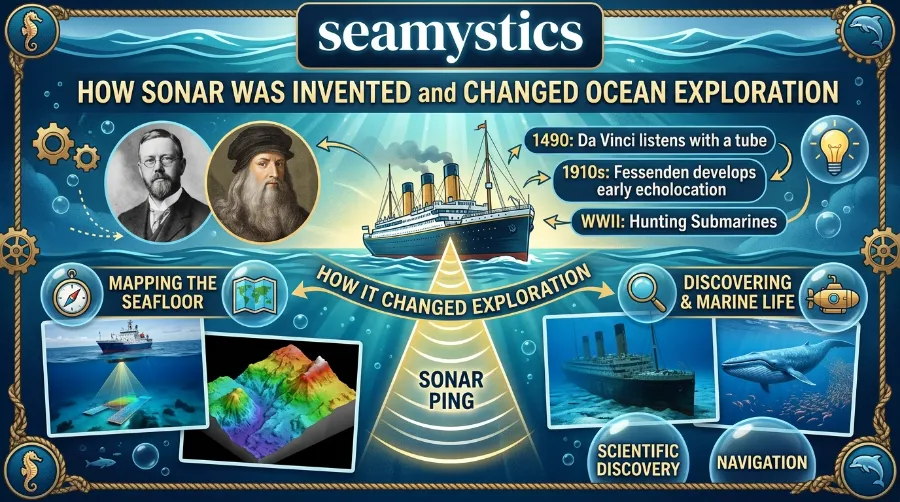
Long before anyone said the word sonar, sailors already knew that sound travels strangely underwater. Leonardo da Vinci reportedly noted in the late 1400s that a tube held underwater let a listener detect a distant ship. Centuries later, in 1826, physicist Daniel Colladen used an underwater bell to measure the speed of sound through Lake Geneva, and got a result that still holds up reasonably well today.
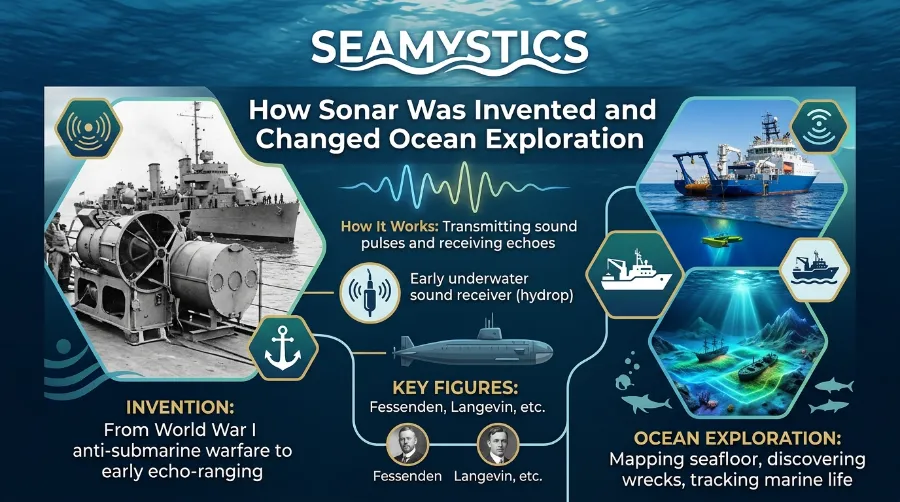
None of this counted as sonar in the modern sense. There was no signal sent out and no echo timed and measured. As a result, ships mostly still ran blind once they left sight of land, relying on lookouts, lead lines, and luck.
The Beagle Voyage Darwin Took How Five Years at Sea Rewrote Ocean Science
The Titanic Disaster That Pushed Everyone to Act
Everything changed on 15 April 1912. When RMS Titanic sank after hitting an iceberg, the shock rippled through engineering circles on both sides of the Atlantic. Within weeks, inventors on multiple continents filed patents for underwater detection devices, hoping to prevent a repeat disaster.
Underwater Archaeology Methods Explained How Sunken History Gets Recovered
German engineer Alexander Behm was reportedly one of them. He filed his echo sounder patent, German patent No. 282009, on 22 July 1913, just over a year after the sinking. His device fired a sound pulse and measured how long the echo took to bounce back, the same basic principle every modern depth sounder still uses. Consequently, echo sounding history usually starts with Behm’s name, even though his original device wasn’t built for finding submarines.
How Sonar Was Invented and Changed Ocean Exploration
Sonar History WWI: Where Necessity Beat Patience
Behm’s patent solved a peacetime problem. World War One created a much scarier one. Once German U-boats began sinking Allied ships by the hundreds, the pressure to detect a submerged submarine became a matter of survival rather than convenience.
Cold War Oceanography The Secret Race to Map the Ocean Floor
In France, physicist Paul Langevin took up the challenge alongside engineer Constantin ChilEdit Home Pageowsky. Working with piezoelectric quartz crystals, discovered decades earlier by Pierre and Jacques Curie, Langevin built a device that could both send and receive ultrasonic pulses through water. By 1918, his system reportedly detected submerged submarines at ranges up to 1,300 metres, an extraordinary distance for the era. That work later earned recognition as an IEEE Milestone, formally dated 1915 to 1918.
How Diving Bells Paved the Way for Modern Submarines
Meanwhile, Britain wasn’t sitting still. Physicist Robert Boyle, a Canadian working under the Board of Invention and Research, led a parallel program that eventually became the Allied Submarine Detection Investigation Committee, better known by its acronym, ASDIC. By mid-1917, Boyle’s team had a working prototype, and by 1918 both Britain and the United States had built active detection systems of their own.
Lighthouse Navigation History: How Beacons Guided Sailors for 2,300 Years
A few numbers help put this race into perspective:
- 1912: Titanic sinks, triggering a wave of underwater detection patents
- 1913: Alexander Behm files the first echo sounder patent in Germany
- 1915 to 1918: Paul Langevin develops piezoelectric sonar in France, reaching 1,300-metre detection ranges
- 1916: Robert Boyle begins Britain’s ASDIC research program
- 1918: Both the US and Britain field active sonar systems
Who Invented Sonar: Why There’s No Single Answer
If you’re searching specifically for who invented sonar, the honest answer is unsatisfying but true: nobody invented it alone. Behm built the first echo sounding patent. Langevin proved active sonar could actually detect submarines at useful range. Boyle turned that into a working British system. And American inventor Reginald Fessenden, working separately, built one of the earliest practical echo sounders, later commercialized as the Fessenden Fathometer, which the Submarine Signal Company installed aboard the liner SS Berkshire in 1924.
This is exactly the kind of nuance most competing articles skip past, usually crediting Langevin alone. In reality, sonar’s birth looks a lot more like a relay race than a single lightbulb moment.
Sonar Technology Timeline: From War Machine to Ocean Science
Once the war ended, sonar didn’t disappear, it just changed jobs. Fishing fleets adopted echo sounders to find schools of fish. Oceanographers used the same pulse-and-echo principle to start mapping the seafloor for the first time in human history. The ThoughtCo history of sonar traces how WWII further refined the technology, adding depth charges and hedgehog mortars that relied on accurate sonar contacts to actually hit their targets.
| Era | Development | Primary Use |
|---|---|---|
| 1913 to 1918 | Echo sounding and piezoelectric sonar invented | Submarine detection, iceberg warning |
| 1920s | Fessenden Fathometer commercialized | Commercial shipping navigation |
| 1939 to 1945 | ASDIC refined into modern sonar | Naval anti-submarine warfare |
| 1950s onward | Sonar adapted for civilian research | Seafloor mapping, fisheries science |
| Today | Multibeam and side-scan sonar | Deep-sea exploration, shipwreck surveys |
By the 1950s, marine researchers were using sonar to chart features nobody had ever seen, deep trenches, underwater mountain ranges, and the outlines of ancient shipwrecks resting far below the reach of any diver.
How Sonar Changed Ocean Exploration for Good
Here’s the part that matters most for anyone who loves the ocean rather than the military history behind it: sonar handed scientists their first real map of the seafloor. Before echo sounding, most of what we knew about ocean depth came from dropped weighted lines, a painfully slow method that gave one data point at a time.
With sonar, a single ship could chart miles of seabed in a day. This directly enabled the deep-sea submersibles that came decades later, since engineers needed accurate depth and terrain data before they could safely send a vehicle down. If you’re curious how that next chapter played out, our guide on deep-sea submersibles picks up right where sonar’s story leaves off.
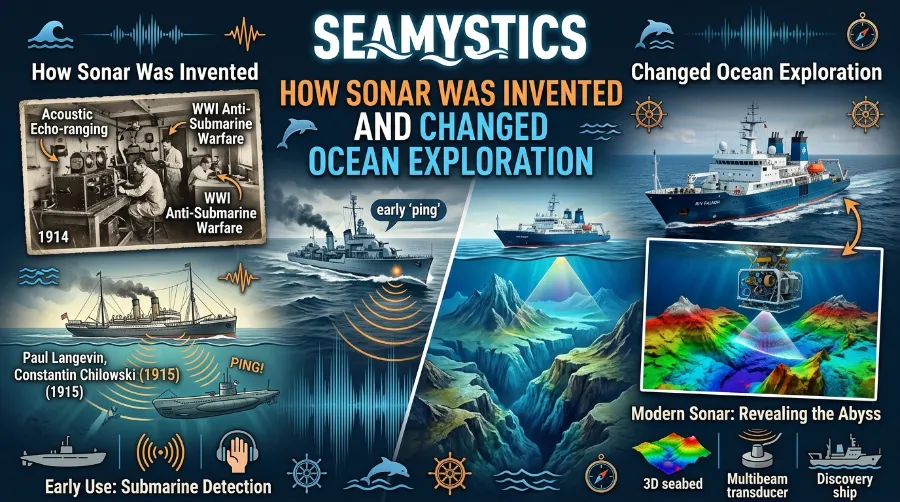
Sonar also changed how divers approached wreck sites. Modern shipwreck hunters now use side-scan sonar to locate a wreck’s exact position before ever getting in the water, a method covered in more depth in our piece on shipwreck salvage history. And because early diving equipment developed on a similar wartime timeline, it’s worth reading about the parallel story of the aqua-lung invention history if you want the fuller picture of how humans finally started exploring underwater directly, not just listening for echoes from the surface.
Frequently Asked Questions
Did one person invent sonar?
No. Alexander Behm patented the first echo sounder in 1913, Paul Langevin built the first working active sonar between 1915 and 1918, and Robert Boyle led Britain’s parallel ASDIC program. Credit is genuinely shared.
Why was sonar invented?
Two pressures drove it: the 1912 Titanic disaster, which pushed inventors toward iceberg detection, and World War One, which made submarine detection a matter of national survival.
What does sonar stand for?
Sound Navigation And Ranging. The term itself came later than the technology, formalized by the US Navy during WWII to match the British term ASDIC.
Is sonar still used for ocean exploration today?
Yes, extensively. Multibeam and side-scan sonar remain standard tools for seafloor mapping, shipwreck discovery, and marine habitat surveys.
Conclusion
Sonar’s invention history isn’t a tidy single-inventor story, and honestly, that’s what makes it interesting. It took a sinking ocean liner, a war nobody asked for, and physicists working an ocean apart to build a technology that eventually let humanity see the seafloor for the first time. Every modern ocean map, every shipwreck survey, and every deep-sea expedition still owes something to that first faint echo Paul Langevin’s team heard bounce back through the Channel in 1918.
References
- ETHW, “Milestones: Invention of Sonar, 1915-1918” (ethw.org)
- Mariners’ Museum and Park, “Sonar” (exploration.marinersmuseum.org)
- ThoughtCo, “The History of Sonar” (thoughtco.com)
- Wikipedia, “Echo Sounding”