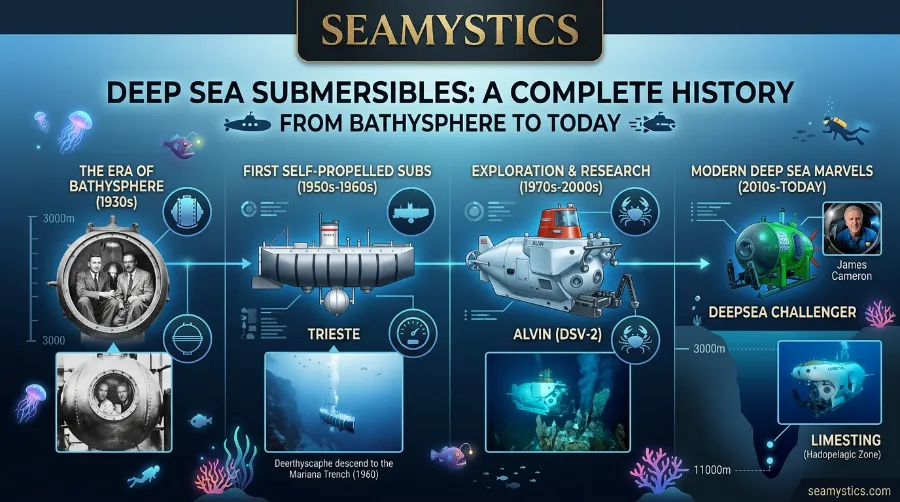

I still remember the first time I watched grainy footage of the bathyscaphe Trieste sinking into the black water of the Mariana Trench. A steel ball, two men, and seven miles of ocean pressed down on every inch of the hull. That single dive in 1960 changed what humans believed was possible underwater. In fact, it is where the real story of deep sea submersibles begins. From that hollow steel sphere to today’s titanium capsules that stream live 4K video from the seafloor, this piece walks through nearly a century of engineering, ambition, and a few very lucky survivals.
TL;DR
Deep sea submersibles evolved from William Beebe’s tethered bathysphere in 1930 into free diving bathyscaphes. Engineers then built modern crewed vehicles like Alvin, and eventually today’s titanium deep submergence vehicles. Each generation solved a different problem: first survival at depth, then mobility, then endurance and science payload capacity. Today’s fleet, mixing crewed subs, ROVs, and autonomous vehicles, has mapped less than a quarter of the ocean floor, so the history is still being written.
| Key Takeaway | Detail |
|---|---|
| First deep dive vehicle | Bathysphere, 1930, reached 1,426 feet off Bermuda |
| Deepest point ever reached | Challenger Deep, Mariana Trench, 35,853 feet |
| First humans to the ocean’s deepest point | Jacques Piccard and Don Walsh, January 23, 1960 |
| Most scientifically productive submersible | Alvin, in service since 1964, still diving today |
| Main vehicle categories | Manned submersibles, ROVs, AUVs, bathyscaphes |
| Ocean floor mapped in detail as of 2024 | Roughly 25 percent, according to Seabed 2030 |
From a Steel Ball to a Working Science Tool: Early Submersible History Timeline
Before anyone built a proper submersible, ocean depth was mostly guesswork. Fishermen and early oceanographers dropped weighted lines and hoped for the best. Eventually, engineers realized that a sealed, pressure resistant chamber could carry a person past the point where lungs and eardrums give out.
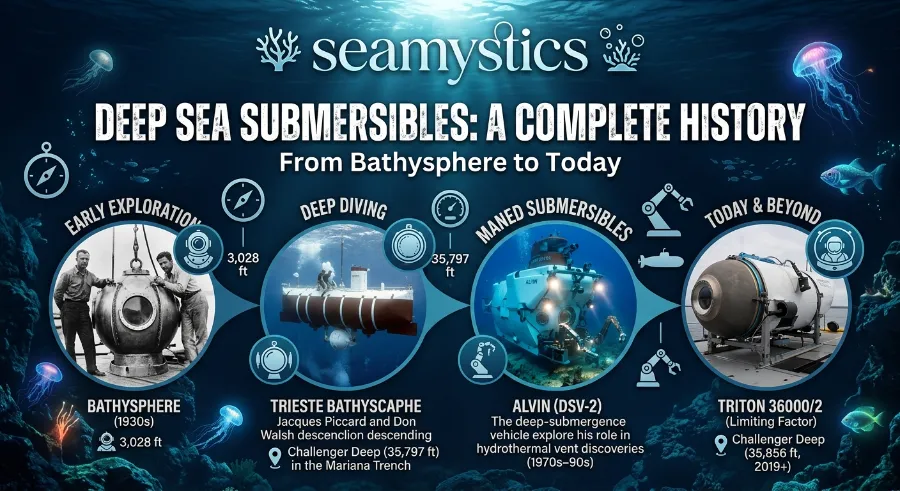
Deep Sea Submersibles A Complete History From Bathysphere to Today
The Bathysphere Invention History
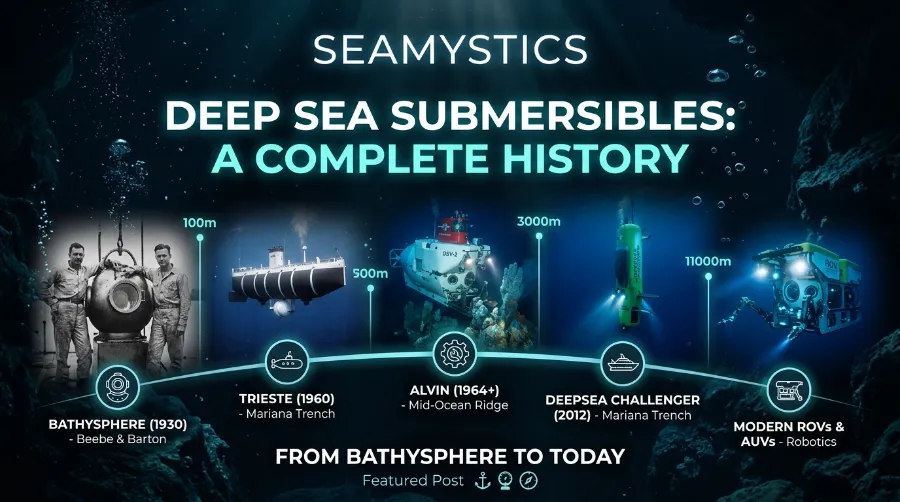
Naturalist William Beebe and engineer Otis Barton built the bathysphere in 1930. It was a hollow steel ball, about 4.75 feet across, with three small quartz windows. It had no engine and no independent power. Instead, a cable lowered it from a ship, and a hose fed in oxygen while chemicals scrubbed the air inside. On August 15, 1934, Beebe and Barton rode it to 3,028 feet off the coast of Bermuda. As a result, they became the first humans to see the deep ocean with their own eyes, rather than through a net full of dead specimens.
That dive still ranks among the most important moments in ocean science. If you want the full technical breakdown of how the design actually worked, the Escambia County Extension office has put together a solid rundown of the bathysphere and its immediate successors. It also pairs well with our own pillar piece on underwater photography history, since Beebe’s dives were also some of the earliest attempts to document the deep ocean visually.
How Diving Bells Paved the Way for Modern Submarines
Auguste Piccard and the Bathyscaphe Era
The bathysphere had one huge limitation. Because a cable tethered it to the surface, it could only go as deep and as far as that cable allowed. Swiss physicist Auguste Piccard solved this problem in the late 1940s with the bathyscaphe, a free diving vessel. A gasoline filled float handled buoyancy, and iron shot ballast let the crew surface on their own. Piccard’s design later led directly to the Trieste, the vessel his son Jacques would eventually pilot into history.
The History of Shipwreck Salvage and Treasure Hunting
The Deepest Dive Ever Made
On January 23, 1960, Jacques Piccard and US Navy Lieutenant Don Walsh climbed into the Trieste. They descended into the Challenger Deep, the deepest known point in any ocean, and reached 35,813 feet. They spent about 20 minutes on the bottom. Piccard later reported seeing a flatfish through the window, a claim marine biologists still debate today. Remarkably, no crewed vehicle returned to that exact depth for another 52 years.
Lighthouse Navigation History: How Beacons Guided Sailors for 2,300 Years
A few numbers worth sitting with:
- The pressure at that depth reaches roughly 8 tons per square inch, enough to crush most submarines instantly.
- The descent alone took nearly 5 hours.
- One of the outer window panes cracked during the dive, a detail Piccard did not mention until after they surfaced.
For a broader look at how that single dive shaped decades of deep ocean research policy, the Smithsonian Ocean portal offers a solid overview of how deep sea submersibles opened up ocean exploration as a serious scientific field.
How Sonar Was Invented and Changed Ocean Exploration
Submersible Types Explained
Not every deep sea vehicle does the same job. Instead, the industry has settled into a handful of distinct categories over time. This distinction actually matters if you follow ocean exploration news, since headlines rarely specify which type of vehicle found what.
- Manned submersibles carry a human crew inside a pressurized hull. Alvin and DSV Limiting Factor fall into this group, and they remain the gold standard for hands on sample collection.
- Bathyscaphes came before manned subs as their free diving ancestors. Most sit retired today, though they remain historically essential.
- ROVs, or remotely operated vehicles, stay connected to a surface ship by a tether while a pilot operates them from the deck. In fact, most deep sea footage on television today comes from ROVs rather than crewed vehicles.
- AUVs, or autonomous underwater vehicles, carry no tether and no pilot on board. Instead, they run pre programmed survey missions and often map large stretches of seafloor.
- HOVs, or human occupied vehicles, describes a term researchers sometimes use interchangeably with manned submersibles.
Each type trades off cost, depth capability, mission length, and crew risk differently. As a result, modern expeditions almost always deploy more than one kind together.
Underwater Archaeology Methods Explained How Sunken History Gets Recovered
Alvin: The Workhorse of Deep Sea Research
The bathysphere and Trieste proved that deep diving was possible. Alvin then proved it could be routine. Woods Hole Oceanographic Institution built Alvin in 1964, and the sub has since completed more than 5,000 dives, a number no other manned submersible comes close to matching.
Alvin’s biggest headlines:
- In 1977, scientists aboard Alvin discovered hydrothermal vents on the Galapagos Rift, along with entire ecosystems living without sunlight. This finding rewrote basic assumptions about where life can exist.
- In 1986, Alvin helped locate and photograph the wreck of the Titanic, working alongside Robert Ballard’s team.
- Engineers rebuilt Alvin in a major overhaul completed in 2021, which extended its certified depth to around 6,500 meters.
Alvin’s story also connects directly to the broader lineage of diving equipment we cover in our piece on the Aqua Lung invention history. Both stories, after all, trace back to the same era of postwar engineering ambition applied to the ocean.
The History of Underwater Photography and Filmmaking
Modern Deep Submergence Vehicles
Builders now construct submersibles from titanium rather than steel, and lithium battery packs have replaced gasoline floats. Today’s vehicles can also transmit live data to the surface. Victor Vescovo’s DSV Limiting Factor, now renamed Bakunawa, reached the bottom of all five oceans between 2018 and 2019 during a project known as the Five Deeps Expedition. Similarly, James Cameron made a solo dive to Challenger Deep in 2012 aboard the Deepsea Challenger, and the footage later appeared in documentaries and museum exhibits.
The Invention of the Aqua-Lung How Modern Diving Began
China’s Fendouzhe, meaning Striver, reached the Mariana Trench in 2020 carrying three scientists. Today it conducts regular research dives rather than one off record attempts. This shift, from record breaking stunt to routine science tool, mirrors exactly what happened with Alvin decades earlier.
Submersible History Timeline at a Glance
| Year | Vehicle | Milestone |
|---|---|---|
| 1930 | Bathysphere | First tethered deep dive, 1,426 feet |
| 1934 | Bathysphere | Record dive to 3,028 feet off Bermuda |
| 1960 | Trieste | First humans reach Challenger Deep, 35,813 feet |
| 1964 | Alvin | Commissioned, becomes primary US research submersible |
| 1977 | Alvin | Discovers hydrothermal vents on Galapagos Rift |
| 1986 | Alvin | Locates and images the Titanic wreck |
| 2012 | Deepsea Challenger | James Cameron’s solo dive to Challenger Deep |
| 2019 | DSV Limiting Factor | Completes dives to all five ocean deeps |
| 2020 | Fendouzhe | Reaches Mariana Trench with three person crew |
If you want to see how deep ocean documentation evolved alongside these vehicles, our guide on underwater photography history walks through the camera technology that let all of these discoveries actually reach an audience, not just get described secondhand.
Cold War Oceanography The Secret Race to Map the Ocean Floor
What Modern Submersibles Are Finding
Deep sea vehicles today do more than chase depth records. Instead, they run real science on a schedule. Recent expeditions using ROVs and AUVs have documented new hydrothermal vent fields, tracked whale falls over multiple years, and cataloged species no one had ever observed alive before. In fact, a single research cruise can now log more seafloor footage in one season than the entire fleet managed throughout the 1970s.
The Beagle Voyage Darwin Took How Five Years at Sea Rewrote Ocean Science
Commercial interest has grown alongside the science too. A recent piece from a watch manufacturer’s editorial team does a good job explaining why submersibles remain central to how researchers actually study the deep ocean. It frames the topic from outside the usual academic angle, which makes it a useful starting point if you are new to the subject.
FAQ
What was the first deep sea submersible? William Beebe and Otis Barton built the bathysphere in 1930, and most historians credit it as the first true deep sea submersible. Even so, it had no independent propulsion and relied entirely on a surface cable.
How deep can modern submersibles go? Vehicles like DSV Limiting Factor can reach the deepest point in any ocean, roughly 35,850 feet. What is more, they can do it repeatedly rather than as a one time record attempt.
What is the difference between a submersible and a submarine? A submarine operates independently and can return to the surface on its own power over long distances. A submersible, on the other hand, typically needs a support ship for launch, recovery, and often power or communication.
Is Alvin still in use today? Yes. Alvin remains active after its 2021 refit, and it still supports research dives for Woods Hole Oceanographic Institution and partner universities.
Why does deep sea exploration matter for marine biology? Most of the ocean floor remains unmapped. Submersibles, therefore, offer the only real way for researchers to directly observe, sample, and film ecosystems that satellites and surface surveys simply cannot reach.
Conclusion
Ninety years separate William Beebe’s steel ball off Bermuda from the titanium research vehicles diving today. Even so, the core motivation has not changed at all: people wanted to see what was actually down there. Each generation of submersible solved the problem the last one exposed, first survival, then range, then endurance, and now data quality and repeatability. What started as a single terrifying descent into the dark has become a working scientific instrument that revisits the same trench dozens of times a year. Ultimately, the next chapter of this history is probably being written right now, somewhere off a research vessel most of us will never hear about until the discovery makes headlines.
References
- Escambia County UF/IFAS Extension, “Deep Sea Submersibles,” 2023
- Smithsonian Ocean, “Deep Sea Submersibles,” Smithsonian Institution
- Spinnaker Watches, “Exploring the Abyss: The Crucial Role of Submersibles in Deep Sea Research”
- Woods Hole Oceanographic Institution, public records on the Alvin submersible program
- Seabed 2030 Project, global ocean floor mapping progress reports