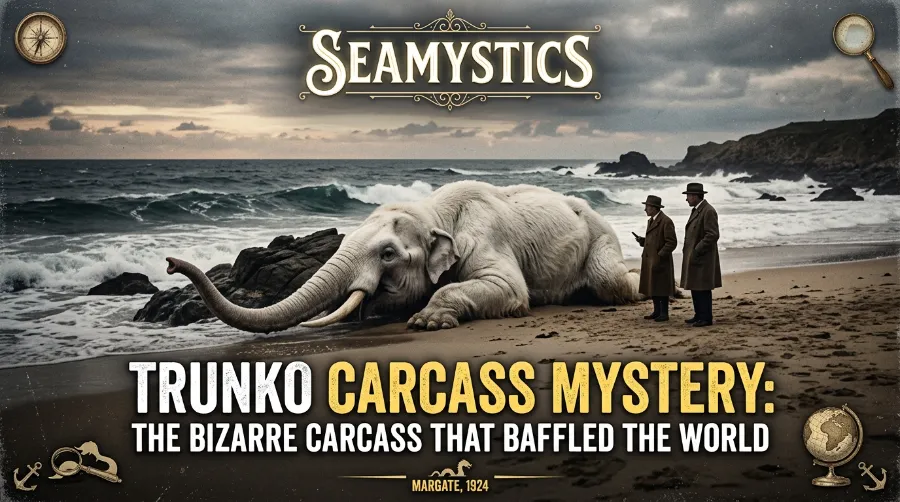

On a quiet October morning in 1924, something enormous and white washed onto a beach in South Africa. Nobody could agree on what it was. Even now, with photographs finally in hand, the Trunko carcass mystery still hasn’t fully closed. This is the strange, oddly human story of a creature nobody bothered to examine, a newspaper that ran with a headline nobody could verify, and a mystery that still teaches us something about the ocean.
Key Takeaways
| Fact | Detail |
|---|---|
| Location | Margate Beach, Natal Province, South Africa |
| Date reported | October 25, 1924 |
| First published | Daily Mail, London, December 27, 1924 |
| Reported length | Roughly 47 feet |
| Reported fur length | Around 8 inches, snow white |
| Time on beach | About 10 days before tides reclaimed it |
| Leading modern theory | Decomposed whale or basking shark, a “globster” |
| Photo rediscovery | Surfaced publicly around 2010 |
TL;DR: Trunko was a giant white, furry carcass that reportedly washed up in Margate, South Africa, in October 1924 after a violent battle with two killer whales. Because no scientist ever examined the body before the sea reclaimed it, the Trunko sea monster history survived mostly through a single newspaper article. Today, most marine biologists treat it as a decomposed whale carcass, a “globster,” though a small minority still push back on that.
What Was Trunko? A Quick Look at the 1924 Sighting
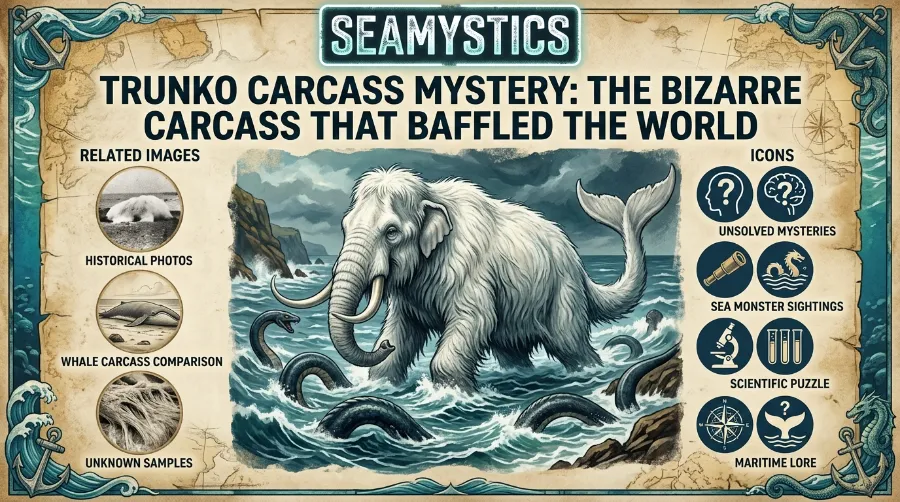
The story actually starts offshore, not on the sand. According to witnesses near Margate Beach, two killer whales were locked in a violent struggle with a much larger, pale animal roughly 1,300 yards from shore. Hugh Ballance, a local farmer and one of the few named eyewitnesses, compared the creature to “a giant polar bear” because of its thick, pale coat. After a fight that reportedly lasted around three hours, the whales finally drove the exhausted animal onto the beach, where it died.
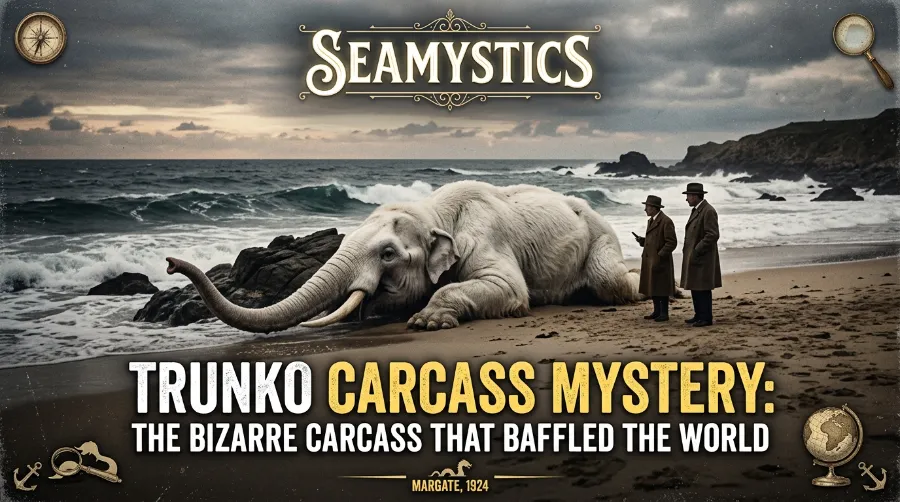
What sets this apart from a typical whale stranding is the description that followed. Once the tide dropped, locals approached the body. They described something with no clear head, no visible eyes, and a long trunk-like projection near the front, which is where the nickname eventually came from. Strangely, several accounts also mention a carcass devoid of blood, a detail that only deepened the confusion at the time.
For comparison, readers who’ve followed the Montauk Monster or the Stronsay Beast mystery will recognize the pattern instantly. A strange body appears, nobody with training reaches it in time, and a legend quietly fills the gap where a lab report should have been.
The Trunko Sea Monster History Almost Wasn’t Recorded at All
Here’s the part that frustrates researchers most. A scientist, a fisheries office, or even a local South African paper didn’t break this story first. Instead, it reached the wider world through a single article, titled “Fish Like A Polar Bear,” published in the December 27, 1924, edition of London’s Daily Mail. By then, more than two months had passed, and the tide had already carried the body away for good.
No formal survey team was ever dispatched. No tissue sample survived. And no measurement was ever taken by anyone with scientific training. Because of that two-month gap between sighting and publication, the Trunko whale identification debate has never fully settled; by the time experts heard about it, there was simply nothing left to check.
Trunko Whale Identification: What the Descriptions Actually Suggest
Eyewitness reports, even secondhand ones, aren’t useless, they’re just messy. Still, piecing together the accounts that survive, a rough physical picture starts to emerge:
- A body estimated around 47 feet long, roughly the length of two city buses parked end to end.
- Skin covered in white, hair-like material said to be about 8 inches long.
- A trunk-like appendage near the head, which some accounts compared to an elephant’s trunk.
- A tail described as lobster-like, used to strike at the attacking whales.
- No obvious eyes, mouth, or fins visible to onlookers on the beach.
Individually, none of these features points clearly to a known animal. Together, though, they read like something drawn by a committee that had only heard whales and elephants described out loud. That mismatch explains why the Trunko sea monster history spread well beyond South Africa’s coastline. Researchers still dissect it today on outlets like Karl Shuker’s Kronos Rising analysis and the long-running Strange Animals Podcast.
Why “No Photographs” Turned Out to Be Wrong
For decades, researchers accepted a simple line: no photographs of Trunko existed. Then, around 2010, cryptozoologist Karl Shuker changed that. He tracked down and published a set of period photographs that appear to show the actual carcass on Margate Beach. Rather than closing the debate, that discovery reopened it, since the images are grainy enough that both camps, the “obvious whale” side and the “genuinely strange animal” side, found something to point to.
For anyone chasing the Trunko explained science angle, this is a useful reminder. A photograph isn’t automatically a final answer.
The Stronsay Beast Mystery: Scotland’s Sea Carcass That Fooled the Experts
Trunko Explained Science: The Leading Theories
Most marine biologists who study the surviving descriptions land on one of a small handful of explanations. Honestly, the leading one isn’t very exotic at all.
- Decomposed whale carcass (“globster”). As a whale dies and drifts, blubber and connective tissue can break down into a pale, fibrous mass. Within days, this process can strip away recognizable features like a jaw, dorsal fin, or eyes.
- Basking shark decomposition. Basking sharks decompose in a famously bizarre way. Their jaws and gill structures fall away first, leaving a small “head” and a long body that can resemble something trunk-like.
- Collagen fiber mistaken for fur. What witnesses called “white fur” may actually have been exposed collagen fibers from decaying blubber. These fibers can genuinely look hair-like at a distance, especially once bleached by sun and salt water.
- Killer whale predation confirming a large marine mammal. Since orcas are known to hunt whales, particularly calves or sick individuals, a prolonged attack on a large animal fits documented orca behavior far better than an attack on some unknown species would.
None of this is a slam dunk, and that’s the honest, slightly unsatisfying truth of the Trunko carcass mystery. Without tissue, bone, or DNA, “most likely” remains the strongest claim science can responsibly make.
South Africa Sea Creature Sightings: Trunko Isn’t Alone
Over the past two centuries, South Africa’s coastline has produced more than one puzzling stranding. Setting Trunko beside its closest cousins helps explain why the globster theory carries so much weight.
| Case | Year | Location | Leading Explanation |
|---|---|---|---|
| Trunko | 1924 | Margate, South Africa | Decomposed whale or shark |
| Stronsay Beast | 1808 | Stronsay, Scotland | Decomposed basking shark |
| Montauk Monster | 2008 | Long Island, USA | Decomposed raccoon (disputed) |
| St. Augustine Monster | 1896 | Florida, USA | Collagen mass from a whale |
Notice the pattern here. Almost every “sea monster” case on this list traces back to the same culprit: decomposition doing strange things to soft tissue. For readers who enjoy this kind of pattern-spotting, the globster mystery explained guide walks through the biology in more depth. The broader deep-sea cryptids hub rounds up similar cases from around the world.
Why the Trunko Carcass Mystery Still Resonates a Century Later
Part of the appeal here isn’t really the animal itself, it’s the gap in the record. In many ways, Trunko occupies a strange middle space, too well documented to dismiss outright, yet too poorly examined to confirm. This same tension keeps cases like the Loch Ness debate and sea serpent sightings alive in public imagination, even when scientific consensus leans firmly in one direction.
There’s also a professional lesson here for anyone working in marine science. Having spent years examining stranded marine mammals along different coastlines, I can say confidently that a fresh carcass and a ten-day-old carcass barely resemble the same animal. Skin sloughs away, blubber liquefies, and once-familiar structures can end up resembling something from a completely different branch of the animal kingdom. In all likelihood, Trunko wasn’t a hoax or a new species. It was probably just biology behaving the way it always does when nobody reaches the evidence in time.
Frequently Asked Questions
What was Trunko actually believed to be?
Most marine biologists believe Trunko was a decomposed whale or basking shark carcass, a phenomenon known as a globster, rather than an unknown species.
When and where did the Trunko sighting happen?
Witnesses reported the sighting near Margate Beach in South Africa on October 25, 1924, though the story didn’t reach international papers until late December of that year.
Are there real photographs of Trunko?
Yes. Around 2010, researchers rediscovered and published photographs believed to show the actual carcass, decades after the original sighting.
Why didn’t scientists examine the carcass at the time?
Between the remote location, the slow news cycle of 1924, and a two-month delay before the story reached international papers, the body had already washed back out to sea.
How long was Trunko reportedly on the beach?
According to eyewitness accounts, the carcass remained on Margate Beach for around 10 days before the tides carried it away for good.
Test Your Trunko Knowledge
1. In what year was Trunko reportedly sighted?
A) 1908
B) 1924
C) 1956
Answer: B) 1924
2. Where did the Trunko sighting take place?
A) Cape Town, South Africa
B) Margate, South Africa
C) Durban, South Africa
Answer: B) Margate, South Africa
3. What is the leading scientific explanation for Trunko?
A) A new species of whale
B) A hoax created by fishermen
C) A decomposed whale or shark carcass
Answer: C) A decomposed whale or shark carcass
4. Roughly how long was the carcass said to be?
Eyewitnesses estimated the body at about 47 feet long.
5. What animals were reportedly attacking Trunko before it washed ashore?
Two killer whales, in a fight that reportedly lasted around three hours.
Conclusion
A century later, the Trunko carcass mystery still sits between folklore and forensic science, mostly because nobody reached the evidence while it mattered. What remains is a newspaper clipping, a handful of secondhand descriptions, and photographs good enough to argue over but not good enough to settle anything. The most likely explanation, a decomposing whale or shark twisted into something unrecognizable, isn’t as thrilling as a brand-new species. Still, it says something true about the ocean: even ordinary animals can look like monsters once nature starts taking them apart. In the end, that lesson is probably what Trunko really left behind.
References
- Daily Mail, “Fish Like A Polar Bear,” December 27, 1924.
- Karl Shuker, Kronos Rising: Trunko Analysis
- Futility Closet, Trunko
- Strange Animals Podcast, Trunko Episode Archive
- Related reading: Globster Mystery Explained, Deep-Sea Cryptids Hub, Sea Serpent Sightings