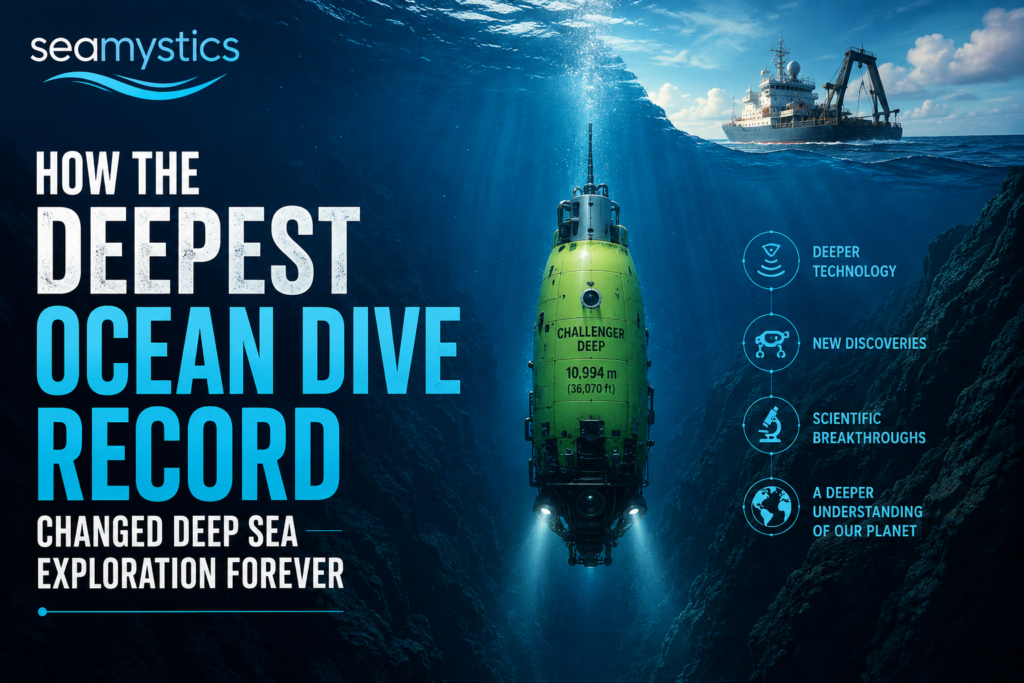

Imagine traveling farther below the sea than Mount Everest is tall. At that depth, sunlight disappears, temperatures stay just above freezing, and the pressure becomes so powerful it could crush most submarines in seconds. Yet one explorer made that journey and safely returned with discoveries that changed how scientists view the deepest parts of Earth’s oceans.
The deepest ocean dive record represents far more than a personal achievement. It marks a milestone in marine science, engineering, and deep-sea exploration. Every successful descent helps researchers learn about life in one of the least explored places on Earth. As a result, these missions continue to inspire scientists, engineers, and ocean lovers across the United States, Europe, and the rest of the world.
you read our blog about history of scuba diving
Key Takeaways
| Topic | Quick Facts |
|---|---|
| Deepest dive location | Challenger Deep, Mariana Trench |
| Maximum recorded depth | Approximately 10,935 meters (35,876 feet) |
| Record holder | Victor Vescovo |
| Dive vehicle | DSV Limiting Factor |
| Year of record-setting expedition | 2019 |
| Ocean | Western Pacific Ocean |
| Water pressure | More than 1,000 times atmospheric pressure |
| Scientific importance | Deep-sea biology, geology, engineering, conservation |
Why the Deepest Ocean Dive Record Matters
Many people think space is the final frontier. However, Earth’s oceans remain even less explored. Scientists estimate that more than 80% of the world’s ocean has not been fully mapped or studied. Because of that, every deep-sea expedition provides valuable information about marine ecosystems, underwater geology, and climate history.
Furthermore, extreme ocean environments help researchers answer important questions, including:
- How life survives without sunlight
- How earthquakes shape the ocean floor
- How deep ocean currents influence global climate
- Where rare marine species live
- How plastic pollution reaches the deepest places on Earth
Each expedition expands our understanding of a hidden world that still holds countless mysteries.
Understanding Challenger Deep
The Deepest Place on Earth
The deepest known location in the world’s oceans is Challenger Deep, located inside the Mariana Trench in the western Pacific Ocean.
This underwater trench stretches for nearly 2,550 kilometers (1,580 miles) and reaches depths greater than the height of Mount Everest. If Everest were placed inside Challenger Deep, its summit would still remain more than two kilometers below sea level.
Challenger Deep at a Glance
| Feature | Details |
|---|---|
| Ocean | Pacific Ocean |
| Region | Mariana Trench |
| Maximum known depth | ~10,935 meters |
| Temperature | 1–4°C (34–39°F) |
| Light | None |
| Pressure | About 1,100 atmospheres |
These conditions make Challenger Deep one of the harshest environments on the planet.
What Makes This Dive So Difficult?
Reaching the deepest point in the ocean requires much more than a strong submarine. Scientists must solve engineering problems that few people ever face.
The biggest challenges include:
- Crushing water pressure
- Complete darkness
- Near-freezing temperatures
- No GPS signals
- Limited communication
- Extremely long travel time
- Emergency rescue challenges
For example, every square inch of a submarine at Challenger Deep experiences roughly 16,000 pounds of pressure. Therefore, engineers build deep-diving vehicles using thick titanium pressure spheres and advanced buoyancy materials.
Who Holds the Deepest Ocean Dive Record?
Victor Vescovo’s Historic Achievement
In 2019, explorer, investor, and retired U.S. Navy officer Victor Vescovo completed the deepest solo dive ever recorded.
Using the specially designed DSV Limiting Factor, he descended to approximately 10,935 meters inside Challenger Deep.
Unlike earlier expeditions that visited the trench only once, Vescovo’s submarine completed multiple successful dives to the deepest point on Earth. This achievement demonstrated that repeat missions to the ocean’s greatest depths were possible, opening new opportunities for scientific research.
His expedition formed part of the Five Deeps Expedition, an ambitious mission to reach the deepest point in each of Earth’s five oceans.
Mission Highlights
| Achievement | Details |
|---|---|
| Explorer | Victor Vescovo |
| Dive year | 2019 |
| Dive type | Solo |
| Vehicle | DSV Limiting Factor |
| Mission | Five Deeps Expedition |
| Record depth | Approximately 10,935 meters |
| Dive duration | Around 12 hours total |
Why This Expedition Changed Marine Science
The record-breaking dive was never just about setting a world record.
Instead, scientists collected valuable information from the seafloor, including:
- Biological samples
- Rock specimens
- Sediment cores
- High-definition images
- Deep-sea water samples
- Ocean floor mapping data
Consequently, researchers gained a better understanding of biodiversity in one of Earth’s most extreme environments. Surprisingly, the expedition also revealed evidence of human pollution, including small pieces of plastic, even at the deepest known point in the ocean.
The History Behind the Deepest Ocean Dive Record
Long before modern deep-sea submarines existed, scientists dreamed of reaching the deepest part of the ocean. However, technology limited exploration for decades. Even so, a few determined explorers continued pushing the limits of engineering and human courage.
As submarine technology improved, each expedition reached greater depths and answered new scientific questions. Moreover, every successful dive inspired the next generation of ocean explorers.
The Race to Reach Challenger Deep
Early Ocean Exploration
Ocean exploration began with simple depth measurements using weighted ropes. Although these methods worked for shallow waters, they could not accurately measure the deepest trenches.
During the late 1800s and early 1900s, researchers introduced echo sounding, which used sound waves to map the ocean floor. Consequently, scientists discovered underwater mountains, valleys, and trenches that had remained hidden for millions of years.
Among these discoveries, the Mariana Trench quickly attracted worldwide attention because of its extraordinary depth.
The First Human Visit to Challenger Deep (1960)
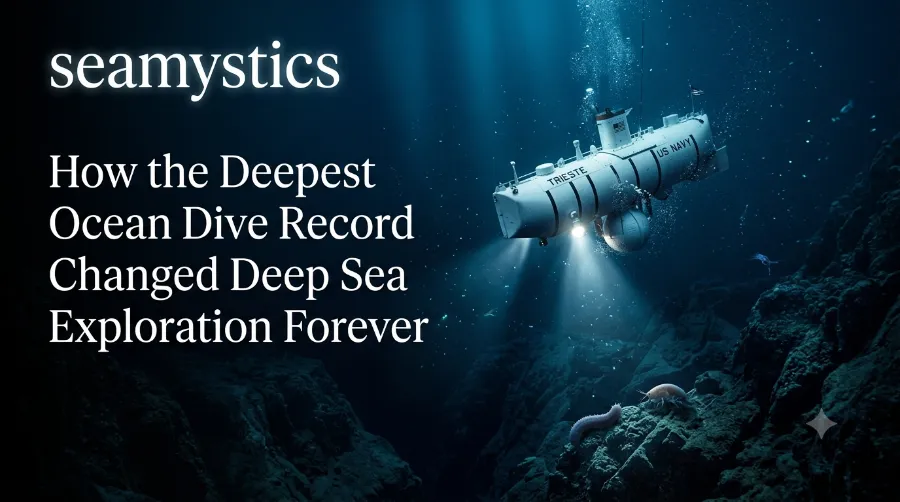
The first successful journey to Challenger Deep happened on January 23, 1960. Swiss oceanographer Jacques Piccard and U.S. Navy Lieutenant Don Walsh descended inside the bathyscaphe Trieste.
Their dive reached nearly 10,911 meters (35,797 feet), setting a record that stood for more than 50 years.
What Was the Trieste?
Unlike today’s streamlined submersibles, the Trieste looked more like a giant floating tank than a submarine.
Key features included:
- Steel pressure sphere for two people
- Gasoline-filled flotation chamber
- Thick acrylic viewing window
- Ballast system using iron pellets
- Limited scientific instruments compared with modern vehicles
Although primitive by today’s standards, the Trieste proved that humans could safely reach the deepest part of Earth’s oceans.
Challenges During the 1960 Dive
The historic mission faced several serious problems.
For example:
- One outer viewing window cracked during descent.
- Communication with the surface remained difficult.
- Visibility near the seafloor became poor because sediment rose after landing.
- The crew stayed only about 20 minutes on the bottom before beginning the ascent.
Even with these challenges, the expedition became one of the greatest achievements in ocean exploration.
Timeline of Record-Breaking Deep Ocean Dives
| Year | Explorer | Vehicle | Approximate Depth | Importance |
|---|---|---|---|---|
| 1960 | Jacques Piccard & Don Walsh | Trieste | 10,911 m | First human visit |
| 2012 | James Cameron | Deepsea Challenger | ~10,908 m | First solo dive |
| 2019 | Victor Vescovo | DSV Limiting Factor | ~10,935 m | Deepest recorded dive |
| 2019–Present | Victor Vescovo and research teams | DSV Limiting Factor | Multiple dives | Repeat scientific missions |
James Cameron’s Solo Expedition
Many people know James Cameron for directing blockbuster films. Yet he is also a passionate ocean explorer.
In 2012, Cameron became the first person to complete a solo dive to Challenger Deep.
Unlike the Trieste mission, Cameron used a highly advanced research submarine called Deepsea Challenger, designed specifically for scientific exploration.
Scientific Goals of the 2012 Dive
Rather than simply setting a record, Cameron focused on collecting valuable research data.
His team gathered:
- Deep-sea sediment samples
- Biological specimens
- High-definition 3D video
- Water chemistry data
- Geological observations
These samples helped scientists better understand deep-ocean ecosystems and the evolution of life under extreme pressure.
Comparing the Three Historic Expeditions
| Feature | Trieste (1960) | Deepsea Challenger (2012) | DSV Limiting Factor (2019) |
|---|---|---|---|
| Crew | Two people | One person | One person |
| Reusable | Limited | Yes | Yes |
| Scientific equipment | Basic | Advanced | Highly advanced |
| High-definition cameras | No | Yes | Yes |
| Repeat dives | No | Limited | Multiple |
| Mapping technology | Minimal | Modern sonar | State-of-the-art sonar |
Modern technology has dramatically improved safety, navigation, and scientific capabilities. Therefore, today’s explorers can spend more time collecting valuable information instead of simply surviving the journey.
How Engineers Built a Submarine That Could Survive
Designing for Extreme Pressure
At Challenger Deep, water pressure exceeds 1,100 atmospheres. That means every square inch of the submarine must withstand enormous force.
Engineers carefully selected materials that combine strength with reliability.
The DSV Limiting Factor includes:
- Titanium pressure sphere
- Specialized flotation foam
- Powerful electric thrusters
- High-capacity batteries
- Precision navigation systems
- Multiple safety backups
As a result, the vehicle can safely complete repeated dives to the deepest part of the ocean.
Why Titanium Is So Important
Titanium offers several major advantages:
- Exceptional strength
- Excellent corrosion resistance
- Long service life
- Lower weight than many other metals
- Outstanding performance under high pressure
Without advanced materials like titanium, repeat dives to Challenger Deep would be much more difficult.
Surprising Discoveries at the Ocean’s Greatest Depths
Scientists expected to find unusual marine life. However, they also discovered several unexpected surprises.
These included:
- Tiny shrimp-like amphipods
- Sea cucumbers adapted to crushing pressure
- Single-celled organisms called xenophyophores
- Microbial communities living without sunlight
- Plastic pollution in deep-sea sediments
These findings showed that life can survive in places once thought impossible. At the same time, they revealed how far human pollution has spread across the planet.
Deep-Sea Life Depends on Adaptation
Animals living at extreme depths cannot rely on sunlight for energy.
Instead, many species survive by feeding on:
- Marine snow (falling organic material)
- Dead animals sinking from above
- Chemosynthetic bacteria
- Organic-rich sediments
Because food arrives slowly, deep-sea organisms often grow slowly, live longer, and use energy very efficiently.
Deep-Sea Environment Snapshot
| Environmental Factor | Typical Value |
|---|---|
| Sunlight | None |
| Water temperature | 1–4°C |
| Oxygen availability | Low to moderate |
| Pressure | ~1,100 atmospheres |
| Food supply | Very limited |
| Human visitors | Extremely rare |
Dr. Rabica’s Marine Insight
As marine biologists continue exploring the hadal zone, each expedition reminds us that the deepest ocean is not an empty abyss. Instead, it is a living ecosystem filled with remarkable organisms that have adapted over millions of years. Every new dive expands our understanding of biodiversity, Earth’s geology, and the resilience of life under extreme conditions.
How the Deepest Ocean Dive Record Helps Science Today
The deepest parts of the ocean may seem far removed from everyday life. However, discoveries from these expeditions influence marine conservation, climate research, engineering, and even medicine. Every successful dive provides data that scientists can use to understand our planet more completely.
Moreover, repeat missions allow researchers to compare changes over time. This long-term approach helps identify trends that a single expedition could never reveal.
Scientific Discoveries from the Deepest Ocean
1. New Marine Species
Every deep-sea expedition increases the chances of finding species that science has never documented before. While many organisms remain under study, researchers continue to identify unique animals adapted to the hadal zone.
Common discoveries include:
- Transparent sea cucumbers
- Giant amphipods
- Deep-sea snailfish
- Xenophyophores
- Specialized microorganisms
These creatures survive without sunlight and under immense pressure, making them valuable for biological research.
2. Plastic Pollution Reaches the Deepest Ocean
One of the most surprising findings from modern expeditions is the presence of human-made pollution in Challenger Deep.
Scientists have documented:
- Plastic fragments
- Synthetic fibers
- Food packaging remnants
- Persistent chemical pollutants
This evidence shows that ocean pollution does not remain near coastlines. Instead, currents and sinking debris can transport waste to even the deepest parts of the sea.
Sources of Deep-Ocean Pollution
| Pollution Type | Possible Source | Environmental Impact |
|---|---|---|
| Microplastics | Consumer products | Enter food chains |
| Fishing gear | Commercial fisheries | Entangles marine life |
| Plastic packaging | Household waste | Long-term degradation |
| Industrial chemicals | Manufacturing | Affects deep ecosystems |
3. Better Maps of the Ocean Floor
Modern submersibles use advanced sonar systems to create detailed maps of underwater landscapes.
These maps help scientists:
- Study tectonic plate movement
- Identify underwater volcanoes
- Understand earthquake zones
- Improve navigation
- Support conservation planning
As mapping technology improves, researchers continue filling gaps in our knowledge of the global seafloor.
Why the Hadal Zone Is Unique
The hadal zone refers to ocean depths below approximately 6,000 meters (19,685 feet). It includes the deepest ocean trenches on Earth, such as Challenger Deep.
Key Features of the Hadal Zone
| Characteristic | Description |
|---|---|
| Depth | More than 6,000 meters |
| Sunlight | None |
| Temperature | Around 1–4°C |
| Pressure | Extremely high |
| Food Supply | Very limited |
| Biodiversity | Highly specialized species |
Although conditions appear hostile, life has adapted in remarkable ways. Therefore, the hadal zone remains one of the most exciting areas for marine biology.
Myths About the Deepest Ocean Dive
Many stories about deep-sea exploration circulate online. However, several popular claims are inaccurate.
Myth 1: Nothing Lives at Challenger Deep
Reality: Scientists have documented microorganisms, crustaceans, sea cucumbers, and other organisms living in this extreme environment.
Myth 2: Humans Can Never Return Safely
Reality: Modern submersibles such as the DSV Limiting Factor have completed multiple successful dives, proving that repeat missions are possible with advanced engineering.
Myth 3: Ocean Exploration Is Less Important Than Space Exploration
Reality: Ocean research contributes directly to climate science, fisheries management, biodiversity conservation, natural hazard monitoring, and new technological innovations.
Visual Chart: Major Milestones in Deep Ocean Exploration
| Year | Milestone | Scientific Impact |
|---|---|---|
| 1960 | First crewed descent to Challenger Deep | Proved humans could reach the deepest ocean |
| 2012 | First solo descent | Advanced deep-sea imaging and sample collection |
| 2019 | Deepest recorded dive | Enabled repeat scientific missions |
| 2020s | Continued repeat expeditions | Expanded mapping and biological research |
Visual Chart: Ocean Depth Comparison
| Location | Approximate Depth |
|---|---|
| Average ocean depth | 3,688 m |
| Grand Canyon (deepest point) | ~1,857 m |
| Mount Everest height | 8,849 m |
| Challenger Deep | ~10,935 m |
Perspective: If Mount Everest were placed inside Challenger Deep, its summit would still remain more than 2,000 meters below sea level.
Internal Reading Recommendations
Continue exploring marine science with these guides:
- /related-guide – How Deep-Sea Creatures Survive Extreme Pressure
- /related-guide – Mariana Trench Facts Every Ocean Lover Should Know
- /related-guide – Hydrothermal Vents and the Origin of Life
These related resources build a strong content cluster for readers interested in ocean exploration, marine biology, and deep-sea ecosystems.
Frequently Asked Questions
How deep is the deepest ocean dive ever recorded?
The deepest recorded crewed ocean dive reached approximately 10,935 meters (35,876 feet) in Challenger Deep, located within the Mariana Trench.
Who holds the deepest ocean dive record?
Explorer Victor Vescovo achieved the deepest recorded crewed dive during the Five Deeps Expedition in 2019.
Can ordinary submarines reach Challenger Deep?
No. Conventional submarines are not designed to withstand the immense pressure found at the deepest parts of the ocean. Specialized deep-submergence vehicles are required.
Why is Challenger Deep important?
It serves as a natural laboratory for studying extreme marine environments, unique organisms, geology, tectonic activity, and the effects of pollution on the deepest ecosystems.
How long does a dive to Challenger Deep take?
A complete mission, including descent, scientific work, and ascent, typically lasts around 10–12 hours, depending on the mission objectives and sea conditions.
What animals live at the deepest ocean depths?
Researchers have observed amphipods, sea cucumbers, xenophyophores, microorganisms, and several fish species adapted to survive extreme pressure and darkness.
Conclusion
The story of the deepest ocean dive record is much more than a tale of breaking records. It reflects humanity’s determination to explore the unknown and expand scientific knowledge. From the pioneering journey of Jacques Piccard and Don Walsh to the groundbreaking expeditions led by Victor Vescovo, each mission has deepened our understanding of one of Earth’s most mysterious environments.
For marine biologists, every descent offers new opportunities to study life under extraordinary conditions. For engineers, it demonstrates the possibilities of advanced design and innovation. Most importantly, these expeditions remind us that even in the deepest, darkest parts of the ocean, there is still much to discover. Protecting these fragile ecosystems will ensure that future generations can continue exploring—and learning from—the last great frontier on our planet.