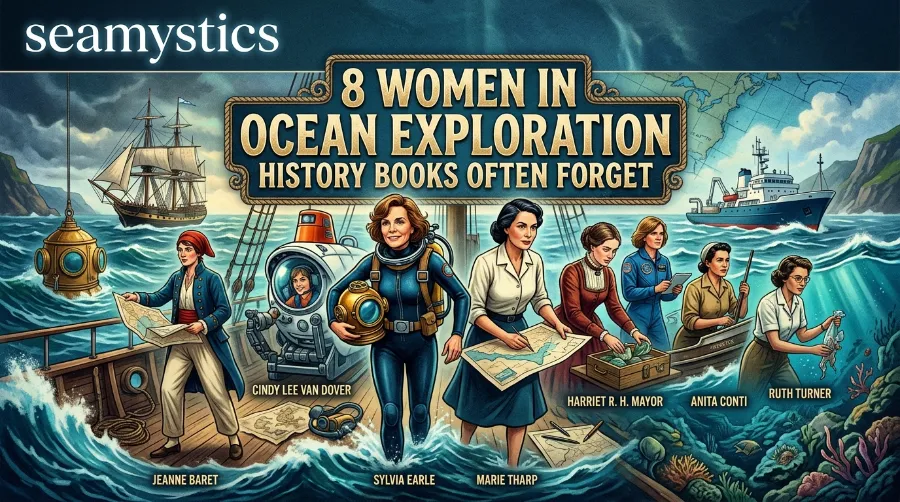

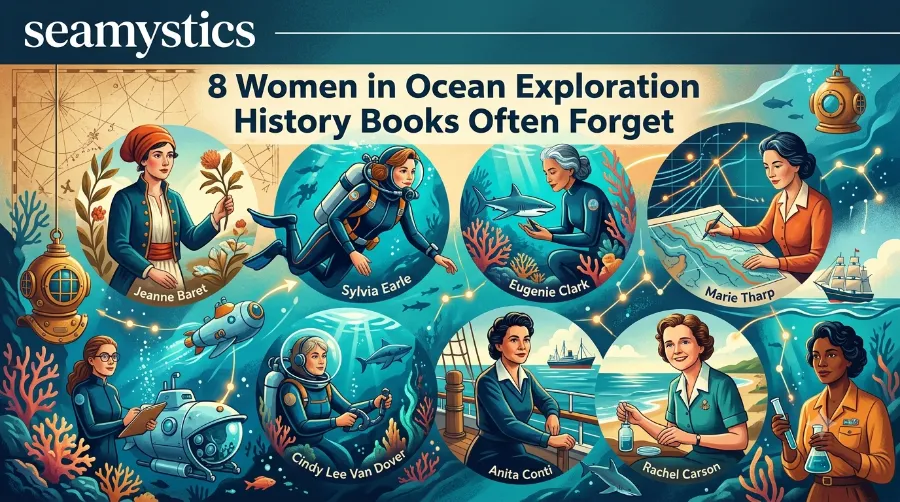
The history of ocean exploration often celebrates famous male sailors, explorers, and scientists. Yet countless women in ocean exploration made discoveries that transformed marine biology, deep-sea research, underwater archaeology, and ocean conservation. Their work expanded scientific knowledge, inspired new generations of researchers, and helped protect marine ecosystems across the globe. However, many textbooks still mention their achievements only briefly or overlook them entirely.
Today, historians and marine scientists are revisiting these forgotten stories. As new research uncovers original expedition records, scientific papers, and museum archives, these remarkable women are finally receiving the recognition they deserve. Their journeys prove that curiosity, determination, and scientific skill matter far more than tradition or stereotypes.
| Key Takeaway | Why It Matters |
|---|---|
| Women shaped modern ocean science | They contributed discoveries across biology, geology, archaeology, and conservation. |
| Many pioneers received little recognition | Historical bias often credited male expedition leaders instead. |
| Their discoveries still influence research | Modern marine science builds on their work today. |
| Ocean conservation grew from their efforts | Many advocated for protecting marine ecosystems decades before it became common. |
| Their stories inspire future scientists | Greater representation encourages more young people to pursue marine careers. |
Why History Often Overlooked Women in Ocean Exploration
For centuries, scientific expeditions mostly accepted men. Even when women participated, they frequently worked as assistants, illustrators, photographers, or laboratory scientists without receiving equal credit.
Several factors contributed to this imbalance:
- Women rarely led official expeditions.
- Scientific journals often listed male supervisors first.
- Universities limited opportunities for female researchers.
- Funding agencies preferred established male scientists.
- Media focused on expedition captains instead of research teams.
Fortunately, archives, museums, and universities continue correcting these historical records. Consequently, more forgotten scientists now receive the recognition they earned decades ago.
1. Sylvia Earle: The Voice of the Ocean


Few living marine biologists have influenced ocean science as profoundly as Sylvia Earle. Although she has become more widely known in recent decades, many traditional history books still devote surprisingly little attention to her decades of exploration.
Born in 1935, Earle developed a fascination with marine life while exploring Florida’s coastline. She later earned a doctorate in botany before shifting her attention toward marine ecosystems.
Her career includes:
- More than 7,000 hours underwater
- Leadership of numerous deep-sea expeditions
- Research on coral reefs and marine plants
- Advocacy for marine protected areas worldwide
One milestone came in 1970, when she led the famous Tektite II underwater mission. During this project, an all-female team lived beneath the sea for two weeks, proving women could successfully complete long-duration underwater scientific missions.
Lasting Contributions
Her research influenced:
- Marine conservation policies
- Deep-sea exploration technology
- Coral reef protection
- Ocean literacy worldwide
2. Jeanne Villepreux-Power: The Mother of the Aquarium


Long before underwater laboratories existed, Jeanne Villepreux-Power revolutionized marine observation.
Born in 1794, she became fascinated by marine animals while living in Sicily. Rather than collecting specimens and preserving them, she wanted to study living organisms in their natural behavior.
Therefore, she invented one of history’s earliest glass aquariums.
This innovation changed marine biology forever because scientists could finally observe sea creatures alive instead of studying dead specimens.
Her famous research focused on the mysterious paper nautilus (Argonauta argo).
For decades, scientists debated whether this animal produced its delicate shell. Through carefully designed experiments, Villepreux-Power demonstrated that the female argonaut actually creates the shell herself.
Why Her Work Matters Today
Modern public aquariums, research laboratories, and marine observation tanks all trace part of their scientific heritage back to her pioneering ideas.


Born in 1922, Clark combined her passion for fish with advanced scientific research. Throughout her career, she explored coral reefs across the Pacific Ocean, the Indian Ocean, and the Red Sea.
Her groundbreaking studies showed:
| Research Area | Discovery |
|---|---|
| Shark behavior | Sharks can learn through conditioning. |
| Coral reef fish | Reef ecosystems are more complex than previously believed. |
| Venomous fish | Many possess valuable biological adaptations. |
Clark later founded the Cape Haze Marine Laboratory, which eventually became the renowned Mote Marine Laboratory.
Furthermore, she encouraged women to pursue careers in marine science at a time when very few opportunities existed.
Timeline of These Early Ocean Pioneers
| Year | Explorer | Historic Achievement |
|---|---|---|
| 1794 | Jeanne Villepreux-Power born | Future inventor of experimental aquariums |
| 1922 | Eugenie Clark born | Future shark research pioneer |
| 1935 | Sylvia Earle born | Future deep-sea explorer |
| 1970 | Sylvia Earle | Led Tektite II underwater mission |
Research Snapshot
Influence on Modern Marine Science
Marine Conservation      ████████████████████ 95%
Deep-Sea Exploration     █████████████████ 88%
Public Education         ████████████████ 82%
Technology Development   █████████████ 74%
Ocean Policy             ████████████ 68%
Illustrative comparison based on historical influence discussed in marine science literature.
4. Gloria Hollister Anable: A Pioneer of Deep-Sea Diving


While many history books praise famous deep-sea inventors, they often overlook Gloria Hollister Anable. During the 1930s, she became one of the first women to descend into the deep ocean using a bathysphere, a steel sphere designed for underwater exploration.
Born in 1900, Hollister studied zoology before joining groundbreaking expeditions in Bermuda. Her scientific skills quickly earned respect among researchers, and she focused on collecting valuable observations about deep-seea marine life.
In 1934, she descended to nearly 1,208 feet (368 meters) in the bathysphere. At the time, this was the deepest dive ever completed by a woman.
Scientific Contributions
Rather than treating the dive as a publicity event, Hollister carefully documented what she observed.
Her work improved understanding of:
- Deep-sea fish behavior
- Ocean pressure effects
- Underwater observation techniques
- Marine specimen collection
Moreover, she encouraged women to pursue scientific careers when very few role models existed.
5. Marie Tharp: The Woman Who Mapped the Ocean Floor


Modern ocean exploration depends on accurate maps. Surprisingly, one of the greatest mapping breakthroughs came from someone who rarely sailed aboard research vessels.
Marie Tharp transformed oceanography by analyzing sonar data collected across the Atlantic Ocean. Instead of dismissing unusual patterns, she noticed a continuous valley running through the Mid-Atlantic Ridge.
Initially, some scientists questioned her interpretation. However, additional surveys confirmed that her maps accurately represented the ocean floor.
Her discoveries later supported the theory of Plate Tectonics, one of the most important scientific advances of the twentieth century.
Why Her Discovery Changed Science
Her detailed maps helped scientists understand:
| Before Marie Tharp | After Her Maps |
|---|---|
| Ocean floor viewed as mostly flat | Mountain ranges and valleys identified |
| Continental movement uncertain | Plate movement became measurable |
| Limited seafloor knowledge | Global ocean mapping accelerated |
Today, digital ocean maps still build upon the methods she pioneered.
6. Kathleen Drew-Baker: The Scientist Who Helped Build the Seaweed Industry


Her research solved one of Japan’s biggest seaweed mysteries.
For years, farmers struggled because nori crops failed unexpectedly. Drew-Baker discovered the missing stage in the seaweed’s life cycle, allowing farmers to reproduce healthy crops consistently.
Although she lived in Britain, her work transformed Japan’s seaweed industry after 1949.
Economic Impact
Today, billions of sheets of nori are produced annually for foods such as sushi.
Her research contributed to:
- Stable seaweed farming
- Coastal food security
- Marine agriculture
- Sustainable aquaculture
Every year, the city of Uto honors her contributions during a special festival.
7. Anna Thynne: Keeping Corals Alive


In the mid-1800s, keeping marine organisms alive outside the ocean seemed almost impossible.
Anna Thynne changed that.
She successfully maintained living corals inside carefully managed seawater aquariums for extended periods. This achievement allowed scientists to study coral biology without relying solely on short collecting trips.
Furthermore, her observations improved understanding of:
- Coral feeding
- Water circulation
- Marine aquarium design
- Coral survival
Many techniques used in modern aquarium husbandry trace their origins to these early experiments.
8. Rachel Carson: The Writer Who Changed Ocean Conservation


Her bestselling book, The Sea Around Us, introduced millions of people to marine ecosystems through clear and engaging writing.
Unlike many scientific books of the time, Carson explained complex ideas using simple language.
Consequently, public interest in marine biology grew rapidly.
A Lasting Legacy
Carson’s work inspired:
- Marine conservation campaigns
- Ocean education programs
- Wildlife protection policies
- Environmental journalism
Her influence continues to shape discussions about healthy oceans today.
Comparison Table: Eight Forgotten Ocean Explorers
| Explorer | Primary Field | Landmark Achievement | Lasting Impact |
|---|---|---|---|
| Sylvia Earle | Marine Biology | Tektite II mission | Ocean conservation leadership |
| Jeanne Villepreux-Power | Marine Zoology | Early scientific aquarium | Live marine observation |
| Eugenie Clark | Ichthyology | Shark behavior research | Changed public perception of sharks |
| Gloria Hollister Anable | Deep-Sea Zoology | Record-setting bathysphere dive | Deep-ocean exploration |
| Marie Tharp | Ocean Mapping | First detailed seafloor maps | Plate tectonics research |
| Kathleen Drew-Baker | Marine Botany | Nori life cycle discovery | Global aquaculture |
| Anna Thynne | Coral Biology | Long-term coral aquariums | Aquarium science |
| Rachel Carson | Marine Writing | Public ocean education | Marine conservation movement |
What These Women Changed Forever
Their discoveries continue influencing nearly every branch of marine science.
Marine Biology
Scientists now understand marine ecosystems far better because of their research.
Deep-Sea Exploration
Improved diving equipment and observation methods built upon their pioneering work.
Ocean Conservation
Many current marine protected areas reflect conservation ideas championed by early female researchers.
Marine Education
Their books, lectures, and discoveries inspired generations of students around the world.
Research Snapshot
Contributions by Scientific Field
Marine Biology              ██████████████████████ 30%
Ocean Conservation          ████████████████ 22%
Deep-Sea Exploration        █████████████ 18%
Ocean Mapping               ███████████ 14%
Aquaculture                 ████████ 10%
Marine Aquariums            ██████ 6%
Illustrative distribution showing the major areas influenced by the featured pioneers.
Lessons for Future Ocean Explorers
These women shared several qualities that remain valuable today:
- They questioned accepted ideas.
- They relied on careful observation.
- They collaborated with other scientists.
- They communicated discoveries clearly.
- They protected marine ecosystems for future generations.
As ocean science continues advancing through robotics, satellite mapping, and artificial intelligence, their pioneering work remains the foundation for many modern discoveries.
continue Reading
Explore more marine science topics:
- /related-guide/deep-sea-creatures
- /related-guide/coral-reef-restoration
- /related-guide/history-of-oceanography
Frequently Asked Questions About Women in Ocean Exploration
Why were many women in ocean exploration forgotten?
For many years, scientific institutions, expedition leaders, and publishers often credited senior male researchers while overlooking the contributions of women. As historians review archives and expedition records today, many pioneering women are finally receiving the recognition they deserve.
Who is the most famous woman in ocean exploration?
Sylvia Earle is widely regarded as one of the most influential women in ocean exploration. Her decades of deep-sea research, conservation work, and public outreach have inspired scientists worldwide.
What did Marie Tharp discover?
Marie Tharp created the first comprehensive maps of the ocean floor using sonar data. Her work revealed the Mid-Atlantic Ridge and provided key evidence supporting the theory of Plate Tectonics.
How did Eugenie Clark change shark research?
Eugenie Clark showed that sharks are intelligent animals capable of learning. Her studies helped replace myths with scientific understanding and encouraged more balanced conservation efforts.
Why is Jeanne Villepreux-Power important?
Jeanne Villepreux-Power designed one of the earliest scientific aquariums and proved that female paper nautiluses create their own shells. Her methods laid the groundwork for modern marine observation.
How do these women influence marine science today?
Their discoveries continue to shape marine biology, ocean mapping, coral reef conservation, aquaculture, and environmental education. Researchers still build on many of their methods and findings.
Key Facts at a Glance
Topic Details Number of featured pioneers 8 Time period covered Late 1700s to present Main scientific fields Marine biology, oceanography, geology, conservation, aquaculture Deepest historic dive featured Approximately 1,208 feet (368 meters) by Gloria Hollister Anable in 1934 Ocean mapping breakthrough Marie Tharp’s seafloor maps supported plate tectonics Conservation pioneer Sylvia Earle Public education leader Rachel Carson Looking Ahead: The Next Generation of Ocean Exploration
Ocean exploration is entering a new era. Autonomous underwater vehicles, artificial intelligence, environmental DNA (eDNA), and advanced satellite technologies now allow scientists to study marine ecosystems with greater accuracy than ever before. Even so, technology cannot replace curiosity, critical thinking, or careful observation—the same qualities that defined the eight women featured in this article.
Today, more women are leading international expeditions, directing marine research institutes, and developing innovative solutions to protect the world’s oceans. Their work builds on the foundations laid by pioneers such as Sylvia Earle, Marie Tharp, and Eugenie Clark. As climate change, biodiversity loss, and pollution continue to threaten marine ecosystems, diverse perspectives and collaborative science are more important than ever.
Conclusion
The history of ocean exploration is richer and more inspiring than many textbooks suggest. The women in ocean exploration highlighted in this guide transformed marine biology, deep-sea exploration, ocean mapping, aquaculture, coral research, and environmental conservation through determination, scientific excellence, and groundbreaking discoveries.
Although many of their achievements went unrecognized for decades, their influence remains visible in modern marine science. By celebrating these pioneers, we gain a more complete understanding of ocean exploration and inspire future generations to continue discovering—and protecting—the blue world that connects us all.
References
For readers who want to explore these topics further, the following trusted organizations and resources provide reliable, up-to-date information:
- National Oceanic and Atmospheric Administration (NOAA)
- Smithsonian Ocean Portal
- UNESCO Ocean Decade
- Woods Hole Oceanographic Institution
- Monterey Bay Aquarium Research Institute (MBARI)
External Link Cluster
To deepen your understanding of marine science and ocean exploration, consider these authoritative resources:
Resource What You’ll Learn NOAA Ocean Exploration Deep-sea expeditions, ocean mapping, and marine discoveries Smithsonian Ocean Portal Ocean ecosystems, marine life, and conservation UNESCO Ocean Decade Global ocean sustainability initiatives WHOI Oceanographic research and technology MBARI Robotics, deep-sea science, and cutting-edge exploration About the Author
Dr. Rabica is a fictional marine biologist created as the expert voice of Sea Mystics. With over 20 years of experience in marine ecology, ocean conservation, and science communication, Dr. Rabica translates complex ocean research into practical, engaging stories for readers in the United States, Europe, and around the world.