
A fish can sit in a jar on a museum shelf for thirty years before anyone names it. That sounds strange, but it happens often. New species confirmation is not a quick label a diver slaps on a strange creature underwater. Scientists build this process on proof, paperwork, and peer review. It can take months or even decades before a name becomes official. This article breaks down exactly how that process works, using real expeditions, real numbers, and real scientists who do this work for a living.
Table of Contents
ToggleROV Ocean Discovery The Robots Finding New Deep-Sea Species Every Year
Key Takeaways
| Point | What It Means |
|---|---|
| A sighting is not a discovery | Photos and field notes only start the process, they do not confirm a species |
| DNA plus physical traits are both needed | Genetic barcoding alone rarely counts as full proof |
| Peer review is mandatory | A named species must survive review by other taxonomists before it becomes official |
| Names must be registered | Since 2012, most electronic species descriptions must be logged in ZooBank to be valid |
| It can take decades | Some ocean specimens sit in collections for 20 to 30 years before formal description |
TL;DR: Researchers collect a specimen, then compare its DNA and body structure against every known relative. Next, they publish the findings in a peer reviewed journal and register the name through the correct taxonomic authority. Only then does a new ocean species become official. Sightings, viral photos, and even genetic hints only start the process, they do not finish it.
Citizen Science Ocean How Regular People Are Finding New Species
What New Species Confirmation Really Means
People often assume a species becomes “discovered” the moment a diver or a robotic camera spots something odd. That moment only starts the story. New species confirmation is the formal scientific step where researchers prove an organism is genetically and physically distinct from every other known species on record.
The Ocean Census Project Inside the Global Hunt for New Marine Life
This distinction matters because oceans hide countless look alikes. Two fish can look nearly identical to the human eye. Yet they can belong to entirely different species once their DNA reveals the truth. Because of this, taxonomists never trust appearance alone. They combine several types of evidence before they even draft a formal description.
So while a headline might announce “scientists discover new species,” the real confirmation usually happens later. It often unfolds in a lab far from the ocean, months or years after someone first spotted the animal.
DNA Barcoding Species How Scientists Prove a New Species Is Real
The Species Verification Process, Step by Step
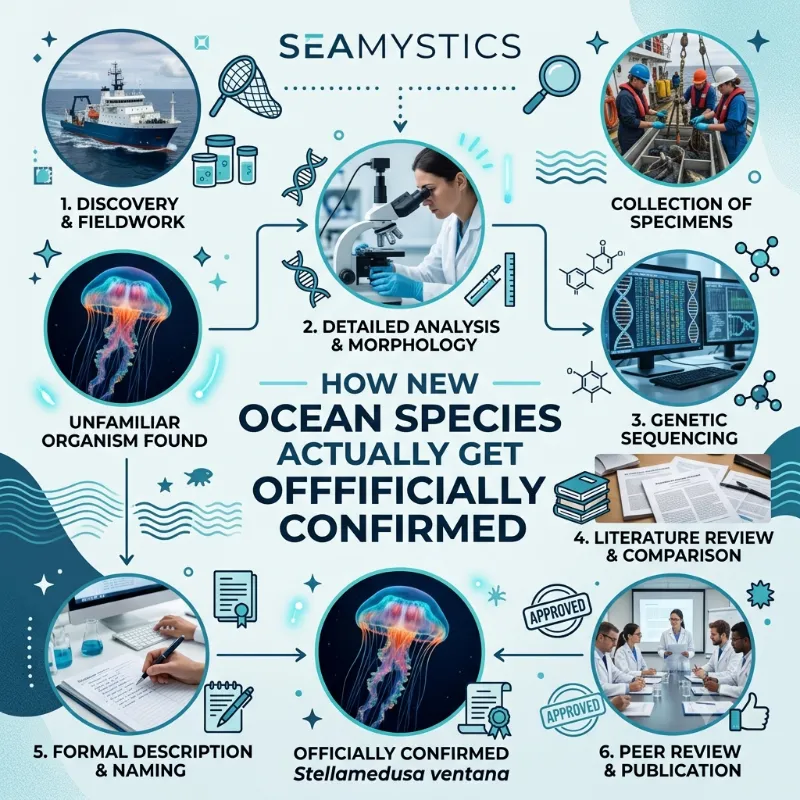
The species verification process follows a fairly consistent path across most research institutions. This holds true whether the team works off the coast of Brazil or inside a museum basement in California. Here is how it typically unfolds.
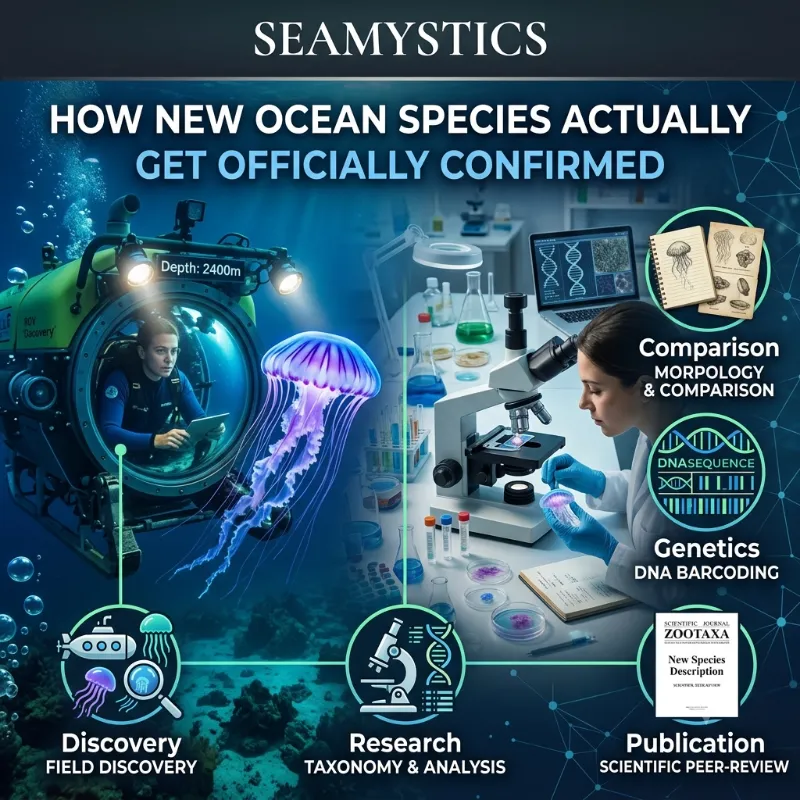
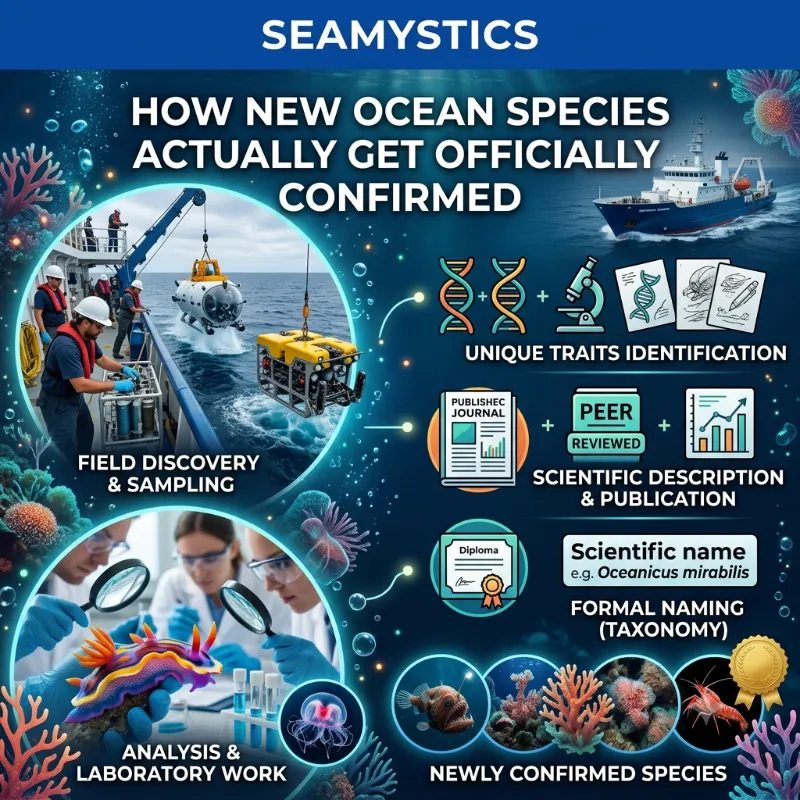
- Field collection and first observations. A team collects a specimen, photographs it, and tags it with depth, location, and date. Sometimes researchers only take DNA samples instead of the whole organism, especially for fragile deep sea creatures.
- Genetic barcoding. Scientists extract a short DNA sequence, usually from the COI gene. They compare it against global genetic databases such as GenBank and BOLD Systems to check for a match with a known species.
- Morphological comparison. Researchers study body shape, coloring, fin structure, scale counts, or shell patterns under a microscope. They compare these traits with museum specimens of related species.
- Peer review and publication. The team writes up the findings as a formal paper and submits it to a scientific journal. Independent taxonomists then check the evidence before they approve publication.
- Naming and registration. Once the journal accepts the paper, the team gives the species a scientific name following strict naming rules. For animals, they typically register the name in ZooBank, the official registry recognized by the International Commission on Zoological Nomenclature.
Each step alone can take weeks. Put them together, and you can see why a full new species confirmation often takes far longer than the public expects.
Step 1: Field Collection and First Observations
This part gets attention on social media, the moment a strange creature appears on camera. A photo or video rarely settles the question, though. Researchers need a physical specimen, a tissue sample, or extremely sharp footage that shows key features clearly.
Rediscovered vs New The Difference Between a Lost Species and a New One
For example, researchers boarded the Schmidt Ocean Institute’s research vessel Falkor (too) off the coast of Brazil in June 2026. They used advanced imaging tools, including a shadowgraph camera and non invasive laser scanning systems, to capture living midwater organisms without harming them. The team combined imaging systems with genetic analysis and confirmed new midwater species within days, a task that normally takes decades. That single trip flagged 31 potential new species for formal description. EcomagazineSevenseasmedia
Step 2: DNA Barcoding and Genetic Comparison
Once a team collects a sample, scientists extract its DNA and run it through a barcoding process. This step compares the organism’s genetic code against thousands of existing records to check for a close match.
If the DNA differs enough from every known relative, that signals a possible new species. Still, DNA alone rarely counts as final proof. Most journals expect physical evidence to back up the genetic data before they accept a paper describing a new species.
Step 3: Morphological Study Under the Microscope
Here is where the slow, detailed work happens. A taxonomist might spend days comparing fin ray counts, tooth shape, or the spot pattern on a sea slug against dozens of preserved museum specimens. This step often gets overlooked, yet it remains the most important part of taxonomy new species work for scientific and legal validity.
New Crustacean Species The Crabs and Shrimp Still Being Named
A striking example comes from the California Academy of Sciences. In January 2026, the Academy announced it had formally described 72 new species collected throughout 2025. One of them had sat in storage for nearly three decades. Curator Emeritus John McCosker had originally discovered a deepwater cardinalfish during a 1997 expedition to Cuba, a trip that famously included an unexpected guest, Cuban president Fidel Castro. The specimen sat quietly in a drawer for almost thirty years. Only recently did researchers formally study it and confirm it as new to science. California Academy of Sciences
This kind of story repeats often in marine taxonomy. Museum collections work like time capsules. They hold specimens that researchers correctly collected but never fully studied, sometimes for decades, until an expert with enough time finally examines them.
New Jellyfish Species Found Why Jellies Are Still Being Discovered
Step 4: Peer Review and Publication
After the team gathers its evidence, it writes a formal species description and submits it to a scientific journal. Other taxonomists, who had no role in the original research, review the paper line by line. They check whether the DNA analysis holds up, whether the physical comparisons make sense, and whether the differences justify a new name.
If reviewers find the evidence weak, they send the paper back for more work, or they reject it outright. This step protects the scientific record from rushed or shaky claims. It also explains why the species verification process takes so long.
New Coral Species Discovered What Makes Reef Taxonomy So Difficult
Step 5: Registration in ZooBank and Global Databases
For animal species, most electronic publications must register in ZooBank once a journal accepts the paper. Only then does the name become valid. According to the International Commission on Zoological Nomenclature, nomenclatural acts published in electronic publications need registration in ZooBank to be available, following a 2012 amendment to the Code that first allowed electronic publication for naming purposes. Without this registration, a name published only online may not count as official under the Code, no matter how solid the science behind it is. Iczn
Plant and fungal species follow a separate but similarly strict system under the International Code of Nomenclature for algae, fungi, and plants. Marine species also go through a cross check against the World Register of Marine Species, a global database that tracks accepted and rejected names across the oceans.
Hybrid Ocean Species When Two Marine Animals Interbreed Naturally
How Species Are Named
Once a species clears verification, researchers choose a scientific name following binomial nomenclature, the two part naming system Carl Linnaeus popularized centuries ago. The first word identifies the genus. The second identifies the species itself. Scientists always write both in italics.
Names often tell a small story. For instance, the California Academy’s 2025 list included a dwarfgoby named Eviota vader. Researchers chose that name because the fish was the darkest colored member of its group, a nod to the Star Wars villain. Another new fish, Plectranthias raki, borrowed its name from the Dhivehi word for shy, since the fish avoided divers and cameras during the Maldives expedition where the team found it.
Researchers must follow a few firm rules when they name a species:
- The name cannot already belong to another organism in the same group.
- It must follow correct Latin or Latinized form.
- It must appear alongside a formal description and a designated type specimen, usually called a holotype.
- It must cite the original published source, known as its authority citation.
These rules exist so scientists anywhere in the world, whether in Germany, Japan, or Brazil, can look up a name and know exactly which organism it refers to, with zero confusion.
New Species Criteria Scientists Actually Use
Not every unusual looking creature qualifies as new. Marine biologists rely on a fairly consistent set of new species criteria before they put a name on paper. These usually include the following:
- Clear and consistent genetic differences from all known relatives.
- Measurable physical differences, such as size, coloring, or skeletal structure.
- A distinct geographic range or habitat that separates the population from close relatives.
- Behavioral or ecological differences, when researchers can document them.
- Agreement among multiple independent lines of evidence, not just one test.
If a specimen only shows a slight color variation with no genetic backup, most taxonomists treat it as a regional variant rather than a separate species. That caution keeps the scientific record trustworthy, even when it slows down headlines.
Taxonomy New Species: Why the Tree of Life Keeps Growing
It might seem like humans should have already catalogued most ocean life by now. That assumption misses the mark by a wide margin. Scientists estimate that more than 90 percent of the species on our planet have yet to be discovered, and the ocean holds a huge share of that unknown diversity. Deep and midwater zones remain especially hard to reach without specialized equipment. California Academy of Sciences
This is why taxonomy new species work keeps expanding rather than slowing down. Better cameras, faster genetic sequencing, and remotely operated vehicles now let teams explore places that were simply out of reach fifteen years ago.
Real Examples of Recent Ocean Species Confirmation
Numbers help more than vague claims, so here is a direct comparison of three recent expeditions and how their new species confirmations played out.
| Expedition | Year | Species Confirmed | Notable Detail |
|---|---|---|---|
| Schmidt Ocean Institute, Brazil | 2026 | 31 new midwater species | Confirmed in about two weeks using onboard genetic sequencing and imaging |
| California Academy of Sciences, global | 2025 | 72 new species across six continents | Included a cardinalfish specimen collected in 1997 and studied nearly 30 years later |
| Conservation International, Bolivia | 2017 | 20 new species in Zongo Valley | Included a snake, a frog, and several butterflies found during a 14 day expedition |
Look closely at this pattern and you will notice something. The number of confirmed species depends less on how remote the location is. It depends more on how much lab time and expert review the team gets afterward. A short field trip, like the Brazil expedition, can still produce a large batch of confirmations when onboard technology speeds up the genetic work.
How the Numbers Compare Over Recent Years
Here is a simple breakdown of how many new species the California Academy of Sciences confirmed over the last few years.
| Year | New Species Described by California Academy of Sciences |
|---|---|
| 2023 | 153 |
| 2024 | 138 |
| 2025 | 72 |
The drop in 2025 does not mean discoveries slowed down. It usually reflects how many specimens researchers had time to fully verify and publish that year. Confirmation, not discovery, remains the real bottleneck.
A Marine Biologist’s Field Perspective
I have spent years on collection boats where the most exciting find of the trip was not a strange new organism. It was finally getting lab time to check a jar that had sat untouched for two field seasons. Outsiders rarely see that waiting game. A tiny sea slug can look identical to five other species in the field. Only a proper genetic comparison back at the lab settles the question.
One thing surprises newer researchers often. A “new species” often turns out to be something a team collected years earlier and simply never studied. That is exactly what happened with the 1997 Cuban cardinalfish specimen, and it happens more than people assume in marine science. Collections hold quiet discoveries that wait for someone with the right expertise and enough hours in the day.
If you want to go deeper into how researchers plan these collecting trips, our guide on /deep-sea-exploration-guide walks through the equipment and logistics involved. For readers who want the basics of classification before diving into naming rules, /marine-taxonomy-basics offers a good starting point. Our /ocean-conservation-guide also explains why documenting new species matters for protecting habitats before they disappear.
Why This Process Matters for Conservation
New species confirmation is not just an academic exercise. Once a species gets a formal name, researchers can assess its conservation status, include it in environmental policy, and track its population over time. An undescribed species has essentially no legal protection, no matter how rare or threatened it might be.
This is part of why expeditions like the one in Bolivia’s Zongo Valley carry weight beyond their species counts. During that trip, researchers identified a total of 1,204 species in the valley, 20 of which were completely new to science, alongside several species that had not been seen for decades. Confirming those species officially opened the door for local conservation groups to push for protected status in the region. Conservation International
For readers who want a broader look at how scientists prioritize which ocean regions to explore first, the World Register of Marine Species keeps an updated public database that anyone can search by name, region, or taxonomic group.
Common Mistakes People Make About New Species
A few misunderstandings come up again and again when this topic goes viral online. Clearing these up helps set realistic expectations about how science actually works.
- People assume a photo alone counts as proof, but physical or genetic evidence almost always matters more.
- People believe DNA differences alone settle the question, but body structure comparisons still play a key role.
- People expect instant naming, but peer review can take months even after strong evidence arrives.
- People confuse “newly discovered” with “newly confirmed,” yet these can sit years apart for the same specimen.
Understanding these points helps explain why some headlines say “scientists find new species” while the actual scientific paper does not appear until a year or two later.
Frequently Asked Questions
How long does it take to officially confirm a new ocean species?
It varies widely. Most confirmations take anywhere from several months to a few years after the specimen is first collected, mainly because of the lab work and peer review involved.
Can a species be confirmed using DNA alone?
Rarely. Most scientific journals expect both genetic evidence and physical trait comparisons before they accept a new species description. DNA alone can sometimes mislead researchers due to natural variation within a species.
Who decides if a name is official?
For animals, the International Commission on Zoological Nomenclature sets the rules. Names published electronically generally need registration in ZooBank to count as valid under the Code.
Why do some specimens sit unstudied for decades?
Museums and research institutions often collect far more specimens than they can study right away. Many wait years for a qualified taxonomist with the right specialty and time to examine them.
Does a new species automatically get legal protection?
No. Formal naming stays separate from conservation status. A species must go through a separate assessment, often through the IUCN Red List, before it receives any protected status.
Conclusion
New ocean species confirmation moves slower and follows stricter rules than the quick headlines suggest. It takes genetic testing, physical comparison, careful peer review, and formal registration before a creature earns an official scientific name. A cardinalfish can wait thirty years in a drawer, while a midwater organism can gain confirmation within two weeks using cutting edge imaging. Either way, the underlying process stays the same at its core. Understanding these steps gives you a much clearer picture of why ocean biodiversity research moves the way it does. Every confirmed species represents months, sometimes years, of careful scientific work behind the scenes.
References
- Schmidt Ocean Institute, “Researchers Discover 31 New Species in the First Two Weeks of Deep-Sea Exploration Journey,” ecomagazine.com, 2026. https://ecomagazine.com/news/research/researchers-discover-31-new-species-in-the-first-two-weeks-of-deep-sea-exploration-journey/
- California Academy of Sciences, “California Academy of Sciences Describes 72 New Species in 2025,” January 2026. https://www.calacademy.org/press/releases/california-academy-of-sciences-describes-72-new-species-in-2025
- Conservation International, “Trove of New Species Discovered in Hidden Bolivian Valley.” https://www.conservation.org/news/trove-of-new-species-discovered-in-hidden-bolivian-valley
- International Commission on Zoological Nomenclature, “Frequently Asked Questions.” https://www.iczn.org/outreach/faqs/
- World Register of Marine Species, WoRMS Editorial Board. https://www.marinespecies.org/