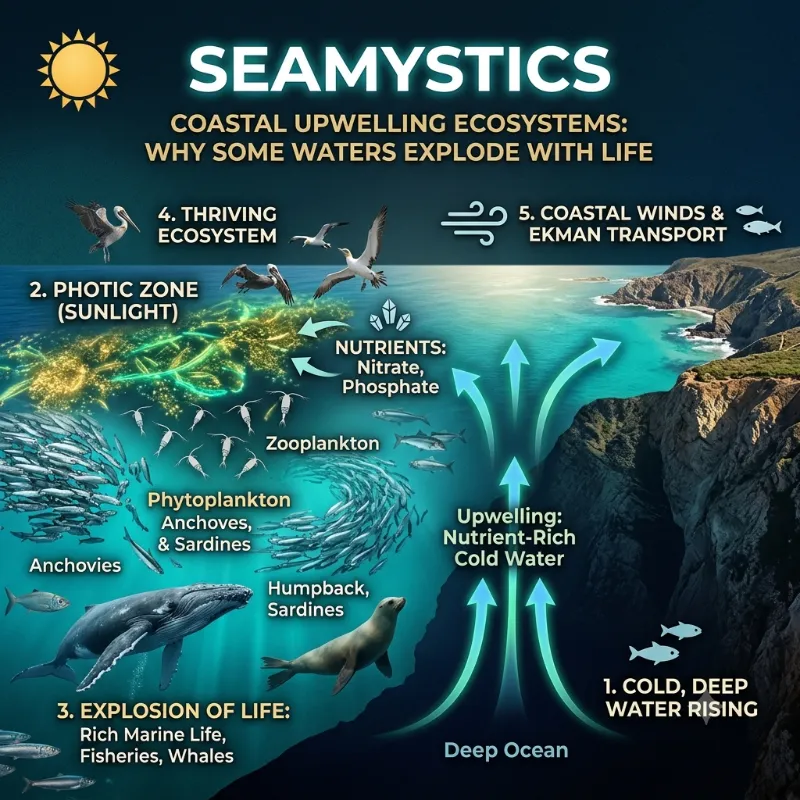

Off the coast of Peru, a narrow strip of ocean produces roughly one out of every ten anchovies caught anywhere on Earth. That fact stunned me the first time I saw the data. I was on a research trip along the Humboldt Current at the time. The water looked unremarkable from the boat deck, gray and cold. Yet beneath the surface, it was one of the busiest food factories on the planet. This is the strange magic of a coastal upwelling ecosystem. Deep, nutrient-loaded water rises to meet sunlight, and life explodes as a result. That chain reaction eventually reaches whales, seabirds, and dinner tables across the globe.
Abyssal Plain Ecosystem What Lives on the Ocean’s Flattest Floor
Coastal upwelling does not get the same attention as coral reefs. Still, it quietly feeds a huge share of the world. In this guide, I will explain how upwelling works. I will also show why it makes certain coastlines so rich, and what climate change means for their future.
Key Takeaways
| Point | Why It Matters |
|---|---|
| Coastal upwelling brings cold, nutrient rich deep water to the sunlit surface | This fuels phytoplankton blooms, the base of the entire marine food web |
| Eastern boundary upwelling systems cover under 2% of the ocean surface | Yet they generate about 7% of global primary production and over 20% of global fish catches |
| The Humboldt Current off Peru supplies close to 10% of the world’s anchovy catch in strong years | Small pelagic fish here support fishmeal and aquaculture industries worldwide |
| Wind, not warmth, drives the process | Persistent coastal winds combined with Earth’s rotation push surface water offshore and pull deep water up |
| Upwelling is shifting under climate change | Some regions may see stronger, longer upwelling seasons while others face disruption and harmful algal blooms |
TL;DR: A coastal upwelling ecosystem forms when wind pushes surface ocean water away from shore. Cold, nutrient rich water then rises from the depths to replace it. That nutrient boost drives some of the most productive fisheries on Earth, including the Humboldt, California, Benguela, and Canary Current systems. Climate change is now reshaping when and how strongly this upwelling happens.
What Is a Coastal Upwelling Ecosystem?
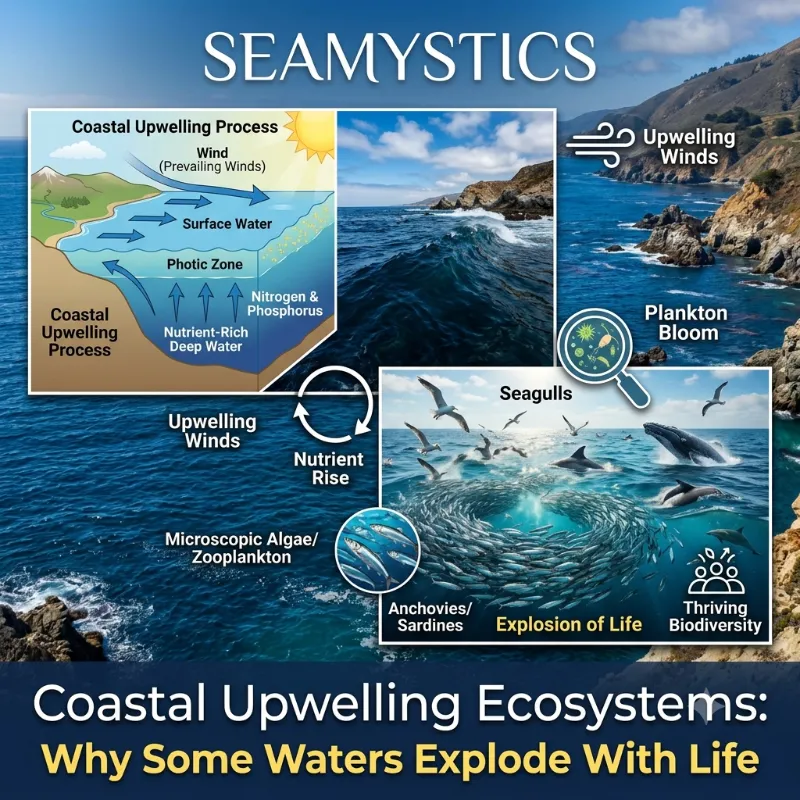
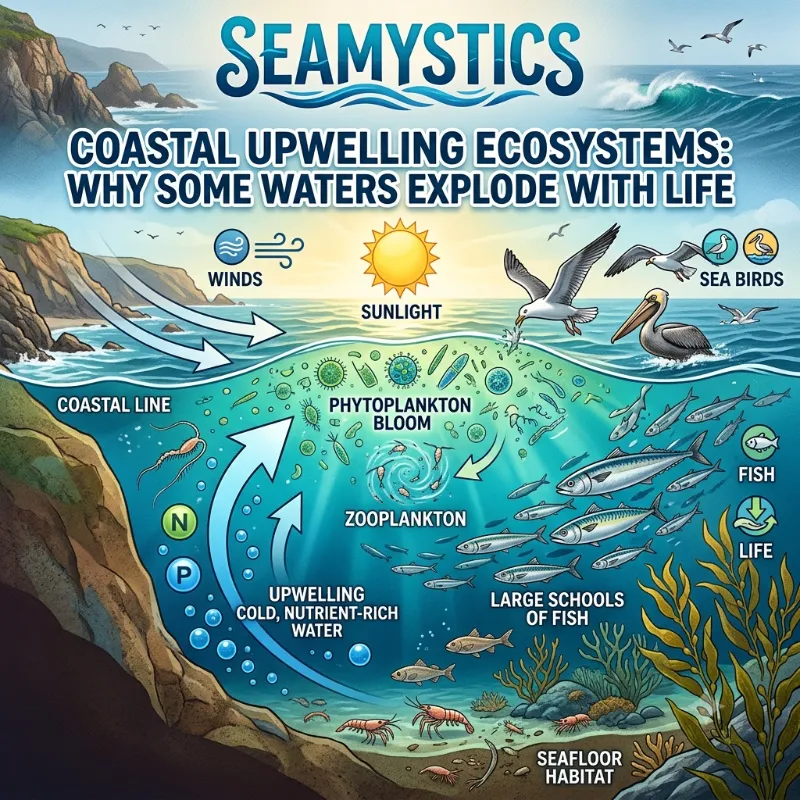
A coastal upwelling ecosystem forms where deep ocean water rises to the surface. As it rises, it carries nutrients that would otherwise stay locked away in the dark. Surface ocean water usually lacks the nitrogen and phosphorus that phytoplankton need to grow. Deep water, however, stays packed with these nutrients, since sinking organic matter decomposes down there for years.
When that deep water finally reaches sunlight, phytoplankton can bloom within days. Zooplankton then arrive to graze on the bloom. Small fish follow to eat the zooplankton, and larger predators follow the small fish in turn. This chain reaction explains why coastal upwelling zones rank among the most productive waters on the planet. It is also the foundation of what marine scientists mean by ocean upwelling explained in simple terms.
How Wind and Rotation Trigger Upwelling
Coastal upwelling relies on a mechanism called Ekman transport. As wind blows steadily along a coastline, it drags the surface layer of ocean water with it. Because of the Coriolis effect, though, that surface water actually moves at an angle to the wind rather than directly with it.
Along the west coasts of continents in the Northern Hemisphere, equatorward winds push surface water offshore. Deep water then rises to replace it, and the cycle repeats for as long as the wind keeps blowing. This is why upwelling season tends to follow predictable patterns tied to seasonal wind shifts, not water temperature alone.
The Major Upwelling Systems of the World
Four eastern boundary current systems dominate the global upwelling conversation. Each one has its own personality, shaped by local winds, coastline shape, and ocean currents.
| Upwelling System | Location | Notable Feature |
|---|---|---|
| Humboldt Current | Peru and Chile | Supplies up to 15% of the world’s fish catch and about 50% of global fishmeal production |
| California Current | US West Coast | Studied closely through NOAA’s annual ecosystem status reports |
| Benguela Current | Southwestern Africa | One of the strongest and most stable upwelling systems globally |
| Canary Current | Northwest Africa and Iberia | Feeds major fisheries off Morocco, Mauritania, and Portugal |
Together, these eastern boundary current systems cover less than 2% of the global ocean surface, yet contribute roughly 7% of the world’s primary production and more than 20% of global fish catches. That is an enormous return from a tiny sliver of ocean. As a result, fisheries scientists watch these regions closely, as shown in this overview of ecological transitions in coastal upwelling systems.
Nutrient Upwelling Ocean: The Engine of Marine Productivity
Nutrient upwelling in the ocean is really a recycling story. Nitrogen, phosphorus, and silica sink from the surface as dead organisms and waste. Over time, they accumulate in deep water. Upwelling then returns those nutrients to where sunlight can put them to use again.
Without this recycling, surface waters in many coastal regions would look almost as barren as the open ocean gyres. Those gyres are famous for clear water and low biodiversity. Instead, upwelling zones stay stocked with raw nutrients almost year round during active upwelling season.
From Deep Water to Dinner Plate: The Food Chain
The path from a nutrient molecule to a fish on a plate is shorter here than almost anywhere else in the ocean. Here is roughly how it unfolds:
- Deep water rich in nitrogen and phosphorus rises to the sunlit surface layer.
- Phytoplankton bloom rapidly, sometimes within days.
- Zooplankton, including krill and copepods, graze on the bloom.
- Small pelagic fish, such as anchovy and sardine, feed heavily on zooplankton.
- Larger predators, from tuna to seabirds, feed on those small fish.
This short, efficient food chain is a major reason upwelling ecosystems produce so much usable biomass. For example, a 2025 NOAA assessment of the California Current found that strong upwelling kept the ecosystem healthy, even during a major marine heatwave. As a result, juvenile salmon, young rockfish, and anchovy all flourished in the productive conditions. Consequently, commercial landings on the West Coast that year came in about 25 percent higher than in 2024, a year that had recorded the lowest total landings since the 1980s. NOAA FisheriesNOAA Fisheries
Upwelling Marine Productivity in Numbers
Numbers make upwelling marine productivity easier to picture. Global ocean models estimate that coastal and equatorial upwelling regions reach net primary production of about 400 to 500 milligrams of carbon per day per cubic meter. This is among the highest values recorded anywhere in the open ocean. NOAA Ecowatch
That productivity, however, does not spread out evenly. Instead, it concentrates along specific coastlines shaped by wind patterns and shelf geography. This explains why a handful of upwelling zones punch so far above their geographic weight.
| Metric | Approximate Value | Source Context |
|---|---|---|
| Share of global ocean surface covered by eastern boundary upwelling systems | Under 2% | Nature Scientific Reports |
| Share of global primary production from these systems | About 7% | Nature Scientific Reports |
| Share of global fish catch from these systems | Over 20% | Nature Scientific Reports |
| Peruvian anchovy catch in 2022 | Nearly 4.9 million tonnes | ScienceDirect, FAO 2024 data |
| Share of global fishmeal from Peru’s anchovy fishery | 30% to 35% | Industry sustainability research |
These figures show why researchers describe eastern boundary upwelling systems as punching above their size. In fact, some call it the “Peruvian puzzle” of enormous fish production relative to the modest area involved. NOAA Fisheries
Upwelling Fishery Impact: Feeding Millions
The upwelling fishery impact reaches well beyond the coastal communities that fish these waters directly. Fishmeal and fish oil from these catches feed farmed fish and livestock on almost every continent. As a result, a remote current off Peru ends up linked to grocery shelves in Europe and Asia.
A few real numbers help put this in perspective:
- The Peruvian anchovy fishery alone has provided up to roughly 10% of the total global marine fish catch in strong years. NOAA Fisheries
- More than 90 percent of anchovies caught in Peru get processed into fishmeal and fish oil, rather than sold for direct human consumption. National Fisherman
- The northern Humboldt Current system delivers five to eight times higher fisheries landings per unit area than other coastal upwelling systems. NOAA Fisheries
I have spent time on Peruvian purse seiners during peak anchovy season. The density of fish schools moving beneath the boat is something photographs never quite capture. Local fishers talk about upwelling the way farmers talk about rain, since a weak season can hurt entire fishing towns. This dependency also connects upwelling zones to other productive nearshore habitats, such as oyster reef ecosystems, which similarly rely on steady nutrient supply.
Even so, this productivity carries real economic tension. A 2026 economic study found that Peru remains one of the world’s top fishing nations. Yet millions of children in the country still face malnutrition and anemia, partly because so much of the catch leaves as export feedstock rather than local food. Researchers involved in the Humboldt Tipping project are now studying policy changes that could redirect more of that nutrition back home. National Fisherman
When Upwelling Turns Dangerous: Harmful Algal Blooms and Hypoxia
Upwelling is not purely a good news story. The same nutrient surge that fuels healthy blooms can also feed harmful algal blooms under the right conditions.
Off the northern Portuguese coast, for instance, researchers have documented how seasonal wind driven upwelling combined with river nutrient input creates conditions that favor recurring blooms of Pseudo-nitzschia, an algae genus capable of producing a neurotoxin. Similarly, along the US West Coast in 2025, NOAA scientists observed that deep water nutrients mixing with unusually warm surface water likely fostered a large toxic algal bloom. That said, the same upwelling still helped hold off the worst of a regional marine heatwave. ScienceNOAA Fisheries
Upwelling zones can also develop low oxygen patches. This happens when decomposing algae consume dissolved oxygen faster than it can be replenished. Therefore, coastal managers now track upwelling intensity alongside water quality data, rather than treating them separately. For a useful comparison, the nutrient dynamics in salt marsh ecosystems show a similar balance between productivity and overload risk.
Climate Change and the Future of Coastal Upwelling
Climate change is already reshaping when and how strongly upwelling happens along major coastlines. High resolution climate modeling in Nature Communications projects an advancement and extension of the coastal upwelling season under high emission scenarios. That said, intensity changes vary considerably by region. arxiv
For the California Current specifically, modeling suggests nearshore vertical water movement could increase by around 20 percent by century’s end, driven largely by a roughly 28 percent increase in alongshore wind strength. Further offshore, however, the picture shifts, since wind curl driven processes take over instead. Nature
Meanwhile, the Humboldt Current shows its own signs of change. Long term analysis using satellite and reanalysis data found that shifts in the Pacific Anticyclone are already altering where productivity concentrates along the Chilean and Peruvian coast. Additionally, paleoclimate research using 125,000 year old sediment cores found that warmer conditions historically favored smaller, less valuable fish species. Consequently, researchers now suggest the ecosystem may be approaching a tipping point where anchovy could eventually lose ground to other species. Nature
None of this means upwelling is disappearing. Instead, it means the timing, location, and intensity of these nutrient pulses are becoming less predictable. That matters enormously for fisheries management and coastal economies planning years ahead.
How Coastal Upwelling Compares to Other Productive Ecosystems
Coastal upwelling is far from the only nutrient rich marine environment worth understanding. Comparing it to neighboring ecosystems helps clarify what makes upwelling distinct.
- Estuaries mix river nutrients with tidal seawater. This produces high productivity through a different pathway, as covered in this guide to estuary ecosystems.
- Tide pools, meanwhile, concentrate biodiversity in small, tidally exposed pockets rather than across open coastal water. This is explored further in this tide pool ecosystem guide.
- Polar oceans experience seasonal nutrient pulses tied to ice melt, not persistent coastal wind. That contrast is detailed in this look at polar ocean ecosystems.
- Deep sea coral communities and seamounts, in turn, rely on very different nutrient delivery mechanisms entirely. These are discussed in these guides to deep sea coral ecosystems and seamount ecosystems.
Each of these systems shows that ocean productivity has more than one recipe. Coastal upwelling simply happens to be one of the most powerful and geographically concentrated versions of it.
Frequently Asked Questions
What causes a coastal upwelling ecosystem to form?
Persistent coastal winds combine with the Coriolis effect to push surface water away from shore. As a result, deep, nutrient rich water rises to replace it.
Why are upwelling zones so important for fisheries?
They supply nutrients that fuel phytoplankton blooms. In turn, these blooms support short, efficient food chains that concentrate biomass into small pelagic fish like anchovy and sardine.
Is coastal upwelling affected by climate change?
Yes. Research shows upwelling seasons may lengthen or shift in some regions. However, intensity changes vary by location and local wind patterns.
Can upwelling cause harmful algal blooms?
It can, especially when nutrient rich upwelled water mixes with warm surface conditions. This combination creates an environment where toxic algae can multiply quickly.
Which is the most productive upwelling system in the world?
The Humboldt Current off Peru and Chile is generally considered the most productive. It historically supplies a large share of the global fish catch relative to its size.
Conclusion
Coastal upwelling ecosystems prove that some of the ocean’s most impressive productivity comes from a fairly simple process. Wind pushes water, and deep nutrients rise to meet the sun. From the anchovy schools off Peru to the salmon and rockfish along the US West Coast, these systems quietly support fisheries, economies, and food supplies far beyond their coastlines. As climate patterns keep shifting wind strength and seasonal timing, understanding upwelling has become less of an academic curiosity and more of a practical necessity for anyone who cares about the future of ocean food systems.
References
- NOAA Ecowatch, Upwelling Thematic Overview
- The Oceanography Society, Ecological Transitions in a Coastal Upwelling Ecosystem
- UC Davis Marine Science, Upwelling Blog
- NOAA Fisheries, “Upwelling Fueled Productive West Coast Ocean, Holding Warm Waters Offshore in 2025”
- Nature Scientific Reports, “Future Changes in Coastal Upwelling Ecosystems With Global Warming: The Case of the California Current System”
- Nature Communications, “Future Changes in Coastal Upwelling and Biological Production in Eastern Boundary Upwelling Systems”
- ScienceDaily, “Tipping Point in Humboldt Current Off Peru Leads to Species Shift”
- Frontiers in Marine Science, “Toward a Solution of the Peruvian Puzzle: Pelagic Food Web Structure in the Northern Humboldt Current Upwelling System”