
A dolphin trainer in Hawaii once watched a bottlenose dolphin give birth to a calf that looked wrong. It was too big, too dark, and missing several teeth compared to a normal dolphin. In fact, that calf turned out to be one of the most famous hybrid marine species on record: a wholphin named Kekaimalu, born from a false killer whale father and a bottlenose dolphin mother. Her story is not a one off, either. Across the ocean, hybrid ocean species keep turning up in unexpected places, and warming water seems to be part of the reason why.
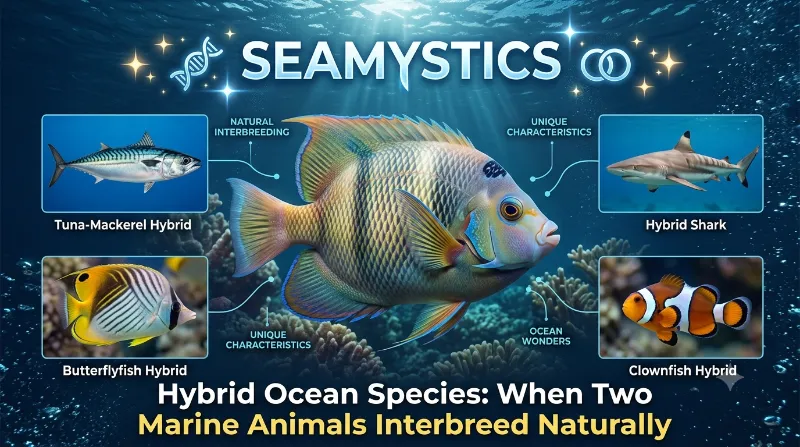
Hybrid Ocean Species When Two Marine Animals Interbreed Naturally
This growing pattern of marine species hybridization touches sharks, dolphins, corals, and fish. As a result, researchers who study new species confirmation now treat hybrids as a normal part of ocean life rather than a rare accident. That shift matters, because it changes how scientists understand adaptation, conservation, and the future shape of ocean biodiversity.
Rediscovered vs New The Difference Between a Lost Species and a New One
Key Takeaways
| Point | Summary |
|---|---|
| What it is | A hybrid marine species forms when two related but distinct species mate and produce offspring in the wild |
| Why it happens | Overlapping habitats, shrinking ranges, and warming seas push related species into closer contact |
| Best known example | The wholphin, a cross between a false killer whale and a bottlenose dolphin, first survived in 1985 |
| Shark example | Hybrid blacktip sharks were confirmed off Australia in 2012, involving 57 wild animals |
| Coral example | A naturally occurring hybrid staghorn coral is now used in reef restoration because it grows faster |
| Why it matters | Hybrids can signal climate stress, but some also show useful traits for conservation |
TL;DR: Hybrid ocean species happen when two closely related marine animals interbreed naturally, and this pattern is documented in dolphins, sharks, and corals. Scientists increasingly link it to shifting ranges and warming oceans. Some hybrids, like a fast growing coral cross, are even being used to help restore damaged reefs.
New Crustacean Species The Crabs and Shrimp Still Being Named
What Are Hybrid Ocean Species?
A hybrid ocean species is the offspring of two different but closely related marine species that mate and produce viable young. This differs from a typical new species discovery, because a hybrid carries genetic material from two known parent species rather than representing an entirely new evolutionary branch. Still, ongoing hybridization can eventually lead to new lineages, which is why marine researchers treat it as a serious part of new species confirmation work.
Ocean animal hybrids, however, are harder to spot than land based ones. Two fish, for instance, can release eggs and sperm into open water without ever touching, and the resulting larvae simply drift away before anyone notices anything unusual. Marine mammals and sharks generally need direct contact to mate, so their hybrids are rarer, but also easier to document once found.
Genetic testing is usually what gives a hybrid away. An animal might look almost identical to one species on the outside, yet carry DNA markers from a completely different one. This is exactly how scientists confirmed the Australian shark hybrids in 2012, and it is also why DNA barcoding for species identification has become a standard tool in modern marine biology.
How Marine Species Hybridization Happens Naturally
Hybridization is not random. Instead, it tends to follow a specific set of conditions that bring related species into contact and allow their reproductive systems to work together.
Genetic Compatibility Between Close Relatives
Two species can only hybridize if their chromosomes are compatible enough to combine. False killer whales and bottlenose dolphins, for example, both carry 44 chromosomes, which partly explains why their hybrid offspring can survive and, in rare cases, even reproduce. Meanwhile, species that are only distantly related almost never produce viable hybrids, no matter how much their ranges overlap.
Overlapping Habitats and Shrinking Ranges
Many hybrid ocean species form where two related species share the same stretch of coastline. The Australian blacktip shark and the common blacktip shark, for instance, both live along Australia’s eastern coast, and their ranges overlap enough for mating to occur between the species. So when one species starts moving into territory once dominated by a close relative, the odds of interbreeding go up.
Climate Driven Range Shifts
Warming water is increasingly named as a driver behind natural ocean hybrids. As sea temperatures rise, cold water and warm water species get pushed into new zones, and animals that would never have met a few decades ago now cross paths during breeding season. Researchers who found the Australian shark hybrids suggested this exact mechanism, since the hybrids were found well outside the tropical range of one of their parent species.
A few conditions, therefore, tend to line up before natural hybridization becomes common in a given area:
- Two closely related species share breeding grounds or migration routes
- Populations of one species are small enough that finding a mate of the same species becomes harder
- Water temperatures shift enough to blur historical boundaries between species ranges
- Spawning or mating seasons for both species overlap in timing
Real Examples of Natural Ocean Hybrids
Documented cases of marine species hybridization are still uncommon. Even so, the ones on record are well studied and give a clear picture of how this process plays out in the wild.
The Wholphin: A Whale and Dolphin Cross
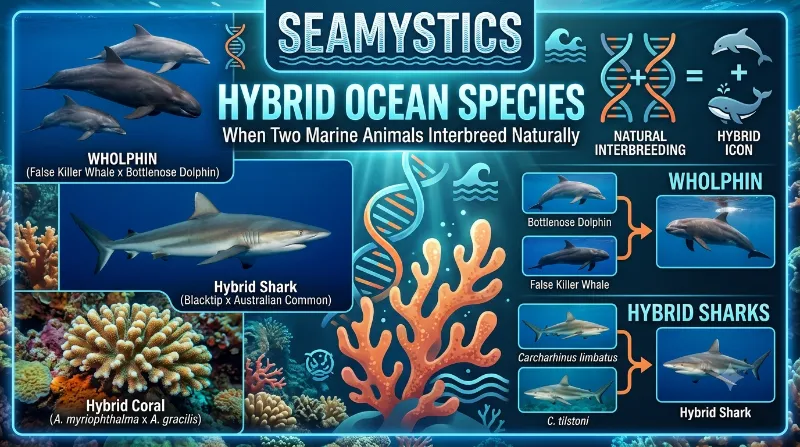
The most famous hybrid marine species in captivity is the wholphin, a cross between a male false killer whale and a female bottlenose dolphin. The first wholphin born in the United States, named Kekaimalu, arrived at Sea Life Park in Hawaii on May 15, 1985. She grew to roughly 12 feet long, a size between her two parent species, and her skin blended the light gray of a dolphin with the darker tone of a false killer whale.
What made Kekaimalu especially significant is that she was not sterile. In fact, she went on to give birth to three calves of her own, which is rare among hybrid animals generally. Her daughter, Kawili Kai, was born in December 2004 and still lives at Sea Life Park today. For a fuller account of her story and what makes wholphins unique, see this feature on the wholphin.
Hybrid Shark Species Found Off Australia
In January 2012, a team of ten Australian researchers announced the first confirmed wild hybrid shark. Working along roughly 2,000 kilometers of Australia’s east coast, from northern New South Wales to far northern Queensland, they identified 57 sharks that were genetic crosses between the Australian blacktip shark and the common blacktip shark. The two species look nearly identical but grow to different maximum sizes.
The discovery, published in the journal Conservation Genetics, stood out because wild animal hybrids are notoriously hard to find. Lead researcher Jess Morgan of the University of Queensland described the hybridization as a possible sign of range expansion, since the smaller, tropical Australian blacktip appeared able to move into cooler southern waters once mixed with its more temperature tolerant relative. Similarly, genetics expert Dr. Jennifer Ovenden, a co-author on the study, noted that other closely related shark and ray species around the world could be doing the same thing in response to changing ocean conditions.
For ongoing tracking of marine mammal and shark behavior research, resources like the Navy Marine Species Monitoring program document species interactions across different ocean regions.
Hybrid Coral: An Unexpected Tool for Reef Restoration
Coral hybridization is one of the more surprising entries on this list, mainly because the resulting hybrid has turned out to be useful. Acropora prolifera, commonly called fused staghorn coral, is a naturally occurring hybrid between two threatened Caribbean coral species: staghorn coral and elkhorn coral.
Research published by the Perry Institute for Marine Science, working with Nova Southeastern University and the University of North Carolina Wilmington, found that this hybrid coral and its fragments grow faster and show more resilience than either parent species alone. The study, conducted around Great Stirrup Cay in the Bahamas starting in 2018, is now shaping how restoration teams choose which coral to plant on damaged reefs. For the full research summary, see this piece on hybrid corals and reef restoration.
A Quick Comparison of Documented Hybrids
| Hybrid | Parent Species | First Confirmed | Location | Notable Trait |
|---|---|---|---|---|
| Wholphin | False killer whale x bottlenose dolphin | 1985 (surviving example) | Hawaii, USA | Fertile, gave birth to healthy calves |
| Hybrid blacktip shark | Australian blacktip x common blacktip | 2012 | Eastern Australia | Extended range into cooler waters |
| Fused staghorn coral | Staghorn coral x elkhorn coral | Documented in reef surveys, studied 2018 onward | Bahamas, Caribbean | Faster growth, higher resilience |
Why Marine Species Hybridization Matters for Ocean Science
Hybrid ocean species are not just a curiosity for marine biologists. Rather, they carry real implications for how scientists track biodiversity, manage fisheries, and plan conservation projects.
- Hybrids can signal that a species is under pressure, since animals sometimes cross breed when mates of their own species become scarce
- Hybridization can act as an early indicator of climate driven range shifts, as seen in the Australian shark case
- Some hybrids show hybrid vigor, meaning they grow faster or survive stress better than either parent, which is now being tested in coral restoration
- Misidentifying a hybrid as a pure species, or the reverse, can distort population counts used in conservation planning
- Ongoing citizen science ocean monitoring programs are increasingly the first to spot unusual looking animals that turn out to be hybrids
Meanwhile, the tools used to confirm these cases keep improving. Underwater surveys captured by ROV ocean discovery missions and large scale efforts like the Ocean Census Project help researchers catalog unusual specimens faster than ever before. Combined with genetic testing, this is turning hybrid detection from a rare accident into a regular part of marine fieldwork.
It is worth noting, though, that not every hybrid case ends up as good news. Some conservationists worry that hybridization between an endangered species and a more common relative could dilute the genetic traits that make the endangered species unique. This tension between hybrids as a threat and hybrids as a possible tool for resilience is still actively debated among marine scientists, and the coral restoration research is one of the few cases where hybridization has been framed as a clear benefit.
Frequently Asked Questions
Are hybrid ocean species common in the wild? No, confirmed cases are still rare. Marine mammals and sharks need direct contact to mate, which limits opportunities. However, broadcast spawning fish and corals have more chances, though confirmed natural hybrids across all ocean animals still remain a small fraction of known species.
Can hybrid marine animals reproduce? It depends on the species. Many animal hybrids are sterile, but some, like the wholphin Kekaimalu, have proven fertile and produced multiple generations.
Is climate change increasing marine species hybridization? Researchers studying the Australian hybrid sharks pointed to shifting water temperatures as a likely factor, since warming can push related species into closer contact. Even so, this link remains an active area of ongoing research rather than a settled fact.
Do hybrid corals or fish help or hurt reef ecosystems? It varies by case. The fused staghorn coral hybrid, for example, has shown clear benefits for restoration because it grows quickly and tolerates stress well. Other hybrids, on the other hand, may pose risks if they threaten the genetic identity of an endangered parent species.
Conclusion
Hybrid ocean species sit at an interesting crossroads between natural biology and a changing climate. From a fertile wholphin born in Hawaii, to hybrid sharks quietly expanding their range along the Australian coast, to a fast growing coral now used to rebuild reefs, each case tells scientists something different about how marine life adapts under pressure. As monitoring tools and genetic testing keep improving, more of these natural crosses are likely to come to light, giving researchers a clearer picture of where ocean biodiversity is headed next.
References
- Guinness World Records, “First hybrid shark,” https://www.guinnessworldrecords.com/world-records/100397-first-hybrid-shark
- Asian Scientist Magazine, “Australian Marine Scientists Discover World’s First Hybrid Sharks,” https://www.asianscientist.com/2012/01/in-the-lab/australia-world-first-discovery-of-hybrid-black-tip-sharks-2012/
- Perry Institute for Marine Science, “Hybrid Corals Could Hold the Key to Reef Restoration,” https://www.perryinstitute.org/hybrid-corals-could-hold-the-key-to-reef-restoration/
- Frontiers in Marine Science, “Should Hybrids Be Used in Coral Nurseries? A Case Study Comparing Caribbean Acropora spp. and Their Hybrid in the Bahamas,” https://www.frontiersin.org/journals/marine-science/articles/10.3389/fmars.2021.669966/full
- A-Z Animals, “Discover the Wholphin: The Amazing, Rare Hybrid Sea Animal,” https://a-z-animals.com/blog/discover-the-wholphin-the-amazing-rare-hybrid-sea-animal/
- Navy Marine Species Monitoring Program blog archive, https://www.navymarinespeciesmonitoring.us/blog/blog-archive/