
Picture a ghost shark gliding through the dark waters of the Coral Sea. Most marine biologists never see one in their entire career. Now picture scientists finding more than a thousand species like this in a single year. That is exactly what the Ocean Census project achieved. This global effort brings together taxonomists, engineers, and citizen scientists. Together, they race to document ocean life before it disappears. Because so little of the seafloor has ever been seen, every expedition uncovers something new.
Rediscovered vs New The Difference Between a Lost Species and a New One
New Jellyfish Species Found Why Jellies Are Still Being Discovered
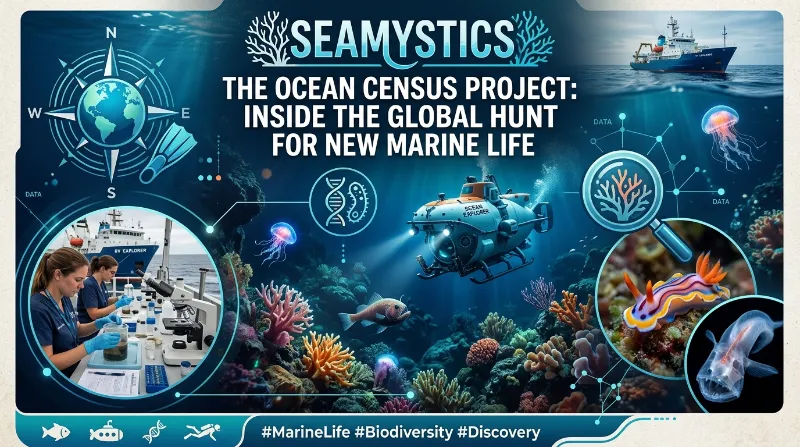
TL;DR: The Ocean Census project is the largest global effort ever launched to find new marine species. It identified 1,121 new species between April 2025 and March 2026 alone. The Nippon Foundation and Nekton lead the mission, and they combine deep sea expeditions, DNA barcoding, and citizen science to speed up discovery. Ocean Census 2026 pushed the project’s total close to 2,000 species, with a goal of finding 100,000 species within its first decade.
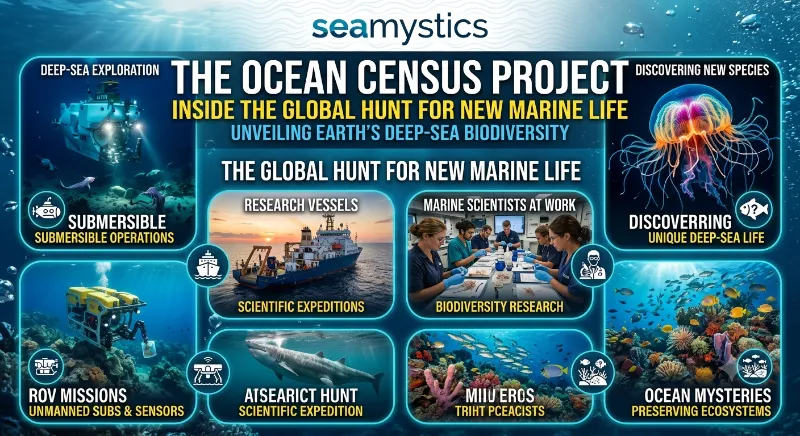
The Ocean Census Project Inside the Global Hunt for New Marine Life
Key Takeaways
| Fact | Detail |
|---|---|
| Project launch | April 2023, by The Nippon Foundation and Nekton |
| New species found (2025 to 2026) | 1,121 species across 13 expeditions |
| Previous year total (2024 to 2025) | 866 species across 10 expeditions |
| Ocean explored so far | Less than 0.001% of the seafloor directly seen |
| Species documented globally | Around 240,000, out of an estimated 1 to 2 million |
| Average identification time (old method) | Up to 13.5 years per species |
| Long term goal | 100,000 new species within one decade |
| Scientific network | Over 800 scientists from 400+ institutions |
What Is the Ocean Census Project?
The Ocean Census project is a global science alliance. It exists to speed up the discovery of marine life. The Nippon Foundation and Nekton launched it in April 2023. Today, the project also works with JAMSTEC, CSIRO, and the Schmidt Ocean Institute. Older research models worked in isolated pockets. This initiative connects taxonomists across continents instead. As a result, teams share and confirm findings much faster.
The ocean covers more than 70 percent of our planet. Yet it remains one of Earth’s least explored places. Scientists estimate that we have identified only around 10 percent of marine species so far. This gap is not a small oversight. It means millions of creatures in trenches, reefs, and open water may still lack a name.
Hybrid Ocean Species When Two Marine Animals Interbreed Naturally
Researchers have formally documented only about 240,000 marine species, while millions more likely remain undiscovered. That single fact explains why this mission exists. Our new species confirmation guide walks through how a first sighting becomes an official scientific record. GlobeNewswire
The United Nations Ocean Decade also endorses the project. This recognition places it alongside other efforts working toward global ocean literacy by 2030. Because of this support, funding and institutional backing have grown steadily since the first expedition.
Ocean Census 2026: A Landmark Year for Species Discovery
Ocean Census 2026 marks the strongest year the project has had so far. Between April 2025 and March 2026, researchers confirmed 1,121 new species. They achieved this through 13 expeditions and nine species discovery workshops. The previous 16 month period produced 866 species. So the momentum is clearly building, not slowing down.
This figure marks a 54 percent jump in annual identifications compared to the prior year. That kind of growth rarely happens by accident. It reflects stronger funding, sharper tools, and a taxonomy workflow that finally matches the pace of modern exploration. Scientific American
How the 2026 Global Species Survey Works
Every expedition under this global species survey follows a fairly consistent rhythm. Locations change, but the process stays similar. Researchers typically move through these stages:
- Field collection using divers, remotely operated vehicles, or human occupied submersibles
- Preliminary sorting on board the research vessel
- Photographic and morphological documentation
- DNA sampling for genetic comparison
- Cross checking against existing databases through the Ocean Census Biodiversity Data Platform
- Formal registration once the team confirms a specimen as new to science
This workflow moves a discovery from seafloor to scientific record much faster than before. Our guide on ROV ocean discovery methods breaks down this exact pipeline, including where delays used to happen.
Ocean Census Discoveries That Made Headlines
Some Ocean Census discoveries from this cycle read like a nature documentary. Off the coast of East Timor, researchers found striped ribbon worms. Scientists suspect these worms carry toxins with possible medical uses. Meanwhile, a team diving off Japan recovered spiky glass sponges. These sponges build their skeletons from clear silica.
New Coral Species Discovered What Makes Reef Taxonomy So Difficult
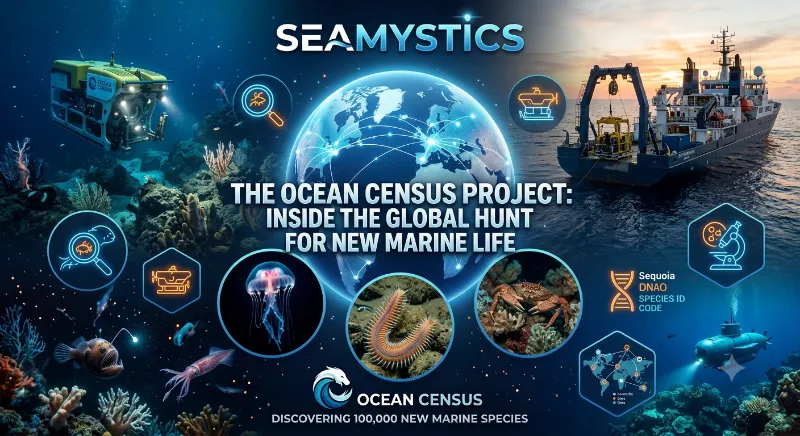
In the Coral Sea, CSIRO ichthyologist Dr William White identified a new chimaera species during a 2025 expedition. People often call chimaeras ghost sharks. This lineage split off from sharks and rays nearly 400 million years ago, before the dinosaurs existed. Finding a new member of such an ancient lineage shows how much still hides in deep water. Forbes
Further south, near the South Sandwich Islands, researchers documented a striking sea pen. They found it during a broader expedition into remote southern waters. You can view the original findings on the Ocean Census website, which updates its press materials as new discoveries arrive.
How Scientists Confirm a New Species
Finding a strange creature is only the first step. Confirming it as genuinely new takes real work. In the past, this process moved painfully slowly. Identification could take up to 13.5 years. Taxonomists worked with limited comparison data and disconnected networks, which slowed everything down.
DNA Barcoding and the Taxonomy Bottleneck
DNA barcoding has changed this process significantly. Researchers now extract a short genetic sequence from a specimen. Then they compare it against global reference libraries. This method flags likely new species within days, not years.
However, DNA barcoding does not replace traditional taxonomy. A trained taxonomist still needs to confirm body structure, coloration, and habitat context. Our article on DNA barcoding for species identification explains the exact lab steps researchers follow.
Professor Lucy Woodall leads science at Ocean Census. She has pointed out that the old system left too many species stuck in limbo. Her team built the Species Discovery step to fix this. It gives researchers a faster path to publish early findings while formal description continues.
The Role of ROVs and Submersibles
Remotely operated vehicles, or ROVs, have opened up ocean areas that human divers cannot reach safely. During the most recent expedition cycle, teams documented species from about 3 feet deep to nearly 3.1 miles down. That range spans shallow reefs and crushing deep sea trenches alike.
ROVs carry high resolution cameras and sampling arms. This lets scientists collect specimens without disturbing fragile habitats too much. Teams working from vessels like the Schmidt Ocean Institute’s Falkor (too) have run expeditions lasting over a month. One such mission spent 35 days near the South Sandwich Islands.
I have worked alongside taxonomy teams reviewing bycatch samples from trawl surveys. From that experience, I can say the sorting stage demands the most patience. A single haul might hold dozens of nearly identical specimens. Often, it takes a second or third look under magnification before something unusual stands out. That slow, careful attention still matters, even with better technology.
Citizen Science and the Public’s Role
This mission does not rely on professional researchers alone. Citizen scientists, divers, and even recreational photographers have shared useful observations. Sometimes, these tips point professional teams toward promising sites. Public involvement matters more as the project grows.
Our guide on citizen science in ocean research shows practical ways to help without a research vessel or a marine biology degree. Community reporting apps, dive club partnerships, and shoreline monitoring programs all feed useful leads into larger research efforts.
New Crustacean Species The Crabs and Shrimp Still Being Named
The Ocean Census Science Network includes over 800 scientists from more than 400 institutions worldwide. This collaboration matters. Because so many people contribute from different regions, coverage gaps close faster than one national team could manage alone.
Why the New Species Count Matters
A rising species count might look like just an interesting statistic. However, each confirmed species adds real weight to conservation policy, fisheries management, and climate research. You cannot protect something nobody has documented. You cannot measure ecosystem health without knowing what actually lives there.
Consider a few practical outcomes tied to this work:
- Newly documented species help define the boundaries of marine protected areas
- Genetic data from new species supports biomedical research, including the East Timor ribbon worm toxins mentioned earlier
- Baseline biodiversity records let scientists track ocean warming over time
- Governments use updated species lists when negotiating international fishing agreements
Oliver Steeds directs Ocean Census. He estimates that discovering 100,000 new species could cost close to one billion dollars. That number sounds large, but it reflects the true scale of what remains unknown. Meanwhile, every completed expedition brings that long term goal closer.
Ocean Discoveries by Region and Depth
This table shows how recent discoveries spread across different depths and locations, based on data from the 2025 to 2026 expedition cycle.
| Region or Feature | Notable Discovery | Depth Range |
|---|---|---|
| Coral Sea, Australia | Ghost shark chimaera | Deep reef zone |
| East Timor | Toxic ribbon worms | Coastal shallows |
| Off the coast of Japan | Glass sponges | Deep volcanic seamount |
| South Sandwich Islands | Sea pen | Remote South Atlantic |
| Mar del Plata Canyon, Argentina | Multiple invertebrates | South Atlantic shelf |
New species do not cluster in one habitat type. Researchers found them from shallow coastal waters barely a meter deep to trenches nearly 5,000 meters down. This spread shows surprises await at nearly every depth.
Challenges Facing the Ocean Census
Despite the impressive numbers, this mission still faces real obstacles. Funding remains a constant concern. Deep sea expeditions need specialized vessels, trained crews, and expensive equipment. Most research institutions cannot afford this alone. Because of this, partnerships with groups like the Nippon Foundation have become essential.
The ocean’s sheer scale creates another challenge. Even with faster methods, researchers have directly observed only a tiny fraction of the seafloor. Most underwater biodiversity remains completely unmapped. Therefore, progress will likely stay uneven, with some years producing more discoveries than others depending on funding and vessel time.
Climate pressures add urgency too. Warming waters, ocean acidification, and habitat disruption threaten many species. Some may go extinct before researchers even find them. This exact race against time motivated the project’s founders back in 2023, and it still drives the mission today.
What’s Next for Ocean Census
The Ocean Census project has already scheduled its next major gathering. In July 2026, taxonomic experts will meet in Buenos Aires, Argentina. They will hold a species discovery workshop focused on the Mar del Plata Canyon ecosystem. This builds directly on the Schmidt Ocean Institute’s 2025 expedition to the same region.
The team also announced the 2026 Species Discovery Awards. Four recipients will receive support for work happening on the front lines of marine taxonomy. These awards fund researchers who might otherwise lack resources to publish quickly. As more regional workshops join the calendar, confirmed discoveries will likely keep climbing.
Want ongoing updates on new expeditions and confirmed species? Check the Ocean Census newsletter archive, which records how the project’s milestones have developed since its early months. Also, This Is Colossal recently published a visual roundup of striking photography from the 2026 discovery cycle, including several species mentioned above.
Frequently Asked Questions
What is the Ocean Census project?
It is a global scientific alliance that The Nippon Foundation and Nekton launched in April 2023. The project speeds up the discovery and documentation of marine species worldwide.
How many new species has Ocean Census found so far?
The project confirmed roughly 1,987 new species across two cycles. Researchers found 866 species in 2024 to 2025, then 1,121 species in 2025 to 2026.
How long does it take to confirm a new marine species?
Traditionally, this process took up to 13.5 years. DNA barcoding and streamlined workflows have shortened that timeline significantly for many specimens.
Can regular people contribute to Ocean Census research?
Yes. Citizen scientists, divers, and photographers can report unusual sightings and join community monitoring programs.
What is the long term goal of the project?
The mission aims to identify at least 100,000 new marine species within its first decade.
Conclusion
The Ocean Census project proves that global collaboration can speed up even the slowest scientific work. Species discovery once took over a decade per species. Now, thanks to DNA barcoding, better vessels, and thousands of collaborating scientists, that timeline keeps shrinking. As expeditions continue into 2026 and beyond, the ocean will likely keep revealing creatures we never knew existed. Each discovery adds another piece to a puzzle we are still far from solving.
References
- Scientific American, Ocean Census Reveals More Than 1,100 New Species, May 2026
- The Nippon Foundation-Nekton Ocean Census, Press Release, May 19 2026
- Forbes, Scientists Discover Over 1,000 New Ocean Species, May 18 2026
- CNN, Ambitious Effort to Document Marine Life Reveals 866 New Species, March 2025
- UNEP-WCMC, Over 850 New Marine Species Discovered by the Ocean Census, March 2025
- Oceanographic Magazine, Over 800 New Species Discovered in World’s Biggest Ocean Mission, March 2025
- Ocean Census official press releases, oceancensus.org