
Whale Stranding Causes: Why Whales Beach Themselves
A whale washing up on a quiet beach at dawn is one of the strangest sights in nature. It never stops shocking the people who witness it. Understanding whale stranding causes matters for scientists too. They race to protect these animals before the next tide turns fatal. In fact, thousands of marine mammals strand along coastlines every year. The reasons range from simple old age to complex ocean-wide disturbances. This guide breaks the science down in plain language. You will learn why whales beach themselves, what happens during a mass whale stranding, and how rescue teams respond when minutes matter most.
Whale Blubber Explained How It Keeps a 100-Ton Animal Warm
Key Takeaways
| Topic | Quick Fact |
|---|---|
| Primary cause categories | Illness, navigation errors, human activity, predator escape, weather |
| US strandings in 2024 | 8,028 confirmed marine mammal strandings nationwide |
| Largest recent mass event | 157 false killer whales, Tasmania, February 2025 |
| Species most prone to mass stranding | Pilot whales and false killer whales |
| Survival rate for live strandings | Roughly 40 percent of large whales that strand alive later die onshore |
| Fastest response window | First 2 to 4 hours are the most critical for survival |
TL;DR: Whales beach themselves for several overlapping reasons. Sonar interference, illness, old age, predator avoidance, ship strikes, and tidal traps all play a part. Mass strandings usually happen because whales travel in tight social pods. They instinctively follow a distressed or disoriented leader onto shore. Quick, trained response from certified stranding networks gives beached whales the best chance of survival.
What Is a Whale Stranding, Really?
Before digging into causes, it helps to define the term. A stranding happens whenever a whale, dolphin, or porpoise ends up on a beach, sandbar, or shallow water. The animal cannot free itself without help.
Single Strandings vs. Mass Strandings
Scientists split these events into two categories, and the difference matters. A single stranding involves one animal. It is often sick, elderly, or injured. A mass stranding involves two or more whales coming ashore at roughly the same time and place.
NOAA Fisheries authorizes and oversees the U.S. Marine Mammal Stranding Response Network, and more than 120 partner organizations work together across the country. This network of biologists, veterinarians, and volunteers forms the backbone of stranding response ocean efforts nationwide. Strandings are not new either. They have been documented for centuries, though modern tracking tools now reveal patterns earlier generations never saw. NOAA Fisheries
Why Whales Beach Themselves: The Core Whale Stranding Causes
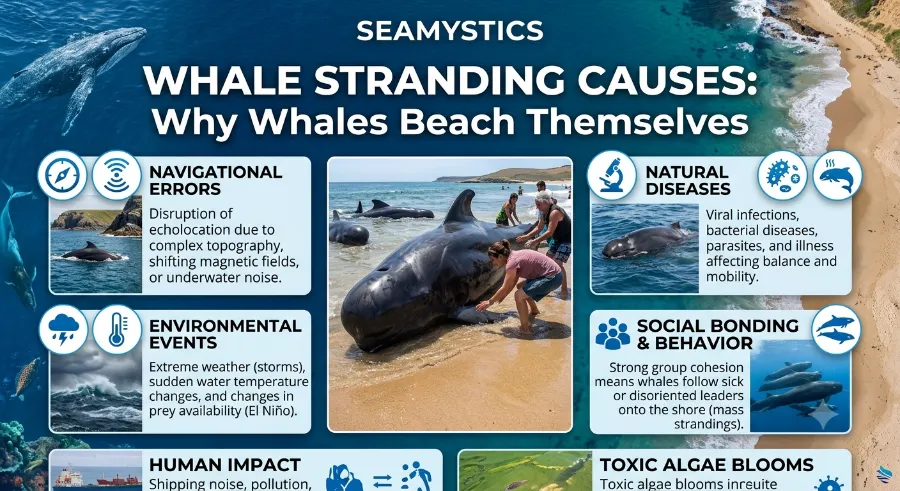
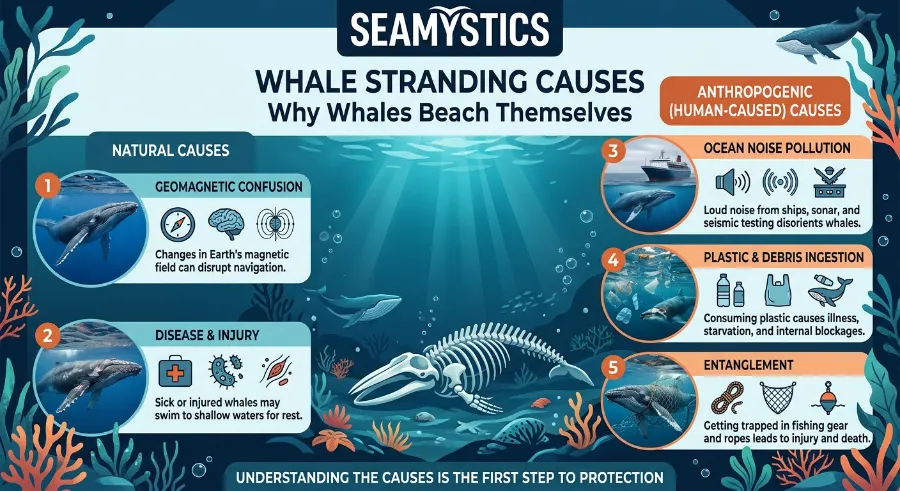
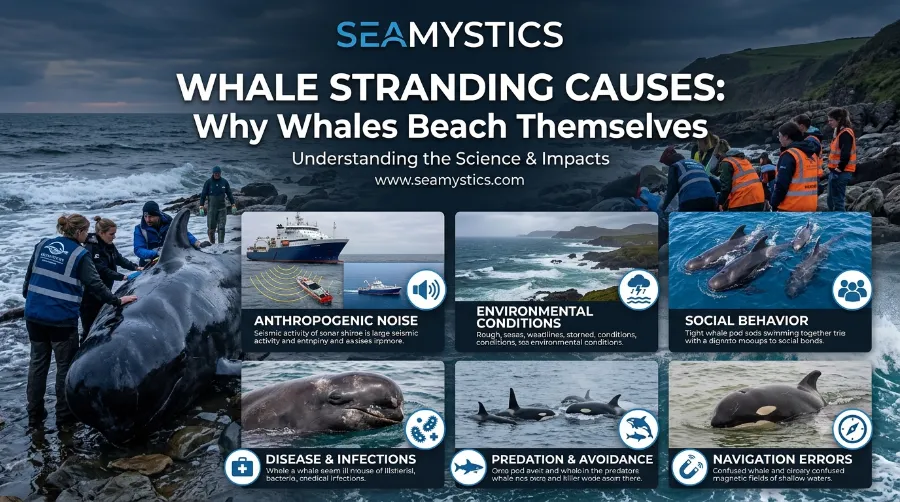
There is rarely a single reason behind why whales beach themselves. Most cases involve biological, environmental, and human factors working together. Below are the most common whale stranding causes confirmed through necropsy findings, which are essentially animal autopsies.
Illness, Parasites, and Old Age
Sick or aging whales often lose the strength needed to navigate open water. Parasitic infections in the brain or ears can throw off an animal’s sense of direction. This can send it toward shore instead of away from it. Bacterial and viral infections weaken the immune system too. This leaves whales too exhausted to fight strong currents.
Pilot Whale Facts Why They’re Actually Giant Dolphins
NOAA’s stranding network lists infectious diseases from parasites, bacteria, fungi, and viruses among the most common causes found during necropsy. This single factor likely explains many solitary strandings, especially among older whales found alone. NOAA Fisheries
Sonar, Noise Pollution, and Navigation Errors
Whales rely on echolocation and low-frequency sound to map the ocean around them. They also use it to communicate and locate prey. Loud, unfamiliar noise can disrupt this internal compass. Military sonar, seismic surveys, and shipping traffic are the biggest offenders.
A landmark case from Alaska shows this clearly. Researchers investigating a cluster of Stejneger’s beaked whales near Adak Island pointed to nearby seismic activity. It may have disoriented the animals before they came ashore. Whales that usually live in deep water can also become confused in shallow coastal zones. Their echolocation signals bounce unpredictably off sand instead of open sea.
Predator Evasion Gone Wrong
Sometimes a whale strands while trying to escape something worse. Orcas can chase gray whales, humpbacks, and other cetaceans into shallow water. The Marine Mammal Center’s necropsy records list probable orca predation as the cause of death for a subadult male humpback whale found at Manchester State Beach in October 2025. Similar cases involving gray whale calves have shown up along the California coast too. Marine Mammal Center
For more on how predator pressure shapes whale behavior, our guide on gray whale migration explains how these animals adjust their routes each season.
Human Activity: Ship Strikes and Fishing Gear
Human activity remains one of the leading whale stranding causes along busy coastlines. Vessel strikes alone account for many documented deaths. The Marine Mammal Center recorded a suspected vessel strike behind an adult female gray whale’s death near Angel Island in March 2026. A nearly identical case happened near Richmond Long Wharf in July 2025.
Fishing gear entanglement poses an equally serious threat. This is especially true for endangered North Atlantic right whales. An aerial survey team spotted right whale number 5110 entangled in fishing gear within Cape Cod Bay in April 2025. He was first documented entangled the previous December. Entanglement rarely causes an instant stranding. It slowly weakens whales over months instead. Learn more in our right whale facts guide. NOAA Fisheries
Extreme Weather and Tidal Traps
Severe storms can push disoriented whales into shallow bays. The animals then become trapped as the tide recedes. Cape Cod, Massachusetts, is a textbook example. According to Misty Niemeyer of the International Fund for Animal Welfare, dolphins strand along the Massachusetts coast partly due to unusual weather and tides, and Cape Cod sees the most frequent large group strandings anywhere in the world. The hook-shaped coastline and dramatic tidal swings create a natural trap. New Bedford Light
Mass Whale Stranding Events: Why Do Whole Pods Beach Together?
A mass whale stranding is one of the most heartbreaking sights in marine science. It usually involves highly social species that travel in tight family units. Pilot whales, false killer whales, and some dolphin species maintain strong social bonds. They often stay within a few body lengths of one another for life.
The Pod Instinct Behind Group Strandings
When one pod member becomes sick, injured, or disoriented, it often swims toward shore. The rest of the group frequently follows. This happens even when it puts the whole pod at risk. This herd instinct explains why mass strandings almost always involve social, deep-diving species. Solitary species rarely strand in groups.
Baleen vs Toothed Whales The Complete Comparison Guide
For more on one species linked to these events, see our pilot whale facts guide.
Tasmania: A Global Hotspot for Mass Strandings
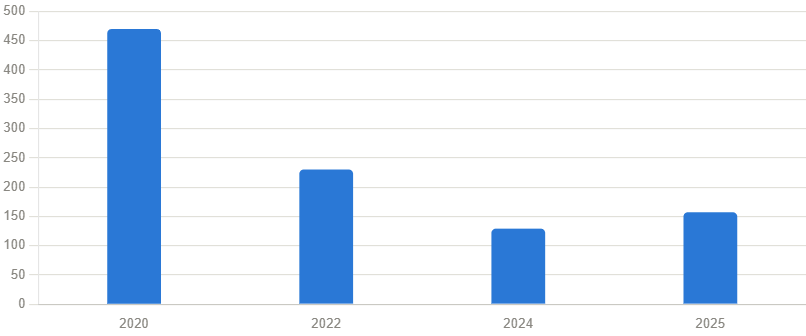
The chart above shows how mass whale stranding events in Tasmania have varied in scale over recent years. The 2020 event at Macquarie Harbour remains the largest ever recorded in Australian history. About 470 long-finned pilot whales became stuck on sandbars there. Only 111 survived after a weeklong rescue effort.
Two years later, almost to the day, another 230 pilot whales stranded in the same harbor. Only 32 could be saved that time. Then in February 2025, a rarer event unfolded near Arthur River. About 157 false killer whales beached themselves, a species that had not stranded in Tasmania since 1974. Marine biologist Kris Carlyon led the response. He noted that all alternative rescue options had failed by the time euthanasia became necessary for the remaining survivors.
Real Cases That Explain Whale Beaching
Numbers only tell part of the story. Specific, documented cases show how varied whale beaching explained through science can actually be.
- September 2024, Fort Bragg, California: A subadult female fin whale stranded at Ten Mile Beach. A probable vessel strike was the cause. See our fin whale facts guide for more.
- October 2025, Manchester State Beach, California: A subadult male humpback whale stranded following probable orca predation.
- January 2025, Oso Flaco Beach, California: An adult male gray whale stranded, with a suspected vessel strike as the leading cause.
- November 15, 2025, Oregon Coast: A juvenile humpback whale stranded alive. This prompted a rapid response from the Oregon State University GEMM Lab team.
- Halloween, Westport, Massachusetts: A dead humpback whale washed ashore, an unusual event for a region more accustomed to dolphin strandings.
These cases span both the West Coast and East Coast. They show that whale stranding causes rarely fit one single explanation. Each animal’s history, health, and environment all play a role.
A Rising National Trend
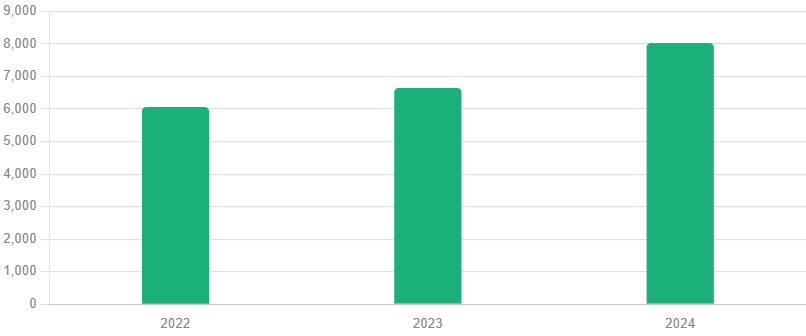
Nationwide stranding numbers have also been climbing. Researchers link this to better reporting, warming ocean temperatures, and increased human activity along coastlines. The chart above shows confirmed strandings rising from 6,061 in 2022 to 8,028 in 2024. That trend does not automatically mean whales are in worse trouble than before. Better detection technology and more volunteer reporting both push the numbers higher. Still, IFAW researchers believe the long-term rise is likely tied to climate change too. Warming waters shift prey distribution and push whales into unfamiliar, riskier waters.
Stranding Response Ocean: How Rescuers Step In
When a whale strands, every hour counts. Certified responders follow a consistent process refined over decades of field experience. Here is a simplified version of how a typical response unfolds.
- Report the sighting immediately. Call a regional hotline right away. Untrained intervention can injure both the animal and the rescuer.
- Assess the animal’s condition. Veterinarians check breathing rate, skin condition, and responsiveness. This decides whether rescue, monitoring, or humane euthanasia is appropriate.
- Keep the whale wet and shaded. Volunteers pour water over the skin and use wet sheets. This prevents sunburn and overheating during assessment.
- Attempt refloating during high tide. Teams use pontoons, slings, or manual pushing to guide the whale into deeper water.
- Track and monitor after release. Some rescued whales receive satellite tags. This confirms they made it back to open water instead of restranding nearby.
This process mirrors the approach used by organizations focused on marine wildlife protection along the Florida coastline. Warm, shallow waters make certain species there particularly prone to beaching. It also matches guidance from university extension researchers who study stranded whales and immediate response steps.
Even with fast, skilled intervention, outcomes are not always positive. NOAA Fisheries reports that between 2006 and 2025, 201 large whales stranded alive along the West Coast alone, and most of these animals died onshore due to underlying health concerns and the physical strain of their own body weight without water to support it. Only 24 of those whales were ever successfully returned to the sea. NOAA Fisheries
Which Whales Strand Most Often?
Not every species faces equal risk. Some whales are more prone to stranding because of their social structure, diving habits, or preferred habitat.
| Species | Stranding Risk Pattern | Common Cause |
|---|---|---|
| Pilot whales | Very high, especially in mass events | Strong pod bonds, following a sick leader |
| False killer whales | Rare but severe when it happens | Pod cohesion, unclear triggers |
| Gray whales | Moderate, often solitary | Vessel strikes, orca predation |
| Fin whales | Moderate | Vessel strikes |
| Beluga whales | Lower overall, higher in Arctic shallows | Ice entrapment, shallow water navigation |
| Right whales | Low stranding rate, high entanglement rate | Fishing gear entanglement |
Cold-Water Species and Family-Bonded Pods
Beluga whales deserve a special mention. Their preference for shallow Arctic waters puts them at unique risk of becoming trapped by shifting ice or falling tides. Our beluga whale facts guide explores this cold-water lifestyle in more depth.
Pilot whales and false killer whales belong to the same broad family as dolphins, despite their whale-sounding names. This close social structure, built around lifelong family pods, is widely considered the biggest reason mass whale stranding events happen at all.
What Years of Case Review Reveal
Having reviewed stranding case files and spoken directly with response teams along both coasts, one pattern stands out. Healthy pods rarely strand without a trigger event. Almost every documented mass stranding traces back to one compromised animal. Whether through illness, injury, or disorientation, the rest of the group refuses to abandon it. This observation lines up with published necropsy findings. It also explains why treating the lead animal quickly can sometimes prevent an entire pod from beaching.
Can Whale Strandings Be Prevented?
Complete prevention is not realistic. Illness, old age, and predator chases will always occur naturally. Still, several practical steps can reduce human-caused strandings.
- Reducing vessel speeds in known whale corridors, particularly during migration season
- Expanding ropeless fishing gear trials to cut down on entanglement risk
- Limiting high-intensity sonar testing near deep-diving beaked whale habitats
- Supporting satellite tracking programs that help vessels avoid active whale pods
- Reporting sightings promptly through official stranding hotlines rather than social media alone
Collaborative projects already show promise. Project OPAL in Oregon brings scientists, fishery managers, and environmental groups together. They map overlap between whale movement and crab fishing gear to reduce entanglement before it leads to a stranding. Programs like this prove that meaningful prevention works when researchers, industry, and government agencies team up.
For more on whale biology, our pillar guide on how whales sleep explains another survival adaptation. It ties directly into how easily these animals can become disoriented in unfamiliar waters.
Frequently Asked Questions
What is the main cause of whale strandings?
There is no single cause. Illness, injury, navigation confusion, predator evasion, and vessel strikes all rank among the most common reasons.
Why do whales strand in groups instead of alone?
Social species like pilot whales maintain tight pod bonds. When one member becomes disoriented or sick, the rest often follow it toward shore.
Can a stranded whale be saved?
Sometimes, yes. Quick reporting within the first few hours improves survival odds. Many large whales that strand alive still do not survive due to underlying health problems.
Is climate change making strandings worse?
Researchers suspect warming ocean temperatures are shifting prey and pushing some species into riskier coastal areas. Better reporting also explains part of the rising numbers.
What should I do if I find a stranded whale?
Call your regional stranding hotline immediately. Keep a safe distance, avoid pouring water into the blowhole, and wait for trained responders.
Conclusion
Whale strandings will likely never be fully preventable. Sickness, aging, and natural predator chases are simply part of ocean life. Still, understanding whale stranding causes gives scientists and everyday beachgoers the tools needed to respond faster. From reducing vessel speeds near migration corridors to supporting round-the-clock stranding networks, every small effort adds up. The next time a headline mentions a beached whale, this guide should help make sense of the science behind it.
References
- NOAA Fisheries, Frequent Questions: Live Large Whale Strandings on the West Coast, fisheries.noaa.gov
- NOAA Fisheries, National Marine Mammal Stranding Response Network, fisheries.noaa.gov
- NOAA Fisheries, North Atlantic Right Whale Health Updates, fisheries.noaa.gov
- Marine Mammal Commission, Marine Mammal Health and Strandings, mmc.gov
- The Marine Mammal Center, Whale Stranding Press Materials, marinemammalcenter.org
- CBS News and Al Jazeera, Tasmania false killer whale stranding coverage, February 2025
- Wildlife Florida, Whales Beach, wildlifeflorida.org
- California Academy of Sciences, Investigating Strandings, Protecting Whales, calacademy.org
- University of Florida IFAS Sarasota County Extension, Stranded Whales: What You Should Know, blogs.ifas.ufl.edu
- Oregon State University GEMM Lab, Marine Mammal Strandings: Responses, Causes, and Significance, blogs.oregonstate.edu
- The New Bedford Light, Scientists Seek Answers to Rising Whale and Dolphin Strandings