
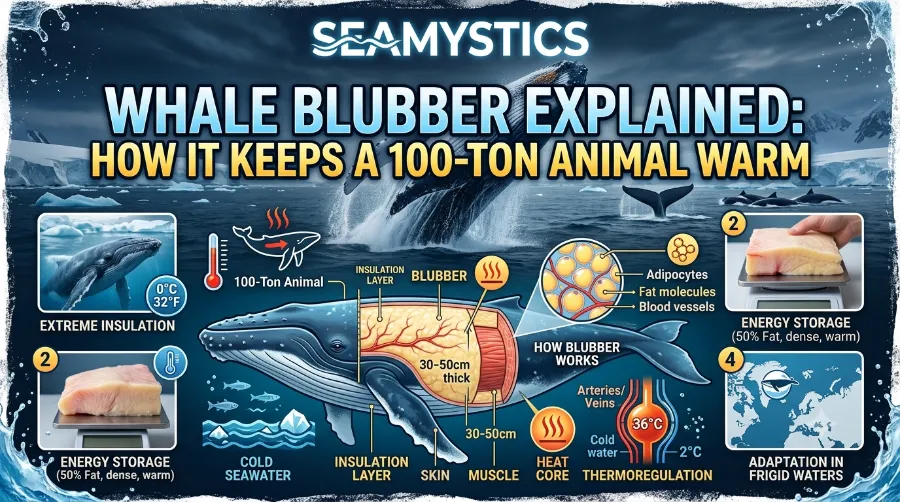

Picture a blue whale gliding through water so cold it would knock a human unconscious within minutes. That whale is not shivering. It is not struggling. It is comfortable. This is the everyday reality of whale blubber science, and once you understand how it works, you will never look at a breaching whale the same way again.
Whale Stranding Causes Why Whales Beach Themselves
Blubber is not simply “whale fat.” It is a living, working organ that stores energy, holds the body together hydrodynamically, and above all, keeps a warm-blooded animal alive in water that can sit near freezing. In this guide we break down blubber thickness whale by whale, explain whale insulation facts backed by real research, and show exactly how the whale fat layer performs blubber temperature regulation for animals that can weigh more than a hundred tons.
Baleen vs Toothed Whales The Complete Comparison Guide
Key Takeaways
| Topic | What the Science Shows |
|---|---|
| What blubber is | A layer of fat, collagen, and connective tissue under the skin, not simple body fat |
| Typical thickness | 15 to 30 cm (6 to 12 inches) in most large whales |
| Thickest known | Bowhead whales, up to 43 to 50 cm (17 to 20 inches) |
| Percent of body weight | Up to 36 to 45 percent in North Atlantic right whales |
| Main functions | Insulation, energy storage, buoyancy, streamlining, hormone signaling |
| Thermal conductivity | Roughly 0.19 to 0.20 W per meter per degree C, close to solid rubber |
| Modern research use | Blubber biopsies now track stress hormones and reproductive health in living whales |
TL;DR: Whale blubber is a dense layer of fat and connective tissue beneath the skin that insulates the body, stores energy, and helps whales stay buoyant and streamlined. It works because fat conducts heat far more slowly than muscle or water, so a blubber layer of a few inches to nearly two feet can keep a whale’s core near 37°C even in near-freezing seas. Thickness and lipid content vary by species, season, and individual health, which is why scientists now use blubber samples as a window into a whale’s hormones, stress levels, and overall condition.
What Is Whale Blubber, Really?
Blubber sits directly beneath a whale’s skin and above the muscle layer, wrapping the entire body except for the fins, flippers, and flukes. It looks like fat, but structurally it behaves more like a spongy, fibrous mat. Collagen fibers form a loose lattice, and fat cells fill the spaces in between, which is why blubber holds its shape even as an animal gains or loses weight.
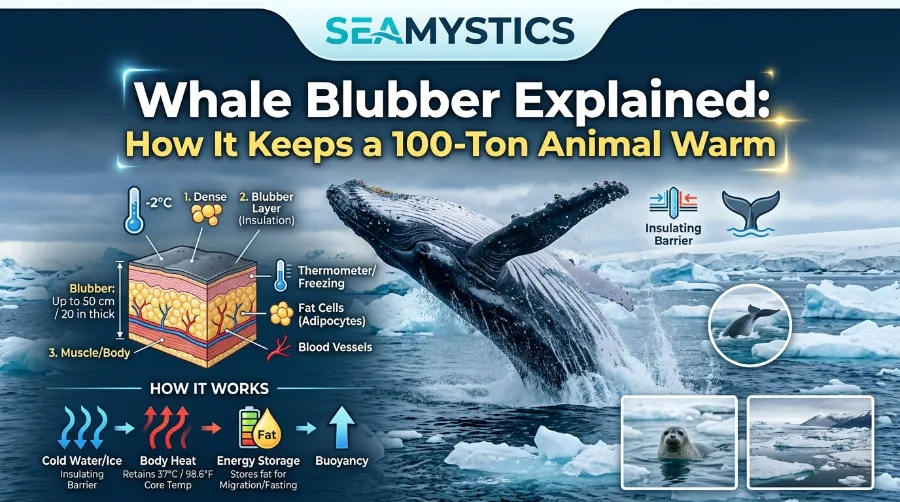
This structure matters for whale blubber science because it means blubber is not inert padding. Researchers at the Anderson Cabot Center for Ocean Life have shown that a small biopsy sample of blubber can reveal a right whale’s stress hormone levels, pregnancy status, and even recent trauma such as fishing gear entanglement, since blubber functions as a site of energy storage, an insulating layer for warmth, and an aid to buoyancy, and its surface tissue can be sampled directly through biopsy. That single detail changed how marine biologists monitor endangered species without ever touching a whale beyond a quick dart sample. New England Aquarium
Blubber also differs from human body fat in composition. In healthy whales it can be up to roughly 80 to 93 percent lipid with very little water content, giving it a thermal conductivity close to that of solid rubber or asbestos insulation. Lower lipid, higher water content blubber, often seen in malnourished or stressed animals, insulates far less effectively.
Related reading: How Whales Sleep
Blubber Thickness Whale by Whale
Not every whale carries the same amount of blubber, and the differences are not random. They track climate, body shape, and lifestyle.
- Bowhead whales, which live year-round in Arctic waters, carry the thickest blubber of any whale, measured at 43 to 50 cm, or 17 to 20 inches.
- North Atlantic right whales average around 20 inches of blubber and can reach 28 inches, making up 36 to 45 percent of total body weight, the highest proportion recorded in any whale.
- Humpback whales typically carry blubber layers around 15 cm, or roughly 6 inches.
- Fin whales and other streamlined, fast-swimming species carry only a few inches of blubber, trading insulation for speed.
- Weddell seals, while not whales, illustrate the same principle. At 400 to 600 kg they can carry up to 240 kg of pure blubber.
These differences explain why a sleek fin whale can migrate thousands of miles quickly while a bulky right whale moves slowly and floats easily, a trait so pronounced it is where the species got its name. You can compare this variation directly on our Right Whale Facts and Fin Whale Facts pages.
Whale Insulation Facts: Why Fat Beats Fur in Water
Land mammals rely on fur to trap warm air near the skin. That system fails underwater because pressure from diving compresses trapped air and squeezes the insulating effect out. Whales solved this problem differently, by dropping fur almost entirely and relying on a dense fat layer instead.
Blubber does not compress under pressure the way an air pocket does. This is one of the clearest whale insulation facts in marine biology, and it is why whales can dive to enormous depths without losing their insulating layer. As the Whale and Dolphin Conservation organization explains, thicker blubber also increases buoyancy, and the thick layer keeps warmth on the inside of the body while the outer skin cools to nearly match the surrounding seawater, since the thick blubber layer not only keeps heat on the inside of the body, but the outermost skin layer is cooled to nearly the temperature of the surrounding water, further reducing heat loss via conduction. University of Hawaii at Hilo
That cooled outer skin might sound counterintuitive, but it is smart engineering. By allowing the surface to run cold, the whale minimizes the temperature difference between its skin and the ocean, which sharply reduces how much heat escapes.
Beluga whales, which live in Arctic and sub-Arctic waters year-round, are a strong example of this adaptation in action. You can read more about their cold-water survival strategies on our Beluga Whale Facts page.
Whale Fat Layer Composition and Structure
The whale fat layer is not a single uniform block. A 2025 study on narwhals, close relatives of belugas, found clear stratification within the blubber itself. The outer layer had higher thermal conductivity and a larger share of monounsaturated fatty acids, while the inner layer, closer to the body core, had lower conductivity and more saturated fatty acids, showing that the outer blubber layer had higher conductivity and a larger proportion of monounsaturated fatty acids than the inner layer, which showed lower conductivity and a higher proportion of saturated fatty acids. Ocean Conservancy
In practical terms, this means the outer blubber acts more like a flexible, slightly leakier barrier, while the inner blubber acts as the true insulating core. This layered design lets whales fine tune heat retention without sacrificing flexibility for swimming.
Pilot Whale Facts Why They’re Actually Giant Dolphins
Milk composition plays a role here too. Marine mammal milk often contains 40 to 50 percent fat, far richer than typical land mammal milk, which allows calves to build a functional blubber layer within weeks of birth. A newborn whale without adequate blubber is at serious risk of hypothermia, so this rapid fat deposition is a survival priority from day one.
Table: Comparative Blubber Data Across Species
| Species | Average Blubber Thickness | Percent of Body Weight | Habitat |
|---|---|---|---|
| Bowhead whale | 43 to 50 cm (17 to 20 in) | Not fully quantified | Arctic, year-round |
| North Atlantic right whale | Up to 51 cm (20 in) | 36 to 45 percent | North Atlantic coastal waters |
| Humpback whale | Around 15 cm (6 in) | Varies by season | Global, migratory |
| Fin whale | A few inches | Lower, built for speed | Global, deep water |
| Narwhal | Multi-layered, stratified | High lipid content | High Arctic |
Blubber Temperature Regulation: The Physics Behind the Warmth
At the heart of blubber temperature regulation is a simple physical principle. Fat conducts heat roughly three times more slowly than water. Since whales lose heat mainly through conduction and convection into the surrounding ocean, slowing that transfer is the whole game.
A bottlenose dolphin, for example, maintains a core body temperature around 36.9°C even though the surrounding water may sit near 0°C. Research on dolphin blubber has shown a clear heat gradient running from the warm core out to the cooler skin, confirming that the fat layer is doing the heavy lifting in keeping the animal’s organs at a stable temperature.
Large whales face the opposite challenge as well. Because their body mass is so enormous relative to their surface area, they can generate more heat than they can safely shed, especially during vigorous activity like breaching or feeding. This is why many species have adapted specialized cooling systems.
- Pilot whales take in water through the blowhole to absorb and carry away excess internal heat.
- Large whales route blood through thin-skinned areas like the flippers and flukes to dump heat quickly when needed.
- Some species reduce activity levels in warm, shallow breeding lagoons to avoid overheating.
You can see this cooling strategy discussed further on our Pilot Whale Facts page, where blowhole water intake is used specifically to prevent overheating during active swimming.
Real World Research: What Blubber Biopsies Reveal
Modern whale blubber science increasingly relies on minimally invasive biopsy sampling rather than necropsies alone. A single dart-collected sample, often just a few grams of tissue, now gives researchers access to hormone levels, contaminant loads, genetic information, and reproductive status.
Published hormone research on North Atlantic right whales analyzed blubber testosterone, progesterone, and cortisol across both living and deceased individuals. The findings showed blubber progesterone in a confirmed pregnant female measured roughly twelve times higher than in non-pregnant females, and cortisol in whales that died from human-caused injuries averaged several times higher than in healthy living whales. These numbers give scientists a practical, non-lethal way to track the health of a population where fewer than 400 individuals remain.
This kind of monitoring matters enormously for conservation. According to the New England Aquarium, more than 86 percent of North Atlantic right whales have been entangled in fishing gear at least once, some as many as nine times, and blubber sampling helps researchers understand how much physiological stress each entanglement causes. To learn more about how human activity threatens whale survival, see our related guide on Whale Stranding Causes.
Seasonal and Migratory Blubber Changes
Blubber is not static. Whales build it up aggressively during feeding season and draw it down during long migrations or breeding periods when food is scarce.
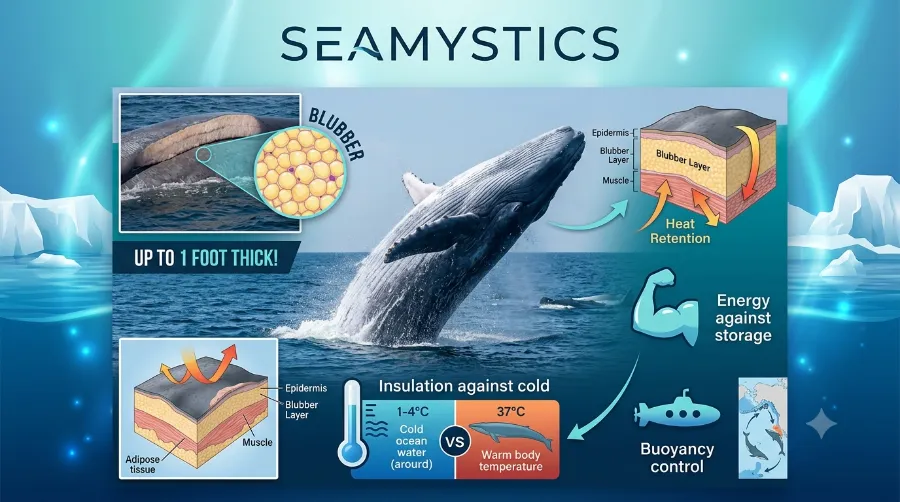
Gray whales offer a clear example. They fast for much of their multi-thousand-mile migration between Arctic feeding grounds and Baja California breeding lagoons, relying almost entirely on stored blubber for energy during that stretch. By the time they reach warmer breeding waters, their blubber reserves are often visibly reduced compared to when they left the feeding grounds. You can explore this cycle in detail in our Gray Whale Migration guide.
This seasonal blubber cycle explains why body condition scoring, essentially estimating blubber thickness from a whale’s outward shape, has become a standard tool for researchers tracking population health, especially in species where body size has been linked to lower reproduction rates in recent studies.
Why This Matters Beyond Curiosity
Understanding blubber temperature regulation is not just a fun fact. It directly informs conservation policy, ship strike regulations, and climate research. As ocean temperatures shift and food availability changes with them, blubber thickness and quality act as an early warning signal for population stress long before numbers decline.
Organizations like Whale and Dolphin Conservation actively study these patterns to inform protective policy, and their public research remains one of the most accessible entry points into the topic for readers outside academia.
Frequently Asked Questions
How thick is whale blubber on average?
Most large whales carry blubber between 15 and 30 cm, or roughly 6 to 12 inches, though this varies widely by species, season, and individual body condition.
Which whale has the thickest blubber?
Bowhead whales hold the record, with blubber reaching 43 to 50 cm, since they live in Arctic waters year-round without migrating to warmer seas.
Does blubber thickness ever change during a whale’s life?
Yes. Blubber thickens during feeding season and thins during migration, fasting periods, and breeding season, when energy is drawn from fat reserves.
Can scientists tell a whale’s health from its blubber?
Yes. Blubber biopsies now reveal hormone levels, stress indicators, pregnancy status, and contaminant exposure, making it one of the most valuable non-lethal research tools available.
Is blubber the same as human body fat?
Not exactly. Blubber has a distinct collagen and lipid structure that makes it a far more effective insulator than typical mammalian fat tissue, with thermal conductivity close to solid rubber.
Conclusion
Whale blubber science shows just how elegantly evolution solves a hard physics problem. A layer of specialized fat, sometimes barely six inches thick and sometimes nearly two feet, is enough to keep a hundred-ton animal warm, buoyant, and energized across some of the coldest waters on Earth. From bowhead whales built for permanent Arctic life to right whales carrying nearly half their body weight in blubber, every species shows a slightly different solution to the same core challenge of staying warm in the sea. As research tools like biopsy sampling continue to advance, blubber is proving to be far more than insulation. It is a living record of a whale’s health, history, and resilience.
References
- Whale and Dolphin Conservation USA, “How Does Blubber Keep Whales Warm?” — https://us.whales.org/2012/10/27/how-does-blubber-keep-whales-warm/
- New England Aquarium, “A Tiny Piece of Whale Blubber Leads to Big Results” — https://www.neaq.org/a-tiny-piece-of-whale-blubber-leads-to-big-results/
- Gentle Giants Iceland, “The Beauty of Blubber” — https://gentlegiants.is/news/2023/11/18/the-beauty-of-blubber
- NOAA Office of Education, “How Marine Mammals Stay Warm” — https://www.noaa.gov/office-education/outreach-communication/hands-on-science-activities/how-marine-mammals-stay-warm
- ScienceDirect Topics, “Blubber: An Overview” — https://www.sciencedirect.com/topics/agricultural-and-biological-sciences/blubber
- Krüger, C. (2025). “The multiple roles of whale blubber… in narwhal,” AGRIS/FAO database.
- Ocean Conservancy, “10 Facts You Didn’t Know About North Atlantic Right Whales.”