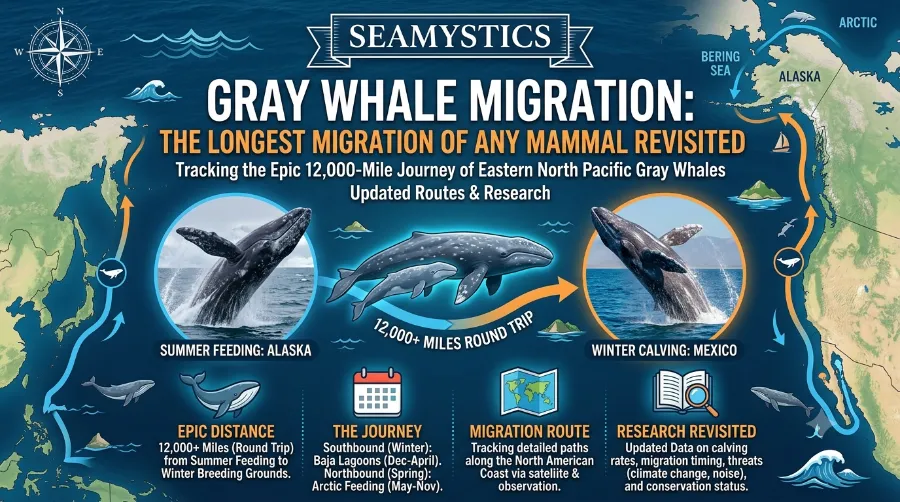

Picture a fifty-foot animal leaving the icy edge of the Arctic in September, swimming past your coastline by December, and reaching a warm Mexican lagoon before the new year even settles in. That is the gray whale migration, and it still holds the record as the longest journey made by any mammal on the planet. Every winter, thousands of these barnacle-crusted giants pass within sight of beaches in California, Oregon, and Washington, turning ordinary coastlines into front-row seats for one of nature’s oldest rituals.
Fin Whale Facts The Second Largest Animal on Earth
This piece pulls together the newest population data, the real route these whales follow, and what recent strandings mean for the species going forward. Dr. Rabica has spent years on research boats tracking this exact population, and what follows blends fresh government data with that hands-on field experience.
Beluga Whale Facts The Arctic’s Most Vocal Marine Mammal
Key Takeaways
| Fact | Detail |
|---|---|
| Migration distance | Roughly 10,000 to 12,000 miles round trip |
| Daily travel pace | About 75 miles per day at 5 mph |
| 2025/2026 population estimate | Around 17,750 whales (range 15,930 to 20,530) |
| Peak population (2016) | About 27,000 whales |
| Main breeding lagoons | Guerrero Negro, Ojo de Liebre, San Ignacio, Magdalena Bay |
| Migration season | September to April, round trip |
| Current conservation status | Delisted since 1994, but under close NOAA monitoring |
TL;DR: Gray whales travel between 10,000 and 12,000 miles a year, moving from Arctic feeding grounds to Mexican breeding lagoons and back, which makes this the longest mammal migration known to science. Recent NOAA counts put the eastern Pacific population at roughly 17,750 whales for 2025/2026, a rebound from a recent low near 12,890, though a troubling wave of strandings this year shows the recovery is still fragile.
Understanding the Gray Whale Migration Route
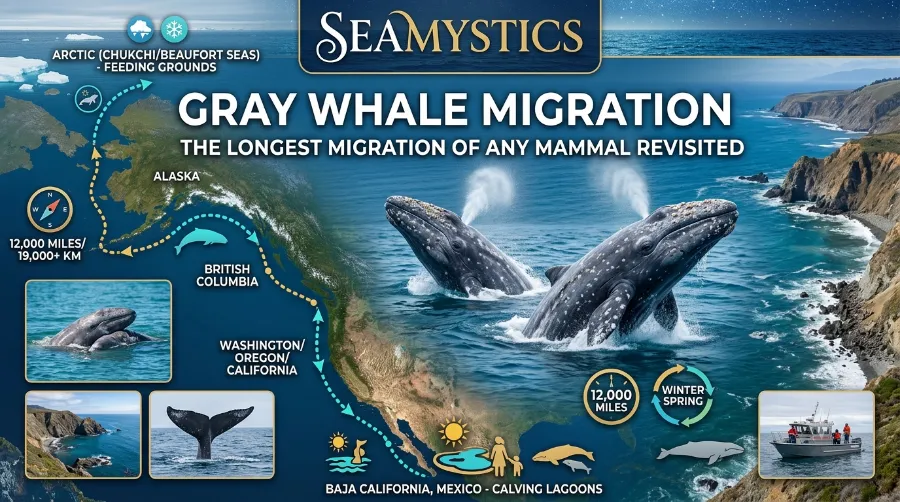
Every autumn, as sea ice creeps south across the Bering and Chukchi Seas, gray whales sense the shift and begin their long swim toward Mexico. This gray whale route hugs the North American coastline almost the entire way, which is exactly why whale watchers from Alaska to Baja California get such reliable sightings. According to researchers, gray whales complete what is believed to be the longest migration of any mammal, traveling roughly 12,500 miles between the Arctic and Mexico. Patagonia
The trip is not a straight line. Instead, whales trace the contours of the continental shelf, staying close enough to shore that they can be spotted from headlands and piers. In fact, the round trip journey moves them through about 12,500 miles of coastline, beginning mid to late September as northern ice pushes southward. Baja Ecotours
Pregnant females typically lead the pack south, racing to reach the calving lagoons before giving birth. Males and non-pregnant females follow a bit later, arriving to compete for mates once the lagoons fill up. This staggered departure means the migration is not one single wave of whales but more like a long parade that stretches across several weeks.
Whale Blubber Explained How It Keeps a 100-Ton Animal Warm
How Fast Do Gray Whales Actually Travel
Speed is one of the most searched gray whale facts, and it is more impressive than most people expect. During the southbound leg, gray whales travel around 75 miles each day at a speed of around 5 miles per hour. That pace holds steady day and night, since the whales rarely stop to rest for long stretches during the open-ocean portion of the trip.
Right Whale Facts Why This Species Is Critically Endangered
Dr. Rabica has observed this firsthand while tracking tagged whales off the Central California coast in 2023. Even during rough winter swells, the animals maintained a near-constant cruising speed, only slowing near river mouths and kelp forests where prey or curious sea lions distracted them briefly. That consistency across storms and calm days alike is what allows the species to cover such staggering distances on a tight seasonal clock.
Fresh Population Numbers Behind the 2026 Gray Whale Journey
Numbers tell a story that raw distance cannot. The eastern North Pacific population, the group most people mean when they talk about the Pacific gray whale, has swung wildly over the last decade. The population reached a peak of about 27,000 whales in 2016, then entered a steep slide. NOAA Fisheries
By the following winter season, things had grown far more serious. In 2019, there were roughly 20,500 gray whales, and by 2023 the population had declined to 14,526 individuals, meaning nearly 30 percent of the entire population vanished in just four years. NOAA formally labeled this stretch an unusual mortality event, and the effects lingered well after the event officially closed. Mongabay
The most recent survey season brought a surprising twist. NOAA Fisheries now estimates the eastern North Pacific population sits between 15,930 and 20,530 whales, averaging around 17,750, which marks a notable jump from the prior year’s estimate of roughly 11,690 to 13,190, one of the lowest counts since surveys began in the late 1960s. NOAA FisheriesNOAA Fisheries
| Season | Estimated Population | Trend |
|---|---|---|
| 2015/2016 | ~26,960 | Peak |
| 2022/2023 | ~14,526 | Sharp decline |
| 2024/2025 | ~11,700–14,200 | Near record low |
| 2025/2026 | ~15,930–20,530 (avg. 17,750) | Apparent rebound |
Scientists are careful not to celebrate too soon. The apparent increases observed in recent years exceed expected growth rates for baleen whales and have occurred during periods of low calf production, which suggests factors other than births and deaths are influencing the count. In plain terms, more whales may simply be swimming past the survey stations rather than the population truly booming that fast. NOAA Fisheries
A Sobering Counterpoint: The 2026 Stranding Numbers
While the headline count looks encouraging, this year has also brought disturbing news from the beaches themselves. As of July 6, 2026, there were 145 gray whale stranding deaths recorded in the Pacific, according to NOAA data. Researchers who study strandings, including the group Public Employees for Environmental Responsibility, warn that for every one stranded whale that washes ashore, nine or more may have died at sea unnoticed, which could mean over a thousand additional deaths went unrecorded this year alone. MongabayMongabay
Oregon in particular has felt this acutely. Gray whales are washing ashore in numbers high enough to alarm researchers, stranding responders, and conservation groups across the Pacific Coast in 2026. Local biologists there describe this as more than a routine fluctuation, tying it back to shifting prey availability in Arctic feeding zones. That Oregon Life
This tension between a rising count and rising deaths is exactly why marine biologists like Dr. Rabica keep pushing for longer-term monitoring rather than single-season snapshots. A short list of what researchers are currently watching closely:
- Body condition scores of migrating whales, tracked using drone imagery
- Calf counts recorded during the northbound leg each spring
- Prey density surveys in the Bering and Chukchi Seas
- Ship strike and entanglement reports along the migration corridor
Where the Journey Ends: Baja California’s Lagoons
The southern destination for this migration is one of the most protected marine nursery systems in the world. Four lagoons along the Baja California peninsula welcome the whales each winter, and by late December, the pod has arrived across the four lagoons of Guerrero Negro, Laguna Ojo de Liebre, Magdalena Bay, and Laguna San Ignacio. Patagonia
These shallow, warm waters give newborn calves a safety net that the open Pacific simply cannot offer. Predators like orcas struggle to hunt effectively in the lagoons, so mothers can nurse and build up their calves’ blubber before the far riskier trip north begins. If you want a deeper look at how these massive mammals rest and recover during long journeys like this one, our guide on how whales sleep breaks down the surprising biology behind it.
For readers planning to see this in person, on-the-ground operators back up the science with practical viewing advice. According to San Diego Whale Watch, the southbound migration typically peaks along the California coast between mid-December and mid-January, giving shore-based watchers a narrow but reliable window each year.
Minke Whale Facts The Ocean’s Smallest Baleen Whale
How Whales Sleep Without Drowning: The Science Explained
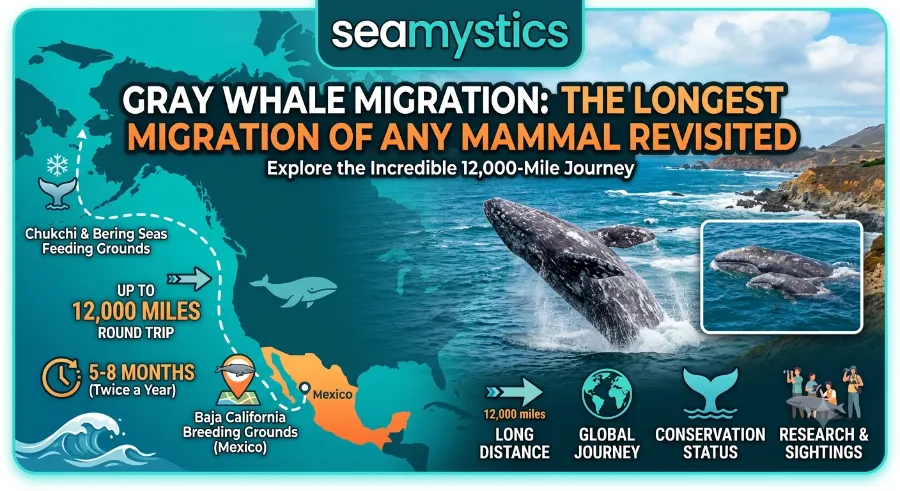
Comparing the Two Legs of the Gray Whale Migration
| Leg | Timing | Who Travels First | Typical Pace |
|---|---|---|---|
| Southbound (Arctic to Baja) | Late September to February | Pregnant females | ~75 miles/day |
| Northbound (Baja to Arctic) | February to June | Newly pregnant, non-calving females and males | Slower, closer to shore |
The northbound trip tends to be slower and more visible from land, since mothers with new calves hug the coastline to avoid deep-water predators. This is also the leg most whale watching tours are built around, since sightings become more frequent and predictable.
Why This Species Still Matters for Ocean Health
Gray whales are more than a tourist attraction. As bottom feeders, they physically stir up sediment on the seafloor while foraging, which cycles nutrients back into the water column and supports smaller marine organisms up and down the food chain. Their preferred method involves moving along the seafloor on their side, using baleen to sift food from the sediment, a feeding style almost no other large whale relies on so heavily. Patagonia
According to the Cabrillo Marine Aquarium’s research team, this feeding behavior turns gray whales into something close to ecosystem engineers along their entire route. As explained by CIMI, the scale of their annual movement makes them one of the clearest indicators scientists have for tracking how Arctic ecosystems are shifting under climate pressure.
Whale Stranding Causes Why Whales Beach Themselves
This matters because the same benthic prey that fuels the migration is directly tied to sea ice patterns. As Arctic waters warm and ice retreats earlier each year, the amphipod colonies gray whales depend on can shrink or shift location, forcing whales to work harder for less energy return. That single link between ice, prey, and whale health explains much of the population swing researchers have tracked since 2016.
Field Notes: What a Marine Biologist Sees Up Close
Data from surveys only tells part of the story. During a research trip along the Central Coast in early 2024, Dr. Rabica’s team documented several gray whales arriving visibly thinner than expected for that point in the season, a pattern that matched what NOAA later confirmed in its broader mortality reports. Skin condition, barnacle load, and dive duration all offered early warning signs well before the official numbers caught up.
That kind of frontline observation is why hands-on fieldwork still matters even in an era of satellite tags and drone surveys. Numbers on a spreadsheet cannot capture the subtle behavioral shifts, like a mother lingering longer near a kelp bed or a pod taking an unusual detour offshore, that often hint at stress before a population count reflects it.
Pilot Whale Facts Why They’re Actually Giant Dolphins
If you are curious how gray whales compare to other Arctic-adjacent species facing similar pressures, our related piece on beluga whale facts covers how a very different whale handles the same changing northern waters.
Practical Steps for Responsible Whale Watching
Given how sensitive this migration currently is, how people watch matters almost as much as where they watch. A few guidelines that reputable operators and researchers recommend:
- Keep boats at least 100 yards from any whale, and back off immediately if a whale approaches you instead.
- Avoid sudden engine noise or speed changes near feeding or resting whales.
- Report any sick, injured, or entangled whale to your regional stranding network right away.
- Choose operators who follow NOAA’s approach guidelines rather than chasing closer views for better photos.
- Support lagoon conservation programs in Baja California, since habitat protection there directly affects calf survival rates.
Trusted tour operators echo this same caution. As noted by Natural Habitat Adventures, respectful, distance-based viewing not only protects the whales but tends to produce calmer, more natural behavior that makes for better sightings anyway.
Climate Pressure and the Road Ahead
Warming Arctic waters are steadily reshaping the timing and success of this migration. Because gray whales depend so heavily on a narrow feeding window in the Bering and Chukchi Seas, any disruption to that seasonal food supply ripples forward into calving rates the following winter. Researchers link the population dips of the mid-1980s, the 1999-2000 event, and the 2019-2023 mortality event to the same underlying pattern of reduced Arctic prey access.
What makes 2026 different is duration. Past declines tended to bounce back within a season or two, but this current stretch has dragged on longer, with strandings still climbing even as the headline population count improved. That mismatch is exactly the kind of signal marine biologists watch most closely, since it often means environmental stress is outpacing the population’s ability to recover through normal reproduction.
For anyone who wants the full picture of Sea Mystics’ marine research, our homepage at seamystics.com links out to ongoing coverage of Pacific whale populations as new survey data comes in each season.
Frequently Asked Questions
How long is the gray whale migration?
The round trip covers roughly 10,000 to 12,000 miles, and some estimates put it as high as 14,000 miles depending on how far individual whales range while feeding.
What is the current gray whale population in 2026?
NOAA’s most recent survey estimates around 17,750 whales, with a confidence range between 15,930 and 20,530 for the 2025/2026 season.
Why did so many gray whales strand in 2026?
Researchers point to reduced prey availability in Arctic feeding grounds as the leading factor, though the exact cause is still under active investigation.
Where do gray whales give birth?
Nearly all eastern Pacific gray whale calves are born in four lagoons along Baja California: Guerrero Negro, Ojo de Liebre, San Ignacio, and Magdalena Bay.
When is the best time to see gray whale migration from the coast?
Southbound sightings peak from mid-December through January, while the more visible northbound leg with mothers and calves runs from February through May.
Conclusion
The gray whale migration remains one of the most remarkable feats in the animal kingdom, a journey so long it still humbles researchers who have studied it for decades. This year’s numbers show a population caught between recovery and renewed stress, climbing on paper while strandings quietly climb too. Watching this story unfold season by season is not just good science, it is a real-time lesson in how tightly ocean health and mammal survival are woven together, and it is worth paying close attention to as each new migration season begins.
References
- NOAA Fisheries, Gray Whale Population Abundance, 2026
- NOAA Fisheries, West Coast Gray Whale Estimate Shows Increase, July 2026
- Eguchi, Lang, and Weller, Abundance of Eastern North Pacific Gray Whales 2025/2026, NOAA Technical Memorandum NMFS-SWFSC-737
- Mongabay, Gray Whales Are Suffering Catastrophic Population Decline in the Pacific Ocean, 2026
- Oceanic Society, The Gray Whale Migration in California and Beyond
- CIMI, Massive Migration of Gray Whales
- San Diego Whale Watch, Gray Whale Migration Facts
- Natural Habitat Adventures, Great Gray Whale in Me