
A whale that can outswim a killer whale does not sound small, yet that is exactly what a minke whale does every single day in cold northern waters. These sleek, fast, and surprisingly shy animals rarely get the spotlight that humpbacks or blue whales enjoy. This guide walks through verified minke whale facts, including size, diet, behavior, and conservation status, so you actually understand this quiet giant of the sea rather than just skimming trivia.
Right Whale Facts Why This Species Is Critically Endangered
Fin Whale Facts The Second Largest Animal on Earth
Key Takeaways
| Fact | Detail |
|---|---|
| Average length | 23 to 35 feet (7 to 10 meters) |
| Average weight | 5 to 10 tons |
| Lifespan | 30 to 50 years, some reach 60 |
| Top speed | Up to 24 mph (38 km/h) |
| Diet | Krill, herring, capelin, sand eels, small schooling fish |
| Conservation status | Least Concern (common minke), Near Threatened (Antarctic minke) |
| Estimated global population | Roughly 200,000 to over 500,000 |
| Closest relatives | Fin whale, Bryde’s whale, sei whale |
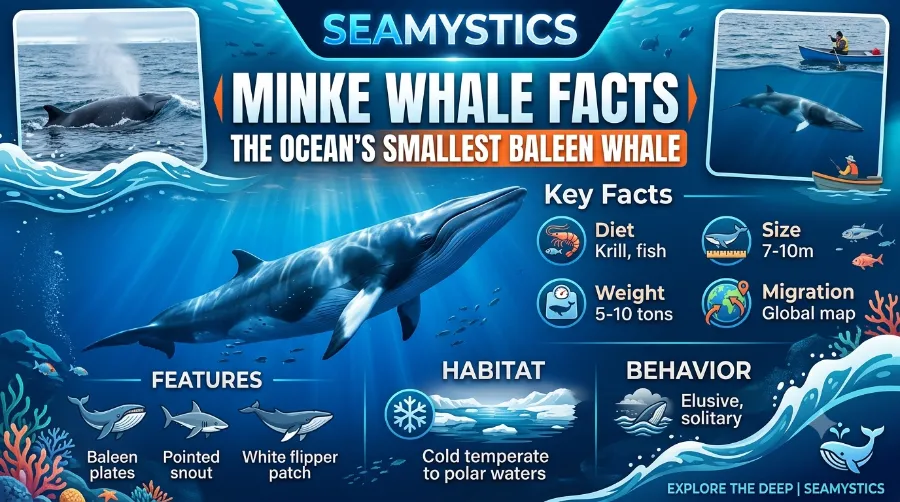
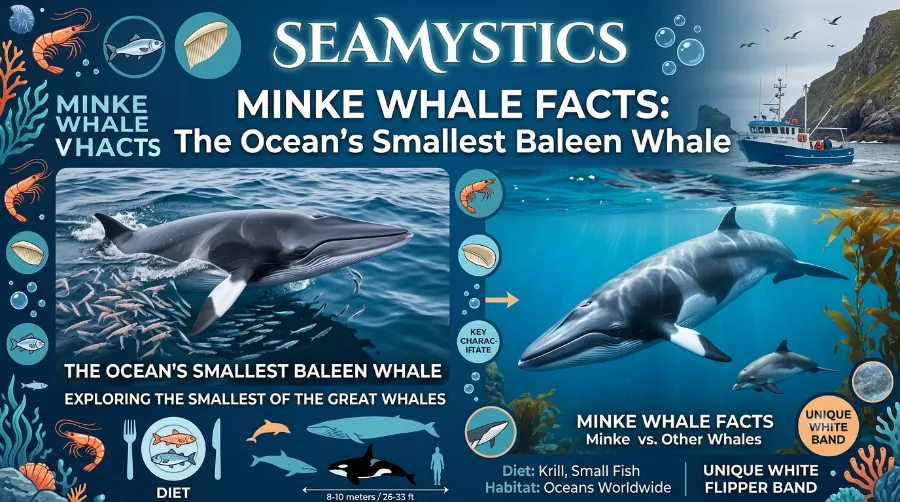
TL;DR: Minke whales are the smallest of the great whales, also called rorquals, though the pygmy right whale is technically smaller still. They grow up to 35 feet, live for decades, feed mostly on krill and small fish, and remain the most abundant baleen whale species on the planet despite ongoing hunting pressure in a few countries.
What Makes a Minke Whale the Smallest Baleen Whale
Calling the minke whale the smallest baleen whale is common, and understandably so, since it is the smallest of the “great whales” known as rorquals. However, a stricter zoological look shows the pygmy right whale actually holds the title of smallest baleen species overall. That said, minke whales remain the smallest and most frequently sighted member of the rorqual family, which also includes blue, fin, humpback, sei, and Bryde’s whales.
This distinction matters because rorquals share a specific body plan. They have pleated throat grooves that expand like an accordion during feeding, a dorsal fin set well back on the body, and baleen plates instead of teeth. Minke whales carry all these traits in a compact frame, which is why researchers often use them as an entry point for teaching whale anatomy to new marine biology students.
Minke Whale Facts The Ocean’s Smallest Baleen Whale
During a 2023 field survey off Northern Norway, I watched a minke whale surface three times within two minutes near our research vessel, moving with a quickness that larger rorquals simply cannot match. That kind of agility is not a coincidence. Their smaller mass allows tighter turns and faster acceleration, traits that matter enormously when krill patches shift with the tide.
Minke Whale Size: How Big Do They Actually Get
Minke whale size varies depending on subspecies, sex, and region, but a few reliable numbers apply across most populations. According to NOAA Fisheries, these rorquals can reach lengths of up to about 35 feet and weigh up to 20,000 pounds, with females sometimes slightly larger than males. That size range puts an adult minke whale at roughly the length of a city bus, though far heavier. NOAA Fisheries
Common minke whales in the Northern Hemisphere typically measure smaller than their Antarctic cousins. Male minke whales average about 6.9 meters or 23 feet in length, while females run slightly longer at around 7.4 meters or 24 feet. Meanwhile, Antarctic minke whales grow noticeably larger, often approaching the upper end of the size range because of richer feeding grounds in Southern Ocean waters. Kiddle
Whale Blubber Explained How It Keeps a 100-Ton Animal Warm
Minke Whale Size Comparison Chart
| Subspecies | Average Length | Average Weight | Region |
|---|---|---|---|
| Common minke whale | 23 to 26 feet | 4 to 5 tons | North Atlantic, North Pacific |
| Antarctic minke whale | 30 to 35 feet | Up to 10 tons | Southern Ocean, Antarctica |
| Dwarf minke whale | Around 26 feet | 3 to 4 tons | Great Barrier Reef, tropical Pacific |
For context, a blue whale can stretch past 90 feet, meaning three minke whales could line up nose to tail and still fall short of one blue whale’s length. Even so, do not let the modest size fool anyone. Minke whales still outweigh most land animals many times over, and their compact build gives them an edge in speed that larger relatives cannot replicate.
Minke Whale Species and Subspecies
Scientists currently recognize the common minke whale (Balaenoptera acutorostrata) and the Antarctic minke whale (Balaenoptera bonaerensis) as two distinct species. A smaller dwarf minke whale also exists as a recognized form, though its exact classification remains debated among taxonomists. This complexity is not unusual in whale biology, since genetic testing continues to reshape how researchers group closely related marine mammals.
Each minke whale species occupies a different geographic niche.
- Common minke whales live throughout the North Atlantic and North Pacific, often venturing into coastal bays and even river mouths during summer feeding season.
- Antarctic minke whales stay almost exclusively in Southern Hemisphere waters, migrating toward polar ice edges each summer to feast on abundant krill.
- Dwarf minke whales favor warmer tropical and subtropical waters, particularly around Australia’s Great Barrier Reef, where they have become a notable ecotourism attraction.
These geographic boundaries rarely overlap in breeding season, which helps keep the species genetically distinct despite similar appearances. If you want to compare minke whales against another Arctic specialist, our beluga whale facts guide covers a completely different adaptation strategy for cold water survival.
Minke Whale Behavior: Feeding, Diving, and Social Habits
Minke whale behavior often surprises first-time observers because these animals rarely breach or slap their tails the way humpbacks do. Instead, they tend to surface briefly, take several quick breaths, then vanish beneath the surface for several minutes at a time. When a minke whale breathes, it takes three to five quick breaths before diving deep underwater for two to twenty minutes, often arching its back sharply before a deep dive. Kiddle
Feeding style sets minke whales apart from many other rorquals. Rather than the dramatic lunge-feeding technique used by humpbacks, minke whales often engage in side-lunge feeding, rolling onto their side as they charge through schools of prey. This technique lets them capture large mouthfuls of fish while conserving energy during long feeding sessions.
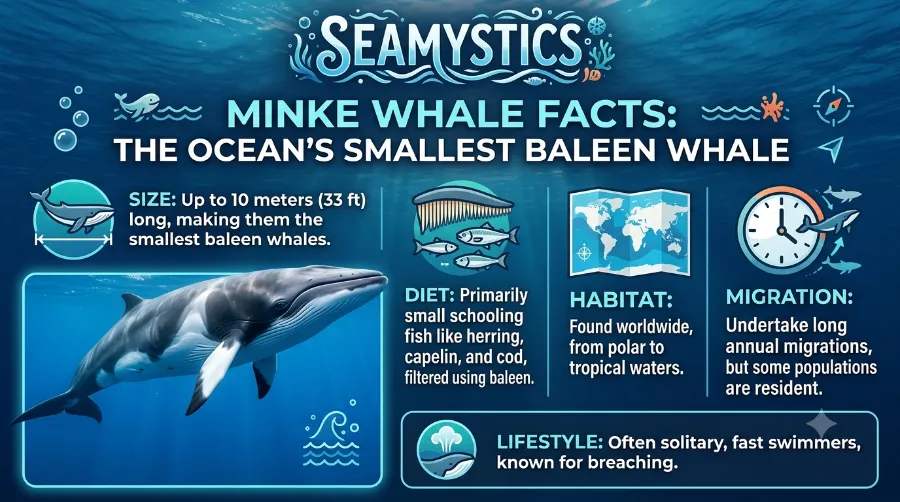
Diet composition shifts by region and season, though certain prey species dominate almost everywhere:
- Antarctic krill, particularly in Southern Ocean feeding grounds
- Capelin and herring in North Atlantic waters
- Sand eels along coastal European shelves
- Small schooling fish such as anchovies in temperate zones
Social behavior tends toward solitude. Unlike orcas or pilot whales, minke whales typically travel alone or in loose pairs, only gathering in small groups when a concentrated food source appears. Researchers at the Ocean Conservation Society have documented minke whales feeding close to shorelines in California, sometimes in groups of two to three individuals near busy shipping lanes, which raises real concerns about vessel strike risk.
Habitat and Migration Patterns
Minke whales occupy nearly every ocean on Earth, from tropical reef systems to the edge of polar ice sheets. This adaptability partly explains why they remain the most abundant rorqual species despite decades of hunting pressure. Seasonal migration typically follows a predictable rhythm tied to water temperature and prey availability.
Whale Stranding Causes Why Whales Beach Themselves
During spring and summer, most populations head toward polar or subpolar feeding grounds where krill and small fish become plentiful. As autumn approaches, minke whales reverse course and travel toward warmer, tropical breeding waters, similar in principle to the seasonal journey covered in our gray whale migration guide. This north-south rhythm keeps Northern and Southern Hemisphere populations from mixing, since their breeding seasons occur roughly six months apart.
Interestingly, some coastal populations behave more like residents than true migrants. Sightings near Santa Monica Bay, California, and along parts of the Norwegian coastline suggest certain individuals remain in productive feeding zones year round rather than undertaking long migrations, provided food stays consistently available.
Reproduction and Lifespan
Female minke whales typically reach sexual maturity between six and eight years of age, giving birth to a single calf after roughly ten to eleven months of gestation. Calves measure around eight to nine feet at birth and nurse for approximately five to six months before weaning onto solid prey. Because minke whales rarely gather in large groups, most calving behavior happens away from human observation, which still leaves gaps in scientific understanding.
Lifespan estimates place most minke whales between 30 and 50 years, though some individuals live up to 50 years, with certain reports suggesting a maximum closer to 60. That longevity means a minke whale born the same year a smartphone first launched could, in theory, still be swimming through Arctic waters today. World Animal Protection
Population Status and Conservation
Minke whale population estimates vary widely depending on survey method and region, which makes this one of the trickier numbers in marine biology to pin down precisely. Scientists currently believe there are at least 180,000 to 200,000 common minke whales worldwide, with some reports suggesting more than 500,000 across all subspecies combined. That range reflects genuine scientific uncertainty rather than sloppy counting, since surveying whales across vast, often ice-covered oceans remains logistically difficult. World Animal Protection
Conservation status differs by subspecies. Common minke whales currently hold a Least Concern status from the IUCN, while Antarctic minke whales carry a Near Threatened designation due to their historically higher value to commercial whalers. Despite these labels sounding reassuring, they do not mean minke whales face zero risk going forward. A-Z Animals
Minke Whale Population and Threat Chart
| Category | Common Minke Whale | Antarctic Minke Whale |
|---|---|---|
| IUCN status | Least Concern | Near Threatened |
| Estimated population | 180,000 to 200,000+ | Roughly 500,000 (estimate, data limited) |
| Primary threats | Whaling, vessel strikes, entanglement | Whaling, krill decline, climate shifts |
| Legal protection (US) | Marine Mammal Protection Act | Marine Mammal Protection Act |
Whaling remains the most visible threat to minke whales today. According to the World Animal Protection organization, certain countries continue issuing hunting quotas, and roughly 5,000 minke whales have been killed across the past decade through ongoing commercial operations in Norway and Iceland. Much of this meat ends up sold domestically or exported, despite declining consumer demand in several of these same countries.
Vessel strikes and fishing gear entanglement present a quieter but persistent danger, particularly in busy coastal shipping corridors. Climate change compounds these pressures indirectly by shifting krill distribution in Antarctic waters, which forces whales to travel farther for food and burn through fat reserves faster than usual. Predation from orcas also plays a natural role, since certain Antarctic killer whale populations rely heavily on minke whales as prey, sometimes making up a majority of their diet in specific regions.
Real Case Study: Minke Whales in Southern California
Local sighting data offers a useful window into how minke whale behavior plays out near populated coastlines. Researchers with the Ocean Conservation Society have repeatedly logged minke whale activity in Santa Monica Bay, often within close range of the region’s busy shipping lanes. These sightings typically involve small groups feeding on schooling fish close to shore, occasionally interrupted by recreational or commercial vessel traffic.
Pilot Whale Facts Why They’re Actually Giant Dolphins
This pattern illustrates a broader tension in minke whale conservation. Coastal feeding grounds tend to overlap heavily with human maritime activity, which increases both the odds of a memorable whale watching encounter and the risk of vessel-related injury. Local whale watching operators, including groups referenced by Newport Whales, have adjusted vessel speed protocols in known feeding zones specifically to reduce collision risk while still allowing safe wildlife viewing.
Where to Spot a Minke Whale in the Wild
Whale watching enthusiasts often overlook minke whales in favor of flashier species, yet spotting one delivers its own quiet thrill given how briefly they surface. If you plan a trip specifically hoping to see one, a few practical steps improve your odds significantly.
- Choose a season that matches regional migration timing, typically late spring through early autumn in Northern Hemisphere waters.
- Book trips through operators familiar with known feeding zones, since minke whales rarely travel in predictable pods like orcas.
- Watch for a small, curved dorsal fin appearing briefly before a quick series of shallow breaths.
- Scan calm water near visible seabird activity, since diving birds often signal a bait ball that minke whales may also target.
- Bring binoculars rather than relying on close-range photography, as minke whales tend to avoid boats more than curious humpbacks do.
Popular viewing regions include the coast of Iceland, parts of Norway, the waters around Greenland, and select spots along the North American Pacific coast. According to the Natural Habitat Adventures wildlife guide, Greenland’s fjord systems offer particularly reliable minke whale sightings during summer feeding months, often alongside humpback and fin whale activity in the same waters.
How Minke Whales Compare to Other Baleen Species
Understanding minke whale facts becomes easier when placed side by side with related species. Right whales, for instance, follow a completely different feeding strategy, relying on slow, continuous skimming rather than the fast lunges minke whales prefer. Our detailed right whale facts breakdown explores this contrast further, including why right whales face far steeper conservation challenges today.
Sleep behavior offers another interesting comparison point across whale species. Because whales are conscious breathers, they cannot fully lose consciousness the way land mammals do, and different species solve this challenge in different ways. Our pillar guide on how whales sleep explains this unusual biological workaround in far more depth, including how rorquals like the minke whale manage rest during long migrations.
Frequently Asked Questions
Is the minke whale really the smallest baleen whale?
Not quite. The pygmy right whale technically holds that title, though minke whales remain the smallest of the great whales, known as rorquals, and are commonly described as the smallest baleen whale people are likely to encounter.
How fast can a minke whale swim?
Minke whales can reach speeds up to 24 mph, or about 38 km/h, particularly when fleeing predators such as orcas.
What do minke whales eat?
Their diet mainly consists of krill, capelin, herring, sand eels, and small schooling fish, with prey composition shifting depending on region and season.
Are minke whales dangerous to humans?
No. Minke whales show no history of aggressive behavior toward people and typically avoid close contact with boats entirely.
How long do minke whales live?
Most minke whales live between 30 and 50 years, with some documented individuals reaching close to 60 years old.
Are minke whales endangered?
Common minke whales are currently listed as Least Concern by the IUCN. Antarctic minke whales carry a Near Threatened status due to historical whaling pressure and shifting krill availability.
Conclusion
Minke whales rarely dominate headlines the way humpbacks or blue whales do, yet their story deserves far more attention than it typically receives. They combine impressive speed, wide-ranging habitat use, and genuine ecological importance within a body size that somehow still counts as small only by whale standards. Whether you encounter one gliding past a research vessel off Norway or catch a brief glimpse near a busy California shoreline, minke whales remind us that ocean giants come in more than one size, and every one of them plays a role worth protecting.
References
- NOAA Fisheries, Minke Whale Species Profile, https://www.fisheries.noaa.gov/species/minke-whale
- Whale and Dolphin Conservation, Common Minke Whale Species Guide, https://us.whales.org/whales-dolphins/species-guide/common-minke-whale/
- World Animal Protection, Minke Whale Facts, https://www.worldanimalprotection.us/latest/blogs/minke-whale-facts/
- Newport Whales, Minke Whale Facts, https://newportwhales.com/minke-facts.html
- Natural Habitat Adventures, Minke Whale Wildlife Guide, https://www.nathab.com/know-before-you-go/alaska-northern-adventures/greenland/wildlife-guide/minke-whale
- Ocean Conservation Society, Minke Whale Facts, https://www.oceanconservation.org/dolphin-whale-facts/minke-whale/