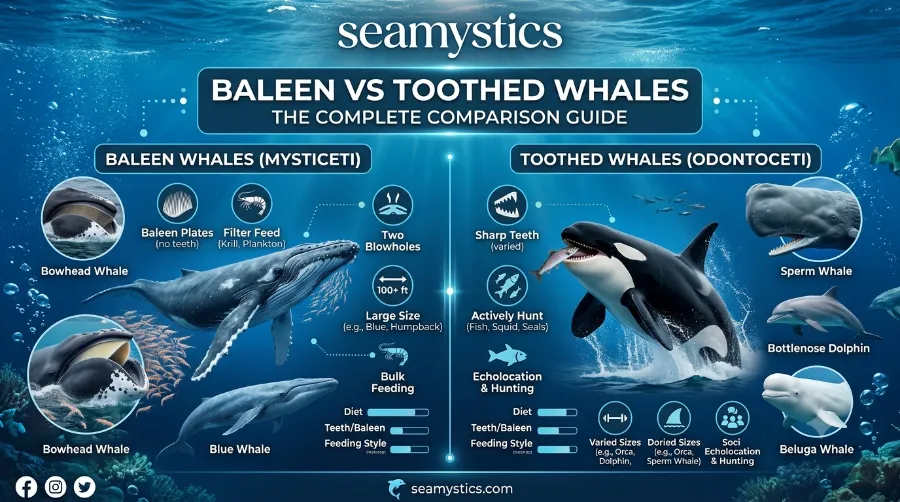

Picture two whales surfacing side by side in the same patch of ocean. One opens a mouth the size of a small room. It gulps down a swimming cloud of krill. The other clicks, listens, and darts off after a single squid hiding far below.
Same ocean, same order of animals, completely different survival strategy. That split, baleen toothed whales, is one of the oldest divisions in the animal kingdom. Once you understand it, almost everything else about whales starts to make sense.
Why This Comparison Matters
At Sea Mystics, I get one question from readers in the US and Europe more than any other. What actually separates a baleen whale from a toothed whale? It sounds simple. But the answer touches feeding, skull shape, sound, size, and even lifespan.
This guide walks through it all in plain language. It is backed by current research and real examples. By the end, you will be able to identify which group a whale belongs to just by watching how it feeds.
Key Takeaway Table
| Feature | Baleen Whales (Mysticeti) | Toothed Whales (Odontoceti) |
|---|---|---|
| Feeding structure | Baleen plates (keratin) | Teeth (2 to over 250) |
| Number of species | Around 15 to 16 | Around 70 to 90 |
| Blowholes | Two | One |
| Diet | Krill, plankton, small schooling fish | Fish, squid, seals, other marine mammals |
| Echolocation | No | Yes |
| Largest member | Blue whale (up to 100 feet) | Sperm whale (up to 60 feet) |
| Skull shape | Symmetrical | Asymmetrical |
| Typical social pattern | Often solitary or loose groups | Frequently travel in pods |
TL;DR: Baleen whales filter tiny prey through comb-like keratin plates. They include the biggest animals ever to exist. Toothed whales hunt individual prey using teeth and echolocation, and this group includes everything from orcas to dolphins. The split comes down to one evolutionary choice made tens of millions of years ago, and it still shapes how each whale eats, moves, and communicates today.
What Does Baleen Toothed Whales Actually Mean?
The term sounds technical, but it describes the two branches of the whale family tree. Every living whale, dolphin, and porpoise belongs to the order Cetacea. Scientists split that order into two suborders based on one feature: what is inside the mouth.
Baleen whales, or Mysticeti, have no teeth at all. Instead they grow rows of fringed plates made of keratin. This is the same protein found in human hair and fingernails, and it hangs from the upper jaw. Toothed whales, or Odontoceti, keep the ancestral tool most mammals use. They have actual teeth, ranging from a couple of tusks to hundreds of small cones.
According to Whale and Dolphin Conservation, there are only around 15 baleen whale species, and they are generally larger than the 77 species of toothed whales, with the sperm whale as the one major exception. That single fact explains a lot of what follows here. There are fewer, bigger filter feeders on one side, and a much larger, more varied group of active hunters on the other. Baleines en direct
If you want a related survival behavior, our guide on how whales sleep covers how both groups rest without ever fully losing consciousness. They still need to breathe on purpose, even while resting.
Baleen Whale Differences: How Filter Feeders Are Built
Baleen whales are built around one job. They need to move huge volumes of water through the mouth efficiently. That single requirement shapes almost every part of their anatomy.
Baleen Plates Instead of Teeth
Baleen plates grow in rows from the upper jaw. Their edges fray into hair-like bristles that trap prey while water flows back out. The plates are not bone. They are keratin, the same flexible material as a fingernail. That is part of why whalers in past centuries called it whalebone, even though it isn’t bone at all.
The National Park Service notes that baleen grows from the upper jaw in the huge mouths of these whales, in plates with fringes that act as a sieve to filter small schooling fish or zooplankton. Some species skim continuously near the surface. Others gulp a huge mouthful of water and then push it out through the baleen with the tongue. fao
Two Blowholes, Not One
One of the fastest ways to identify a baleen whale from a boat is the blowhole, and you do not even need to see the mouth. Baleen whales have two blowholes side by side. This often produces a tall, V-shaped spout when they exhale.
Size and the Rorqual Family
Baleen whales include the largest animals that have ever lived on this planet, not just the largest living ones. The rorqual family includes blue, fin, humpback, Bryde’s, sei, and minke whales, and it ranges enormously in size. Whale and Dolphin Conservation reports that rorquals vary in size from the smallest minke whale 8.8m (29ft) long to the blue whale who can reach 33m (108ft) long. Baleines en direct
A blue whale can weigh close to 200 tons. That is roughly the weight of 33 adult African elephants. Yet its entire diet is built almost exclusively around krill smaller than a paperclip. That contrast, the biggest body on Earth surviving on some of the smallest prey, is one of the most quoted facts in marine biology for a reason. It really is that extreme.
For readers who want to see this filter-feeding strategy in a very different-looking baleen species, our piece on gray whale migration covers a bottom-feeding rorqual relative. It scoops prey from the seafloor instead of the open water column.
Toothed Whale Species: A Much Bigger, More Varied Group
Baleen whales are built around one efficient system. Toothed whales are built around flexibility instead. This group is far more numerous, and it covers an enormous range of body sizes, hunting styles, and habitats.
Teeth Built for Grabbing, Not Chewing
Toothed whale teeth are almost always conical or peg-shaped. They are designed to grip slippery prey rather than chew it. Number and shape vary wildly by species. The Animal Fund notes that tooth count ranges from 2 (in some beaked whales) to 250 (some dolphins), and some dolphin species carry over 160 teeth in total. Wikipedia
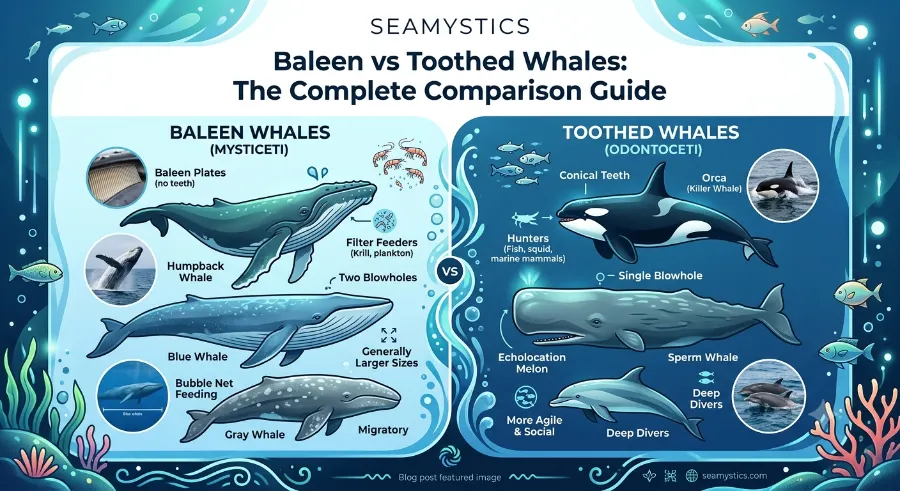
Not every toothed whale actually uses visible teeth to feed. Certain beaked whale species have teeth that never erupt through the gums in females. Male narwhals rely on a single long tusk, technically an elongated tooth, that can grow past 9 feet, rather than a full set of biting teeth.
One Blowhole, Positioned Off-Center
Unlike baleen whales, toothed whales have a single blowhole. It typically sits slightly off-center on the top of the head. This asymmetry connects to something deeper in their skull structure, which brings us to echolocation.
Echolocation: The Toothed Whale Superpower
This is the biggest functional difference between the two groups beyond diet. Toothed whales can echolocate. They send out clicks and read the returning echoes to build a sound picture of their surroundings, including prey hiding in dark or murky water. Baleen whales cannot do this.
Sperm whales use echolocation to hunt squid at depths beyond 1,000 meters, in near total darkness. They rely entirely on sound rather than sight. Orcas use a related form of biosonar to coordinate hunts in pods. They sometimes target seals, sea lions, and even other whale species.
Size Range: From Tiny Porpoises to the Sperm Whale
Toothed whales include the smallest cetaceans on Earth. Some porpoises barely reach 5 feet. At the other end sits the sperm whale, the single largest toothed predator alive. The American Museum of Natural History describes sperm whales as far larger than most other species in this group, reaching about 60 feet long. nps
The group also includes some of the most recognizable ocean animals around. Killer whales, pilot whales, belugas, narwhals, and every species of dolphin and porpoise all belong here. Yes, that includes orcas, which are technically the largest member of the dolphin family, not a separate whale lineage.
To see one popular toothed species up close, check our guide on beluga whale facts. For a look at highly social pod behavior, our pilot whale facts page breaks down one of the most tightly bonded toothed whale species.
Whale Classification Types: The Full Family Tree
Understanding whale classification types helps make sense of why some animals get called whales while very similar animals get called dolphins.
Here is the basic breakdown:
- Order Cetacea – covers all whales, dolphins, and porpoises, roughly 90 species total.
- Suborder Mysticeti (baleen whales) – filter feeders with baleen plates, split into families like Balaenidae (right and bowhead whales) and Balaenopteridae (rorquals).
- Suborder Odontoceti (toothed whales) – active hunters with teeth, including sperm whales, beaked whales, belugas, narwhals, dolphins, and porpoises.
The FAO’s marine species data confirms this proportion clearly. It notes that toothed whales constitute roughly 80% of all whales. That is why most whale species you can name off the top of your head, orca, dolphin, sperm whale, belong to the toothed side rather than the baleen side.
It is worth pointing out that “dolphin” and “porpoise” are not separate scientific categories from “toothed whale.” They are toothed whales, just smaller members of the same suborder. The split comes from tooth shape and body build, not from any deeper biological difference.
For a species right at the edge of the baleen size spectrum, our right whale facts guide covers one of the rarest and most endangered baleen families still swimming today. Our fin whale facts page covers the second-largest animal on the planet.
Whale Feeding Comparison: Filtering vs Hunting
This is where the two groups diverge most visibly. It is usually the fastest way to tell them apart in the field.
How Baleen Whales Feed
Baleen whales use one of a few core strategies:
- Lunge feeding – rorquals like humpbacks and blue whales expand pleated throat grooves and engulf huge volumes of water and prey in a single lunge, then push the water back out through the baleen.
- Skim feeding – right whales swim slowly with their mouths open near the surface, continuously filtering plankton as they move.
- Bottom feeding – gray whales roll onto their side and suck sediment from the seafloor, filtering out small crustaceans.
A single humpback whale can consume close to 1.5 tons of krill and small fish in a single day during peak feeding season. That is based on long-term feeding studies off the coasts of California and Alaska. That volume only makes sense because baleen filtering processes huge amounts of water per lunge.
How Toothed Whales Feed
Toothed whales generally hunt one prey item at a time. Some species do coordinate as a group, though. Their approach depends heavily on echolocation, speed, and in some cases teamwork.
- Sperm whales dive deep and hunt giant and colossal squid using echolocation alone.
- Orcas hunt cooperatively in pods, sometimes herding fish into tight balls or working together to isolate a seal from an ice floe.
- Dolphins often use rapid clicks and coordinated group tactics to corral schooling fish into shallow water.
Toothed whales actively chase individual prey rather than filtering plankton. Because of this, they generally need more calories per body pound than a filter feeder. Their hunting ranges also tend to be wider and more varied, from river mouths to open ocean trenches.
Real-World Example: Monterey Bay, California
Few places make this comparison easier to see than Monterey Bay, where both groups regularly feed in the same stretch of water. Blue whales and humpback whales, both baleen species, gather here in summer and fall. They lunge feed on dense krill swarms pushed up by seasonal upwelling.
At the same time, pods of orcas and Risso’s dolphins, both toothed species, patrol the same waters. They hunt gray whale calves and squid. Local whale watching operators in the bay report that visitors can sometimes see a baleen whale lunge feeding on one side of the boat and a toothed whale pod hunting on the other, within the same outing.
Behavior, Sound, and Social Life
Feeding style is not the only place these two groups differ. Sound production, social structure, and how they move through water often trace back to the same baleen-versus-toothed split.
Baleen whales are famous for low-frequency songs, especially humpbacks. These songs can travel for miles underwater. Researchers believe they play a role in mating and possibly long-distance communication. Baleen whales produce these sounds without the nasal structures toothed whales use for echolocation, and they cannot echolocate at all.
Toothed whales rely heavily on high-frequency clicks and whistles instead. They use these both for hunting and for social communication within pods. Orcas in particular are known for distinct regional dialects. Different pods produce recognizably different call patterns, almost like accents.
Socially, many toothed whale species form long-term, tightly bonded pods. Some stay with the same family group for life, as seen in resident orca populations off the Pacific Northwest. Baleen whales tend to be more solitary or form loose, temporary groups. They often only gather in numbers where food is unusually dense.
Conservation Status: A Quick Snapshot
Both groups face real, ongoing threats. The specific pressures differ, though.
| Threat | Baleen Whales | Toothed Whales |
|---|---|---|
| Ship strikes | High risk (large, slow-moving) | Moderate risk |
| Entanglement | High risk (surface feeding) | Moderate to high risk |
| Noise pollution | Disrupts communication and migration | Disrupts echolocation and hunting |
| Prey depletion | Krill and small fish declines | Overfishing of squid and fish stocks |
| Hunting pressure | Historic commercial whaling legacy | Targeted hunts in some regions (e.g., narwhal ivory) |
NOAA Fisheries notes that under the Marine Mammal Protection Act, twelve whales are also listed as endangered in part or all of their range under the Endangered Species Act, spanning both baleen and toothed species. Right whales, a baleen family, remain among the most critically endangered large whales on Earth. Fewer than 400 North Atlantic right whales are estimated to survive today. Theanimalfund
If you are curious how these pressures sometimes lead to tragic outcomes, our guide on whale stranding causes looks at why both baleen and toothed species sometimes end up beached, and the different theories behind each.
Quick Identification Guide
If you are out on a whale watching trip, here is a simple checklist for guessing which group you are looking at:
- Count the blowhole spouts – one blowhole usually means toothed, two usually means baleen.
- Watch the feeding behavior – lunging, skimming, or gulping water points to baleen; chasing or pod-coordinated hunting points to toothed.
- Check the group size – large, tightly coordinated pods lean toothed; solitary or loosely spaced individuals lean baleen.
- Compare body size – anything smaller than roughly 20 feet is almost certainly toothed, since most baleen species are much larger.
- Listen, if possible – long, low moaning songs suggest baleen; sharp clicks and whistles suggest toothed.
None of these signs are perfect alone. Combined, they get you very close to a correct identification most of the time.
Why This Classification Still Matters Today
Understanding baleen toothed whale differences is not just trivia. Conservation groups use this classification to design targeted protections. A baleen whale’s biggest threats, ship strikes and entanglement during surface feeding, are very different from a toothed whale’s biggest threats, prey depletion and noise interference with echolocation.
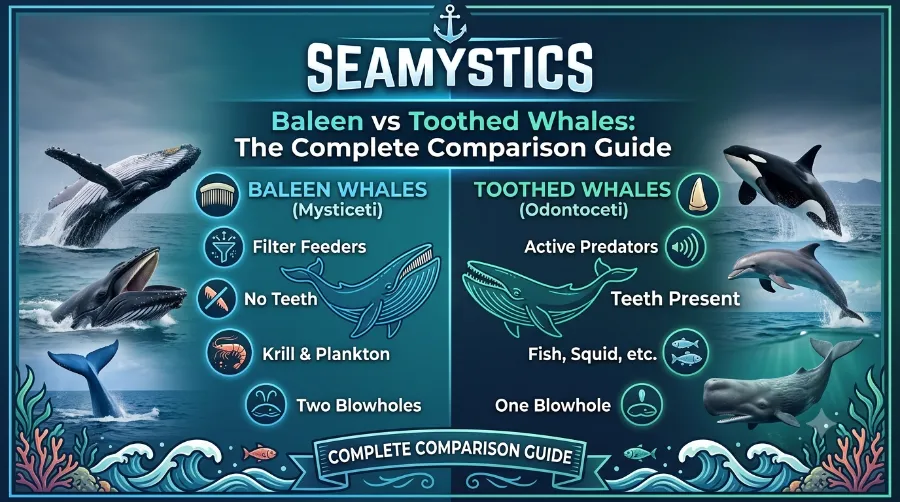
Researchers also use it to track evolutionary history. Genetic studies confirm that baleen and toothed whales share a common ancestor from roughly 30 to 35 million years ago. After that, the two lineages split. One evolved toward filter feeding and gigantism, and the other evolved toward echolocation and active predation.
For readers interested in the physical layer that helps every whale survive cold and deep water, our guide on whale blubber science explains how this insulating fat layer works across both groups.
Frequently Asked Questions
Are orcas baleen or toothed whales?
Orcas are toothed whales. They are technically the largest member of the dolphin family, not a separate whale lineage.
Which group has more species, baleen or toothed?
Toothed whales have far more species. Depending on the source, there are roughly 70 to 90, compared to around 15 to 16 baleen species.
Can baleen whales echolocate?
No. Echolocation is unique to toothed whales. Baleen whales rely on other sounds, like low-frequency songs, for communication instead.
Do any toothed whales lack visible teeth?
Yes. Some beaked whale species and female narwhals have teeth that never fully erupt through the gums. This makes them functionally toothless despite being classified as toothed whales.
What is the largest baleen whale and the largest toothed whale?
The blue whale is the largest baleen whale, and the largest animal ever known to have lived. The sperm whale is the largest toothed whale.
Conclusion
The line between baleen and toothed whales comes down to one evolutionary fork taken tens of millions of years ago. It still shapes nearly everything about how these animals live today. Baleen whales built their existence around efficient filtering, growing into the largest animals the planet has ever supported. Toothed whales kept teeth, gained echolocation, and diversified into dozens of species built for active hunting.
Once you know what to look for, blowhole count, feeding style, group behavior, this split becomes easy to spot from the deck of any whale watching boat. It turns a simple sighting into a much richer story about how these animals actually survive.
References
- IFAW, “Types of Whales: Meet the Largest Animals in the Ocean” – https://www.ifaw.org/journal/types-of-whales
- Whale and Dolphin Conservation, “Whales – Meet the Different Species” – https://us.whales.org/whales-dolphins/whales/
- Whale and Dolphin Conservation, “Facts About Whales” – https://us.whales.org/whales-dolphins/facts-about-whales/
- NOAA Fisheries, “Whales” – https://www.fisheries.noaa.gov/whales
- American Museum of Natural History, “What Are Whales? Understanding Cetaceans” – https://www.amnh.org/explore/news-blogs/whale-classification-baleen-toothed
- National Park Service, “Toothed vs Baleen Whales” – https://www.nps.gov/redw/learn/nature/toothed-vs-baleen-whales.htm
- Food and Agriculture Organization of the United Nations, Marine Mammal Species Overview – https://www.fao.org/4/i1276b/i1276b16.pdf
- Oceanwide Expeditions, “Baleen Whales: The Gentle Giants of the Ocean” – https://oceanwide-expeditions.com/blog/baleen-whales-the-gentle-giants-of-the-ocean
- Sea Goddess Whale Watch, “Baleen vs Toothed Whales in Monterey Bay” – https://seagoddesswhalewatch.com/blog/baleen-vs-toothed-whales-in-monterey-bay/