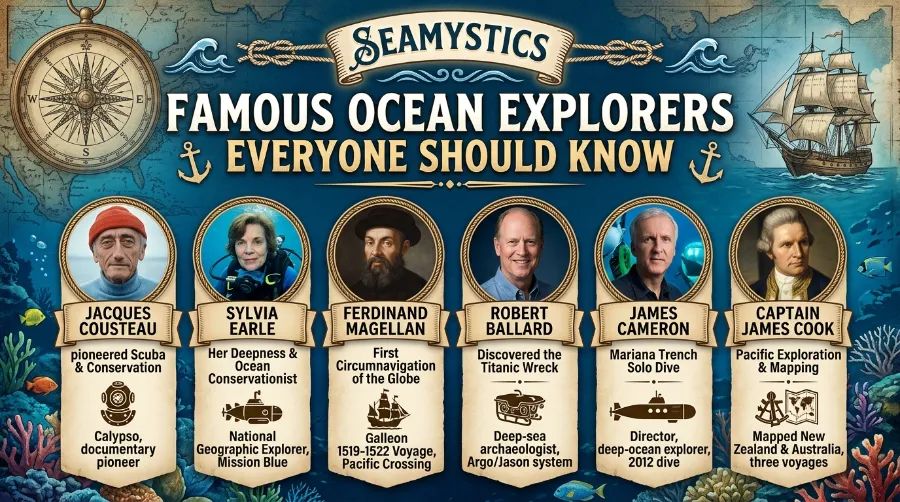

The ocean covers more than seventy percent of our planet, yet we have mapped less of its floor than we have mapped the surface of Mars. That gap between curiosity and knowledge is exactly what pulled a handful of famous ocean explorers into the water, into submersibles, and into history books. This guide walks through the lives, dives, and discoveries of the people who turned the deep sea from a blank space on the map into a place we can actually study.
Key Takeaways
| Explorer | Known For | Milestone Year |
|---|---|---|
| Jacques Cousteau | Co-invented the Aqua-Lung, filmed the ocean for TV audiences | 1943 |
| William Beebe & Otis Barton | First humans to descend in a bathysphere | 1934 |
| Auguste Piccard | Designed the bathyscaphe, the ancestor of modern submersibles | 1948 |
| Jacques Piccard & Don Walsh | First manned dive to Challenger Deep | 1960 |
| Sylvia Earle | Deepest untethered solo dive by a human at the time | 1979 |
| Robert Ballard | Located the wreck of the RMS Titanic | 1985 |
| Marie Tharp | Mapped the Mid-Atlantic Ridge, proved continental drift | 1957 |
| James Cameron | Second solo dive to Challenger Deep, first in over 50 years | 2012 |
TL;DR: The most famous marine explorers, Jacques Cousteau, Sylvia Earle, Robert Ballard, the Piccard family, William Beebe, and Marie Tharp, each solved one piece of the deep sea puzzle, from breathing underwater to mapping the ocean floor to reaching its deepest trench. Their combined work over the last century built the entire field of modern oceanography, and their tools and data still guide ocean exploration pioneers working today.
Sylvia Earle The Marine Biologist Who Redefined Deep Diving
Why Ocean Exploration History Still Matters
Before diving into names and dates, it helps to understand why this history ocean explorers built is not just trivia. Every modern piece of ocean technology, from remotely operated vehicles to satellite ocean mapping, traces back to a person who tried something first, often with equipment that looks laughably basic by today’s standards. Understanding that lineage makes today’s marine science easier to appreciate, and it also explains why so much of the seafloor is still unmapped almost a century after the first bathysphere dive.
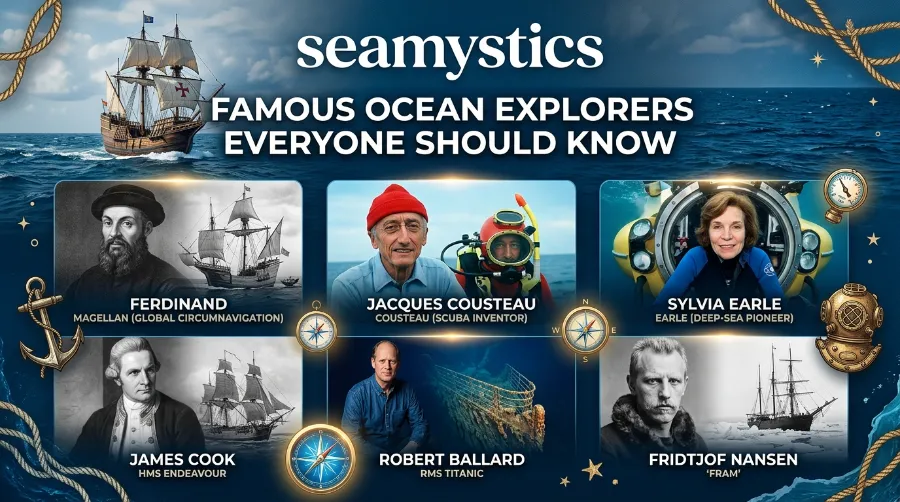
According to the National Oceanic and Atmospheric Administration, roughly 80 percent of the global ocean remains unmapped, unobserved, and unexplored (NOAA Ocean Exploration). That single statistic is the reason the work of famous marine explorers still gets taught in classrooms and cited in funding proposals. We are still finishing a job they started.
Jacques Cousteau: The Explorer Who Made the Ocean Public
Jacques Cousteau is probably the name most people picture when they hear “ocean explorer,” and there is a good reason for that. In 1943, working alongside engineer Émile Gagnan, he co-developed the Aqua-Lung, the first safe and reliable open-circuit scuba system. That single invention did more to open the underwater world to regular divers than almost anything before it.
Jacques Cousteau Legacy How He Changed Ocean Exploration Forever
Cousteau did not stop at invention, though. He turned his research vessel Calypso into a floating film studio and brought the ocean into living rooms through documentaries such as The Silent World and the long-running series The Undersea World of Jacques Cousteau. He also founded the Cousteau Society in 1974 to push marine conservation, at a time when almost nobody outside the scientific community was talking about ocean protection.
A few reasons Cousteau’s influence has lasted so long:
- He made underwater filmmaking a genre of its own, which shaped decades of nature television
- He connected exploration to conservation long before it was a common message
- His books, including The Silent World, sold in the millions and reached readers who never got near a coastline
If you want a deeper technical breakdown of his diving equipment and expeditions, seasky.org keeps a well-organized archive of famous ocean explorers that is worth bookmarking.
William Beebe and Otis Barton: The First Humans in the Deep Sea
Long before Cousteau strapped on an Aqua-Lung, naturalist William Beebe and engineer Otis Barton were doing something that sounds almost reckless today. In 1930, they began testing the bathysphere, a hollow steel ball barely five feet across, lowered into the ocean on a steel cable. By 1934, off the coast of Bermuda, they reached a depth of 3,028 feet, a record that stood for 15 years.
Robert Ballard Discoveries The Man Who Found the Titanic
There was no propulsion, no escape route, and no real way to communicate other than a phone line running up the cable. Beebe described creatures at that depth that had never been seen alive by a human being, and his written accounts became some of the earliest firsthand descriptions of deep sea life. It is easy to forget, looking at today’s remotely operated vehicles, that someone had to be the first person willing to get lowered into total darkness in a metal ball.
Eugenie Clark The Shark Lady Who Changed Marine Biology
Auguste and Jacques Piccard: A Father-Son Dynasty of Deep Sea Engineering
The Piccard name shows up twice in ocean exploration history, and both times it changed what was technically possible. Auguste Piccard, a Swiss physicist, designed the bathyscaphe in the late 1940s, a self-propelled deep-diving vessel that did not need a surface cable like the bathysphere did. His prototype, the FNRS-2, first tested the concept in 1948.
James Cameron’s Deepsea Challenger Dive Explained
His son, Jacques Piccard, took that design further. Together with U.S. Navy Lieutenant Don Walsh, Jacques piloted the bathyscaphe Trieste to the bottom of the Challenger Deep in the Mariana Trench on January 23, 1960, reaching a depth of roughly 10,911 meters, the deepest point in any ocean on Earth. No human being repeated that specific feat for more than 50 years.
Don Walsh Trieste The First Man to Reach the Challenger Deep
That single dive is still cited as one of the most important moments in the history of ocean exploration pioneers, not because of what they found at the bottom, which was surprisingly little visibility, but because of what it proved: humans could survive the crushing pressure of the deepest trench on the planet and come back to tell us about it.
Sylvia Earle: Setting Records and Rewriting Who Gets to Explore
Sylvia Earle earned the nickname “Her Deepness” for good reason. In 1979, wearing a pressurized JIM suit, she walked untethered on the ocean floor near Oahu at a depth of about 381 meters (1,250 feet), setting a record for the deepest untethered dive by any person at the time. She later became the first female chief scientist of NOAA in 1990, a position that let her push conservation policy from inside the U.S. government rather than only from outside it.
HMS Challenger Expedition The Voyage That Founded Oceanography
Earle has logged more than 7,000 hours underwater across her career and led more than 100 expeditions. In 2009 she founded Mission Blue, a campaign to establish “Hope Spots,” protected marine areas around the world, which by 2024 had grown to include over 150 sites globally (Mission Blue). Her career is a reminder that famous marine explorers are not only about depth records; they are also about what you do with the data once you surface.
Robert Ballard: The Man Who Found the Titanic
Robert Ballard’s name is tied to one discovery more than any other. On September 1, 1985, using the submersible Argo and a strategy of searching for the ship’s debris trail rather than the wreck itself, Ballard located the RMS Titanic roughly 370 miles off the coast of Newfoundland, at a depth of about 3,800 meters. The discovery made global headlines and reshaped how underwater archaeology was done.
Ballard did not stop there. He went on to locate the German battleship Bismarck, the aircraft carrier USS Yorktown, and PT-109, the World War II patrol boat once commanded by John F. Kennedy. His technique of searching for debris fields rather than a single point on the map became standard practice for deep sea wreck hunters. Ballard later founded the Ocean Exploration Trust and continues to run live-streamed expeditions aboard the research vessel Nautilus, which you can follow through Nautilus Live’s ocean explorer stories.
Marie Tharp: The Cartographer Who Proved Continental Drift
Marie Tharp rarely gets top billing in lists of famous ocean explorers, and that is worth correcting. Working with geologist Bruce Heezen in the 1950s, Tharp hand-drew detailed maps of the Atlantic Ocean floor using sonar data, work that was groundbreaking specifically because women were not allowed on the research ships at the time, so she analyzed the data entirely from shore.
Marie Tharp Mapping The Woman Who Mapped the Ocean Floor
In 1957, her maps revealed the Mid-Atlantic Ridge and, more importantly, a rift valley running down its center. That rift was physical evidence for continental drift and plate tectonics, ideas that most geologists dismissed as “girl talk” when Tharp first proposed them, according to her own later interviews. Her cartography eventually became foundational to modern plate tectonic theory, proving that mapping work counts as exploration just as much as diving does.
Auguste Piccard The Engineer Behind the First Deep Dives
James Cameron: A Filmmaker Returns to the Trench
More than 50 years after the Piccard-Walsh dive, filmmaker James Cameron piloted the Deepsea Challenger to the bottom of the Challenger Deep on March 26, 2012, becoming the first person to complete a solo dive to that depth, and only the third human ever to reach it. The dive lasted about three hours at the bottom, during which Cameron collected samples and video footage that scientists used for years afterward.
Cameron’s dive mattered for reasons beyond spectacle. The Deepsea Challenger carried scientific instruments built specifically for research, not just filming, and the mission generated new data on deep sea microbial life and sediment samples that National Geographic and partner institutions continued to study for years. It also proved that private funding and modern engineering could revive a type of exploration that had gone quiet for decades.
A Quick Comparison of Deep Sea Milestones
| Milestone | Explorer(s) | Depth Reached | Year |
|---|---|---|---|
| First bathysphere dive | Beebe & Barton | 3,028 ft (923 m) | 1934 |
| First bathyscaphe test | Auguste Piccard | ~4,600 ft (1,402 m) | 1953 |
| Deepest manned dive (Challenger Deep) | J. Piccard & Walsh | 35,814 ft (10,911 m) | 1960 |
| Deepest untethered solo walk | Sylvia Earle | 1,250 ft (381 m) | 1979 |
| Titanic wreck located | Robert Ballard | 12,500 ft (3,810 m) | 1985 |
| Solo dive to Challenger Deep | James Cameron | 35,787 ft (10,908 m) | 2012 |
Why These Ocean Exploration Pioneers Still Matter Today
Modern ocean science leans on tools these explorers could not have imagined, autonomous underwater vehicles, satellite bathymetry, and DNA sampling of seawater. But the underlying questions have not changed much. Groups like the Ocean Discovery League continue the same basic mission that Beebe and Cousteau started, using low cost tools to expand who gets to explore the deep sea, an approach detailed on their research and field blog.
A few patterns show up again and again when you study this group of notable oceanographers:
- Most made their biggest discovery with equipment that looks primitive by today’s standards
- Nearly all of them combined science with public storytelling, whether through film, books, or live-streamed dives
- Several of the most important contributions, like Tharp’s mapping, happened without the person ever going underwater themselves
- Almost every major milestone was reached by a small team rather than a single individual working alone
That last point gets lost in headlines that credit one famous name, but it is worth remembering. Ballard needed engineers to build Argo. Cameron needed a team of naval architects to design Deepsea Challenger. Earle needed the support of NOAA’s institutional backing to reach the positions she held. Exploration, even when one person gets the photo, is almost always a team sport.
How to Learn More About Ocean Exploration
If this list sparked an interest in the field, there are a few practical next steps worth taking. You do not need a research vessel to start paying attention to ocean science.
- Follow live-streamed research expeditions, several institutions now broadcast dives in real time
- Read primary accounts rather than only summaries, Cousteau’s and Earle’s own books hold up decades later
- Check in on marine protected area news, since Hope Spots and similar programs are still expanding
For readers who want a structured way to keep exploring this topic, our related guide on marine conservation milestones walks through how these explorers’ work shaped current ocean protection laws, and our deep sea technology explainer breaks down how today’s submersibles compare to the Trieste and Deepsea Challenger.
Frequently Asked Questions
Who is considered the most famous ocean explorer in history?
Jacques Cousteau is usually named first, mainly because of how widely his documentaries were broadcast, but Robert Ballard and Sylvia Earle are close behind due to their record-setting discoveries and long careers in marine science.
Who was the first person to reach the deepest part of the ocean?
Jacques Piccard and Don Walsh were the first, reaching the Challenger Deep in the bathyscaphe Trieste on January 23, 1960.
Are there famous female ocean explorers?
Yes. Sylvia Earle set deep dive records and led NOAA as its first female chief scientist, and Marie Tharp’s ocean floor maps provided key evidence for plate tectonics.
What is the deepest point in the ocean?
The Challenger Deep, located in the Mariana Trench in the western Pacific, sits at approximately 10,911 meters (35,814 feet) below sea level.
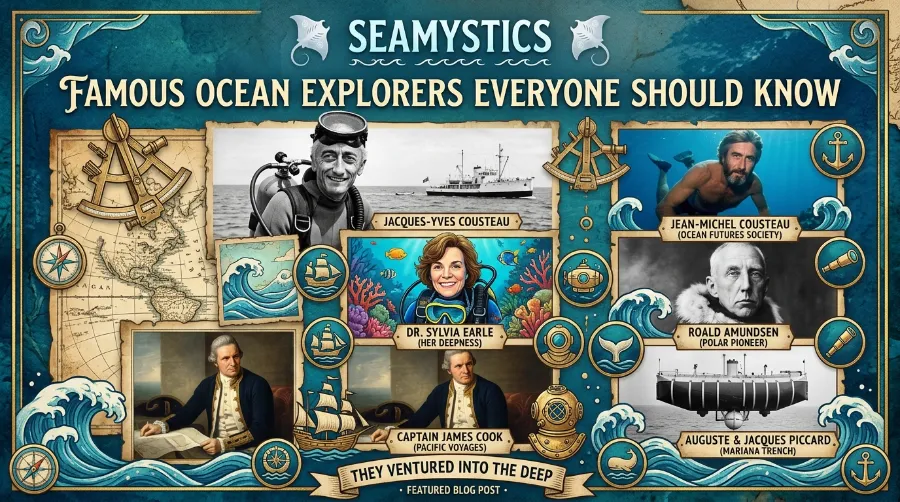
How much of the ocean has actually been explored?
According to NOAA, roughly 80 percent of the ocean remains unmapped and unexplored, which is why ocean exploration is still considered an active, unfinished field rather than a historical one.
Conclusion
The famous ocean explorers covered here did not just chase depth records for their own sake. Each one solved a specific technical or scientific problem, breathing underwater, surviving crushing pressure, mapping an invisible seafloor, or simply convincing the public that the ocean was worth caring about. Their combined work built the field that today’s marine scientists now stand on, and with 80 percent of the ocean still unexplored, there is a real chance the next name on this list has not made their discovery yet.
References
- NOAA Ocean Exploration. “Ocean Exploration Facts.” oceanexplorer.noaa.gov
- Sea and Sky. “Meet the Ocean Explorers.” seasky.org/ocean-exploration/ocean-explorers-menu.html
- Ocean Discovery League. “Field Blog.” oceandiscoveryleague.org/blog
- Nautilus Live / Ocean Exploration Trust. “World Ocean Day Stories.” nautiluslive.org
- Mission Blue. “Hope Spots.” mission-blue.org/hope-spots