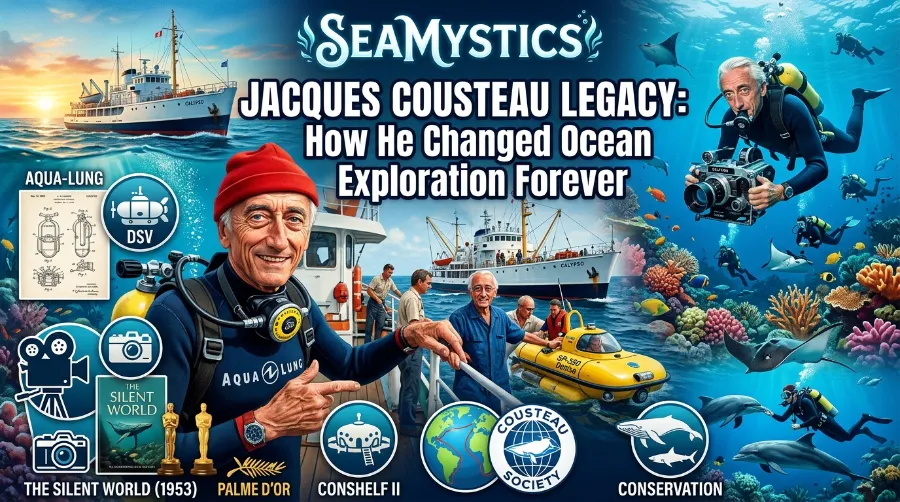

Long before drones mapped coral reefs, one man in a red beanie strapped a metal tank to his back. He swam into the unknown. The Jacques Cousteau legacy did not start with fame. It started with curiosity, a pair of fogged up goggles, and a stubborn refusal to accept limits. Today, more than a century after his birth, his fingerprints are still on every scuba class. They show up in every underwater camera rig and every ocean conservation campaign that fills our news feeds.
Sylvia Earle The Marine Biologist Who Redefined Deep Diving
This piece walks through his life, his inventions, and his films. It also covers why his influence still shapes how we protect the water planet, as he liked to call it.
Key Takeaways
| Focus Area | What You Need to Know |
|---|---|
| Who he was | French naval officer, inventor, filmmaker, and conservationist, born June 11, 1910 |
| Biggest invention | He co-created the Aqua Lung with Emile Gagnan in 1943, the first reliable open circuit scuba system |
| Screen legacy | He made more than 120 documentaries and won three Academy Awards |
| Ship | Calypso, his research vessel, carried him on expeditions across 13 nations and beyond |
| Conservation impact | He helped push through the 1986 global whaling moratorium and fought nuclear waste dumping in the Mediterranean |
| Lasting institution | He founded The Cousteau Society in 1973. It is still active today |
| Why it matters now | Over 80 percent of the ocean remains unmapped. His call to explore and protect is far from finished |
TL;DR: Jacques Cousteau co-invented the Aqua Lung in 1943. He turned underwater filmmaking into a global phenomenon through Calypso and The Silent World. He spent his later decades fighting for ocean conservation until his death in 1997. His work built the technical, cultural, and environmental foundation that modern ocean exploration still relies on today.
Famous Ocean Explorers Everyone Should Know
Who Was Jacques Cousteau? A Quick Biography
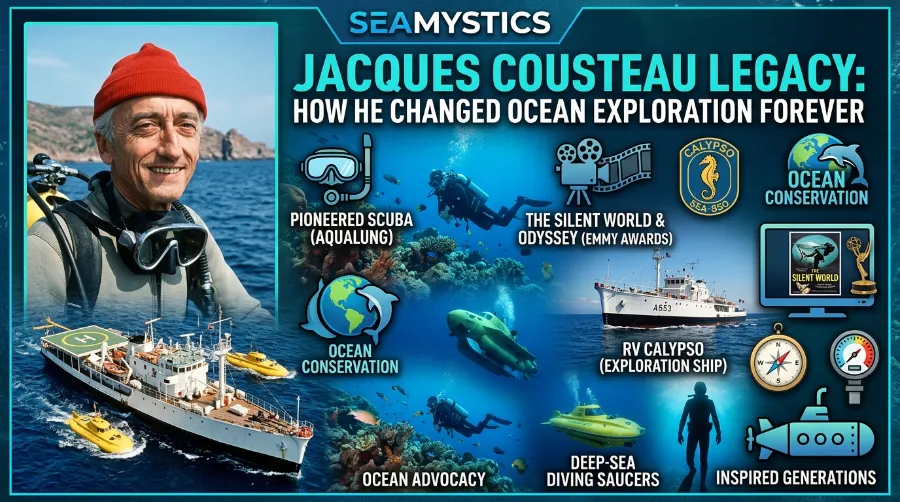
Any honest Jacques Cousteau biography starts in Saint-Andre-de-Cubzac, a small town in southwestern France. He was born there on June 11, 1910. As a child, he was sickly and restless. He found comfort in swimming and in taking machines apart just to see how they worked. Nobody around him could have guessed that this fidgety kid would one day redefine our relationship with the sea.
Early Life and the Accident That Changed Everything
Cousteau entered the French naval academy, the Ecole navale, in the late 1920s. He graduated in 1930 with dreams of becoming a naval aviator. A serious car accident ended those dreams in 1936 and shattered both of his arms. During his long recovery, he swam in the Mediterranean to rebuild his strength. That same year, he tried underwater goggles for the first time off the coast of Toulon. He later called that first clear look beneath the surface the moment that set the course of his life.
Robert Ballard Discoveries The Man Who Found the Titanic
It is a small, human detail that most retellings skip. Yet it explains so much. A career ending injury pushed him toward the one place where he would build a much bigger career instead.
From Naval Officer to Ocean Pioneer
During World War II, Cousteau served as a gunnery officer. At the same time, he quietly worked on a problem that had frustrated divers for decades: how to breathe underwater without a surface pump. He teamed up with engineer Emile Gagnan in occupied France. Together they adapted a demand regulator, so a diver could pull air from a tank only when inhaling, at the same pressure as the surrounding water. That breakthrough, tested in 1943, became the Aqua Lung. It is the single invention most responsible for his father of scuba diving title.
James Cameron’s Deepsea Challenger Dive Explained
Cousteau Ocean Inventions That Changed Diving Forever
People often sum up the Jacques Cousteau legacy in one word: exploration. The truth runs deeper than that. He was, first and foremost, a problem solver. His ocean inventions gave regular people, not just naval specialists, a real chance to see the underwater world with their own eyes.
Here are the innovations that mattered most:
- The Aqua Lung (1943): The first widely used open circuit scuba system, co-developed with Emile Gagnan. It let divers move freely instead of relying on surface air lines.
- Underwater housings and cameras: Cousteau adapted film equipment for use at depth. This made his documentaries possible and pushed underwater cinematography forward by decades.
- Conshelf I, II, and III: A series of underwater habitats that let oceanauts live and work below the surface for weeks at a time. They arrived years ahead of similar United States Navy programs.
- The diving saucer: A small submersible built for one or two people. Divers used it to explore depths that free diving could never reach safely.
- Calypso itself: A converted British Royal Navy minesweeper. Cousteau leased it in 1950 for a symbolic one franc a year and turned it into a floating laboratory and film studio.
The Aqua Lung: Birth of Modern Scuba
Before the Aqua Lung, diving equipment either tied a person to the surface or delivered air in an awkward, fixed way. That made deep, extended dives risky and impractical. Cousteau and Gagnan’s demand regulator solved the problem cleanly. Within a few years, recreational and scientific diving both became realistic options. If you have taken a certification course through PADI or a similar agency, you have used a direct descendant of that 1943 design.
Calypso and the Underwater Habitats
Calypso carried Cousteau across decades of expeditions. These ranged from archaeological dives on Roman shipwrecks near Tunisia in 1948 to marine life surveys and a notable 1977 study of Mediterranean pollution. The Conshelf habitats, meanwhile, proved that people could live underwater for extended stretches. Marine research and offshore industries still use a modified version of that concept today. According to the Cousteau Society’s own history of his legacy, these projects were never just stunts. They offered early proof that humans could work, not just visit, beneath the waves.
Cousteau Documentaries History: Bringing the Ocean Into Living Rooms
The Aqua Lung gave Cousteau access to the ocean. Film gave him access to everyone else. Cousteau documentaries history is really a story about translation. He took something almost nobody could witness firsthand and made it feel personal to millions of people who had never worn a mask and fins.
| Title or Series | Year | Recognition |
|---|---|---|
| The Silent World | 1956 | Palme d’Or at Cannes, Academy Award for Best Documentary |
| The Golden Fish | 1959 | Academy Award, Best Short Subject |
| World Without Sun | 1964 | Academy Award for Best Documentary |
| The Undersea World of Jacques Cousteau | 1968 to 1976 | Long running ABC series, narrated in part by Rod Serling |
| Total documentary output | Career total | More than 120 films across five decades |
The Silent World and the Oscar Years
Cousteau co-wrote the 1953 book The Silent World with Frederic Dumas. He then co-directed the 1956 film version with a young Louis Malle. The film won the Palme d’Or that year. It won the Academy Award for Best Documentary the following year, an almost unheard of double for underwater footage at the time. As National Geographic’s retrospective on his centennial notes, Clark Lee Merriam of the Cousteau Society said his films always had a clear storyline. They invited audiences to come look at something wonderful and understand how it lived. That warm, curious approach is a big reason the films still hold up.
Eugenie Clark The Shark Lady Who Changed Marine Biology
The Undersea World of Jacques Cousteau
From 1968 to 1976, American audiences welcomed Cousteau into their homes weekly through The Undersea World of Jacques Cousteau. It aired at a time when very few viewers had ever seen a coral reef or a hammerhead shark in motion. That series did more to normalize ocean science as popular entertainment than almost any project before or since. You can still see its influence in nearly every nature documentary made in the decades that followed.
Jacques Cousteau Legacy: From Explorer to Environmental Advocate
By the late 1960s, Cousteau’s focus had started shifting. He was not always an early environmentalist. Merriam’s account in the same National Geographic piece notes that he began his career as a spear fisherman and adventurer, not a guardian of marine life. Some of his earlier footage reflects that harder edge. What changed was watching, expedition after expedition, how quickly the ocean he loved was disappearing.
HMS Challenger Expedition The Voyage That Founded Oceanography
That shift produced real, measurable results:
- He personally lobbied heads of state. This helped build the international support the International Whaling Commission needed for its 1986 moratorium on commercial whaling.
- He organized public opposition to a 1960 French government plan to dump nuclear waste in the Mediterranean Sea. The campaign ended when protestors staged a sit in on the tracks carrying the waste train.
- In 1973, he founded The Cousteau Society. This nonprofit still funds marine research and public education today.
- He received the United States Presidential Medal of Freedom in 1985. Three years later, France’s Academie francaise welcomed him as a member.
His son, Jean-Michel Cousteau, wrote a moving tribute for Cousteau’s 100th birthday commemoration. He recalled that his father wanted to be remembered for one simple idea: people protect what they love. That phrase, simple as it sounds, may be the clearest summary of the entire Jacques Cousteau legacy.
Marie Tharp Mapping The Woman Who Mapped the Ocean Floor
Why the Jacques Cousteau Legacy Still Matters Today
It would be easy to file Cousteau away as a historical figure. You might picture his work sitting in a museum next to old diving gear. The numbers say otherwise. According to NOAA Ocean Exploration, more than 80 percent of the world’s ocean remains unmapped, unobserved, and unexplored even now. A May 2025 study in Science Advances found that humans have visually observed less than 0.001 percent of the deep seafloor, an area roughly the size of Rhode Island. In short, the frontier Cousteau opened is nowhere near fully mapped.
Here is a simple snapshot of where ocean exploration stands today.
| Metric | Status |
|---|---|
| Ocean surface explored to any degree | Roughly 20 to 25 percent |
| Deep seafloor visually observed | Less than 0.001 percent |
| Marine protected areas globally | About 7 to 8 percent of the ocean |
| Cousteau’s Calypso voyages | Visited 13 nations in a single major expedition |
| New marine species described yearly | Nearly 2,000 |
His grandson, Fabien Cousteau, carried the family’s underwater habitat tradition forward in 2014. His Mission 31 project kept him inside the Aquarius underwater laboratory for 31 days. That single mission produced roughly three years worth of research data in one month, according to reporting at the time. It stands as a direct, traceable echo of the Conshelf habitats his grandfather built more than half a century earlier.
Don Walsh Trieste The First Man to Reach the Challenger Deep
Want to see how Cousteau compares to other pioneers of the deep? Our pillar guide to famous ocean explorers places his career alongside figures like William Beebe and Sylvia Earle. And if you are just starting to explore ocean science content on Sea Mystics, this profile makes a solid entry point before you dive into our other marine history features.
A Working Marine Biologist’s Take
I have spent years reading expedition logs, conservation reports, and diving history archives. What stands out most about Cousteau is not any single invention or film. It is a pattern. He kept treating the ocean as something worth understanding on its own terms, not just as scenery or a resource to extract. That habit, curiosity followed by responsibility, still guides most working marine scientists. You see it in researchers tagging sharks in the Pacific and in teams mapping cold water coral in the North Atlantic. Students often ask why ocean conservation messaging leans so heavily on storytelling instead of raw data. Cousteau’s career answers that question. He proved decades ago that people protect what they have been shown, not just what they have been told.
Auguste Piccard The Engineer Behind the First Deep Dives
Common Questions About the Jacques Cousteau Legacy
Was Jacques Cousteau actually the father of scuba diving? People widely credit him as the father of scuba diving because he co-invented the Aqua Lung in 1943. It was the first practical open circuit breathing system that let divers move freely underwater. Earlier inventors tried other underwater breathing devices, but Cousteau and Gagnan built the first version that became commercially successful and widely adopted.
How many documentaries did Jacques Cousteau make? Across his career, Cousteau made or produced more than 120 television documentaries and specials. He also wrote or co-wrote roughly 50 books, according to The Cousteau Society’s own records.
What is The Cousteau Society and is it still active? The Cousteau Society is a nonprofit marine conservation organization that Cousteau founded in 1973. It continues research, education, and film restoration work today, decades after his death in 1997.
Did Jacques Cousteau discover Calypso or build it himself? Neither. Calypso started as a British Royal Navy minesweeper. Cousteau leased and refitted the ship in 1950 with help from a British backer, who charged him a symbolic one franc a year.
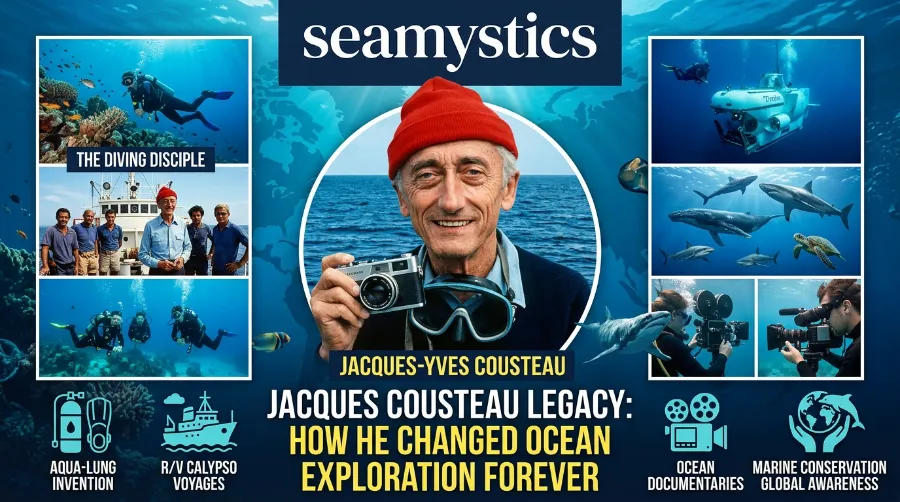
What is Cousteau’s biggest contribution to modern ocean exploration? Most marine scientists point to two things working together. The Aqua Lung made underwater work physically possible for large numbers of people. His documentary films made the public care enough to fund and support ocean science in the decades that followed.
Conclusion
Strip away the red beanie and the Oscar statues, and a fairly simple story remains. A man who could not fly learned to dive instead. He then spent the rest of his life making sure everyone else could see what he saw down there. The Jacques Cousteau legacy goes beyond a list of inventions or awards. It turned ocean exploration into a shared, public interest instead of a narrow scientific specialty. More than 80 percent of the ocean remains unexplored today. His work feels less like a closed chapter and more like an open invitation that we have not fully accepted yet.
References
- National Geographic, Jacques Cousteau Centennial: What He Did, Why He Matters, https://www.nationalgeographic.com/adventure/article/100611-jacques-cousteau-100th-anniversary-birthday-legacy-google
- The Huffington Post, Remembering My Father, Jacques Cousteau, by Jean-Michel Cousteau, https://www.huffpost.com/entry/remembering-jacques-coust_b_604414
- Confinity, Jacques-Yves Cousteau Legacy, https://www.confinity.com/legacies/jacques-yves-cousteau
- The Cousteau Society, Legacy, https://www.cousteau.org/know/legacy/
- NOAA Ocean Exploration, How much of the ocean has been explored, https://oceanexplorer.noaa.gov/ocean-fact/explored/
- Discover Magazine, 99.999 Percent of the Deep Ocean Is Unexplored, May 2025, https://www.discovermagazine.com/99-999-percent-of-the-deep-ocean-is-unexplored-its-secrets-are-key-to-47636