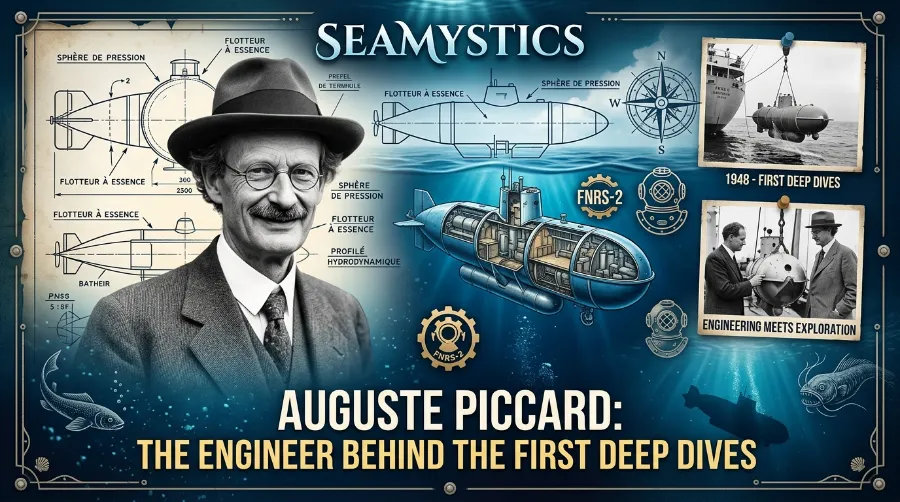

Long before satellites mapped the seafloor, one Swiss physicist made a bold leap. He had flown a balloon into the stratosphere. So he decided he could just as easily sink a steel sphere to the bottom of the ocean. That physicist was Auguste Piccard. The machine he built, the bathyscaphe, became the ancestor of every deep-diving submersible used today. The Auguste Piccard bathyscaphe was not a lucky invention. It came from decades of trial, failure, and stubborn engineering. That work eventually carried two men to the deepest point on Earth. This article covers his biography, the invention itself, and why marine scientists still cite his work today.
Key Takeaways
| Milestone | Detail |
|---|---|
| Born | January 28, 1884, Basel, Switzerland |
| First bathyscaphe | FNRS-2, completed in 1948 |
| First manned Trieste dive | 3,150 meters (10,335 feet), September 1953 |
| Record dive | 10,916 meters (35,814 feet), Challenger Deep, January 23, 1960 |
| Pilots on record dive | Jacques Piccard and Lieutenant Don Walsh, USN |
| Died | March 24, 1962, Lausanne, Switzerland |
TL;DR: Auguste Piccard was a Swiss physicist who invented the bathyscaphe. It is a free-diving deep-sea vessel. He first set stratosphere balloon altitude records in 1931 and 1932. That design work led directly to the Trieste. His son Jacques Piccard piloted it with Don Walsh to the bottom of the Mariana Trench on January 23, 1960. It remains one of the most significant dives in ocean exploration history.
James Cameron’s Deepsea Challenger Dive Explained
Who Was Auguste Piccard? A Short Biography
Auguste Antoine Piccard was born on January 28, 1884, in Basel, Switzerland. His twin brother, Jean Felix Piccard, was born alongside him. He studied at ETH Zurich, training as a physicist rather than a marine engineer. That background makes his later career genuinely unusual. Most people who shaped the field of famous ocean explorers came from naval or biology backgrounds. Piccard came from physics. That difference shaped everything he later built.
He began teaching at the Free University of Brussels in the early 1920s. It was there that his curiosity first turned skyward instead of downward. Colleagues described him as quiet and methodical. He tested his own inventions personally instead of sending assistants ahead of him. That habit nearly cost him his life more than once. It also earned him a reputation for genuine hands-on expertise instead of theoretical bravado.
Piccard’s Circle: Einstein and the Solvay Conferences
Piccard did not work alone in a shed. He studied alongside Albert Einstein at ETH Zurich. The two later crossed paths at the famous Solvay physics conferences in Brussels. This context matters. It shows Piccard was operating inside the top tier of European physics before he ever built a diving vessel. His engineering instincts came from rigorous scientific training, not guesswork.
From Stratosphere to Seafloor: The Balloon That Started It All
In 1931, Piccard did something no human had ever done. He climbed into a sealed aluminum gondola attached to a hydrogen balloon. He rose to 15,781 meters, becoming the first person to enter the stratosphere. A year later, in August 1932, he pushed the record further. He reached roughly 16,940 meters with his colleague Max Cosyns. These flights were not stunts. Piccard gathered real data on cosmic rays and upper atmospheric pressure. His sealed pressure cabin design later influenced how modern aircraft cabins were built.
Marie Tharp Mapping The Woman Who Mapped the Ocean Floor
This balloon work pointed him toward the ocean. Around 1933, Piccard met the American naturalist William Beebe at the Chicago World’s Fair. Beebe was demonstrating his own diving sphere, the bathysphere. The two men compared notes. Piccard realized that the physics keeping his balloon gondola safe in thin air could work in reverse. It could keep a crew alive under crushing water pressure. By 1937, he had sketched the first designs for a vessel he called a bathyscaphe. The name combines the Greek words for deep and vessel.
Auguste Piccard The Engineer Behind the First Deep Dives
World War II delayed everything. Construction did not resume until 1945. The first working prototype, the FNRS-2, was not finished until 1948. Piccard was patient in a way few inventors are. He spent roughly a decade on a project before it produced a single successful dive.
Designing the First Bathyscaphe: How the FNRS-2 Actually Worked
Piccard faced one central engineering problem. It was simple to state and brutally hard to solve. A cable-lowered diving sphere, like Beebe’s bathysphere, could only go as deep as its cable allowed. It also depended entirely on the surface ship. Piccard wanted a free vessel that could descend and rise on its own.
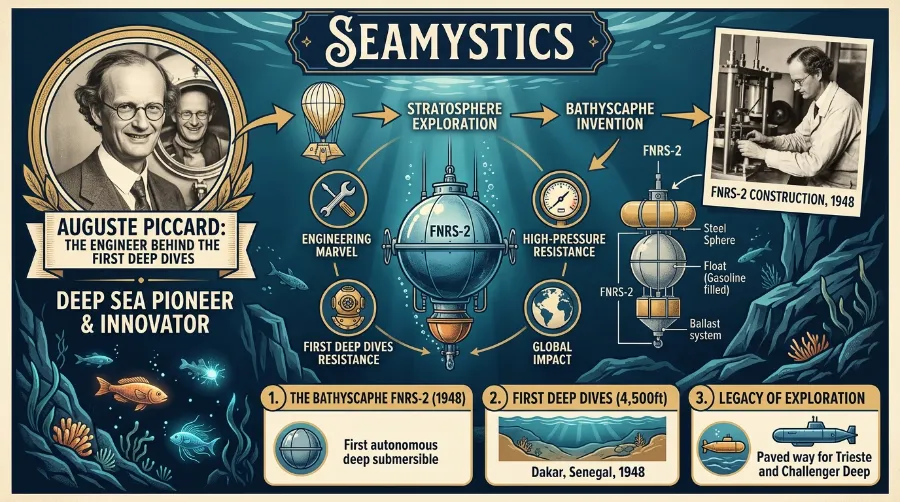
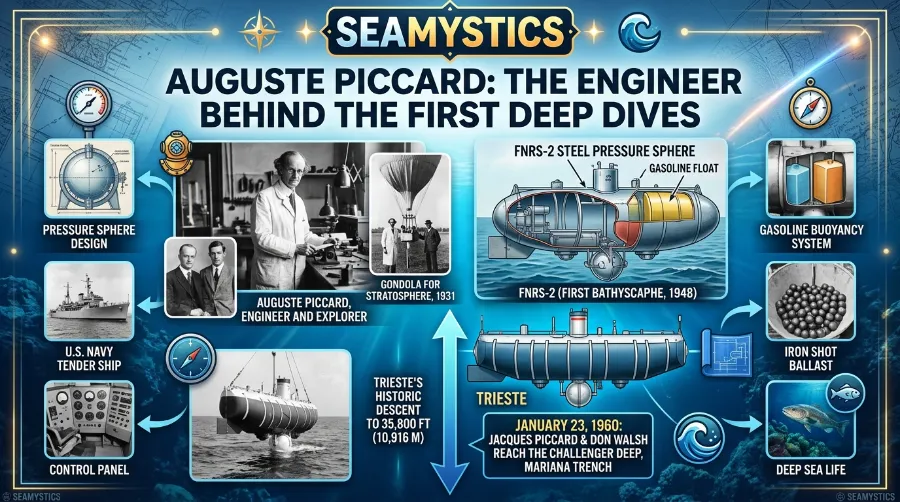
His solution borrowed directly from balloon design. Instead of hydrogen gas for lift, he used gasoline. Gasoline is lighter than water and nearly incompressible. It would not collapse under pressure the way air would. The float held the gasoline for buoyancy. A separate, heavily reinforced steel sphere hung below it to hold the crew. Iron shot pellets served as ballast, held in place by electromagnets. Cut the current, and the pellets fell away, letting the vessel rise. The design was elegant. It was also, frankly, terrifying to test.
The FNRS-2’s Rocky First Trials
The FNRS-2 was named for Belgium’s National Fund for Scientific Research. It made its first unmanned trial dives off the Cape Verde Islands in 1948. It reached around 1,400 meters. The vessel was damaged during those trials. Piccard’s French Navy partners eventually rebuilt it into an improved version called the FNRS-3. This detail gets lost in short biographies, but it matters for anyone studying bathyscaphe inventor history. The first version basically failed. Piccard kept going anyway.
Eugenie Clark The Shark Lady Who Changed Marine Biology
Here is a quick look at how the depth records climbed across his career.
That climb, from roughly 4,600 feet in 1948 to nearly 35,800 feet twelve years later, tells the whole story of Piccard’s career in one chart. Each dive fed lessons into the next design.
The Piccard Deep Sea Invention That Changed Everything: Building the Trieste
By 1952, Piccard had a new opportunity. Italian backers invited him to the port city of Trieste to build his most ambitious vessel yet. He named the finished bathyscaphe after the city in gratitude. Construction happened at a civilian shipyard near Naples. Instruments came from Switzerland, Germany, and Italy, making it a genuinely international effort for its time.
Don Walsh Trieste The First Man to Reach the Challenger Deep
The Trieste launched on August 1, 1953. Weeks later, on August 11, Piccard and his son Jacques made a shallow trial dive together. Then, on September 30, 1953, father and son piloted the Trieste to 3,150 meters, about 10,335 feet, off the island of Ponza, Italy. That single dive tripled the previous manned depth record, held by William Beebe since 1934.
Jacques Piccard trained as a physicist and economist, not an engineer. By this point, he had become his father’s full working partner. Readers who enjoy pioneering underwater careers often compare this father-son partnership to the story in our profile of Sylvia Earle’s achievements. Both stories show how personal risk and scientific curiosity tend to travel together in this field.
A Quick Comparison of Piccard’s Vessels
| Vessel | Year Completed | Deepest Recorded Dive | Notable Detail |
|---|---|---|---|
| FNRS-2 | 1948 | About 1,400 meters | Unmanned trial off Cape Verde |
| FNRS-3 | 1954 | 4,050 meters | Rebuilt by the French Navy |
| Trieste | 1953 | 10,916 meters (1960) | Sold to the US Navy in 1958 |
Why the US Navy Bought a Swiss Submarine
The Trieste operated in the Mediterranean for several years after 1953. Its reputation quietly spread. In 1955, Dr. Robert Dietz of the US Navy’s Office of Naval Research met Piccard in London. The two discussed the bathyscaphe’s future. That conversation eventually led to a deal. In August 1958, the US Navy purchased the Trieste for roughly 250,000 dollars and moved it to San Diego, California.
The Navy then fitted the vessel with a far stronger pressure sphere, built by the Krupp works in Germany. This let it survive the pressure at the deepest trenches on Earth. On November 15, 1959, off Guam, the upgraded Trieste dove to 18,600 feet. It broke its own previous record and proved the new sphere could handle serious depth. This dive was part of what the Navy called Project Nekton. It served as the final test before the mission everyone remembers.
January 23, 1960: The Dive to Challenger Deep
This is the moment the Auguste Piccard bathyscaphe story is best remembered for, even though Auguste himself did not pilot it. His son Jacques Piccard, together with US Navy Lieutenant Don Walsh, boarded the Trieste. They began their descent into the Challenger Deep, the deepest known point of the Mariana Trench, near Guam.
The descent took nearly five hours. About 30,000 feet down, the crew heard a loud crack. The outer Plexiglas window had fractured. Rather than shattering inward under the pressure, the crack forced the remaining panes tighter into their frame, sealing itself. It sounds almost too dramatic to be true, but it is well documented. It also shows how conservatively Piccard had engineered the safety margins into the sphere years earlier.
What Happened at the Bottom
At 1:06 PM local time, the Trieste touched the seafloor at approximately 10,916 meters, or 35,814 feet, below the surface. That is deeper than Mount Everest is tall. Walsh and Piccard reported seeing what looked like a small flatfish and a shrimp moving across the silt outside the window. It was evidence that life exists even in total darkness under more than 1,000 atmospheres of pressure. The two men stayed on the bottom for about 20 minutes. Then they began the ascent, which took just over three hours.
A few practical numbers help put this dive in perspective:
- Total round trip time: approximately 9 hours
- Maximum depth reached: 10,916 meters (35,814 feet)
- Pressure at the bottom: roughly 16,000 pounds per square inch
- Crew: 2, Jacques Piccard and Don Walsh
No crewed vessel returned to that exact depth for another 52 years, until James Cameron’s solo dive in 2012. That gap alone shows how far ahead of its time the Piccard design really was. For a detailed account of how this record compares to other pressure-hull vessels of the era, see this race to the deep overview. This close look at the Trieste’s Mariana Trench dive adds useful technical detail on the sphere’s construction.
Beyond the Trieste: The Mesoscaphe and Later Family Legacy
Auguste Piccard did not stop working after 1960, even at age 76. He and Jacques turned to a new vessel meant for medium depths rather than trench diving. They called it the mesoscaphe. The first one, named the Auguste Piccard, could carry 40 passengers. It made its debut at Expo 64 in Lausanne. It completed around 1,100 dives and carried roughly 33,000 visitors through the depths of Lake Geneva in 1964 and 1965. Deep-sea engineering had turned into a public attraction.
Piccard’s earlier career felt like pure science. This final project felt like an invitation. It let ordinary tourists experience something reserved for two men in a steel sphere a few years earlier. Anyone curious about the mesoscaphe’s exact route around Lake Geneva can find good background in this account of the Lake Geneva submarine.
Auguste Piccard died on March 24, 1962, in Lausanne, at age 78. He did not live to see the mesoscaphe’s public debut in 1964. He had already secured his place in engineering history twice over, once in the sky and once at the bottom of the sea.
A Family That Kept Exploring
The Piccard name kept making headlines after Auguste’s death. Jacques went on to design the mesoscaphe Ben Franklin. In 1969, he drifted nearly 3,000 kilometers along the Gulf Stream, gathering data for the US Navy. His grandson Bertrand Piccard completed the first nonstop balloon flight around the world in 1999. He later piloted the solar-powered Solar Impulse aircraft. It is genuinely rare for one family to hold both the altitude record and the depth record within a single generation, then produce a third generation still pushing exploration boundaries decades later.
Auguste Piccard’s tall frame and unruly hair also inspired the Belgian cartoonist Hergé. Hergé used him as the model for Professor Cuthbert Calculus in the Tintin comics. It is a small but charming footnote. It shows how far his public profile reached in his own lifetime.
How the Bathyscaphe Shaped Modern Ocean Exploration
It is worth asking why any of this still matters to marine science today. The bathyscaphe’s free-diving, self-propelled design directly influenced later deep-submergence vehicles. Engineers studying pressure hulls for modern submersibles still reference Piccard’s ballast and float system as a foundational case study.
Setting the Stage for Later Explorers
Piccard’s work also predates, and in some ways set the stage for, the broader wave of twentieth-century ocean exploration. The same decade that saw Piccard’s Trieste dive also produced expeditions like the original HMS Challenger expedition. Later explorers, such as those covered in our piece on Jacques Cousteau’s legacy and Robert Ballard’s discoveries, built directly on the confidence Piccard’s engineering had established. Humans really could survive, work, and observe life at extreme ocean depths.
What the Naval Record Confirms
According to the US Naval History and Heritage Command, the Trieste’s design concept was first studied by Piccard in 1937. It remained in active naval service for a full decade after the record dive. That included underwater search work following the loss of USS Thresher in 1963. For a broader overview of how these figures connect across the twentieth century, our famous ocean explorers guide traces the full timeline, from early bathysphere pioneers through today’s robotic submersibles.
Frequently Asked Questions
What is a bathyscaphe, and who invented it?
A bathyscaphe is a free-diving, self-propelled deep-sea vessel. It has a buoyant float and a separate pressure sphere for the crew. Auguste Piccard invented the concept in the late 1930s. He completed the first working version, the FNRS-2, in 1948.
Did Auguste Piccard dive to the Mariana Trench himself?
No. Auguste Piccard designed the Trieste. His son Jacques Piccard piloted the record 1960 dive to Challenger Deep, alongside US Navy Lieutenant Don Walsh. Auguste was 75 at the time and had already handed most piloting duties to Jacques.
How deep did the Trieste actually go?
On January 23, 1960, the Trieste reached approximately 10,916 meters, or 35,814 feet, in the Challenger Deep section of the Mariana Trench, near Guam.
What happened to the Trieste afterward?
The US Navy continued using the Trieste for research and search operations through the early 1960s. This included locating wreckage from USS Thresher in 1963. It was eventually retired and is now preserved as an exhibit at the US Navy Museum.
Is Piccard related to any other famous explorers?
Yes. His son Jacques Piccard piloted the record 1960 dive. His grandson Bertrand Piccard later completed the first nonstop around-the-world balloon flight in 1999.
Conclusion
Auguste Piccard’s career reads almost like two biographies stitched together. One is about a man who conquered the sky. The other is about a man who conquered the ocean floor. They were the same person, using the same core engineering idea in both directions. The bathyscaphe was not a flashy invention. It came from a physicist who tested his own machines, absorbed repeated failures, and kept refining one principle: buoyancy control without a surface cable. That principle carried his son and an American naval officer to the deepest place on Earth in 1960. It still shapes how engineers think about pressure hulls today. For anyone tracing the roots of modern deep-sea science, Piccard’s workshop is where the story genuinely begins.
References
- US Naval History and Heritage Command, “Bathyscaph Trieste, 1958-1963”
- Encyclopaedia Britannica, “Bathyscaphe” and “Auguste Piccard”
- EBSCO Research Starters, “Auguste Piccard” and “Trieste Dive”
- Wikipedia, “Auguste Piccard” and “Trieste (bathyscaphe)”
- Longines Magazine, “Auguste Jacques Piccard: Pioneer Spirit”